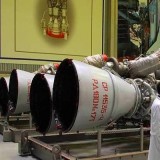
Australian Ghost Bat drone fires AIM-120 missile in first collaborative combat aircraft test
{loadposition bannertop}
{loadposition sidebarpub}
The Royal Australian Air Force has carried out an autonomous air-to-air missile engagement from an MQ-28A Ghost Bat at Woomera, using an AIM-120 AMRAAM to destroy an airborne target under the Collaborative Combat Aircraft program. The test, paired with a roughly A$1.4 billion order for six Block 2 aircraft and a Block 3 prototype, pushes Ghost Bat from experimentation into an operational path and signals a major shift in Indo-Pacific air combat integration.
At Woomera on 9 December 2025, Boeing and the Australian government confirmed that an MQ-28A Ghost Bat had autonomously launched an AIM-120 AMRAAM and destroyed an aerial target during a force-integrated weapons trial, with the engagement supervised from an E-7A Wedgetail and track data provided by an F/A-18F Super Hornet operating from a separate location. The event validates the Royal Australian Air Force’s Collaborative Combat Aircraft concept in live firing and coincides with a government decision to invest around A$1.4 billion in six Block 2 Ghost Bats and a Block 3 prototype, moving the program onto a clearly operational footing.Follow Army Recognition on Google News at this link
A ground crew loads an AIM-120 Advanced Medium Range Air-to-Air Missile onto an MQ-28A Ghost Bat during Trial Kareela at RAAF Base Woomera in South Australia. (Picture source: Australian MoD)
The Ghost Bat is presented as a collaborative combat drone designed to operate alongside crewed platforms in air superiority, penetration, or forward reconnaissance missions. The aircraft has an endurance of roughly 2,000 kilometres and can carry different payloads, including electro-optical sensors or radars tailored to the mission. Its airframe and overall architecture are designed to reduce its signature and allow employment ahead of a fighter formation. The integration of modular mission systems makes it possible to add or replace sensors on short cycles, which supports the planned evolutions of the Block 2 and Block 3 configurations.
The MQ-28A configuration includes an open architecture aligned with government standards, which simplifies the integration of new weapons or software functions in a distributed environment. The aircraft uses protected data links to receive tracks and instructions from the F/A-18F or the E-7A. It can adjust its trajectory autonomously based on transmitted tactical parameters while remaining under supervised safety constraints. The combination of its range, adaptable payload, and decision autonomy is intended to increase available air mass and provide support to crewed fleets during long-range engagements.
Expected tactical effects are clearly identified. The Ghost Bat can move ahead of a patrol and absorb the first radar exposure, complicate the adversary’s management of the air battle space, or increase the number of firing platforms available within a mixed formation. The successful air-to-air engagement also validates the drone’s ability to contribute to the initial air superiority fight without direct pilot control. The autonomous firing becomes a way to dilute adversary defences, increase the number of engagements that can be conducted in a given time, and sustain a higher operational tempo in contested airspace.
The missile used during the test is an AIM-120 AMRAAM equipped with an active radar seeker and a range of more than 70 kilometres, depending on the engagement profile. The missile first receives guidance parameters transmitted via the F/A-18F, then manages its terminal phase autonomously. The choice of the AMRAAM for this initial validation underlines the compatibility of the Ghost Bat with weapons already in service with Australian and allied forces, which simplifies immediate integration into an interoperable environment.
Official statements indicate that Australia has become the second country to validate a live firing from a collaborative combat drone, after Türkiye, which employed a Gökdoğan missile from a Kizilelma on 28 November. The Australian government highlights a local industrial content rate above 70 percent and views the program as a tool to strengthen the national defence industrial and technological base. The US Air Force and several industrial partners are also involved in the test campaign.
The Woomera firing takes place at a time when distributed architectures and mixed crewed and autonomous formations gain importance in the Indo-Pacific. The increase in available air mass, the ability to disperse firing points, and the integration of air-to-air weapons on autonomous platforms have a direct impact on regional military balances. The Ghost Bat emerges as a central element in Australia’s strategy to maintain credible air superiority in contested environments and to secure sufficient operational depth in the face of growing regional capabilities

{loadposition bannertop}
{loadposition sidebarpub}
The Royal Australian Air Force has carried out an autonomous air-to-air missile engagement from an MQ-28A Ghost Bat at Woomera, using an AIM-120 AMRAAM to destroy an airborne target under the Collaborative Combat Aircraft program. The test, paired with a roughly A$1.4 billion order for six Block 2 aircraft and a Block 3 prototype, pushes Ghost Bat from experimentation into an operational path and signals a major shift in Indo-Pacific air combat integration.
At Woomera on 9 December 2025, Boeing and the Australian government confirmed that an MQ-28A Ghost Bat had autonomously launched an AIM-120 AMRAAM and destroyed an aerial target during a force-integrated weapons trial, with the engagement supervised from an E-7A Wedgetail and track data provided by an F/A-18F Super Hornet operating from a separate location. The event validates the Royal Australian Air Force’s Collaborative Combat Aircraft concept in live firing and coincides with a government decision to invest around A$1.4 billion in six Block 2 Ghost Bats and a Block 3 prototype, moving the program onto a clearly operational footing.
Follow Army Recognition on Google News at this link
A ground crew loads an AIM-120 Advanced Medium Range Air-to-Air Missile onto an MQ-28A Ghost Bat during Trial Kareela at RAAF Base Woomera in South Australia. (Picture source: Australian MoD)
The Ghost Bat is presented as a collaborative combat drone designed to operate alongside crewed platforms in air superiority, penetration, or forward reconnaissance missions. The aircraft has an endurance of roughly 2,000 kilometres and can carry different payloads, including electro-optical sensors or radars tailored to the mission. Its airframe and overall architecture are designed to reduce its signature and allow employment ahead of a fighter formation. The integration of modular mission systems makes it possible to add or replace sensors on short cycles, which supports the planned evolutions of the Block 2 and Block 3 configurations.
The MQ-28A configuration includes an open architecture aligned with government standards, which simplifies the integration of new weapons or software functions in a distributed environment. The aircraft uses protected data links to receive tracks and instructions from the F/A-18F or the E-7A. It can adjust its trajectory autonomously based on transmitted tactical parameters while remaining under supervised safety constraints. The combination of its range, adaptable payload, and decision autonomy is intended to increase available air mass and provide support to crewed fleets during long-range engagements.
Expected tactical effects are clearly identified. The Ghost Bat can move ahead of a patrol and absorb the first radar exposure, complicate the adversary’s management of the air battle space, or increase the number of firing platforms available within a mixed formation. The successful air-to-air engagement also validates the drone’s ability to contribute to the initial air superiority fight without direct pilot control. The autonomous firing becomes a way to dilute adversary defences, increase the number of engagements that can be conducted in a given time, and sustain a higher operational tempo in contested airspace.
The missile used during the test is an AIM-120 AMRAAM equipped with an active radar seeker and a range of more than 70 kilometres, depending on the engagement profile. The missile first receives guidance parameters transmitted via the F/A-18F, then manages its terminal phase autonomously. The choice of the AMRAAM for this initial validation underlines the compatibility of the Ghost Bat with weapons already in service with Australian and allied forces, which simplifies immediate integration into an interoperable environment.
Official statements indicate that Australia has become the second country to validate a live firing from a collaborative combat drone, after Türkiye, which employed a Gökdoğan missile from a Kizilelma on 28 November. The Australian government highlights a local industrial content rate above 70 percent and views the program as a tool to strengthen the national defence industrial and technological base. The US Air Force and several industrial partners are also involved in the test campaign.
The Woomera firing takes place at a time when distributed architectures and mixed crewed and autonomous formations gain importance in the Indo-Pacific. The increase in available air mass, the ability to disperse firing points, and the integration of air-to-air weapons on autonomous platforms have a direct impact on regional military balances. The Ghost Bat emerges as a central element in Australia’s strategy to maintain credible air superiority in contested environments and to secure sufficient operational depth in the face of growing regional capabilities