France signs $1.34bn contract for two Saab GlobalEye airborne early warning aircraft
{loadposition bannertop}
{loadposition sidebarpub}
France has signed a $1.34 billion contract with Saab to acquire two GlobalEye AEW&C aircraft, replacing its aging E-3F Sentry fleet. The move modernizes French airborne surveillance while strengthening NATO-aligned early warning coverage across Europe and beyond.
France has finalized a high-stakes acquisition of two GlobalEye Airborne Early Warning and Control (AEW&C) aircraft from Swedish defense firm Saab, signaling a decisive move to replace its aging Boeing E-3F Sentry fleet and reshape its strategic surveillance capabilities. The contract, signed on December 30, 2025, by the Direction Générale de l’Armement (DGA), is valued at SEK 12.3 billion (approximately $1.34 billion) and includes ground support, crew training, and multi-year sustainment. Deliveries are scheduled between 2029 and 2032, with an option for two additional aircraft, positioning France to scale its early warning force as threats evolve across NATO’s eastern flank and beyond.
Follow Army Recognition on Google News at this link
France has signed a $1.34 billion agreement with Saab to acquire GlobalEye AEW&C aircraft, replacing its aging E-3F Sentry fleet and modernizing national and NATO-aligned airborne early warning capabilities (Picture Source: SAAB)
Saab’s GlobalEye system combines the powerful Erieye Extended Range (ER) radar with a multi-sensor fusion suite onboard the Bombardier Global 6000/6500 ultra-long-range business jet. The core of its surveillance capability lies in the Erieye ER, a gallium nitride (GaN)-based active electronically scanned array (AESA) radar mounted atop the fuselage. With a claimed instrumented range exceeding 550 kilometers, the radar provides superior target detection and tracking across multiple domains, including stealthy, low-flying, or fast-moving aerial threats. Unlike traditional rotating dome radars, the fixed dorsal installation offers rapid scan rates and continuous coverage across 300 degrees of airspace.
Complementing the Erieye ER is a suite of additional sensors designed for maritime and land surveillance, including a high-performance maritime surveillance radar (MSR), electro-optical/infrared (EO/IR) systems, signals intelligence (SIGINT) payloads, and automatic identification system (AIS) receivers. This integration enables GlobalEye to detect, track, and classify both conventional and asymmetric threats in congested or contested environments. Saab’s open architecture allows for future sensor upgrades and mission-specific payload customization, something French defense planners are expected to leverage as the system is tailored to European operational contexts.
The Bombardier Global 6000 airframe provides high-altitude performance, low radar cross-section, and endurance exceeding 11 hours without refueling. This ensures persistent wide-area coverage with reduced logistical footprint compared to larger legacy platforms. The aircraft’s maximum ceiling of 51,000 feet gives GlobalEye radar systems extended line-of-sight detection ranges, which is especially critical in the context of missile defense and long-range air surveillance.
For the French Air and Space Force, this marks a generational leap in airborne early warning. The current E-3F Sentry fleet, introduced in the early 1990s, has faced increasing obsolescence amid changing air defense threats and contested airspace challenges. The introduction of GlobalEye aligns with France’s broader ISR modernization objectives and reinforces its capability to operate autonomously while maintaining full interoperability with NATO’s C2 architecture. It also reflects a strategic turn toward European defense industrial cooperation, as Sweden and France deepen ties beyond EU frameworks following Stockholm’s NATO accession.
Saab President and CEO Micael Johansson hailed the contract as “a strong commitment to Saab’s GlobalEye as a world-leading AEW&C solution” and emphasized the strategic trust between the two nations. “France is now the second NATO country to acquire GlobalEye, reinforcing the system’s role in supporting European security,” he said.
This is the third export success for the GlobalEye platform after contracts with the United Arab Emirates and Sweden. Analysts believe France’s endorsement may serve as a catalyst for other NATO members, including Germany and Italy, which are assessing next-generation AEW&C replacements to counter emerging air and missile threats. With Boeing’s E-7 Wedgetail also competing for NATO attention, France’s decision could significantly influence the alliance’s future C2 and ISR architecture.
By opting for a non-U.S. system, Paris signals its ongoing ambition for strategic autonomy while still supporting NATO interoperability. GlobalEye’s modular design and multi-domain awareness capability also enable integration into France’s broader sensor-to-shooter kill chain, potentially linking with space-based ISR platforms, ground-based air defense units, and Rafale F5 multirole fighter jets under development.
The aircraft’s onboard mission system supports up to seven operators, each managing real-time command-and-control, threat assessment, and situational awareness functions via advanced multi-screen workstations. Secure SATCOM, Link 16, and other tactical data links ensure seamless connectivity with French and NATO forces, enabling the aircraft to serve as a flying command post in crisis scenarios.
This order positions Saab as a major player in the high-end AEW&C segment and strengthens Europe’s capability to maintain persistent aerial surveillance in an era of increasingly complex airspace. As European air forces look to replace Cold War-era platforms, GlobalEye may well be at the center of a new generation of sovereign airborne command and control solutions.
{loadposition bannertop}
{loadposition sidebarpub}
France has signed a $1.34 billion contract with Saab to acquire two GlobalEye AEW&C aircraft, replacing its aging E-3F Sentry fleet. The move modernizes French airborne surveillance while strengthening NATO-aligned early warning coverage across Europe and beyond.
France has finalized a high-stakes acquisition of two GlobalEye Airborne Early Warning and Control (AEW&C) aircraft from Swedish defense firm Saab, signaling a decisive move to replace its aging Boeing E-3F Sentry fleet and reshape its strategic surveillance capabilities. The contract, signed on December 30, 2025, by the Direction Générale de l’Armement (DGA), is valued at SEK 12.3 billion (approximately $1.34 billion) and includes ground support, crew training, and multi-year sustainment. Deliveries are scheduled between 2029 and 2032, with an option for two additional aircraft, positioning France to scale its early warning force as threats evolve across NATO’s eastern flank and beyond.
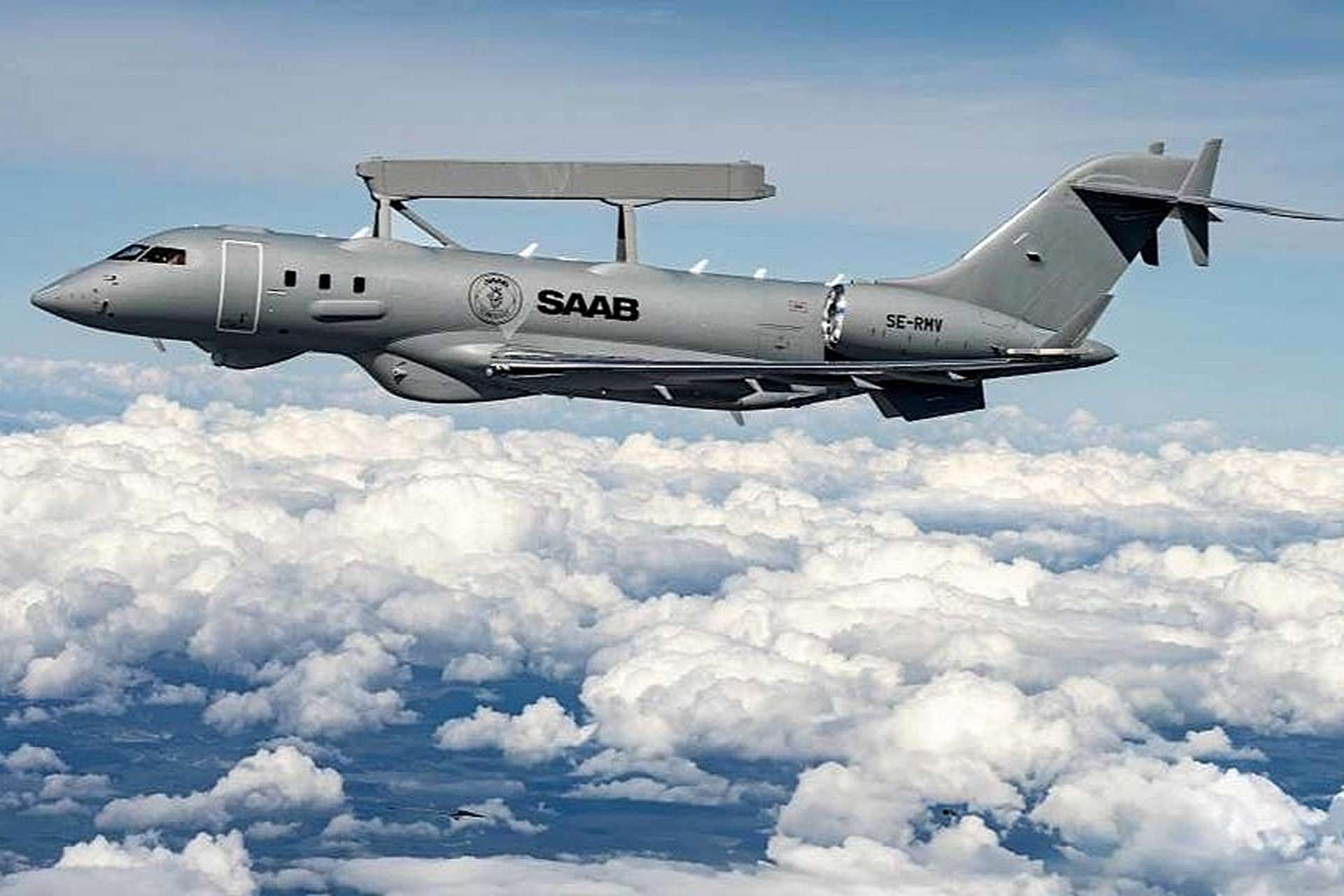
France has signed a $1.34 billion agreement with Saab to acquire GlobalEye AEW&C aircraft, replacing its aging E-3F Sentry fleet and modernizing national and NATO-aligned airborne early warning capabilities (Picture Source: SAAB)
Saab’s GlobalEye system combines the powerful Erieye Extended Range (ER) radar with a multi-sensor fusion suite onboard the Bombardier Global 6000/6500 ultra-long-range business jet. The core of its surveillance capability lies in the Erieye ER, a gallium nitride (GaN)-based active electronically scanned array (AESA) radar mounted atop the fuselage. With a claimed instrumented range exceeding 550 kilometers, the radar provides superior target detection and tracking across multiple domains, including stealthy, low-flying, or fast-moving aerial threats. Unlike traditional rotating dome radars, the fixed dorsal installation offers rapid scan rates and continuous coverage across 300 degrees of airspace.
Complementing the Erieye ER is a suite of additional sensors designed for maritime and land surveillance, including a high-performance maritime surveillance radar (MSR), electro-optical/infrared (EO/IR) systems, signals intelligence (SIGINT) payloads, and automatic identification system (AIS) receivers. This integration enables GlobalEye to detect, track, and classify both conventional and asymmetric threats in congested or contested environments. Saab’s open architecture allows for future sensor upgrades and mission-specific payload customization, something French defense planners are expected to leverage as the system is tailored to European operational contexts.
The Bombardier Global 6000 airframe provides high-altitude performance, low radar cross-section, and endurance exceeding 11 hours without refueling. This ensures persistent wide-area coverage with reduced logistical footprint compared to larger legacy platforms. The aircraft’s maximum ceiling of 51,000 feet gives GlobalEye radar systems extended line-of-sight detection ranges, which is especially critical in the context of missile defense and long-range air surveillance.
For the French Air and Space Force, this marks a generational leap in airborne early warning. The current E-3F Sentry fleet, introduced in the early 1990s, has faced increasing obsolescence amid changing air defense threats and contested airspace challenges. The introduction of GlobalEye aligns with France’s broader ISR modernization objectives and reinforces its capability to operate autonomously while maintaining full interoperability with NATO’s C2 architecture. It also reflects a strategic turn toward European defense industrial cooperation, as Sweden and France deepen ties beyond EU frameworks following Stockholm’s NATO accession.
Saab President and CEO Micael Johansson hailed the contract as “a strong commitment to Saab’s GlobalEye as a world-leading AEW&C solution” and emphasized the strategic trust between the two nations. “France is now the second NATO country to acquire GlobalEye, reinforcing the system’s role in supporting European security,” he said.
This is the third export success for the GlobalEye platform after contracts with the United Arab Emirates and Sweden. Analysts believe France’s endorsement may serve as a catalyst for other NATO members, including Germany and Italy, which are assessing next-generation AEW&C replacements to counter emerging air and missile threats. With Boeing’s E-7 Wedgetail also competing for NATO attention, France’s decision could significantly influence the alliance’s future C2 and ISR architecture.
By opting for a non-U.S. system, Paris signals its ongoing ambition for strategic autonomy while still supporting NATO interoperability. GlobalEye’s modular design and multi-domain awareness capability also enable integration into France’s broader sensor-to-shooter kill chain, potentially linking with space-based ISR platforms, ground-based air defense units, and Rafale F5 multirole fighter jets under development.
The aircraft’s onboard mission system supports up to seven operators, each managing real-time command-and-control, threat assessment, and situational awareness functions via advanced multi-screen workstations. Secure SATCOM, Link 16, and other tactical data links ensure seamless connectivity with French and NATO forces, enabling the aircraft to serve as a flying command post in crisis scenarios.
This order positions Saab as a major player in the high-end AEW&C segment and strengthens Europe’s capability to maintain persistent aerial surveillance in an era of increasingly complex airspace. As European air forces look to replace Cold War-era platforms, GlobalEye may well be at the center of a new generation of sovereign airborne command and control solutions.