Indonesia Takes Delivery of First Rafale Jets Heralding New Era of Air Power in Southeast Asia
{loadposition bannertop}
{loadposition sidebarpub}
Indonesia has taken delivery of its first three Dassault Rafale fighter jets from France, officials confirmed on 26 January 2026, beginning fulfillment of a 42-aircraft order signed in 2022. The arrival signals a major modernization step for the Indonesian Air Force and highlights Jakarta’s deepening defense alignment with Paris amid rising Indo-Pacific security pressures.
On 26 January 2026, Indonesian officials confirmed to Reuters that three Dassault Rafale fighter jets from France had arrived in-country, marking the first concrete deliveries under an approximately 8 billion dollar combat aviation agreement signed in 2022 and expanded in 2024. The aircraft represents the opening move in a 42-jet order intended to renew an ageing Indonesian Air Force (TNI-AU) fleet built around legacy F-16s, Su-27/30s and retired F-5s. This step is strategically significant for Jakarta, not only because it introduces a new generation of multi-role combat aircraft, but also because it consolidates a rapidly deepening defence partnership with France at a time of growing military competition in the Indo-Pacific.
Follow Army Recognition on Google News at this link
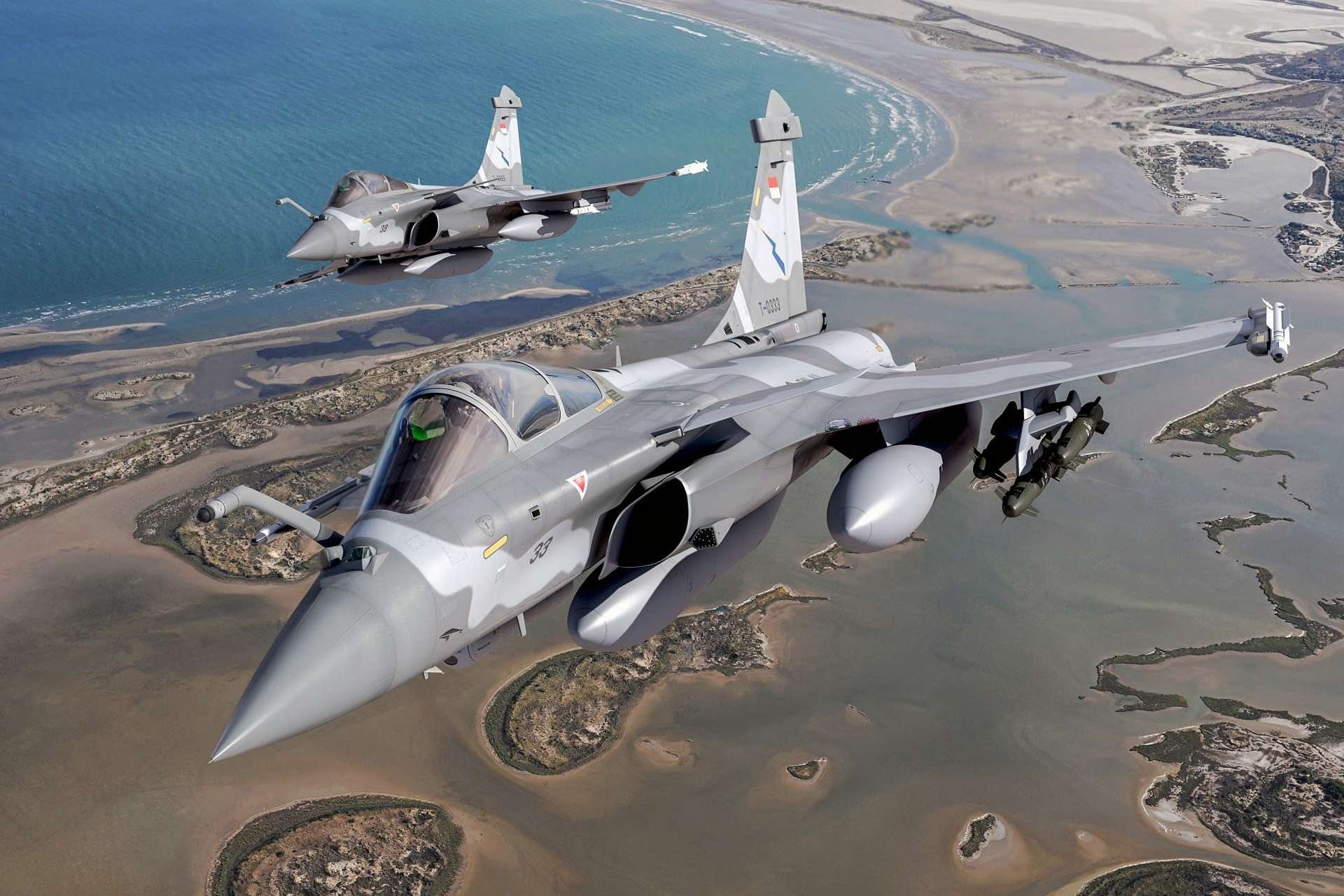
Indonesia’s receipt of its first Dassault Rafale fighter jets marks a pivotal step in modernizing its air force while deepening strategic defense ties with France amid intensifying Indo-Pacific competition (Picture Source: Dassault Aviation)
The three Rafales delivered are part of a broader package agreed between Jakarta and Paris in February 2022, under which Indonesia ordered 42 Rafale F4 aircraft in three tranches of 6, 18 and 18 jets, at an estimated value of around 8.1 billion US dollars. Subsequent French and Indonesian announcements confirmed that all three tranches have now entered into force, committing both sides to deliveries through the second half of this decade. The first trio, assembled in France by Dassault Aviation, was ceremonially handed over in late 2025 before being ferried to Roesmin Nurjadin Air Base in Pekanbaru, on the western island of Sumatra, where they arrived on 23 January and were formally confirmed in Indonesian service days later. Official statements underline that this batch inaugurates a longer delivery sequence, with at least three more aircraft due in April 2026 and further rotations planned until the full 42-aircraft fleet is in place.
At Roesmin Nurjadin Air Base, the Rafale is set to become a key element of the 31st Air Wing. The aircraft will be operated by the 12th Air Squadron “Black Panther,” designated as the Indonesian Air Force’s first Rafale C/B F4 unit, alongside the 16th Air Squadron, which continues to fly upgraded F-16C/D Block 52ID fighters and Hawk 209 aircraft. According to Indonesian sources, selected pilots and maintenance personnel have been undergoing training in France since 2025. This effort is intended to prepare the TNI-AU for the introduction of a highly digital, network-centric combat aircraft, whose operational concepts, maintenance philosophy and mission planning differ significantly from those of Indonesia’s existing U.S.- and Russian-origin fighter fleets.
The Rafale programme also fits into a wider restructuring of Indonesia’s air power capabilities. Ongoing and planned acquisitions, including Airbus A400M transport and tanker aircraft, new air-surveillance radar systems, and prospective purchases of F-15EX fighters and the Turkish KAAN, reflect an attempt to modernise the air force after years marked by limited investment and restrictions linked to international sanctions. Beyond the operational dimension, the agreement reinforces France’s position as a long-term strategic partner for Jakarta, alongside cooperation on Scorpène submarines and naval surface combatants. At the same time, it supports Indonesia’s long-standing policy of balancing its defence partnerships across American, European and Asian suppliers to preserve strategic autonomy.
The Rafale F4 standard chosen by Indonesia is a 4.5-generation, twin-engine, canard-delta multirole fighter designed to perform air superiority, deep strike, reconnaissance, anti-ship and even nuclear deterrent missions in French service. Powered by two Safran M88 turbofans delivering about 75 kN of thrust each in afterburner, the aircraft can reach speeds of around Mach 1.8 at altitude and sustain manoeuvres up to 9 g, with a combat radius in excess of 1,000 km depending on configuration. Its RBE2-AA active electronically scanned array radar offers long-range multi-target detection and tracking and is designed to fully exploit beyond-visual-range missiles such as Meteor, while a sophisticated SPECTRA electronic-warfare suite provides threat detection, jamming, decoying and, when needed, route re-planning to avoid surface-to-air systems. The aircraft’s frontal optronics (OSF) infrared search-and-track sensor, data-fusion architecture and modern cockpit, including helmet-mounted displays in the F4 standard, give the pilot a consolidated tactical picture, optimised for operations in dense, contested airspaces.
Weapons configuration is a key element of the Rafale package negotiated by Indonesia. Open sources suggest that Jakarta will have access to the full French weapons family associated with the F4 standard: Meteor long-range air-to-air missiles, MICA in both infrared and active-radar versions for within-visual-range and medium-range engagements, SCALP-EG cruise missiles for deep land attack, AASM Hammer precision-guided bombs with multiple seeker options, and the Exocet AM39 Block II missile for anti-ship operations. This arsenal, combined with a payload capacity of around 9 tonnes spread over 14 hardpoints, allows the Rafale to carry mixed air-to-air and air-to-surface loads, enabling so-called “omni-role” missions where a single sortie can transition from maritime interdiction to air defence or close air support as the tactical situation evolves. The F4 upgrades, focused on connectivity, data-link performance and enhanced targeting pods, are designed precisely to improve such collaborative operations, turning each aircraft into a sensor-shooter node that can share targeting data with other aircraft, ground command posts, surface vessels and, in the future, unmanned systems.
From an operational standpoint, Indonesia is acquiring a platform with two decades of intensive combat experience. Rafales have been used by France in Afghanistan, Libya, Mali and the Sahel, as well as in coalition operations over Iraq and Syria, and by India in high-altitude missions near the Line of Control with Pakistan. These campaigns have validated the aircraft’s ability to conduct swing-role missions, shifting from air-to-air escort to precision strike during a single flight, under demanding rules of engagement and in environments with credible air-defence threats. For Indonesia, which has not flown a modern Western multi-role fighter of this generation before, this track record significantly lowers integration risk: tactics, logistics chains, simulator syllabi and maintenance procedures have been refined by multiple export users such as Egypt, Qatar, Greece and Croatia. It also means that TNI-AU can tap into a growing community of Rafale operators that are progressively upgrading to the same F4 baseline, creating opportunities for joint training and standardisation.
The initial three aircraft will have limited mass but high impact as a seed capability. Based at Roesmin Nurjadin in Riau province, the Rafale’s range and sensors allow it to cover key maritime chokepoints such as the Malacca Strait, approaches to the Singapore Strait and the North Natuna Sea, where civil and military traffic intersect with disputed maritime claims. When armed with Meteor, the Rafale can hold hostile aircraft at risk well beyond the engagement envelope of legacy short-range missiles carried by many regional platforms, while its SCALP and AASM load-outs give Indonesian planners tools for precision strikes against high-value targets such as airbases, command centres or radar sites. The integration of Exocet and advanced targeting pods further enhances Indonesia’s anti-ship warfare options, complementing the navy’s surface and submarine capabilities and complicating the planning of any adversary operating in or near Indonesian waters. In daily peacetime operations, the Rafale’s endurance and sensor fusion make it well suited for sovereignty patrols and quick-reaction alert missions in response to airspace intrusions, which Indonesia has reported in significant numbers over recent years.
The decision to acquire the Rafale takes shape in a regional environment marked by persistent tensions in the South China Sea, particularly around the Natuna Islands. In recent years, Chinese coast guard and survey vessels have repeatedly operated in waters that Indonesia defines as part of its exclusive economic zone, leading Jakarta to reinforce air and naval patrols and invest in new military infrastructure in the area. The introduction of a long-range, network-enabled multirole fighter equipped with beyond-visual-range and stand-off strike capabilities enhances Indonesia’s capacity to monitor developments and respond to pressure without having to rely solely on naval forces or on external airpower. At the same time, Indonesian authorities have sought to balance this reinforcement with sustained diplomatic engagement, including maritime cooperation and coast guard coordination with China, in an effort to manage tensions while clearly affirming that sovereignty claims north of Natuna remain non-negotiable. In this context, the Rafale contributes to a posture of deterrence based on autonomy, providing a high-end air combat capability able to operate alongside major powers in the region without being politically or operationally dependent on them.
Beyond its operational impact, the agreement has wider industrial and diplomatic significance. For France, the Indonesian order reinforces the Rafale’s standing as a reference European combat aircraft on the international market and consolidates a broader strategic partnership covering air, naval and surveillance domains. For Indonesia, the aircraft is part of a consciously diversified procurement strategy that also includes interest in U.S. F-15EX fighters, a contract for 48 Turkish KAAN fifth-generation aircraft, and exploratory discussions with China on the J-10 and with Pakistan on combat aircraft and unmanned systems. While this diversity introduces challenges in terms of logistics, training and sustainment, it also strengthens Jakarta’s negotiating position and limits exposure to the political constraints, export controls or sanctions associated with any single supplier. Over the medium term, industrial offsets and maintenance, repair and overhaul activities linked to the Rafale programme could further support the development of Indonesia’s aerospace industry, particularly if local firms are integrated into component manufacturing, radar networks or weapons support chains.
The first three Rafales now on Indonesian soil are therefore better seen as the opening phase of a long-term transformation of the TNI-AU rather than an isolated delivery milestone. Over the next few years, the pace at which additional aircraft arrive, the maturity of pilot and maintainer training, and the depth of the weapons package actually fielded will determine how rapidly the Rafale can move from symbolic flagship to fully integrated combat system within Indonesia’s order of battle. If Jakarta succeeds in exploiting the aircraft’s full F4 potential, from long-range maritime interdiction to networked air defence and deep precision strike, the Rafale fleet will become a central pillar of Indonesia’s strategy to protect its airspace and maritime approaches, manage tensions in the South China Sea and affirm its status as a pivotal Indo-Pacific air power with diversified, sovereign choices in defence procurement.
Written by Teoman S. Nicanci – Defense Analyst, Army Recognition Group
Teoman S. Nicanci holds degrees in Political Science, Comparative and International Politics, and International Relations and Diplomacy from leading Belgian universities, with research focused on Russian strategic behavior, defense technology, and modern warfare. He is a defense analyst at Army Recognition, specializing in the global defense industry, military armament, and emerging defense technologies.
{loadposition bannertop}
{loadposition sidebarpub}
Indonesia has taken delivery of its first three Dassault Rafale fighter jets from France, officials confirmed on 26 January 2026, beginning fulfillment of a 42-aircraft order signed in 2022. The arrival signals a major modernization step for the Indonesian Air Force and highlights Jakarta’s deepening defense alignment with Paris amid rising Indo-Pacific security pressures.
On 26 January 2026, Indonesian officials confirmed to Reuters that three Dassault Rafale fighter jets from France had arrived in-country, marking the first concrete deliveries under an approximately 8 billion dollar combat aviation agreement signed in 2022 and expanded in 2024. The aircraft represents the opening move in a 42-jet order intended to renew an ageing Indonesian Air Force (TNI-AU) fleet built around legacy F-16s, Su-27/30s and retired F-5s. This step is strategically significant for Jakarta, not only because it introduces a new generation of multi-role combat aircraft, but also because it consolidates a rapidly deepening defence partnership with France at a time of growing military competition in the Indo-Pacific.
Indonesia’s receipt of its first Dassault Rafale fighter jets marks a pivotal step in modernizing its air force while deepening strategic defense ties with France amid intensifying Indo-Pacific competition (Picture Source: Dassault Aviation)
The three Rafales delivered are part of a broader package agreed between Jakarta and Paris in February 2022, under which Indonesia ordered 42 Rafale F4 aircraft in three tranches of 6, 18 and 18 jets, at an estimated value of around 8.1 billion US dollars. Subsequent French and Indonesian announcements confirmed that all three tranches have now entered into force, committing both sides to deliveries through the second half of this decade. The first trio, assembled in France by Dassault Aviation, was ceremonially handed over in late 2025 before being ferried to Roesmin Nurjadin Air Base in Pekanbaru, on the western island of Sumatra, where they arrived on 23 January and were formally confirmed in Indonesian service days later. Official statements underline that this batch inaugurates a longer delivery sequence, with at least three more aircraft due in April 2026 and further rotations planned until the full 42-aircraft fleet is in place.
At Roesmin Nurjadin Air Base, the Rafale is set to become a key element of the 31st Air Wing. The aircraft will be operated by the 12th Air Squadron “Black Panther,” designated as the Indonesian Air Force’s first Rafale C/B F4 unit, alongside the 16th Air Squadron, which continues to fly upgraded F-16C/D Block 52ID fighters and Hawk 209 aircraft. According to Indonesian sources, selected pilots and maintenance personnel have been undergoing training in France since 2025. This effort is intended to prepare the TNI-AU for the introduction of a highly digital, network-centric combat aircraft, whose operational concepts, maintenance philosophy and mission planning differ significantly from those of Indonesia’s existing U.S.- and Russian-origin fighter fleets.
The Rafale programme also fits into a wider restructuring of Indonesia’s air power capabilities. Ongoing and planned acquisitions, including Airbus A400M transport and tanker aircraft, new air-surveillance radar systems, and prospective purchases of F-15EX fighters and the Turkish KAAN, reflect an attempt to modernise the air force after years marked by limited investment and restrictions linked to international sanctions. Beyond the operational dimension, the agreement reinforces France’s position as a long-term strategic partner for Jakarta, alongside cooperation on Scorpène submarines and naval surface combatants. At the same time, it supports Indonesia’s long-standing policy of balancing its defence partnerships across American, European and Asian suppliers to preserve strategic autonomy.
The Rafale F4 standard chosen by Indonesia is a 4.5-generation, twin-engine, canard-delta multirole fighter designed to perform air superiority, deep strike, reconnaissance, anti-ship and even nuclear deterrent missions in French service. Powered by two Safran M88 turbofans delivering about 75 kN of thrust each in afterburner, the aircraft can reach speeds of around Mach 1.8 at altitude and sustain manoeuvres up to 9 g, with a combat radius in excess of 1,000 km depending on configuration. Its RBE2-AA active electronically scanned array radar offers long-range multi-target detection and tracking and is designed to fully exploit beyond-visual-range missiles such as Meteor, while a sophisticated SPECTRA electronic-warfare suite provides threat detection, jamming, decoying and, when needed, route re-planning to avoid surface-to-air systems. The aircraft’s frontal optronics (OSF) infrared search-and-track sensor, data-fusion architecture and modern cockpit, including helmet-mounted displays in the F4 standard, give the pilot a consolidated tactical picture, optimised for operations in dense, contested airspaces.
Weapons configuration is a key element of the Rafale package negotiated by Indonesia. Open sources suggest that Jakarta will have access to the full French weapons family associated with the F4 standard: Meteor long-range air-to-air missiles, MICA in both infrared and active-radar versions for within-visual-range and medium-range engagements, SCALP-EG cruise missiles for deep land attack, AASM Hammer precision-guided bombs with multiple seeker options, and the Exocet AM39 Block II missile for anti-ship operations. This arsenal, combined with a payload capacity of around 9 tonnes spread over 14 hardpoints, allows the Rafale to carry mixed air-to-air and air-to-surface loads, enabling so-called “omni-role” missions where a single sortie can transition from maritime interdiction to air defence or close air support as the tactical situation evolves. The F4 upgrades, focused on connectivity, data-link performance and enhanced targeting pods, are designed precisely to improve such collaborative operations, turning each aircraft into a sensor-shooter node that can share targeting data with other aircraft, ground command posts, surface vessels and, in the future, unmanned systems.
From an operational standpoint, Indonesia is acquiring a platform with two decades of intensive combat experience. Rafales have been used by France in Afghanistan, Libya, Mali and the Sahel, as well as in coalition operations over Iraq and Syria, and by India in high-altitude missions near the Line of Control with Pakistan. These campaigns have validated the aircraft’s ability to conduct swing-role missions, shifting from air-to-air escort to precision strike during a single flight, under demanding rules of engagement and in environments with credible air-defence threats. For Indonesia, which has not flown a modern Western multi-role fighter of this generation before, this track record significantly lowers integration risk: tactics, logistics chains, simulator syllabi and maintenance procedures have been refined by multiple export users such as Egypt, Qatar, Greece and Croatia. It also means that TNI-AU can tap into a growing community of Rafale operators that are progressively upgrading to the same F4 baseline, creating opportunities for joint training and standardisation.
The initial three aircraft will have limited mass but high impact as a seed capability. Based at Roesmin Nurjadin in Riau province, the Rafale’s range and sensors allow it to cover key maritime chokepoints such as the Malacca Strait, approaches to the Singapore Strait and the North Natuna Sea, where civil and military traffic intersect with disputed maritime claims. When armed with Meteor, the Rafale can hold hostile aircraft at risk well beyond the engagement envelope of legacy short-range missiles carried by many regional platforms, while its SCALP and AASM load-outs give Indonesian planners tools for precision strikes against high-value targets such as airbases, command centres or radar sites. The integration of Exocet and advanced targeting pods further enhances Indonesia’s anti-ship warfare options, complementing the navy’s surface and submarine capabilities and complicating the planning of any adversary operating in or near Indonesian waters. In daily peacetime operations, the Rafale’s endurance and sensor fusion make it well suited for sovereignty patrols and quick-reaction alert missions in response to airspace intrusions, which Indonesia has reported in significant numbers over recent years.
The decision to acquire the Rafale takes shape in a regional environment marked by persistent tensions in the South China Sea, particularly around the Natuna Islands. In recent years, Chinese coast guard and survey vessels have repeatedly operated in waters that Indonesia defines as part of its exclusive economic zone, leading Jakarta to reinforce air and naval patrols and invest in new military infrastructure in the area. The introduction of a long-range, network-enabled multirole fighter equipped with beyond-visual-range and stand-off strike capabilities enhances Indonesia’s capacity to monitor developments and respond to pressure without having to rely solely on naval forces or on external airpower. At the same time, Indonesian authorities have sought to balance this reinforcement with sustained diplomatic engagement, including maritime cooperation and coast guard coordination with China, in an effort to manage tensions while clearly affirming that sovereignty claims north of Natuna remain non-negotiable. In this context, the Rafale contributes to a posture of deterrence based on autonomy, providing a high-end air combat capability able to operate alongside major powers in the region without being politically or operationally dependent on them.
Beyond its operational impact, the agreement has wider industrial and diplomatic significance. For France, the Indonesian order reinforces the Rafale’s standing as a reference European combat aircraft on the international market and consolidates a broader strategic partnership covering air, naval and surveillance domains. For Indonesia, the aircraft is part of a consciously diversified procurement strategy that also includes interest in U.S. F-15EX fighters, a contract for 48 Turkish KAAN fifth-generation aircraft, and exploratory discussions with China on the J-10 and with Pakistan on combat aircraft and unmanned systems. While this diversity introduces challenges in terms of logistics, training and sustainment, it also strengthens Jakarta’s negotiating position and limits exposure to the political constraints, export controls or sanctions associated with any single supplier. Over the medium term, industrial offsets and maintenance, repair and overhaul activities linked to the Rafale programme could further support the development of Indonesia’s aerospace industry, particularly if local firms are integrated into component manufacturing, radar networks or weapons support chains.
The first three Rafales now on Indonesian soil are therefore better seen as the opening phase of a long-term transformation of the TNI-AU rather than an isolated delivery milestone. Over the next few years, the pace at which additional aircraft arrive, the maturity of pilot and maintainer training, and the depth of the weapons package actually fielded will determine how rapidly the Rafale can move from symbolic flagship to fully integrated combat system within Indonesia’s order of battle. If Jakarta succeeds in exploiting the aircraft’s full F4 potential, from long-range maritime interdiction to networked air defence and deep precision strike, the Rafale fleet will become a central pillar of Indonesia’s strategy to protect its airspace and maritime approaches, manage tensions in the South China Sea and affirm its status as a pivotal Indo-Pacific air power with diversified, sovereign choices in defence procurement.
Written by Teoman S. Nicanci – Defense Analyst, Army Recognition Group
Teoman S. Nicanci holds degrees in Political Science, Comparative and International Politics, and International Relations and Diplomacy from leading Belgian universities, with research focused on Russian strategic behavior, defense technology, and modern warfare. He is a defense analyst at Army Recognition, specializing in the global defense industry, military armament, and emerging defense technologies.