U.S. Air Force develops hard-kill missile defense for KC-135 and KC-46 tanker aircraft
{loadposition bannertop}
{loadposition sidebarpub}
The U.S. Air Force is evaluating kinetic missile defense for KC-135, KC-46A, C-17A, C-130, and C-5M fleets to intercept incoming missiles inside the weapons engagement zone, amid expanding long-range air and missile threats.
In an interview with the U.S. Air Force Materiel Command on February 10, 2026, Kevin Stamey, Program Executive Officer for Mobility, confirmed that the U.S. Air Force is evaluating kinetic self-protection systems, such as hard-kill missiles, for KC-135, KC-46A, C-17A, C-130, and C-5M tanker and transport aircraft to intercept incoming missiles inside the weapons engagement zone. The effort reflects concern that expanding long-range air-to-air and surface-to-air missile threats are reducing safe stand-off distances for non-stealth mobility aircraft..Follow Army Recognition on Google News at this link
Large, non-stealth aircraft such as the KC-135 Stratotanker and KC-46A Pegasus have significant radar cross-sections and infrared signatures, making them more detectable than stealth fighters such as the F-22 or the F-35. (Picture source: US Air Force)
The U.S. Air Force confirmed it is exploring kinetic self-protection systems for aerial refueling tankers and other high-value mobility aircraft, introducing the possibility of physically destroying incoming missiles as a last line of defense inside the weapons engagement zone. The initiative applies to aircraft under the Air Force Life Cycle Management Center’s Mobility Directorate, including the KC-135 Stratotanker, KC-46A Pegasus, C-17A Globemaster III, C-130 variants, and C-5M Super Galaxy fleets. Kevin Stamey, Program Executive Officer for Mobility, stated that the objective is to develop a protection method independent of missile seeker type, whether infrared or radar-guided, and usable if electronic warfare and decoys fail. The effort is framed within a shortened two-to-three-year preparation window for potential peer conflict, replacing the earlier three-to-five-year planning horizon and aligning U.S. mobility forces with what leadership describes as a wartime footing.
The operational driver is the expansion of adversary long-range kill chains designed to hold support aircraft at risk far beyond traditional front lines. Air-to-air and surface-to-air missiles with engagement ranges approaching 1,000 miles, combined with integrated air defense systems linking ground radars, airborne sensors, and fighter aircraft, reduce safe stand-off distances for tankers. Large, non-stealth aircraft such as the KC-135 Stratotanker and KC-46A Pegasus have significant radar cross-sections and infrared signatures, making them more detectable than stealth fighters such as the F-22, the F-35, or the planned F-47. Imaging infrared seekers are immune to radiofrequency jamming and passive in operation, providing no emission warning to crews, while modern radar-guided systems can shift frequencies and modulate waveforms to degrade electronic countermeasures, compressing the reaction time and increasing the probability that at least some inbound weapons, such as China’s PL-15 and PL-17 missiles, may penetrate soft-kill defenses.
Current tanker survivability architecture relies on layered soft-kill systems. Directional infrared countermeasures (or DICMs) use laser energy to disrupt heat-seeking missile guidance, while onboard electronic warfare suites operate using threat libraries that must be continuously updated as adversary radars and seekers evolve. Reprogramming cycles involve rapid mission data updates to account for frequency hopping, mode changes, and altered signal signatures, but new cognitive electronic warfare initiatives seek to automate portions of this update process to reduce response time. Tankers and airlifters also deploy expendable countermeasures such as flares, chaff, and active radiofrequency decoys, and connectivity upgrades aim to provide improved battlespace awareness. A kinetic self-protection is likely not intended to replace these measures but to function as an adjunct layer capable of engaging a missile that survives jamming and deception.
Technical pathways under consideration would probably draw on earlier U.S. research. The Miniature Self-Defense Munition program examined an interceptor approximately one meter in length, significantly smaller than an AIM-9 or AIM-120, designed to be more agile and cheaper. In 2018, the U.S. Navy also issued requirements for a Hard Kill Self Protection Countermeasure System (HKSPCS) for transport and tanker aircraft, specifying internal systems under 2,300 pounds or external pods between 850 and 2,890 pounds, capable of defeating four to ten inbound missiles. Northrop Grumman, for its part, patented an aircraft-mounted miniature interceptor concept adaptable to large aircraft or unmanned escorts. The U.S. Air Force has also tested the use of Common Launch Tubes on KC-135 aircraft to deploy small drones, which could provide loitering defensive options and potential re-engagement capability. Integration constraints include launcher weight, aerodynamic impact, magazine depth, and internal space allocation.
A kinetic interceptor architecture would require rapid detection and cueing from sensors such as infrared search and track systems, onboard radars, or distributed sensor feeds from other aircraft, with engagement timelines measured in seconds against high-speed threats. Distributed networking across aircraft and space-based assets would support such early detection and targeting. The U.S. Air Force is pursuing proliferated low Earth orbit satellite constellations and hybrid communication architectures to ensure resilient data links under jamming conditions, concepts comparable to commercial systems such as Starlink and defense variants such as Starshield. High-bandwidth data sharing would allow mobility crews to receive updated threat information before entering terminal phases of flight, reducing scenarios where aircraft approach compromised airfields or unusable runways without awareness. This approach, which links survivability directly to connectivity, could transform tankers from rear-area logistics assets into platforms expected to operate closer to contested zones alongside aircraft such as the F-22 and F-35.
Parallel global trends indicate that support aircraft roles are expanding under similar threat pressures. Japan has evaluated arming the Kawasaki C-2 transport aircraft using palletized systems similar to Rapid Dragon, enabling the deployment of AGM-158 JASSM cruise missiles with a range of roughly 900 kilometers or modified Type 12 missiles with ranges up to 1,000 kilometers. With the C-2’s flight range between approximately 7,600 and 10,200 kilometers, depending on configuration, the combined reach could exceed 11,000 kilometers. Only about 13 to 15 C-2 aircraft are operational, and each airframe costs roughly $176 million as of 2017, limiting fleet expansion. Globally, large commercial-derived aircraft such as the Airbus A330 MRTT and even cargo platforms such as FedEx-operated Airbus A321 freighters could eventually be fitted with infrared countermeasure systems to mitigate the risk from air defense systems in high-risk airspace.
These developments occur within the context of the world’s largest aerial refueling fleet. The United States operates more than 600 air-to-air refueling-capable aircraft, representing roughly 75 percent of global tanker capacity, with approximately 466 strategic tankers projected at the start of fiscal year 2025. The KC-135, first delivered in 1957, still constitutes roughly 80 percent of the tanker fleet, while the KC-46A Pegasus surpassed 100 deliveries in December 2025 and remains under contract for additional production lots extending into the late 2020s and early 2030s. Future planning under the Next Generation Air Refueling System examines options including conventional tube-and-wing designs, business jet-based concepts, blended wing body aircraft such as the JetZero proposal, and signature-managed tankers. The exploration of kinetic self-protection, therefore, reflects a structural reassessmentby the U.S. Air Force of tanker survivability doctrine in response to extended-range missile threats and integrated peer air defense networks.
Written by Jérôme Brahy
Jérôme Brahy is a defense analyst and documentalist at Army Recognition. He specializes in naval modernization, aviation, drones, armored vehicles, and artillery, with a focus on strategic developments in the United States, China, Ukraine, Russia, Türkiye, and Belgium. His analyses go beyond the facts, providing context, identifying key actors, and explaining why defense news matters on a global scale.
{loadposition bannertop}
{loadposition sidebarpub}
The U.S. Air Force is evaluating kinetic missile defense for KC-135, KC-46A, C-17A, C-130, and C-5M fleets to intercept incoming missiles inside the weapons engagement zone, amid expanding long-range air and missile threats.
In an interview with the U.S. Air Force Materiel Command on February 10, 2026, Kevin Stamey, Program Executive Officer for Mobility, confirmed that the U.S. Air Force is evaluating kinetic self-protection systems, such as hard-kill missiles, for KC-135, KC-46A, C-17A, C-130, and C-5M tanker and transport aircraft to intercept incoming missiles inside the weapons engagement zone. The effort reflects concern that expanding long-range air-to-air and surface-to-air missile threats are reducing safe stand-off distances for non-stealth mobility aircraft..
Follow Army Recognition on Google News at this link
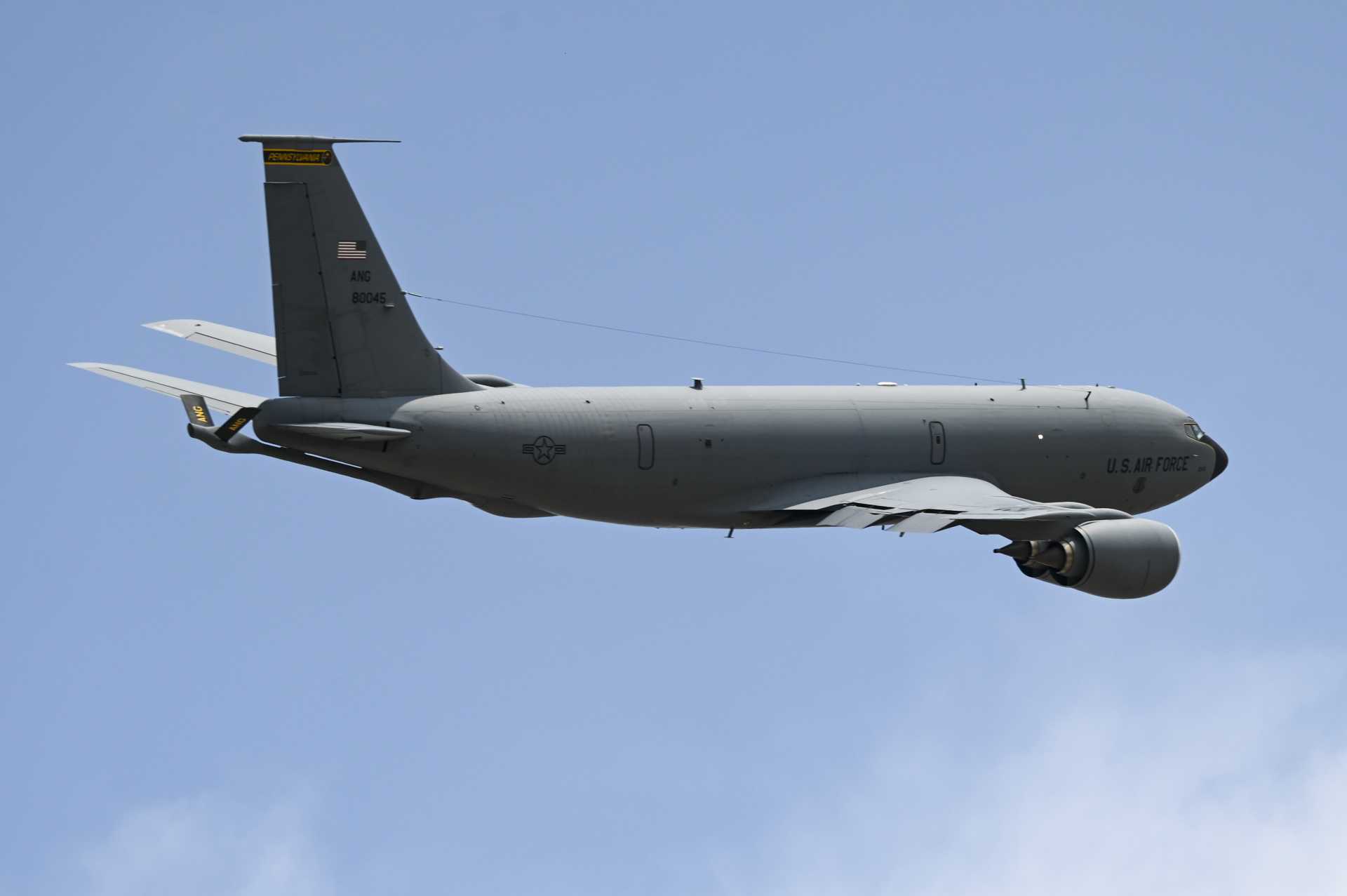
Large, non-stealth aircraft such as the KC-135 Stratotanker and KC-46A Pegasus have significant radar cross-sections and infrared signatures, making them more detectable than stealth fighters such as the F-22 or the F-35. (Picture source: US Air Force)
The U.S. Air Force confirmed it is exploring kinetic self-protection systems for aerial refueling tankers and other high-value mobility aircraft, introducing the possibility of physically destroying incoming missiles as a last line of defense inside the weapons engagement zone. The initiative applies to aircraft under the Air Force Life Cycle Management Center’s Mobility Directorate, including the KC-135 Stratotanker, KC-46A Pegasus, C-17A Globemaster III, C-130 variants, and C-5M Super Galaxy fleets. Kevin Stamey, Program Executive Officer for Mobility, stated that the objective is to develop a protection method independent of missile seeker type, whether infrared or radar-guided, and usable if electronic warfare and decoys fail. The effort is framed within a shortened two-to-three-year preparation window for potential peer conflict, replacing the earlier three-to-five-year planning horizon and aligning U.S. mobility forces with what leadership describes as a wartime footing.
The operational driver is the expansion of adversary long-range kill chains designed to hold support aircraft at risk far beyond traditional front lines. Air-to-air and surface-to-air missiles with engagement ranges approaching 1,000 miles, combined with integrated air defense systems linking ground radars, airborne sensors, and fighter aircraft, reduce safe stand-off distances for tankers. Large, non-stealth aircraft such as the KC-135 Stratotanker and KC-46A Pegasus have significant radar cross-sections and infrared signatures, making them more detectable than stealth fighters such as the F-22, the F-35, or the planned F-47. Imaging infrared seekers are immune to radiofrequency jamming and passive in operation, providing no emission warning to crews, while modern radar-guided systems can shift frequencies and modulate waveforms to degrade electronic countermeasures, compressing the reaction time and increasing the probability that at least some inbound weapons, such as China’s PL-15 and PL-17 missiles, may penetrate soft-kill defenses.
Current tanker survivability architecture relies on layered soft-kill systems. Directional infrared countermeasures (or DICMs) use laser energy to disrupt heat-seeking missile guidance, while onboard electronic warfare suites operate using threat libraries that must be continuously updated as adversary radars and seekers evolve. Reprogramming cycles involve rapid mission data updates to account for frequency hopping, mode changes, and altered signal signatures, but new cognitive electronic warfare initiatives seek to automate portions of this update process to reduce response time. Tankers and airlifters also deploy expendable countermeasures such as flares, chaff, and active radiofrequency decoys, and connectivity upgrades aim to provide improved battlespace awareness. A kinetic self-protection is likely not intended to replace these measures but to function as an adjunct layer capable of engaging a missile that survives jamming and deception.
Technical pathways under consideration would probably draw on earlier U.S. research. The Miniature Self-Defense Munition program examined an interceptor approximately one meter in length, significantly smaller than an AIM-9 or AIM-120, designed to be more agile and cheaper. In 2018, the U.S. Navy also issued requirements for a Hard Kill Self Protection Countermeasure System (HKSPCS) for transport and tanker aircraft, specifying internal systems under 2,300 pounds or external pods between 850 and 2,890 pounds, capable of defeating four to ten inbound missiles. Northrop Grumman, for its part, patented an aircraft-mounted miniature interceptor concept adaptable to large aircraft or unmanned escorts. The U.S. Air Force has also tested the use of Common Launch Tubes on KC-135 aircraft to deploy small drones, which could provide loitering defensive options and potential re-engagement capability. Integration constraints include launcher weight, aerodynamic impact, magazine depth, and internal space allocation.
A kinetic interceptor architecture would require rapid detection and cueing from sensors such as infrared search and track systems, onboard radars, or distributed sensor feeds from other aircraft, with engagement timelines measured in seconds against high-speed threats. Distributed networking across aircraft and space-based assets would support such early detection and targeting. The U.S. Air Force is pursuing proliferated low Earth orbit satellite constellations and hybrid communication architectures to ensure resilient data links under jamming conditions, concepts comparable to commercial systems such as Starlink and defense variants such as Starshield. High-bandwidth data sharing would allow mobility crews to receive updated threat information before entering terminal phases of flight, reducing scenarios where aircraft approach compromised airfields or unusable runways without awareness. This approach, which links survivability directly to connectivity, could transform tankers from rear-area logistics assets into platforms expected to operate closer to contested zones alongside aircraft such as the F-22 and F-35.
Parallel global trends indicate that support aircraft roles are expanding under similar threat pressures. Japan has evaluated arming the Kawasaki C-2 transport aircraft using palletized systems similar to Rapid Dragon, enabling the deployment of AGM-158 JASSM cruise missiles with a range of roughly 900 kilometers or modified Type 12 missiles with ranges up to 1,000 kilometers. With the C-2’s flight range between approximately 7,600 and 10,200 kilometers, depending on configuration, the combined reach could exceed 11,000 kilometers. Only about 13 to 15 C-2 aircraft are operational, and each airframe costs roughly $176 million as of 2017, limiting fleet expansion. Globally, large commercial-derived aircraft such as the Airbus A330 MRTT and even cargo platforms such as FedEx-operated Airbus A321 freighters could eventually be fitted with infrared countermeasure systems to mitigate the risk from air defense systems in high-risk airspace.
These developments occur within the context of the world’s largest aerial refueling fleet. The United States operates more than 600 air-to-air refueling-capable aircraft, representing roughly 75 percent of global tanker capacity, with approximately 466 strategic tankers projected at the start of fiscal year 2025. The KC-135, first delivered in 1957, still constitutes roughly 80 percent of the tanker fleet, while the KC-46A Pegasus surpassed 100 deliveries in December 2025 and remains under contract for additional production lots extending into the late 2020s and early 2030s. Future planning under the Next Generation Air Refueling System examines options including conventional tube-and-wing designs, business jet-based concepts, blended wing body aircraft such as the JetZero proposal, and signature-managed tankers. The exploration of kinetic self-protection, therefore, reflects a structural reassessmentby the U.S. Air Force of tanker survivability doctrine in response to extended-range missile threats and integrated peer air defense networks.
Written by Jérôme Brahy
Jérôme Brahy is a defense analyst and documentalist at Army Recognition. He specializes in naval modernization, aviation, drones, armored vehicles, and artillery, with a focus on strategic developments in the United States, China, Ukraine, Russia, Türkiye, and Belgium. His analyses go beyond the facts, providing context, identifying key actors, and explaining why defense news matters on a global scale.