U.S. Navy F/A-18 Super Hornet Now Armed with StormBreaker Smart Glide Bomb for Enhanced Precision Warfare
{loadposition bannertop}
{loadposition sidebarpub}
The U.S. Navy declared initial operational capability for the Small Diameter Bomb II, known as StormBreaker, on the F/A-18E/F Super Hornet after qualification testing at Patuxent River, Maryland. The milestone gives carrier air wings a networked, all-weather weapon designed to hit moving land and maritime targets at standoff range in contested environments.
On 19 February 2026, the U.S. Navy announced that the Small Diameter Bomb II, better known as the StormBreaker, has reached initial operational capability on the F/A-18E/F Super Hornet, following a qualification campaign led at Patuxent River, Maryland. According to a release from Naval Air Warfare Center Aircraft Division, this decision formalizes a capability that had already been exercised during limited early operational use in 2025. The move is a key step in the Navy’s effort to equip carrier air wings with networked, all-weather precision munitions optimized for moving targets. It also signals how seriously the service is treating the need to hold mobile land and maritime targets at risk from standoff range in increasingly contested theaters.
Follow Army Recognition on Google News at this link
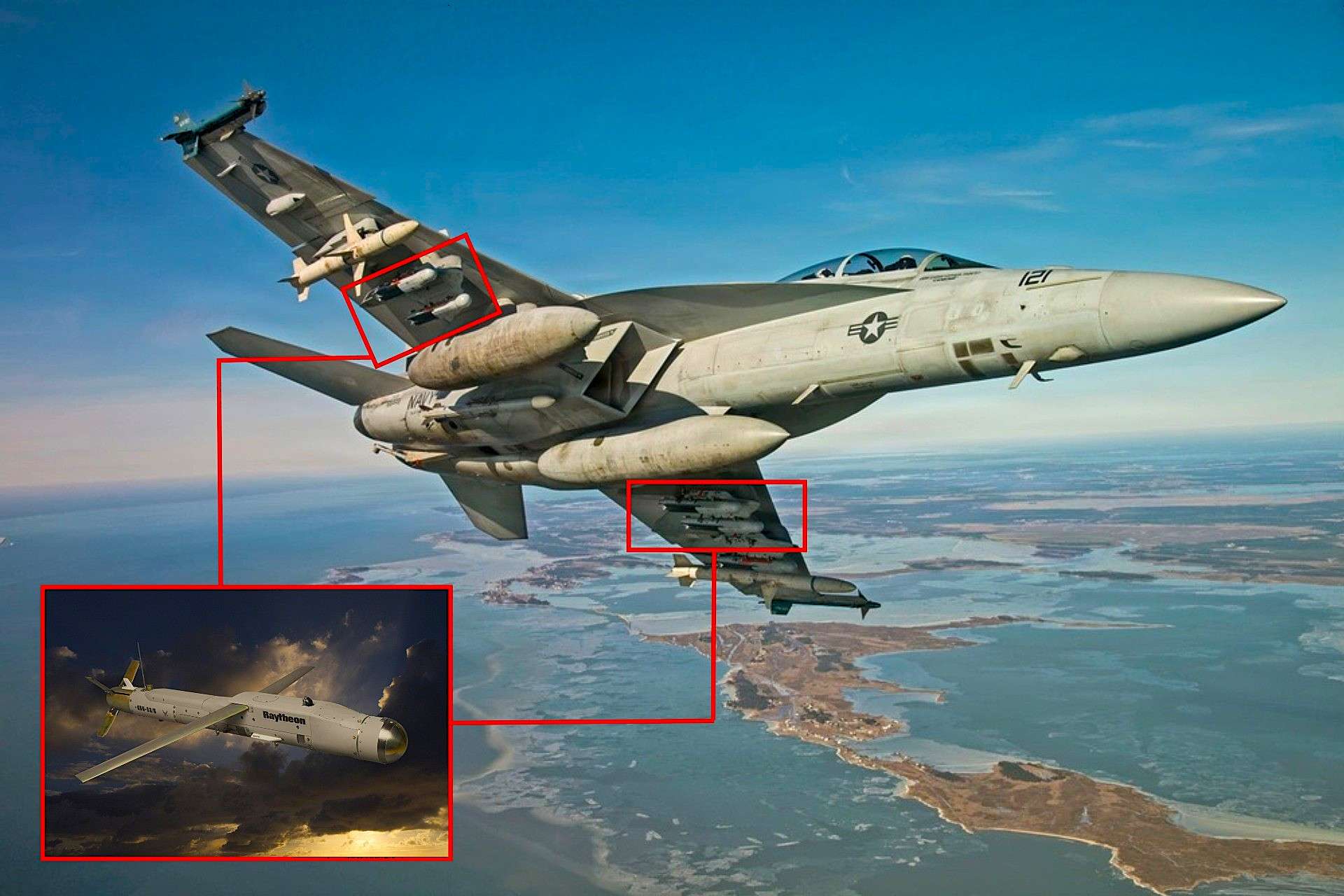
An F/A-18 tests the Small Diameter Bomb II at Naval Air Station Patuxent River, Maryland, showcasing its tri-mode seeker for engaging moving targets in adverse conditions (Picture Source: U.S. Navy / Raytheon)
The new milestone confirms that the U.S. Navy can now routinely load and employ the GBU-53/B StormBreaker from fleet Super Hornet squadrons, not just test units. IOC follows an “early operational capability” phase that saw SDB II carried on combat sorties in 2025, providing real-world feedback on weapon–aircraft integration, mission planning workflows and datalink behavior in complex airspace. The StormBreaker was originally fielded on the U.S. Air Force F-15E Strike Eagle earlier in the decade and is being integrated on the F-35, but making it part of the day-to-day load-out of carrier-based F/A-18E/Fs is a different step: it turns the workhorse of the carrier air wing into a primary delivery platform for a new generation of networked glide bombs.
The SDB II is a 250-lb-class air-to-surface glide weapon whose design philosophy is to trade explosive mass for precision, discrimination and carriage capacity. Weighing roughly 93 kg and equipped with folding wings, the GBU-53/B can engage targets at standoff ranges approaching 40–45 nautical miles, depending on release conditions. Its tri-mode seeker combines millimeter-wave radar, imaging infrared and semi-active laser in a single nose section, fused with GPS/INS midcourse guidance and a two-way datalink. This architecture allows the weapon to be cued toward a general area, autonomously search for a target set, discriminate objects of interest through weather and battlefield obscurants, and then either prosecute the engagement on its own logic or respond to external terminal guidance from a laser designator. For a Super Hornet crew, this means the bomb can be retasked in flight, handed off between controllers and still reach a moving vehicle or fast attack craft under cloud, smoke or dust.
Integrating this weapon on the F/A-18E/F is not a simple “add one more store” exercise; it reshapes the way a strike fighter uses its hardpoints. The aircraft employs smart racks such as the BRU-55 to carry multiple 1760-interface munitions per station, enabling several SDB II rounds to be loaded where previously only a single larger bomb might fit. In practice, a Super Hornet can launch with a mixed load of StormBreakers, air-to-air missiles and perhaps a couple of heavier stand-off weapons, retaining self-defense capability while carrying a magazine of precision effects suitable for multiple discrete targets. From a deck-cycle perspective, this increases the number of aim points a single sortie can service, which is particularly important when catapult and recovery cycles, tanker availability and deck space on a carrier are all constrained resources.
The operational history of SDB II helps explain why the Navy is moving quickly to consolidate it on its main strike platform. Development started in the mid-2000s, with the weapon conceived as an evolution of the original Small Diameter Bomb optimized for mobile targets. After a competition, Raytheon was selected to produce the system, and the Air Force achieved operational use on the F-15E around 2019–2020, followed by live combat usage. For the Navy, the 2025 early operational employment from carrier-based Super Hornets, reportedly including missions in the Red Sea region, demonstrated that StormBreaker could be safely handled on crowded flight decks, survive the stresses of catapult launch and arrested recovery, and integrate with naval mission systems in a joint operational environment.
The Super Hornet–StormBreaker combination significantly broadens the mission set that a carrier air wing can undertake with a limited number of aircraft on station. Instead of dedicating separate sorties or heavier munitions to each threat, a section of F/A-18E/Fs armed with SDB II can service multiple time-sensitive targets in a single pass: mobile surface-to-air missile batteries shifting firing positions, maneuvering armor columns, logistics convoys, fast inshore attack craft or missile boats attempting a swarm attack, and high-value command nodes that briefly expose themselves. The tri-mode seeker and network connectivity compress the kill chain: off-board sensors, from other aircraft, surface combatants or ground elements, can generate targets, while the StormBreaker can be updated in flight to chase them as they move. For strike planners, this translates into denser target servicing per sortie and more flexibility to adapt when the tactical situation changes after weapons release.
At the operational and strategic level, IOC on the Super Hornet reinforces the aircraft carrier’s role as a mobile node in a broader, distributed strike network. Carrier strike groups operating in the Indo-Pacific, the North Atlantic or the Eastern Mediterranean increasingly face adversaries who use mobility, dispersion and complex terrain, urban areas, littorals, archipelagos, to dilute the effectiveness of traditional strike packages. Equipping embarked fighters with a weapon designed specifically to find and hit moving targets through weather conditions helps close that gap. It also increases the effective “magazine depth” of a carrier: instead of using scarce, high-end cruise missiles for every dynamic target, commanders can rely on StormBreaker for many tasks, preserving longer-range or higher-yield assets for hardened or heavily defended objectives. In a scenario where surface combatants and submarines are also firing land-attack and anti-ship missiles, Super Hornets armed with SDB II add a layer of responsive, discriminate firepower within the carrier’s immediate operating radius.
The joint and coalition dimension should not be overlooked. The StormBreaker is already in service with the U.S. Air Force on the F-15E and is being integrated on the F-35A/B/C, including those destined for allied air forces. As a result, the same class of weapon will be deliverable from land-based fighters, carrier-borne Super Hornets and, in future, fifth-generation aircraft embarked on amphibious or carrier platforms. This convergence simplifies logistics, training and mission data management across services and partners. For carrier strike groups operating in combined task forces, it means that U.S. Navy Super Hornets carrying SDB II can plug into a common target-development and fires network with allied F-35s, sharing tracks and intent in real time. Over the longer term, as the Navy transitions toward its next-generation carrier air wing, StormBreaker on the Super Hornet can be seen as a bridge capability, deploying today on a mature platform while setting doctrinal and technical standards for how networked munitions will be used from sea in the 2030s.
The U.S. Navy’s declaration of initial operational capability for the Small Diameter Bomb II on the F/A-18E/F marks more than a routine milestone; it locks in a new way of using carrier aviation against mobile, time-sensitive targets in contested environments. By pairing the Super Hornet’s reach and endurance with a compact, tri-mode, network-enabled glide bomb, U.S. carrier strike groups gain a flexible tool to impose cost on adversaries who rely on mobility, weather and clutter for protection. The decision reflects an understanding that in future crises, from the Red Sea to the South China Sea, what will matter is not only how far a carrier can project power, but how precisely and how often its aircraft can deliver discriminate effects against targets that refuse to stand still.
Written by Teoman S. Nicanci – Defense Analyst, Army Recognition Group
Teoman S. Nicanci holds degrees in Political Science, Comparative and International Politics, and International Relations and Diplomacy from leading Belgian universities, with research focused on Russian strategic behavior, defense technology, and modern warfare. He is a defense analyst at Army Recognition, specializing in the global defense industry, military armament, and emerging defense technologies.
{loadposition bannertop}
{loadposition sidebarpub}
The U.S. Navy declared initial operational capability for the Small Diameter Bomb II, known as StormBreaker, on the F/A-18E/F Super Hornet after qualification testing at Patuxent River, Maryland. The milestone gives carrier air wings a networked, all-weather weapon designed to hit moving land and maritime targets at standoff range in contested environments.
On 19 February 2026, the U.S. Navy announced that the Small Diameter Bomb II, better known as the StormBreaker, has reached initial operational capability on the F/A-18E/F Super Hornet, following a qualification campaign led at Patuxent River, Maryland. According to a release from Naval Air Warfare Center Aircraft Division, this decision formalizes a capability that had already been exercised during limited early operational use in 2025. The move is a key step in the Navy’s effort to equip carrier air wings with networked, all-weather precision munitions optimized for moving targets. It also signals how seriously the service is treating the need to hold mobile land and maritime targets at risk from standoff range in increasingly contested theaters.
An F/A-18 tests the Small Diameter Bomb II at Naval Air Station Patuxent River, Maryland, showcasing its tri-mode seeker for engaging moving targets in adverse conditions (Picture Source: U.S. Navy / Raytheon)
The new milestone confirms that the U.S. Navy can now routinely load and employ the GBU-53/B StormBreaker from fleet Super Hornet squadrons, not just test units. IOC follows an “early operational capability” phase that saw SDB II carried on combat sorties in 2025, providing real-world feedback on weapon–aircraft integration, mission planning workflows and datalink behavior in complex airspace. The StormBreaker was originally fielded on the U.S. Air Force F-15E Strike Eagle earlier in the decade and is being integrated on the F-35, but making it part of the day-to-day load-out of carrier-based F/A-18E/Fs is a different step: it turns the workhorse of the carrier air wing into a primary delivery platform for a new generation of networked glide bombs.
The SDB II is a 250-lb-class air-to-surface glide weapon whose design philosophy is to trade explosive mass for precision, discrimination and carriage capacity. Weighing roughly 93 kg and equipped with folding wings, the GBU-53/B can engage targets at standoff ranges approaching 40–45 nautical miles, depending on release conditions. Its tri-mode seeker combines millimeter-wave radar, imaging infrared and semi-active laser in a single nose section, fused with GPS/INS midcourse guidance and a two-way datalink. This architecture allows the weapon to be cued toward a general area, autonomously search for a target set, discriminate objects of interest through weather and battlefield obscurants, and then either prosecute the engagement on its own logic or respond to external terminal guidance from a laser designator. For a Super Hornet crew, this means the bomb can be retasked in flight, handed off between controllers and still reach a moving vehicle or fast attack craft under cloud, smoke or dust.
Integrating this weapon on the F/A-18E/F is not a simple “add one more store” exercise; it reshapes the way a strike fighter uses its hardpoints. The aircraft employs smart racks such as the BRU-55 to carry multiple 1760-interface munitions per station, enabling several SDB II rounds to be loaded where previously only a single larger bomb might fit. In practice, a Super Hornet can launch with a mixed load of StormBreakers, air-to-air missiles and perhaps a couple of heavier stand-off weapons, retaining self-defense capability while carrying a magazine of precision effects suitable for multiple discrete targets. From a deck-cycle perspective, this increases the number of aim points a single sortie can service, which is particularly important when catapult and recovery cycles, tanker availability and deck space on a carrier are all constrained resources.
The operational history of SDB II helps explain why the Navy is moving quickly to consolidate it on its main strike platform. Development started in the mid-2000s, with the weapon conceived as an evolution of the original Small Diameter Bomb optimized for mobile targets. After a competition, Raytheon was selected to produce the system, and the Air Force achieved operational use on the F-15E around 2019–2020, followed by live combat usage. For the Navy, the 2025 early operational employment from carrier-based Super Hornets, reportedly including missions in the Red Sea region, demonstrated that StormBreaker could be safely handled on crowded flight decks, survive the stresses of catapult launch and arrested recovery, and integrate with naval mission systems in a joint operational environment.
The Super Hornet–StormBreaker combination significantly broadens the mission set that a carrier air wing can undertake with a limited number of aircraft on station. Instead of dedicating separate sorties or heavier munitions to each threat, a section of F/A-18E/Fs armed with SDB II can service multiple time-sensitive targets in a single pass: mobile surface-to-air missile batteries shifting firing positions, maneuvering armor columns, logistics convoys, fast inshore attack craft or missile boats attempting a swarm attack, and high-value command nodes that briefly expose themselves. The tri-mode seeker and network connectivity compress the kill chain: off-board sensors, from other aircraft, surface combatants or ground elements, can generate targets, while the StormBreaker can be updated in flight to chase them as they move. For strike planners, this translates into denser target servicing per sortie and more flexibility to adapt when the tactical situation changes after weapons release.
At the operational and strategic level, IOC on the Super Hornet reinforces the aircraft carrier’s role as a mobile node in a broader, distributed strike network. Carrier strike groups operating in the Indo-Pacific, the North Atlantic or the Eastern Mediterranean increasingly face adversaries who use mobility, dispersion and complex terrain, urban areas, littorals, archipelagos, to dilute the effectiveness of traditional strike packages. Equipping embarked fighters with a weapon designed specifically to find and hit moving targets through weather conditions helps close that gap. It also increases the effective “magazine depth” of a carrier: instead of using scarce, high-end cruise missiles for every dynamic target, commanders can rely on StormBreaker for many tasks, preserving longer-range or higher-yield assets for hardened or heavily defended objectives. In a scenario where surface combatants and submarines are also firing land-attack and anti-ship missiles, Super Hornets armed with SDB II add a layer of responsive, discriminate firepower within the carrier’s immediate operating radius.
The joint and coalition dimension should not be overlooked. The StormBreaker is already in service with the U.S. Air Force on the F-15E and is being integrated on the F-35A/B/C, including those destined for allied air forces. As a result, the same class of weapon will be deliverable from land-based fighters, carrier-borne Super Hornets and, in future, fifth-generation aircraft embarked on amphibious or carrier platforms. This convergence simplifies logistics, training and mission data management across services and partners. For carrier strike groups operating in combined task forces, it means that U.S. Navy Super Hornets carrying SDB II can plug into a common target-development and fires network with allied F-35s, sharing tracks and intent in real time. Over the longer term, as the Navy transitions toward its next-generation carrier air wing, StormBreaker on the Super Hornet can be seen as a bridge capability, deploying today on a mature platform while setting doctrinal and technical standards for how networked munitions will be used from sea in the 2030s.
The U.S. Navy’s declaration of initial operational capability for the Small Diameter Bomb II on the F/A-18E/F marks more than a routine milestone; it locks in a new way of using carrier aviation against mobile, time-sensitive targets in contested environments. By pairing the Super Hornet’s reach and endurance with a compact, tri-mode, network-enabled glide bomb, U.S. carrier strike groups gain a flexible tool to impose cost on adversaries who rely on mobility, weather and clutter for protection. The decision reflects an understanding that in future crises, from the Red Sea to the South China Sea, what will matter is not only how far a carrier can project power, but how precisely and how often its aircraft can deliver discriminate effects against targets that refuse to stand still.
Written by Teoman S. Nicanci – Defense Analyst, Army Recognition Group
Teoman S. Nicanci holds degrees in Political Science, Comparative and International Politics, and International Relations and Diplomacy from leading Belgian universities, with research focused on Russian strategic behavior, defense technology, and modern warfare. He is a defense analyst at Army Recognition, specializing in the global defense industry, military armament, and emerging defense technologies.