Airbus Unveils Dual Rotorcraft Concepts to Advance NATO’s Future Airpower Capabilities
{loadposition bannertop}
{loadposition sidebarpub}
Airbus Helicopters on 23 February 2026 in Marignane, France, revealed two next-generation military rotorcraft concepts for NATO’s Next Generation Rotorcraft Capability programme. The designs signal Europe’s industrial push to shape NATO’s post-2035 medium multi-role fleet for contested, long-range operations while managing acquisition and lifecycle costs.
On 23 February 2026 in Marignane, France, Airbus Helicopters unveiled two next-generation military rotorcraft concepts designed for the NATO Next Generation Rotorcraft Capability (NGRC) programme. According to the company, the concepts are intended to meet future medium multi-role requirements while keeping acquisition and lifecycle costs under control. In a context where allied forces are preparing for more contested airspace, long-range operations and high-tempo deployments, the launch of these designs gives the first concrete glimpse of what NATO’s post-2035 helicopter fleet could look like. The announcement also marks a visible milestone in the NGRC studies launched under the NATO Support and Procurement Agency.
Follow Army Recognition on Google News at this link
Airbus Helicopters unveiled two next-generation military rotorcraft concepts in France for NATO’s NGRC programme, outlining a potential post-2035 medium helicopter replacement focused on contested airspace performance and lifecycle cost control (Picture Source: Airbus)
At the heart of the proposal is a dual-track approach that combines a high-performance conventional helicopter with a high-speed compound rotorcraft, both conceived as part of a single, modular family. Airbus’ NGRC work is being carried out with RTX businesses Collins Aerospace and Raytheon, together with missile house MBDA, under a 13-month concept study contract awarded by the NATO Support and Procurement Agency in July 2024. The industrial team is tasked with proposing integrated platform concepts that can be tailored to multiple NATO nations while maintaining maximum commonality in systems, training and support. This dual-concept architecture is designed to give defence ministries a choice between a more traditional platform and a higher-speed option, without fragmenting logistics chains or training pipelines.
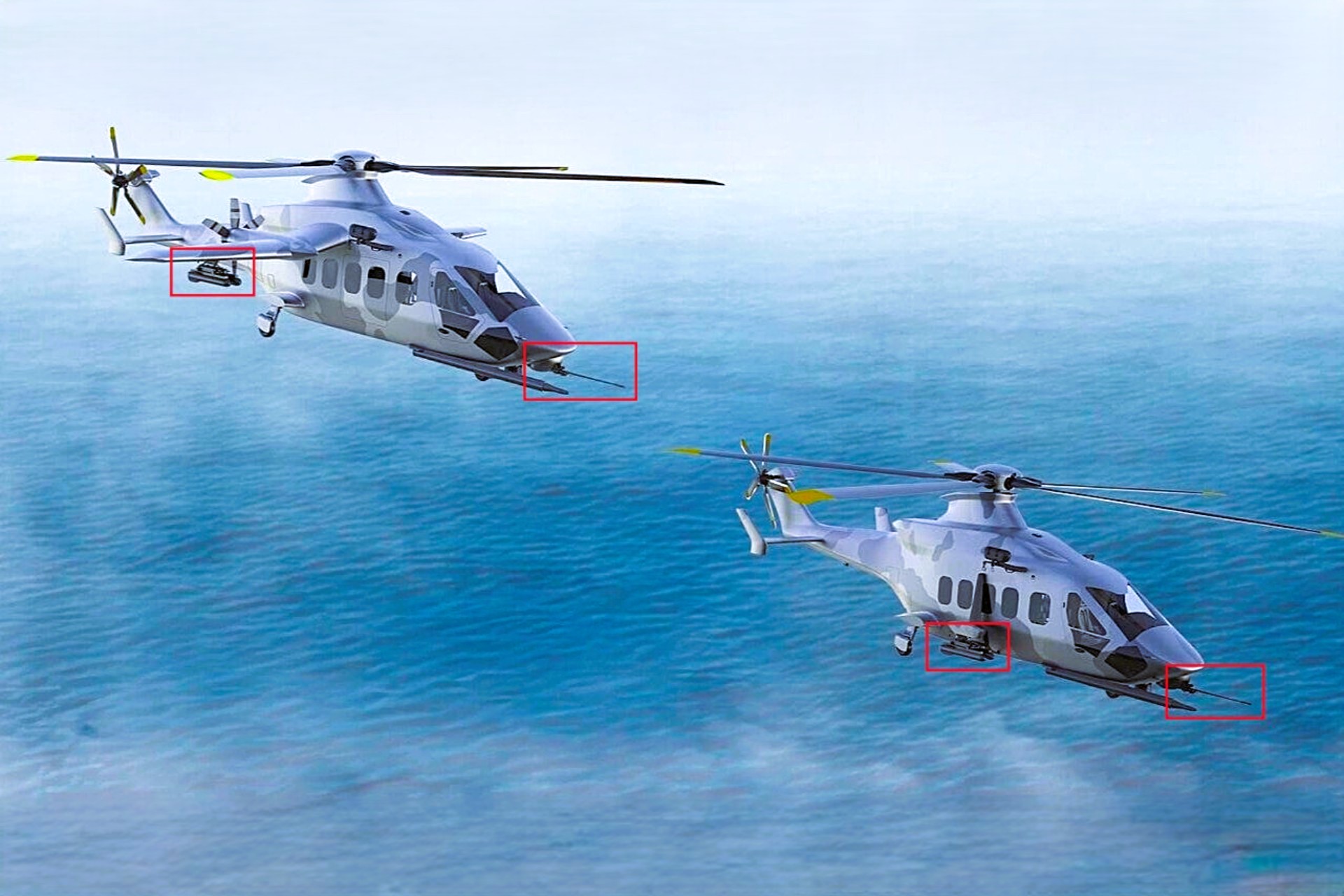
The first aircraft is a conventional helicopter design focused on efficiency, survivability and ease of integration into existing fleets. Digital renderings show a streamlined fuselage with faceted cockpit glazing, a five-blade main rotor and an enclosed fenestron tail rotor blended into the vertical stabiliser, a configuration associated with low acoustic signature and enhanced safety in confined areas. The airframe is depicted in a low-visibility grey finish suited to maritime or expeditionary operations. Beneath the fuselage, multiple hardpoints can host rocket pods, guided munitions or external fuel tanks, while a dedicated nose weapon station accommodates a forward-firing gun or cannon. An electro-optical/infrared sensor turret under the forward section provides day/night surveillance and targeting. Together, these features point to a multi-role platform able to conduct armed reconnaissance, close air support, over-water protection and special operations insertion while retaining the hover performance and agility of a classic helicopter.
The second design is a high-speed compound rotorcraft concept that builds directly on Airbus’ experimental Racer and earlier X3 demonstrator experience in compound configurations. Retaining a main rotor for vertical lift, the aircraft adds short wings projecting from the fuselage, providing extra lift in forward flight and hosting several underwing pylons for weapons or mission equipment. The concept also incorporates additional propulsion for forward thrust, enabling significantly higher cruise speeds and rapid dash profiles compared to today’s medium-lift helicopters. Airbus notes that compound configurations validated on Racer give access to a much wider flight envelope, with faster climb and descent, rapid acceleration and deceleration, and improved manoeuvrability at low altitude. Like the conventional variant, the high-speed design includes a nose weapon station and provision for guided munitions, suggesting a platform that can carry out deep penetration, time-sensitive strike and long-range escort missions while remaining capable of vertical insertion and extraction.
Beyond airframe shapes, Airbus emphasises a common digital backbone based on a Modular Open Systems Architecture, enabling both aircraft to share avionics, mission systems, weapons, training tools and even elements of their support infrastructure. This approach is meant to simplify upgrades across the fleet, from integrating new effectors from MBDA to adding sensors, electronic warfare suites or advanced navigation and communication systems developed with Collins Aerospace and Raytheon. It also reflects a broader shift in the company’s military helicopter portfolio, which includes the evolution path for the NH90 and the dual-use platforms H145M, H160M and H225M. Lessons from these helicopters, including connectivity, maintainability and high availability rates, are being folded into the NGRC designs from the outset.
The two concepts answer different but complementary operational needs identified by NATO nations. The conventional helicopter offers a relatively low-risk, flexible solution for missions where endurance, hover performance, shipboard operations and high-frequency tasking are paramount: maritime security, amphibious assault support, casualty evacuation, logistics, urban operations and special forces tasks. The compound rotorcraft, by contrast, targets scenarios where speed, range and survivability in high-threat environments are decisive, such as long-range infiltration, deep fires coordination, or rapid reaction against mobile targets. In both cases, Airbus’ design philosophy integrates connectivity, cybersecurity, crewed-uncrewed teaming, multi-domain collaborative combat, survivability and rapid battle damage repair as baseline attributes rather than later add-ons.
The NGRC concepts sit at the crossroads of NATO’s capability planning and Europe’s industrial ambitions. The Airbus-led study brings together partners and participating nations including Germany, the United Kingdom, the United States, Ireland and Italy, each contributing expertise in platform design, systems integration, effectors and sensors. For European allies, a mature Airbus solution could support defence industrial sovereignty in a domain where the US Future Vertical Lift initiative is already shaping future helicopter fleets. At the same time, NGRC is conceived as a fully interoperable NATO capability, able to plug into allied command-and-control networks and operate alongside US-developed platforms in combined operations, from the High North to the Black Sea and Indo-Pacific deployments.
Looking ahead, the concepts unveiled in Marignane are not production-ready aircraft but rather reference designs that will feed into ongoing NATO studies, with NGRC nations expecting to converge on requirements for a new medium-lift rotorcraft family aimed at the 2035–2040 timeframe. Airbus’ choice to field two complementary configurations under a single, modular umbrella offers participating countries options in terms of performance and risk while preserving commonality. As the NSPA consolidates study results from Airbus, Leonardo and Lockheed Martin’s Sikorsky business, the way in which allies prioritise speed, range, survivability, affordability and industrial return will determine which concepts move forward into development. Whatever the final configuration, the Marignane designs confirm that the next generation of NATO rotorcraft will be more connected, more flexible and more tightly integrated into multi-domain operations than any helicopter fleet the Alliance has fielded to date.
Written by Teoman S. Nicanci – Defense Analyst, Army Recognition Group
Teoman S. Nicanci holds degrees in Political Science, Comparative and International Politics, and International Relations and Diplomacy from leading Belgian universities, with research focused on Russian strategic behavior, defense technology, and modern warfare. He is a defense analyst at Army Recognition, specializing in the global defense industry, military armament, and emerging defense technologies.
{loadposition bannertop}
{loadposition sidebarpub}
Airbus Helicopters on 23 February 2026 in Marignane, France, revealed two next-generation military rotorcraft concepts for NATO’s Next Generation Rotorcraft Capability programme. The designs signal Europe’s industrial push to shape NATO’s post-2035 medium multi-role fleet for contested, long-range operations while managing acquisition and lifecycle costs.
On 23 February 2026 in Marignane, France, Airbus Helicopters unveiled two next-generation military rotorcraft concepts designed for the NATO Next Generation Rotorcraft Capability (NGRC) programme. According to the company, the concepts are intended to meet future medium multi-role requirements while keeping acquisition and lifecycle costs under control. In a context where allied forces are preparing for more contested airspace, long-range operations and high-tempo deployments, the launch of these designs gives the first concrete glimpse of what NATO’s post-2035 helicopter fleet could look like. The announcement also marks a visible milestone in the NGRC studies launched under the NATO Support and Procurement Agency.
Airbus Helicopters unveiled two next-generation military rotorcraft concepts in France for NATO’s NGRC programme, outlining a potential post-2035 medium helicopter replacement focused on contested airspace performance and lifecycle cost control (Picture Source: Airbus)
At the heart of the proposal is a dual-track approach that combines a high-performance conventional helicopter with a high-speed compound rotorcraft, both conceived as part of a single, modular family. Airbus’ NGRC work is being carried out with RTX businesses Collins Aerospace and Raytheon, together with missile house MBDA, under a 13-month concept study contract awarded by the NATO Support and Procurement Agency in July 2024. The industrial team is tasked with proposing integrated platform concepts that can be tailored to multiple NATO nations while maintaining maximum commonality in systems, training and support. This dual-concept architecture is designed to give defence ministries a choice between a more traditional platform and a higher-speed option, without fragmenting logistics chains or training pipelines.
The first aircraft is a conventional helicopter design focused on efficiency, survivability and ease of integration into existing fleets. Digital renderings show a streamlined fuselage with faceted cockpit glazing, a five-blade main rotor and an enclosed fenestron tail rotor blended into the vertical stabiliser, a configuration associated with low acoustic signature and enhanced safety in confined areas. The airframe is depicted in a low-visibility grey finish suited to maritime or expeditionary operations. Beneath the fuselage, multiple hardpoints can host rocket pods, guided munitions or external fuel tanks, while a dedicated nose weapon station accommodates a forward-firing gun or cannon. An electro-optical/infrared sensor turret under the forward section provides day/night surveillance and targeting. Together, these features point to a multi-role platform able to conduct armed reconnaissance, close air support, over-water protection and special operations insertion while retaining the hover performance and agility of a classic helicopter.
The second design is a high-speed compound rotorcraft concept that builds directly on Airbus’ experimental Racer and earlier X3 demonstrator experience in compound configurations. Retaining a main rotor for vertical lift, the aircraft adds short wings projecting from the fuselage, providing extra lift in forward flight and hosting several underwing pylons for weapons or mission equipment. The concept also incorporates additional propulsion for forward thrust, enabling significantly higher cruise speeds and rapid dash profiles compared to today’s medium-lift helicopters. Airbus notes that compound configurations validated on Racer give access to a much wider flight envelope, with faster climb and descent, rapid acceleration and deceleration, and improved manoeuvrability at low altitude. Like the conventional variant, the high-speed design includes a nose weapon station and provision for guided munitions, suggesting a platform that can carry out deep penetration, time-sensitive strike and long-range escort missions while remaining capable of vertical insertion and extraction.
Beyond airframe shapes, Airbus emphasises a common digital backbone based on a Modular Open Systems Architecture, enabling both aircraft to share avionics, mission systems, weapons, training tools and even elements of their support infrastructure. This approach is meant to simplify upgrades across the fleet, from integrating new effectors from MBDA to adding sensors, electronic warfare suites or advanced navigation and communication systems developed with Collins Aerospace and Raytheon. It also reflects a broader shift in the company’s military helicopter portfolio, which includes the evolution path for the NH90 and the dual-use platforms H145M, H160M and H225M. Lessons from these helicopters, including connectivity, maintainability and high availability rates, are being folded into the NGRC designs from the outset.
The two concepts answer different but complementary operational needs identified by NATO nations. The conventional helicopter offers a relatively low-risk, flexible solution for missions where endurance, hover performance, shipboard operations and high-frequency tasking are paramount: maritime security, amphibious assault support, casualty evacuation, logistics, urban operations and special forces tasks. The compound rotorcraft, by contrast, targets scenarios where speed, range and survivability in high-threat environments are decisive, such as long-range infiltration, deep fires coordination, or rapid reaction against mobile targets. In both cases, Airbus’ design philosophy integrates connectivity, cybersecurity, crewed-uncrewed teaming, multi-domain collaborative combat, survivability and rapid battle damage repair as baseline attributes rather than later add-ons.
The NGRC concepts sit at the crossroads of NATO’s capability planning and Europe’s industrial ambitions. The Airbus-led study brings together partners and participating nations including Germany, the United Kingdom, the United States, Ireland and Italy, each contributing expertise in platform design, systems integration, effectors and sensors. For European allies, a mature Airbus solution could support defence industrial sovereignty in a domain where the US Future Vertical Lift initiative is already shaping future helicopter fleets. At the same time, NGRC is conceived as a fully interoperable NATO capability, able to plug into allied command-and-control networks and operate alongside US-developed platforms in combined operations, from the High North to the Black Sea and Indo-Pacific deployments.
Looking ahead, the concepts unveiled in Marignane are not production-ready aircraft but rather reference designs that will feed into ongoing NATO studies, with NGRC nations expecting to converge on requirements for a new medium-lift rotorcraft family aimed at the 2035–2040 timeframe. Airbus’ choice to field two complementary configurations under a single, modular umbrella offers participating countries options in terms of performance and risk while preserving commonality. As the NSPA consolidates study results from Airbus, Leonardo and Lockheed Martin’s Sikorsky business, the way in which allies prioritise speed, range, survivability, affordability and industrial return will determine which concepts move forward into development. Whatever the final configuration, the Marignane designs confirm that the next generation of NATO rotorcraft will be more connected, more flexible and more tightly integrated into multi-domain operations than any helicopter fleet the Alliance has fielded to date.
Written by Teoman S. Nicanci – Defense Analyst, Army Recognition Group
Teoman S. Nicanci holds degrees in Political Science, Comparative and International Politics, and International Relations and Diplomacy from leading Belgian universities, with research focused on Russian strategic behavior, defense technology, and modern warfare. He is a defense analyst at Army Recognition, specializing in the global defense industry, military armament, and emerging defense technologies.