U.S. deploys B-2 stealth bombers to strike Iran’s ballistic missile sites in Operation Epic Fury
{loadposition bannertop}
{loadposition sidebarpub}
On March 1, 2026, several US B-2 Spirit stealth bombers flew directly from the United States to Iran during Operation Epic Fury to strike hardened ballistic missile facilities using 2,000 lb Mk-84 and GBU-31 bombs.
On March 1, 2026, several US B-2 Spirit stealth bombers flew from the continental United States to Iran during Operation Epic Fury, and struck hardened ballistic missile facilities at night using 2,000 lb class bombs such as Mk-84s and GBU-31s as part of a coordinated campaign targeting more than 1,000 sites in the first 24 hours. The opening phase targeted air defense systems, command nodes, missile storage sites, and drone facilities, while Iranian forces launched retaliatory missiles and drones across the region.Follow Army Recognition on Google News at this link
Within the Operation Epic Fury, B-2 stealth bombers were used for strikes against Iran’s hardened ballistic missile facilities requiring high-mass precision weapons. (Picture source: US CENTCOM)
The U.S. Central Command confirmed that the B-2 bombers were armed with 2,000 lb bombs (Mk-84 and GBU-31) and conducted the strikes at night against hardened sites during the opening phase of Operation Epic Fury, a coordinated U.S. military campaign conducted alongside Israel’s Operation Roaring Lion, with synchronized air and maritime strikes against Iranian military infrastructure. The first 48 hours included long-range bomber sorties from the continental United States, cruise missile launches from surface combatants, and fighter aircraft tasked with suppression of air defenses. More than 1,000 targets were struck during the opening phase, including missile storage areas, radar installations, drone facilities, naval sites, and command and control nodes. The campaign incorporated electronic warfare support and aerial refueling to sustain long-duration missions. Iranian air defenses and retaliatory missile launches generated sustained interception activity across the region.
The Northrop B-2 Spirit originated from the Advanced Technology Bomber program launched in 1979 to develop a long-range strategic aircraft capable of penetrating advanced air defense systems. Northrop was selected as prime contractor in October 1981, and full-scale development proceeded under a classified framework during the 1980s. The first public rollout occurred in November 1988, followed by the maiden flight on July 17, 1989. Production ran from 1989 to 2000, resulting in 21 aircraft built at an average program cost exceeding $2 billion per unit when development, procurement, and support were included. The aircraft entered operational service on January 1, 1997, with the U.S. Air Force. Originally conceived for nuclear strike missions during the Cold War, its role expanded after 1991 to include conventional precision attack. To date, nineteen B-2s remain in active service with the U.S. Air Force Global Strike Command, with retirement planned by 2032 as the B-21 Raider enters service.
The B-2 features a flying-wing configuration without a vertical tail, reducing radar cross-section through shaping and composite materials. It has a wingspan of 52.4 m, a length of 21.0 m, and a height of 5.18 m. The wing area measures 478 m², and maximum takeoff weight reaches 170,600 kg, with an empty weight of about 71,700 kg. Internal fuel capacity is approximately 75,750 kg, supporting an unrefueled range of more than 11,000 km and extended global missions with aerial refueling. The aircraft is powered by four General Electric F118-GE-100 turbofan engines, each producing 77 kN of thrust, enabling a cruise speed of about 900 km/h at 12,000 m altitude and operations up to a service ceiling of 15,200 m. The B-2 carries up to 40,000 lb (18,000 kg) of ordnance in two internal bomb bays using rotary launchers or bomb rack assemblies, maintaining a reduced radar signature by avoiding external pylons. The crew consists of two personnel seated side by side, supported by a quadruplex digital fly-by-wire control system that stabilizes the inherently unstable flying-wing configuration.
Operationally, the B-2 first saw combat in 1999 during the Kosovo War, conducting long-range sorties from Whiteman Air Force Base, Missouri, to strike targets in the Balkans and delivering GPS-guided bombs. It subsequently participated in operations in Afghanistan beginning in 2001, in Iraq in 2003, and later in Libya in 2011, often flying missions exceeding 30 hours from the continental United States with multiple aerial refuelings. For instance, on January 18, 2017, two B-2s conducted 33-hour round-trip missions from the United States to Libya and dropped 108 precision-guided bombs against a training camp near Sirte. The Spirit has also been deployed to forward operating locations such as Andersen Air Force Base in Guam and RAF Fairford in the United Kingdom to support regional contingencies. Across its operational history, the B-2 has been used primarily for deep-penetration strike missions against defended and high-value targets requiring precision and heavy payload delivery.
The Mark 84 bomb is the heaviest standard member of the Mark 80 series of low-drag general-purpose bombs, with an overall length of 12 ft 0 in (3.84 m), a body diameter of 18 in (457 mm), and a typical total weight of 1,980 to 2,040 lb depending on fuze and configuration. The bomb contains approximately 945 lb (429 kg) of high explosive, commonly Tritonal, within a forged steel casing designed to maximize fragmentation and blast overpressure. The Mk-84 can be fitted with nose and tail fuze combinations supporting instantaneous, delayed, or proximity detonation. When released from high altitude in a low-drag configuration, ballistic range depends on release parameters, with delivery profiles optimized for medium to high-altitude strike aircraft. Within the B-2, up to 16× 2,000 lb class bombs such as the Mk-84 can be mounted on Rotary Launcher Assemblies inside the internal bomb bays, maintaining reduced radar exposure until release.
When equipped with a Joint Direct Attack Munition (JDAM) guidance kit, the Mark 84 becomes the GBU-31 through the addition of a tail section containing guidance electronics and aerodynamic control surfaces. The JDAM kit integrates an inertial navigation system and a GPS receiver operating on military-coded signals, providing a published range of up to 15 nautical miles (28 km) depending on release altitude and aircraft speed. Accuracy with GPS support is typically within 13 m circular error probable, while inertial-only guidance maintains accuracy within 30 m CEP for limited time periods if satellite signals are unavailable. The guidance section includes movable tail fins for trajectory correction and a strake kit to improve lift and glide efficiency. The total weight of a GBU-31 configured with a Mk-84 body remains in the 2,000 lb class, with overall dimensions similar to the base bomb plus the extended tail assembly. The system entered service in 1999 and has been employed across multiple theaters for fixed-target precision strike missions requiring a heavy explosive payload.
Written by Jérôme Brahy
Jérôme Brahy is a defense analyst and documentalist at Army Recognition. He specializes in naval modernization, aviation, drones, armored vehicles, and artillery, with a focus on strategic developments in the United States, China, Ukraine, Russia, Türkiye, and Belgium. His analyses go beyond the facts, providing context, identifying key actors, and explaining why defense news matters on a global scale.
{loadposition bannertop}
{loadposition sidebarpub}
On March 1, 2026, several US B-2 Spirit stealth bombers flew directly from the United States to Iran during Operation Epic Fury to strike hardened ballistic missile facilities using 2,000 lb Mk-84 and GBU-31 bombs.
On March 1, 2026, several US B-2 Spirit stealth bombers flew from the continental United States to Iran during Operation Epic Fury, and struck hardened ballistic missile facilities at night using 2,000 lb class bombs such as Mk-84s and GBU-31s as part of a coordinated campaign targeting more than 1,000 sites in the first 24 hours. The opening phase targeted air defense systems, command nodes, missile storage sites, and drone facilities, while Iranian forces launched retaliatory missiles and drones across the region.
Follow Army Recognition on Google News at this link
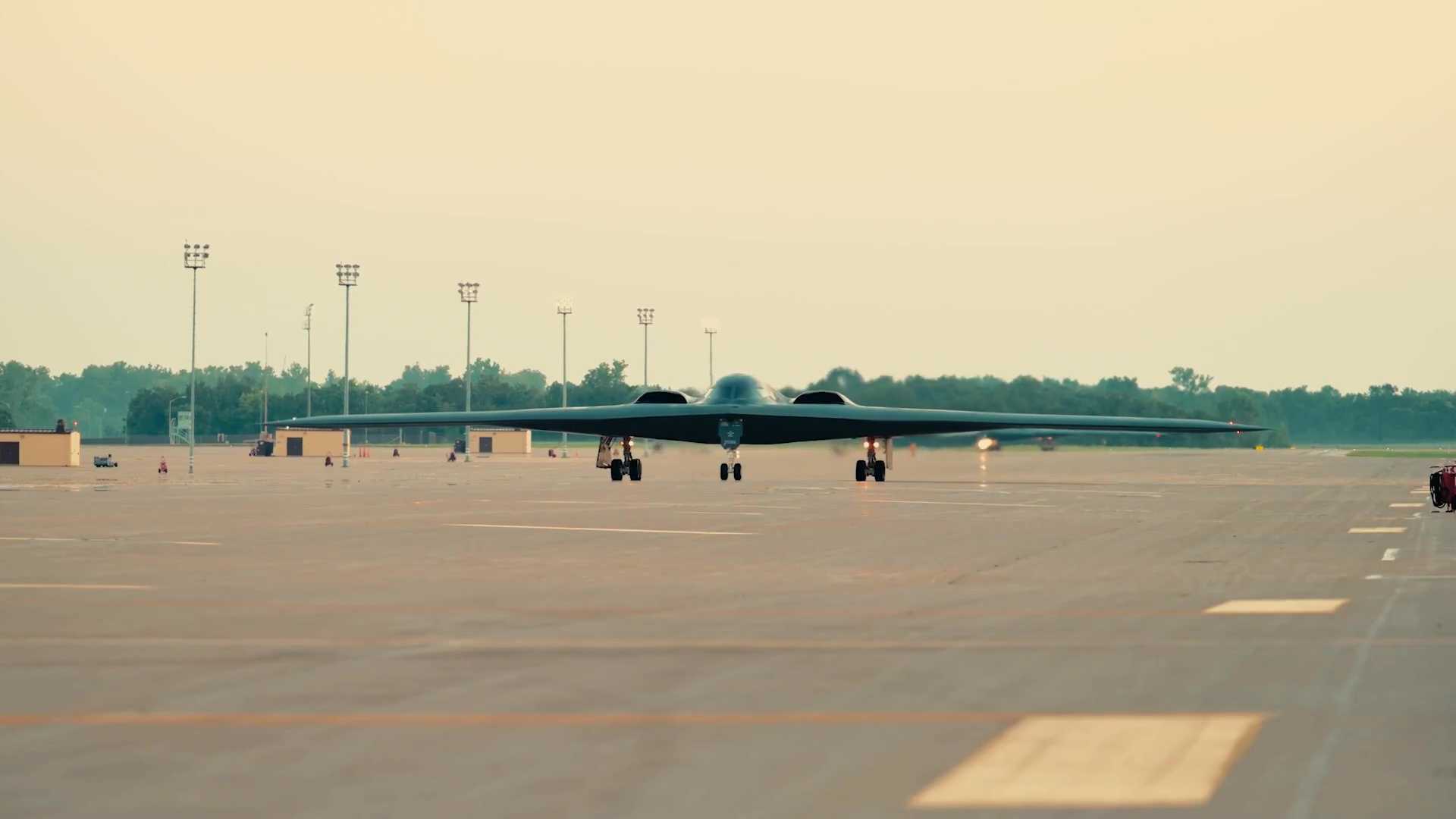
Within the Operation Epic Fury, B-2 stealth bombers were used for strikes against Iran’s hardened ballistic missile facilities requiring high-mass precision weapons. (Picture source: US CENTCOM)
The U.S. Central Command confirmed that the B-2 bombers were armed with 2,000 lb bombs (Mk-84 and GBU-31) and conducted the strikes at night against hardened sites during the opening phase of Operation Epic Fury, a coordinated U.S. military campaign conducted alongside Israel’s Operation Roaring Lion, with synchronized air and maritime strikes against Iranian military infrastructure. The first 48 hours included long-range bomber sorties from the continental United States, cruise missile launches from surface combatants, and fighter aircraft tasked with suppression of air defenses. More than 1,000 targets were struck during the opening phase, including missile storage areas, radar installations, drone facilities, naval sites, and command and control nodes. The campaign incorporated electronic warfare support and aerial refueling to sustain long-duration missions. Iranian air defenses and retaliatory missile launches generated sustained interception activity across the region.
The Northrop B-2 Spirit originated from the Advanced Technology Bomber program launched in 1979 to develop a long-range strategic aircraft capable of penetrating advanced air defense systems. Northrop was selected as prime contractor in October 1981, and full-scale development proceeded under a classified framework during the 1980s. The first public rollout occurred in November 1988, followed by the maiden flight on July 17, 1989. Production ran from 1989 to 2000, resulting in 21 aircraft built at an average program cost exceeding $2 billion per unit when development, procurement, and support were included. The aircraft entered operational service on January 1, 1997, with the U.S. Air Force. Originally conceived for nuclear strike missions during the Cold War, its role expanded after 1991 to include conventional precision attack. To date, nineteen B-2s remain in active service with the U.S. Air Force Global Strike Command, with retirement planned by 2032 as the B-21 Raider enters service.
The B-2 features a flying-wing configuration without a vertical tail, reducing radar cross-section through shaping and composite materials. It has a wingspan of 52.4 m, a length of 21.0 m, and a height of 5.18 m. The wing area measures 478 m², and maximum takeoff weight reaches 170,600 kg, with an empty weight of about 71,700 kg. Internal fuel capacity is approximately 75,750 kg, supporting an unrefueled range of more than 11,000 km and extended global missions with aerial refueling. The aircraft is powered by four General Electric F118-GE-100 turbofan engines, each producing 77 kN of thrust, enabling a cruise speed of about 900 km/h at 12,000 m altitude and operations up to a service ceiling of 15,200 m. The B-2 carries up to 40,000 lb (18,000 kg) of ordnance in two internal bomb bays using rotary launchers or bomb rack assemblies, maintaining a reduced radar signature by avoiding external pylons. The crew consists of two personnel seated side by side, supported by a quadruplex digital fly-by-wire control system that stabilizes the inherently unstable flying-wing configuration.
Operationally, the B-2 first saw combat in 1999 during the Kosovo War, conducting long-range sorties from Whiteman Air Force Base, Missouri, to strike targets in the Balkans and delivering GPS-guided bombs. It subsequently participated in operations in Afghanistan beginning in 2001, in Iraq in 2003, and later in Libya in 2011, often flying missions exceeding 30 hours from the continental United States with multiple aerial refuelings. For instance, on January 18, 2017, two B-2s conducted 33-hour round-trip missions from the United States to Libya and dropped 108 precision-guided bombs against a training camp near Sirte. The Spirit has also been deployed to forward operating locations such as Andersen Air Force Base in Guam and RAF Fairford in the United Kingdom to support regional contingencies. Across its operational history, the B-2 has been used primarily for deep-penetration strike missions against defended and high-value targets requiring precision and heavy payload delivery.
The Mark 84 bomb is the heaviest standard member of the Mark 80 series of low-drag general-purpose bombs, with an overall length of 12 ft 0 in (3.84 m), a body diameter of 18 in (457 mm), and a typical total weight of 1,980 to 2,040 lb depending on fuze and configuration. The bomb contains approximately 945 lb (429 kg) of high explosive, commonly Tritonal, within a forged steel casing designed to maximize fragmentation and blast overpressure. The Mk-84 can be fitted with nose and tail fuze combinations supporting instantaneous, delayed, or proximity detonation. When released from high altitude in a low-drag configuration, ballistic range depends on release parameters, with delivery profiles optimized for medium to high-altitude strike aircraft. Within the B-2, up to 16× 2,000 lb class bombs such as the Mk-84 can be mounted on Rotary Launcher Assemblies inside the internal bomb bays, maintaining reduced radar exposure until release.
When equipped with a Joint Direct Attack Munition (JDAM) guidance kit, the Mark 84 becomes the GBU-31 through the addition of a tail section containing guidance electronics and aerodynamic control surfaces. The JDAM kit integrates an inertial navigation system and a GPS receiver operating on military-coded signals, providing a published range of up to 15 nautical miles (28 km) depending on release altitude and aircraft speed. Accuracy with GPS support is typically within 13 m circular error probable, while inertial-only guidance maintains accuracy within 30 m CEP for limited time periods if satellite signals are unavailable. The guidance section includes movable tail fins for trajectory correction and a strake kit to improve lift and glide efficiency. The total weight of a GBU-31 configured with a Mk-84 body remains in the 2,000 lb class, with overall dimensions similar to the base bomb plus the extended tail assembly. The system entered service in 1999 and has been employed across multiple theaters for fixed-target precision strike missions requiring a heavy explosive payload.
Written by Jérôme Brahy
Jérôme Brahy is a defense analyst and documentalist at Army Recognition. He specializes in naval modernization, aviation, drones, armored vehicles, and artillery, with a focus on strategic developments in the United States, China, Ukraine, Russia, Türkiye, and Belgium. His analyses go beyond the facts, providing context, identifying key actors, and explaining why defense news matters on a global scale.