F-35 Fighter Records First Air-to-Air Kill in History as Israeli F-35I Downs Iranian Yak-130 Jet
{loadposition bannertop}
{loadposition sidebarpub}
Israel reports that an Israeli Air Force F-35I “Adir” shot down an Iranian Yak-130 aircraft over Tehran during ongoing strike operations, though Iranian confirmation has not yet emerged publicly. If verified, the incident would represent the first known F-35 air-to-air kill against a manned aircraft and highlight the operational advantage of fifth-generation stealth fighters.
An Israeli Air Force F-35I “Adir” is reported to have shot down an Iranian Air Force Yakovlev Yak-130 over Tehran, a tactical event that, if confirmed, highlights Israel’s ability to project survivable airpower deep into contested airspace and sustain localized air superiority even under the shadow of Iranian air defenses. This engagement marks the first time in history that an F-35 fighter has shot down another manned jet in air-to-air combat. Israeli military statements carried by Israeli and international outlets describe the engagement as an air-to-air kill executed over the Iranian capital amid an expanding strike campaign, suggesting that Israeli fighters are not only striking fixed targets but also actively denying Iran the ability to generate meaningful defensive sorties. Iranian confirmation has not emerged publicly at the time of writing, leaving key details such as timing, weapon type, and engagement geometry unverified.Follow Army Recognition on Google News at this link
An Israeli Air Force F-35I “Adir” reportedly shot down an Iranian Yak-130 over Tehran, marking what Israel describes as the first confirmed F-35 kill against a manned fighter and highlighting the stealth jet’s sensor-fusion and beyond-visual-range dominance over a subsonic trainer-light attack aircraft operating in contested airspace (Picture source: Israeli MoD).
The Israeli Air Force also framed the engagement as a watershed: “the first shootdown in history of a manned fighter aircraft by an F-35 ‘Adir’ fighter jet.” In practical terms, that wording matters for two reasons. First, many F-35 combat actions to date have involved strike missions, intelligence collection, and engagements against unmanned threats; Israel previously acknowledged aerial engagements in which its F-35Is destroyed Iranian drones, a milestone widely assessed as the first confirmed airborne kill for any F-35 operator. Second, downing a manned, jet-powered aircraft introduces a different operational benchmark because it implies the complete air-to-air kill chain was executed against a piloted platform that can maneuver, employ countermeasures, and attempt to fight back.
Operational context is central to interpreting this incident. Reporting on the broader crisis indicates Israel has conducted multiple waves of strikes in and around Tehran and across Iran, pointing to a campaign logic consistent with classic suppression and destruction of enemy air defenses followed by repeated precision strikes against time-sensitive targets. In such a setting, even a modest Iranian sortie becomes tactically significant: Iran must either hold aircraft at risk on the ground, or attempt limited airborne defense with whatever assets can be generated and sustained under pressure. Iran’s Yak-130 fleet was acquired from Russia only recently, with deliveries reported from 2023 onward, and was publicly presented as a step to improve training and limited combat capacity.
The reported engagement pairs two aircraft designed for fundamentally different purposes. The F-35I “Adir” is Israel’s customized variant of the F-35A, a fifth-generation, low-observable multirole fighter optimized for penetrating strike, electronic warfare support, and networked targeting, while retaining a credible air-to-air capability. The baseline F-35A’s performance envelope includes Mach 1.6 class speed, a ceiling above 50,000 ft, and a combat radius above 590 nautical miles on internal fuel in a typical operational profile. Its combat advantage is not raw kinematics alone, but the fusion of sensors and data into a single tactical picture: the AN/APG-81 AESA radar provides long-range air-to-air and air-to-ground modes alongside electronic attack and ISR functions, while the electro-optical targeting system enables passive tracking and precision strike. The Distributed Aperture System contributes spherical infrared coverage to support missile warning, passive aircraft detection, and helmet-displayed imagery, strengthening survivability and first-detect potential in cluttered air defense environments.
Israel’s “Adir” configuration layers national requirements onto that baseline. Israel’s long-running objective has been mission autonomy: the ability to adapt electronic warfare suites, mission software, and weapons integration to regional threats without being constrained by external release cycles. Israeli industry has contributed components and modifications to the F-35 ecosystem, including elements associated with helmet-mounted display technologies and Israeli-specific integration pathways. This approach allows the Israeli Air Force to rapidly update threat libraries, electronic countermeasures, and mission data files, an advantage that becomes decisive in environments where radar detection, emissions management, and electronic attack define the tempo of aerial combat.
The Yak-130 sits at the opposite end of the capability spectrum. Developed as an advanced lead-in fighter trainer following the collapse of the Soviet Union, the Yak-130 was designed to prepare pilots for modern combat aircraft by emulating handling characteristics through a digital fly-by-wire system and embedded simulation architecture. The aircraft originated from early 1990s requirements and initially involved cooperation with Italy’s Aermacchi before the partnership split, leading to separate aircraft designs. The Yak-130 ultimately entered Russian service as a trainer capable of performing limited light attack missions.
In terms of performance, the Yak-130 is a subsonic aircraft with a top speed of roughly Mach 0.93 and a service ceiling of around 12,500 meters. Powered by two AI-222-25 turbofan engines, the aircraft features nine external hardpoints capable of carrying approximately 3,000 kilograms of ordnance, including guided bombs, rockets, and short-range air-to-air missiles. While the aircraft incorporates modern cockpit displays and a flexible avionics architecture designed to simulate different fighter flight profiles, it lacks the low-observable shaping, sensor fusion, and integrated electronic warfare systems associated with fifth-generation combat aircraft. In operational terms, the Yak-130’s combat role is closer to light attack or advanced training support rather than dedicated air superiority.
From a tactical standpoint, the reported outcome is consistent with a mismatch in “first look, first shot, first kill” dynamics. Against a conventional airframe like the Yak-130, the F-35’s low observable profile reduces detection ranges for legacy or modest fighter radars, while the F-35’s own sensors can search actively or passively, correlate tracks, and cue weapons from advantageous geometry. The APG-81 radar, combined with electro-optical sensors, allows the aircraft to track targets while minimizing its own emissions, preserving the element of surprise. In such a scenario, the Yak-130 pilot may receive little warning before a beyond-visual-range missile engagement occurs.
The procurement histories behind both jets also shape how this engagement should be interpreted. Israel’s path to the F-35 began with early participation in the multinational Joint Strike Fighter program, culminating in a landmark agreement in 2010 for the acquisition of its first batch of aircraft. Over time, Israel expanded its planned fleet, positioning the F-35I as a central pillar of Israeli airpower and deep-strike doctrine. The aircraft now serves as a cornerstone of Israel’s strategy for penetrating heavily defended airspace and conducting precision operations against strategic targets.
For Iran, the Yak-130 acquisition represents a more limited modernization step intended primarily to rebuild pilot training capacity after decades of sanctions and aging aircraft fleets. The aircraft provides a modern training environment capable of preparing pilots for more advanced fighters that Iran may seek to acquire in the future, while offering modest combat capability in secondary roles. However, in a confrontation with a stealth-enabled fifth-generation aircraft such as the F-35I, the platform’s design limitations become evident.
If the shootdown is corroborated independently, it will likely influence both regional and broader force-design debates. Regionally, it reinforces the operational reality that survivable aircraft are not simply platforms but nodes in a larger kill web, where stealth, electronic warfare, and networked sensing compress decision cycles and deny opponents the opportunity to engage on equal terms. Beyond the Middle East, a confirmed manned air-to-air kill by an F-35 variant would become a significant milestone in the operational history of fifth-generation combat aviation, demonstrating in real combat conditions how sensor dominance and low observability translate into decisive tactical advantage.
{loadposition bannertop}
{loadposition sidebarpub}
Israel reports that an Israeli Air Force F-35I “Adir” shot down an Iranian Yak-130 aircraft over Tehran during ongoing strike operations, though Iranian confirmation has not yet emerged publicly. If verified, the incident would represent the first known F-35 air-to-air kill against a manned aircraft and highlight the operational advantage of fifth-generation stealth fighters.
An Israeli Air Force F-35I “Adir” is reported to have shot down an Iranian Air Force Yakovlev Yak-130 over Tehran, a tactical event that, if confirmed, highlights Israel’s ability to project survivable airpower deep into contested airspace and sustain localized air superiority even under the shadow of Iranian air defenses. This engagement marks the first time in history that an F-35 fighter has shot down another manned jet in air-to-air combat. Israeli military statements carried by Israeli and international outlets describe the engagement as an air-to-air kill executed over the Iranian capital amid an expanding strike campaign, suggesting that Israeli fighters are not only striking fixed targets but also actively denying Iran the ability to generate meaningful defensive sorties. Iranian confirmation has not emerged publicly at the time of writing, leaving key details such as timing, weapon type, and engagement geometry unverified.
Follow Army Recognition on Google News at this link
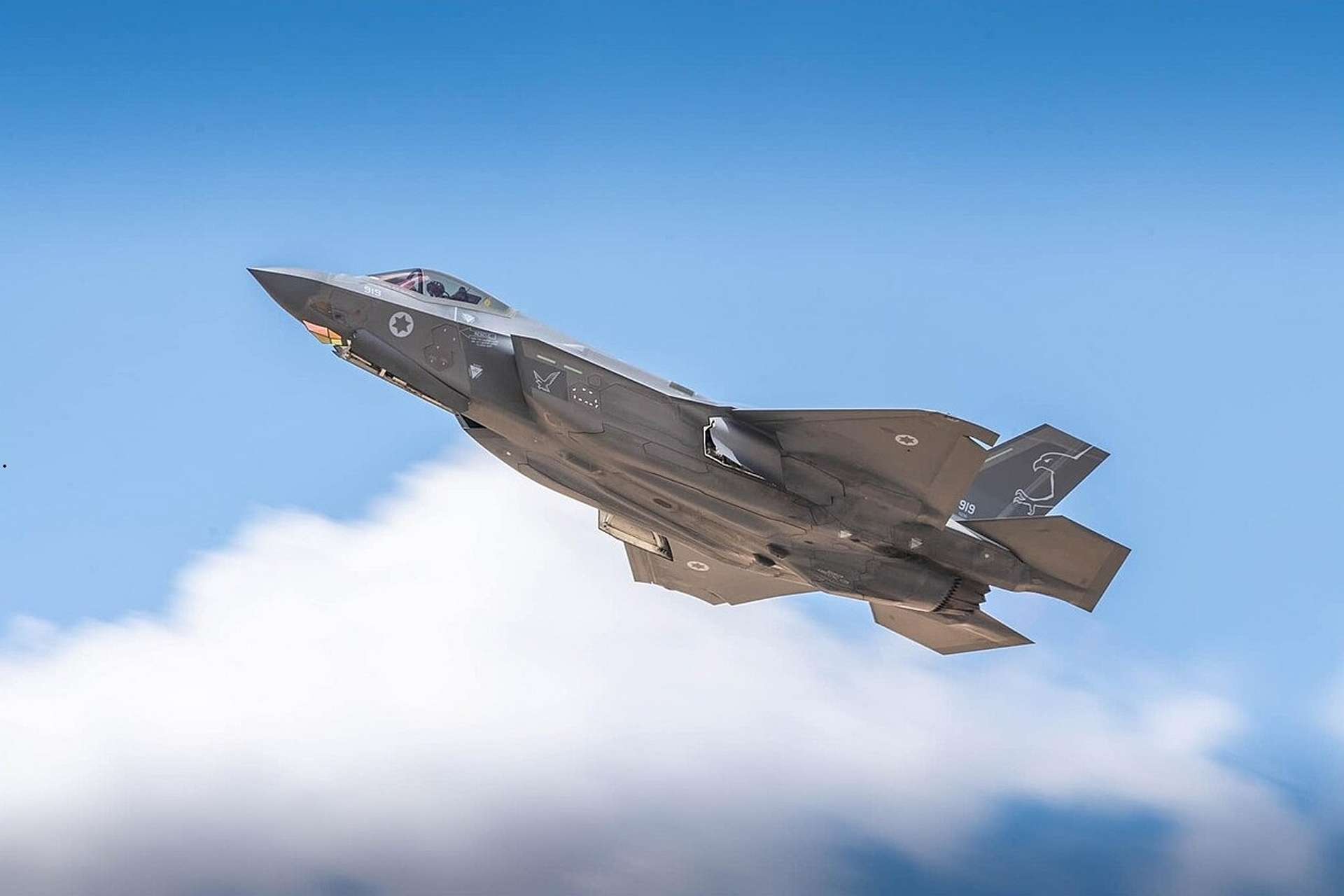
An Israeli Air Force F-35I “Adir” reportedly shot down an Iranian Yak-130 over Tehran, marking what Israel describes as the first confirmed F-35 kill against a manned fighter and highlighting the stealth jet’s sensor-fusion and beyond-visual-range dominance over a subsonic trainer-light attack aircraft operating in contested airspace (Picture source: Israeli MoD).
The Israeli Air Force also framed the engagement as a watershed: “the first shootdown in history of a manned fighter aircraft by an F-35 ‘Adir’ fighter jet.” In practical terms, that wording matters for two reasons. First, many F-35 combat actions to date have involved strike missions, intelligence collection, and engagements against unmanned threats; Israel previously acknowledged aerial engagements in which its F-35Is destroyed Iranian drones, a milestone widely assessed as the first confirmed airborne kill for any F-35 operator. Second, downing a manned, jet-powered aircraft introduces a different operational benchmark because it implies the complete air-to-air kill chain was executed against a piloted platform that can maneuver, employ countermeasures, and attempt to fight back.
Operational context is central to interpreting this incident. Reporting on the broader crisis indicates Israel has conducted multiple waves of strikes in and around Tehran and across Iran, pointing to a campaign logic consistent with classic suppression and destruction of enemy air defenses followed by repeated precision strikes against time-sensitive targets. In such a setting, even a modest Iranian sortie becomes tactically significant: Iran must either hold aircraft at risk on the ground, or attempt limited airborne defense with whatever assets can be generated and sustained under pressure. Iran’s Yak-130 fleet was acquired from Russia only recently, with deliveries reported from 2023 onward, and was publicly presented as a step to improve training and limited combat capacity.
The reported engagement pairs two aircraft designed for fundamentally different purposes. The F-35I “Adir” is Israel’s customized variant of the F-35A, a fifth-generation, low-observable multirole fighter optimized for penetrating strike, electronic warfare support, and networked targeting, while retaining a credible air-to-air capability. The baseline F-35A’s performance envelope includes Mach 1.6 class speed, a ceiling above 50,000 ft, and a combat radius above 590 nautical miles on internal fuel in a typical operational profile. Its combat advantage is not raw kinematics alone, but the fusion of sensors and data into a single tactical picture: the AN/APG-81 AESA radar provides long-range air-to-air and air-to-ground modes alongside electronic attack and ISR functions, while the electro-optical targeting system enables passive tracking and precision strike. The Distributed Aperture System contributes spherical infrared coverage to support missile warning, passive aircraft detection, and helmet-displayed imagery, strengthening survivability and first-detect potential in cluttered air defense environments.
Israel’s “Adir” configuration layers national requirements onto that baseline. Israel’s long-running objective has been mission autonomy: the ability to adapt electronic warfare suites, mission software, and weapons integration to regional threats without being constrained by external release cycles. Israeli industry has contributed components and modifications to the F-35 ecosystem, including elements associated with helmet-mounted display technologies and Israeli-specific integration pathways. This approach allows the Israeli Air Force to rapidly update threat libraries, electronic countermeasures, and mission data files, an advantage that becomes decisive in environments where radar detection, emissions management, and electronic attack define the tempo of aerial combat.
The Yak-130 sits at the opposite end of the capability spectrum. Developed as an advanced lead-in fighter trainer following the collapse of the Soviet Union, the Yak-130 was designed to prepare pilots for modern combat aircraft by emulating handling characteristics through a digital fly-by-wire system and embedded simulation architecture. The aircraft originated from early 1990s requirements and initially involved cooperation with Italy’s Aermacchi before the partnership split, leading to separate aircraft designs. The Yak-130 ultimately entered Russian service as a trainer capable of performing limited light attack missions.
In terms of performance, the Yak-130 is a subsonic aircraft with a top speed of roughly Mach 0.93 and a service ceiling of around 12,500 meters. Powered by two AI-222-25 turbofan engines, the aircraft features nine external hardpoints capable of carrying approximately 3,000 kilograms of ordnance, including guided bombs, rockets, and short-range air-to-air missiles. While the aircraft incorporates modern cockpit displays and a flexible avionics architecture designed to simulate different fighter flight profiles, it lacks the low-observable shaping, sensor fusion, and integrated electronic warfare systems associated with fifth-generation combat aircraft. In operational terms, the Yak-130’s combat role is closer to light attack or advanced training support rather than dedicated air superiority.
From a tactical standpoint, the reported outcome is consistent with a mismatch in “first look, first shot, first kill” dynamics. Against a conventional airframe like the Yak-130, the F-35’s low observable profile reduces detection ranges for legacy or modest fighter radars, while the F-35’s own sensors can search actively or passively, correlate tracks, and cue weapons from advantageous geometry. The APG-81 radar, combined with electro-optical sensors, allows the aircraft to track targets while minimizing its own emissions, preserving the element of surprise. In such a scenario, the Yak-130 pilot may receive little warning before a beyond-visual-range missile engagement occurs.
The procurement histories behind both jets also shape how this engagement should be interpreted. Israel’s path to the F-35 began with early participation in the multinational Joint Strike Fighter program, culminating in a landmark agreement in 2010 for the acquisition of its first batch of aircraft. Over time, Israel expanded its planned fleet, positioning the F-35I as a central pillar of Israeli airpower and deep-strike doctrine. The aircraft now serves as a cornerstone of Israel’s strategy for penetrating heavily defended airspace and conducting precision operations against strategic targets.
For Iran, the Yak-130 acquisition represents a more limited modernization step intended primarily to rebuild pilot training capacity after decades of sanctions and aging aircraft fleets. The aircraft provides a modern training environment capable of preparing pilots for more advanced fighters that Iran may seek to acquire in the future, while offering modest combat capability in secondary roles. However, in a confrontation with a stealth-enabled fifth-generation aircraft such as the F-35I, the platform’s design limitations become evident.
If the shootdown is corroborated independently, it will likely influence both regional and broader force-design debates. Regionally, it reinforces the operational reality that survivable aircraft are not simply platforms but nodes in a larger kill web, where stealth, electronic warfare, and networked sensing compress decision cycles and deny opponents the opportunity to engage on equal terms. Beyond the Middle East, a confirmed manned air-to-air kill by an F-35 variant would become a significant milestone in the operational history of fifth-generation combat aviation, demonstrating in real combat conditions how sensor dominance and low observability translate into decisive tactical advantage.