Canada develops sovereign loyal wingman drone to boost F-35’s combat capabilities
{loadposition bannertop}
{loadposition sidebarpub}
Dominion Dynamics invests $50 million to develop Canada’s first loyal wingman drone, the Autonomous Collaborative Platform (ACP), to operate alongside F-35 fighters.
Dominion Dynamics announced a $50 million investment to develop Canada’s first collaborative combat aircraft (CCA), the Autonomous Collaborative Platform (ACP), which is intended to operate alongside F-35 fighters as a loyal wingman in networked formations. The project includes modelling, simulation, and prototype development with scaled aircraft planned before a full-scale prototype within 24 to 36 months.Follow Army Recognition on Google News at this link
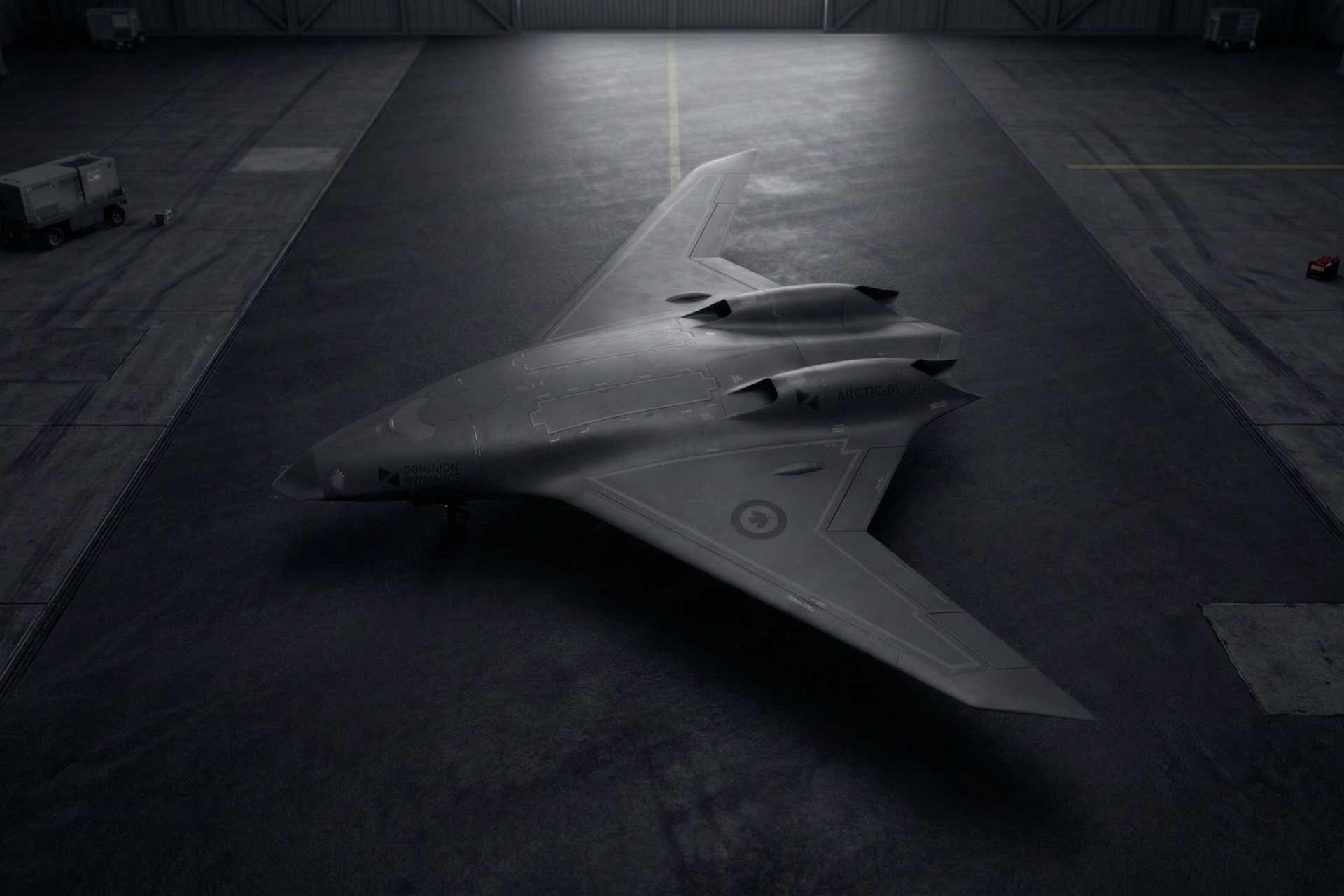
Some loyal wingman drone projects, such as Dominion Dynamics’ ACP, envision a modular aircraft capable of functioning as sensors, weapons carriers, or electronic warfare systems, depending on mission requirements. (Picture source: Dominion Dynamics)
On March 5, 2026, the Canadian company Dominion Dynamics announced a $50 million investment to initiate the development of a sovereign Autonomous Collaborative Platform (ACP), an uncrewed aircraft intended to operate alongside crewed fighter jets such as the F-35 or the Gripen. The ACP is conceived as an autonomous wingman designed to extend the operational range of fighters and enable missions in environments considered too dangerous or too distant for human pilots. The project aims to establish Canada’s first domestically designed collaborative combat aircraft (CCA), capable of operating as part of networked formations involving crewed fighters, surveillance aircraft, and ground control nodes.
The ACP is intended to conduct missions including persistent surveillance, electronic warfare, and strike support while preserving aircrew and expensive aircraft. The company indicated that the initial investment will finance engineering, modelling, simulation work, and prototype development. The first development phase includes the creation of scaled prototypes before moving to a full-scale aircraft within an estimated 24 to 36 months. Dominion Dynamics was founded in Ottawa to develop sovereign defence technologies adapted to Canadian operational requirements, particularly in remote environments such as the Arctic. The company’s activities include the development of sensor networks, artificial intelligence systems, and autonomous vehicles engineered to operate in extreme climates and remote territories.
One of its current projects involves building a persistent sensing architecture that integrates sensors across land, sea, air, and space to produce a continuous operational picture of northern regions. These networks combine commercial sensors with communications nodes that transmit data from remote locations to command centres where information is fused into a single intelligence stream. The system is intended to support surveillance missions and provide early warning capabilities in regions with limited communications infrastructure. The company has tested elements of this architecture with Canadian Rangers in northern environments to collect operational data on hardware performance in extreme cold conditions.
The architecture also integrates onboard processing, so sensors and autonomous vehicles could interpret information locally before transmitting it through the network. Dominion Dynamics’ strategy reflects the perspective of its founder and chief executive officer Eliot Pence, who previously led international market expansion at the US defence company Anduril Industries. Pence has argued that future military capabilities will depend increasingly on integrated networks of sensors, communications systems, and autonomous vehicles rather than on individual aircraft alone. From this perspective, the decisive element of air power lies not only in the aircraft but in the surrounding architecture of software, sensing, and mission systems that determine how fighter jets operate within distributed formations.
Pence has emphasized that Canada’s long-term security depends on developing domestic capabilities in these areas rather than relying entirely on foreign suppliers. The company’s approach, therefore, focuses on technologies that can operate independently while remaining interoperable with allied systems used by NATO and Five Eyes partners. Pence has also argued that Canada’s operational challenges differ from those of other countries because of the scale of its territory and the communications difficulties associated with Arctic operations. These conditions require aircraft capable of long-range operations, reliable communications over vast distances, and the ability to operate in extremely cold temperatures.
The company’s long-term objective extends beyond a single aircraft design and includes the development of modular autonomous systems that can be adapted for different missions. Dominion Dynamics has indicated that production may follow a model similar to satellite manufacturing, in which a common airframe or bus serves as the basis for multiple variants with different sensors, payloads, or weapons. This approach allows a single design to be modified for reconnaissance, electronic warfare, strike support, or communications relay roles. The Canadian company is also developing a simulation engine to evaluate different operational concepts and determine the most effective combination of sensors, drones, and communications systems to counter specific threats.
Such modelling tools are intended to simulate scenarios such as missile or hypersonic threats approaching across the Arctic and to test possible responses using distributed networks of autonomous systems. Dominion has leased a facility in Kanata, where construction of prototype aircraft and associated systems will take place. The company currently employs several dozen personnel and expects to expand its workforce to roughly one hundred employees as development progresses. The Autonomous Collaborative Platform (ACP) reflects the expansion of a broader category of unmanned aircraft known as loyal wingman systems, which operate within formations combining crewed and uncrewed aircraft.
In these formations, a pilot in a crewed aircraft functions as a mission commander supervising multiple autonomous aircraft operating nearby. These unmanned aircraft can conduct reconnaissance, electronic warfare, targeting, or weapons delivery, while the crewed aircraft focuses on command and decision-making tasks. Loyal wingman drones are designed to be smaller and less expensive than crewed fighters, so they can be deployed in larger numbers and accept higher operational risk. Some concepts allow the unmanned aircraft to carry additional missiles or sensors, effectively increasing the payload capacity of the formation. Other variants are intended to act as decoys or electronic warfare systems to disrupt enemy sensors.
This model distributes functions across multiple aircraft rather than concentrating them in a single platform. Like other loyal wingmen, Dominion Dynamics’ ACP is expected to rely heavily on artificial intelligence, automated flight control, and secure communications networks linking crewed and uncrewed aircraft. Modern unmanned systems can perform functions including autonomous navigation, formation flight, target recognition, and coordinated manoeuvres with minimal human input. Human operators typically supervise these systems and intervene only when necessary to approve or modify actions.
In advanced concepts, a single crewed aircraft may control several autonomous aircraft simultaneously, creating formations in which unmanned aircraft perform specialized tasks while remaining integrated with the pilot’s tactical plan. Military planners view this structure as a method to increase combat mass and expand operational reach without increasing the number of crewed aircraft. The concept also reduces risk to pilots by assigning the most dangerous tasks to unmanned systems. Several air forces are exploring combinations of high-end stealthy unmanned aircraft and lower-cost modular systems to perform different mission sets within the same formation.
The development of such unmanned aircraft is taking place alongside Canada’s Future Fighter Capability Project, which aims to replace the Royal Canadian Air Force’s aging fleet of CF-18 Hornet fighters. Canada formally committed in January 2023 to acquire 88 Lockheed Martin F-35A stealth fighters under a procurement program intended to maintain air defence capabilities through the middle of the 21st century. The acquisition includes aircraft, weapons, training infrastructure, information technology systems, and long-term sustainment arrangements. The initial procurement cost has been estimated at about C$19 billion, with total lifecycle costs expected to increase as infrastructure and maintenance expenses are included.
The F-35A was selected following a competition that also included the Saab Gripen E fighter. Canada has participated in the F-35 program as an industrial partner since 2002, allowing domestic companies to compete for production contracts within the aircraft’s global supply chain. Delivery of the first Canadian F-35 is scheduled to begin in 2026 for pilot training in the United States, with aircraft expected to start arriving in Canada in 2028. The final aircraft deliveries are scheduled to occur by 2032, with full operational capability projected between 2032 and 2034.
The stealth fighter will perform missions including air sovereignty patrols over Canadian territory, interception under the North American Aerospace Defense Command, participation in NATO operations abroad, and intelligence, surveillance, and reconnaissance missions. The F-35’s sensor fusion architecture integrates radar, electro-optical sensors and data links to provide pilots with a unified operational picture. In this context, autonomous aircraft such as Dominion Dynamics’ proposed collaborative platform could function as force multipliers by carrying additional sensors or weapons, extending surveillance coverage, and conducting high-risk missions ahead of crewed fighters.
Written by Jérôme Brahy
Jérôme Brahy is a defense analyst and documentalist at Army Recognition. He specializes in naval modernization, aviation, drones, armored vehicles, and artillery, with a focus on strategic developments in the United States, China, Ukraine, Russia, Türkiye, and Belgium. His analyses go beyond the facts, providing context, identifying key actors, and explaining why defense news matters on a global scale.
{loadposition bannertop}
{loadposition sidebarpub}
Dominion Dynamics invests $50 million to develop Canada’s first loyal wingman drone, the Autonomous Collaborative Platform (ACP), to operate alongside F-35 fighters.
Dominion Dynamics announced a $50 million investment to develop Canada’s first collaborative combat aircraft (CCA), the Autonomous Collaborative Platform (ACP), which is intended to operate alongside F-35 fighters as a loyal wingman in networked formations. The project includes modelling, simulation, and prototype development with scaled aircraft planned before a full-scale prototype within 24 to 36 months.
Follow Army Recognition on Google News at this link
Some loyal wingman drone projects, such as Dominion Dynamics’ ACP, envision a modular aircraft capable of functioning as sensors, weapons carriers, or electronic warfare systems, depending on mission requirements. (Picture source: Dominion Dynamics)
On March 5, 2026, the Canadian company Dominion Dynamics announced a $50 million investment to initiate the development of a sovereign Autonomous Collaborative Platform (ACP), an uncrewed aircraft intended to operate alongside crewed fighter jets such as the F-35 or the Gripen. The ACP is conceived as an autonomous wingman designed to extend the operational range of fighters and enable missions in environments considered too dangerous or too distant for human pilots. The project aims to establish Canada’s first domestically designed collaborative combat aircraft (CCA), capable of operating as part of networked formations involving crewed fighters, surveillance aircraft, and ground control nodes.
The ACP is intended to conduct missions including persistent surveillance, electronic warfare, and strike support while preserving aircrew and expensive aircraft. The company indicated that the initial investment will finance engineering, modelling, simulation work, and prototype development. The first development phase includes the creation of scaled prototypes before moving to a full-scale aircraft within an estimated 24 to 36 months. Dominion Dynamics was founded in Ottawa to develop sovereign defence technologies adapted to Canadian operational requirements, particularly in remote environments such as the Arctic. The company’s activities include the development of sensor networks, artificial intelligence systems, and autonomous vehicles engineered to operate in extreme climates and remote territories.
One of its current projects involves building a persistent sensing architecture that integrates sensors across land, sea, air, and space to produce a continuous operational picture of northern regions. These networks combine commercial sensors with communications nodes that transmit data from remote locations to command centres where information is fused into a single intelligence stream. The system is intended to support surveillance missions and provide early warning capabilities in regions with limited communications infrastructure. The company has tested elements of this architecture with Canadian Rangers in northern environments to collect operational data on hardware performance in extreme cold conditions.
The architecture also integrates onboard processing, so sensors and autonomous vehicles could interpret information locally before transmitting it through the network. Dominion Dynamics’ strategy reflects the perspective of its founder and chief executive officer Eliot Pence, who previously led international market expansion at the US defence company Anduril Industries. Pence has argued that future military capabilities will depend increasingly on integrated networks of sensors, communications systems, and autonomous vehicles rather than on individual aircraft alone. From this perspective, the decisive element of air power lies not only in the aircraft but in the surrounding architecture of software, sensing, and mission systems that determine how fighter jets operate within distributed formations.
Pence has emphasized that Canada’s long-term security depends on developing domestic capabilities in these areas rather than relying entirely on foreign suppliers. The company’s approach, therefore, focuses on technologies that can operate independently while remaining interoperable with allied systems used by NATO and Five Eyes partners. Pence has also argued that Canada’s operational challenges differ from those of other countries because of the scale of its territory and the communications difficulties associated with Arctic operations. These conditions require aircraft capable of long-range operations, reliable communications over vast distances, and the ability to operate in extremely cold temperatures.
The company’s long-term objective extends beyond a single aircraft design and includes the development of modular autonomous systems that can be adapted for different missions. Dominion Dynamics has indicated that production may follow a model similar to satellite manufacturing, in which a common airframe or bus serves as the basis for multiple variants with different sensors, payloads, or weapons. This approach allows a single design to be modified for reconnaissance, electronic warfare, strike support, or communications relay roles. The Canadian company is also developing a simulation engine to evaluate different operational concepts and determine the most effective combination of sensors, drones, and communications systems to counter specific threats.
Such modelling tools are intended to simulate scenarios such as missile or hypersonic threats approaching across the Arctic and to test possible responses using distributed networks of autonomous systems. Dominion has leased a facility in Kanata, where construction of prototype aircraft and associated systems will take place. The company currently employs several dozen personnel and expects to expand its workforce to roughly one hundred employees as development progresses. The Autonomous Collaborative Platform (ACP) reflects the expansion of a broader category of unmanned aircraft known as loyal wingman systems, which operate within formations combining crewed and uncrewed aircraft.
In these formations, a pilot in a crewed aircraft functions as a mission commander supervising multiple autonomous aircraft operating nearby. These unmanned aircraft can conduct reconnaissance, electronic warfare, targeting, or weapons delivery, while the crewed aircraft focuses on command and decision-making tasks. Loyal wingman drones are designed to be smaller and less expensive than crewed fighters, so they can be deployed in larger numbers and accept higher operational risk. Some concepts allow the unmanned aircraft to carry additional missiles or sensors, effectively increasing the payload capacity of the formation. Other variants are intended to act as decoys or electronic warfare systems to disrupt enemy sensors.
This model distributes functions across multiple aircraft rather than concentrating them in a single platform. Like other loyal wingmen, Dominion Dynamics’ ACP is expected to rely heavily on artificial intelligence, automated flight control, and secure communications networks linking crewed and uncrewed aircraft. Modern unmanned systems can perform functions including autonomous navigation, formation flight, target recognition, and coordinated manoeuvres with minimal human input. Human operators typically supervise these systems and intervene only when necessary to approve or modify actions.
In advanced concepts, a single crewed aircraft may control several autonomous aircraft simultaneously, creating formations in which unmanned aircraft perform specialized tasks while remaining integrated with the pilot’s tactical plan. Military planners view this structure as a method to increase combat mass and expand operational reach without increasing the number of crewed aircraft. The concept also reduces risk to pilots by assigning the most dangerous tasks to unmanned systems. Several air forces are exploring combinations of high-end stealthy unmanned aircraft and lower-cost modular systems to perform different mission sets within the same formation.
The development of such unmanned aircraft is taking place alongside Canada’s Future Fighter Capability Project, which aims to replace the Royal Canadian Air Force’s aging fleet of CF-18 Hornet fighters. Canada formally committed in January 2023 to acquire 88 Lockheed Martin F-35A stealth fighters under a procurement program intended to maintain air defence capabilities through the middle of the 21st century. The acquisition includes aircraft, weapons, training infrastructure, information technology systems, and long-term sustainment arrangements. The initial procurement cost has been estimated at about C$19 billion, with total lifecycle costs expected to increase as infrastructure and maintenance expenses are included.
The F-35A was selected following a competition that also included the Saab Gripen E fighter. Canada has participated in the F-35 program as an industrial partner since 2002, allowing domestic companies to compete for production contracts within the aircraft’s global supply chain. Delivery of the first Canadian F-35 is scheduled to begin in 2026 for pilot training in the United States, with aircraft expected to start arriving in Canada in 2028. The final aircraft deliveries are scheduled to occur by 2032, with full operational capability projected between 2032 and 2034.
The stealth fighter will perform missions including air sovereignty patrols over Canadian territory, interception under the North American Aerospace Defense Command, participation in NATO operations abroad, and intelligence, surveillance, and reconnaissance missions. The F-35’s sensor fusion architecture integrates radar, electro-optical sensors and data links to provide pilots with a unified operational picture. In this context, autonomous aircraft such as Dominion Dynamics’ proposed collaborative platform could function as force multipliers by carrying additional sensors or weapons, extending surveillance coverage, and conducting high-risk missions ahead of crewed fighters.
Written by Jérôme Brahy
Jérôme Brahy is a defense analyst and documentalist at Army Recognition. He specializes in naval modernization, aviation, drones, armored vehicles, and artillery, with a focus on strategic developments in the United States, China, Ukraine, Russia, Türkiye, and Belgium. His analyses go beyond the facts, providing context, identifying key actors, and explaining why defense news matters on a global scale.