U.S. Aerovironment Unveils MAYHEM 10 Combat Drone with 100 km Range and Modular Strike Payloads
{loadposition bannertop}
{loadposition sidebarpub}
AeroVironment unveiled the MAYHEM 10 at AAAA 2026, a modular launched-effects drone designed to execute ISR, electronic warfare, communications relay, and strike missions in a single platform. With a 100 km range and 50-minute endurance, the Group 2 system gives U.S. Army units a flexible, multi-role asset built to operate deep inside contested environments.
MAYHEM 10 moves beyond single-use loitering munitions by combining multiple mission sets into one adaptable air vehicle. Its modular payload architecture supports rapid reconfiguration, enabling forces to adjust capabilities in real time while advancing the Army’s push for scalable, attritable systems that can keep pace with evolving battlefield demands.
Related topic: U.S. Army to Field Red Dragon Autonomous Drone Capable of 400 km Strikes Without GPS.
AeroVironment’s MAYHEM 10 is a modular launched-effects drone for air, ground, and maritime missions, combining strike, ISR, electronic warfare, and communications relay in one platform. With a 100-km range and anti-armor payload options, it extends battlefield reach and survivability in contested operations (Picture source: Aerovironment).
The timing matters because MAYHEM 10 arrives as the U.S. Army accelerates its launched effects effort and openly frames the capability as central to extending reach, lethality, and survivability in contested operations. AV is effectively positioning the new system inside that requirement space, where forces want attritable uncrewed teammates that can be adapted quickly as threats, payloads, and tactics evolve.
MAYHEM 10 falls under the Group 2 classification and is designed around a 29-pound vehicle, a 42-pound all-up round, and a 10-pound modular payload bay. AeroVironment lists cruise speed at 80 mph, dash speed above 120 mph, endurance of 50 minutes, a 100-km range, nominal operating altitude of 650 feet AGL, and a 15,000-foot ceiling, with assembly and launch readiness in under five minutes. Those figures place it between a backpack loitering munition and a larger tactical UAS, giving small units and aviation formations a fast, relatively compact effect with real reach.
The most important design choice is the armament architecture. Instead of tying the drone to one fixed warhead, AV built a removable forward modular payload section with a published interface for third-party integration, allowing the same air vehicle to carry EO/IR ISR payloads, electronic warfare packages, decoy and deception modules, communications relay equipment, or lethal strike payloads. Reporting from the unveiling indicates company executives said MAYHEM 10 can also accept the Javelin Multi-Purpose warhead already associated with the Switchblade 600 family, which would give it a credible anti-armor role against tanks and other hardened targets without forcing users into a different launcher or control chain.
That modularity matters tactically because it changes the drone from a niche precision weapon into a configurable mission effector. A unit could launch one MAYHEM 10 as a decoy, another as an ISR node to confirm target identity, a third as a relay to preserve communications over broken terrain, and a fourth as the strike element, all under a common architecture. In a battlefield where frequencies, target signatures, and air-defense behavior can change in days rather than months, that flexibility is not cosmetic; it is a hedge against rapid adaptation by the enemy.
The enabling layer is the autonomy and networking stack. AV says MAYHEM 10 uses an AI-enabled processor for automatic target recognition and collaborative autonomy, alongside M-Code GPS, alternative PNT fusion, a Silvus datalink, and a MANET secure mesh network for resilient control in jamming, spoofing, degraded communications, and denied-navigation conditions. The system is managed through the Tomahawk Grip tablet and AV_Halo COMMAND interface, with STANAG 4586/RAS-A-based interoperability and native Cursor-on-Target integration with TAK/ATAK, an important detail because it should reduce the burden of inserting another drone into Army tactical digital workflows.
Launch flexibility further expands its operational value. AeroVironment’s data sheet advertises air launch from Black Hawk, Apache, and future FLRAA-class platforms, as well as fixed or mounted ground launch and maritime employment from surface vessels or submarines. In practical terms, that means a helicopter can push sensors or lethal effects roughly 100 kilometers ahead without moving deeper into enemy engagement zones, while a ground formation can use the same family to look over terrain, attack fleeting targets, or create a temporary communications bridge where line-of-sight radios struggle.
AV is also selling MAYHEM 10 as a collaborative attack system rather than a lone missile. The company says it can be employed individually or in coordinated groups to expand coverage, confuse defenses, and execute parallel effects, and executives told reporters that the autonomy algorithms have already been tested in laboratory conditions with partner Applied Intuition, even if larger swarm-style flight demonstrations are still ahead. That is an important distinction: the real battlefield value lies not simply in launching more drones, but in dividing ISR, deception, EW, and strike functions across several cooperating systems inside one engagement window.
For the force using it, MAYHEM 10 offers a practical way to extend combat power without exposing crews or concentrating valuable platforms. Aviation units could launch it from standoff to scout air-defense corridors or prosecute pop-up armor; maneuver forces could use it to fix an enemy with ISR or EW before handing off to lethal effects; maritime teams could deploy it as a low-signature scout or attack asset. The underlying advantage is decision-speed: commanders gain another forward sensor-shooter that can compress the sense-decide-act loop while keeping helicopters, vehicles, or boats farther outside threat envelopes.
The industrial and strategic picture strengthens the case. AeroVironment says the system was engineered for scalable manufacture up to 240 units per month, while executives told reporters low-rate initial production will begin this year and ramp with demand, even though no Pentagon orders have yet been announced. Seen alongside the Army’s recent $186 million order for next-generation Switchblade systems and the service’s continuing push to field launched effects more broadly, MAYHEM 10 looks less like an isolated drone launch than a bridge toward a more distributed, modular, and survivable way of generating combat power. If field performance matches the published architecture, especially in anti-armor and collaborative attack roles, it will give U.S. and allied forces a versatile launched effect that does more than add another drone to inventory; it changes what a small unit or aviation formation can do before ever crossing into the enemy’s kill zone.
{loadposition bannertop}
{loadposition sidebarpub}
AeroVironment unveiled the MAYHEM 10 at AAAA 2026, a modular launched-effects drone designed to execute ISR, electronic warfare, communications relay, and strike missions in a single platform. With a 100 km range and 50-minute endurance, the Group 2 system gives U.S. Army units a flexible, multi-role asset built to operate deep inside contested environments.
MAYHEM 10 moves beyond single-use loitering munitions by combining multiple mission sets into one adaptable air vehicle. Its modular payload architecture supports rapid reconfiguration, enabling forces to adjust capabilities in real time while advancing the Army’s push for scalable, attritable systems that can keep pace with evolving battlefield demands.
Related topic: U.S. Army to Field Red Dragon Autonomous Drone Capable of 400 km Strikes Without GPS.
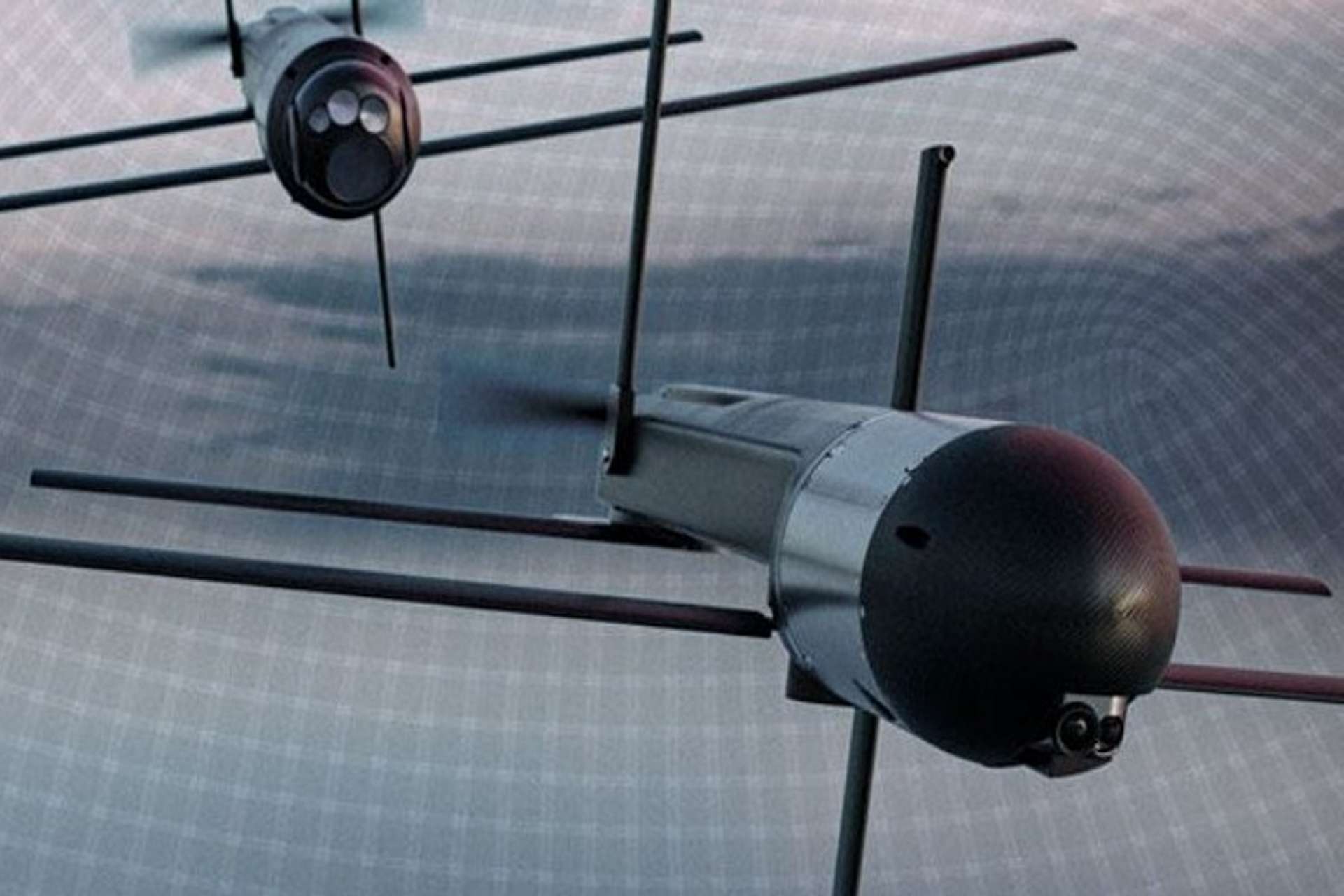
AeroVironment’s MAYHEM 10 is a modular launched-effects drone for air, ground, and maritime missions, combining strike, ISR, electronic warfare, and communications relay in one platform. With a 100-km range and anti-armor payload options, it extends battlefield reach and survivability in contested operations (Picture source: Aerovironment).
The timing matters because MAYHEM 10 arrives as the U.S. Army accelerates its launched effects effort and openly frames the capability as central to extending reach, lethality, and survivability in contested operations. AV is effectively positioning the new system inside that requirement space, where forces want attritable uncrewed teammates that can be adapted quickly as threats, payloads, and tactics evolve.
MAYHEM 10 falls under the Group 2 classification and is designed around a 29-pound vehicle, a 42-pound all-up round, and a 10-pound modular payload bay. AeroVironment lists cruise speed at 80 mph, dash speed above 120 mph, endurance of 50 minutes, a 100-km range, nominal operating altitude of 650 feet AGL, and a 15,000-foot ceiling, with assembly and launch readiness in under five minutes. Those figures place it between a backpack loitering munition and a larger tactical UAS, giving small units and aviation formations a fast, relatively compact effect with real reach.
The most important design choice is the armament architecture. Instead of tying the drone to one fixed warhead, AV built a removable forward modular payload section with a published interface for third-party integration, allowing the same air vehicle to carry EO/IR ISR payloads, electronic warfare packages, decoy and deception modules, communications relay equipment, or lethal strike payloads. Reporting from the unveiling indicates company executives said MAYHEM 10 can also accept the Javelin Multi-Purpose warhead already associated with the Switchblade 600 family, which would give it a credible anti-armor role against tanks and other hardened targets without forcing users into a different launcher or control chain.
That modularity matters tactically because it changes the drone from a niche precision weapon into a configurable mission effector. A unit could launch one MAYHEM 10 as a decoy, another as an ISR node to confirm target identity, a third as a relay to preserve communications over broken terrain, and a fourth as the strike element, all under a common architecture. In a battlefield where frequencies, target signatures, and air-defense behavior can change in days rather than months, that flexibility is not cosmetic; it is a hedge against rapid adaptation by the enemy.
The enabling layer is the autonomy and networking stack. AV says MAYHEM 10 uses an AI-enabled processor for automatic target recognition and collaborative autonomy, alongside M-Code GPS, alternative PNT fusion, a Silvus datalink, and a MANET secure mesh network for resilient control in jamming, spoofing, degraded communications, and denied-navigation conditions. The system is managed through the Tomahawk Grip tablet and AV_Halo COMMAND interface, with STANAG 4586/RAS-A-based interoperability and native Cursor-on-Target integration with TAK/ATAK, an important detail because it should reduce the burden of inserting another drone into Army tactical digital workflows.
Launch flexibility further expands its operational value. AeroVironment’s data sheet advertises air launch from Black Hawk, Apache, and future FLRAA-class platforms, as well as fixed or mounted ground launch and maritime employment from surface vessels or submarines. In practical terms, that means a helicopter can push sensors or lethal effects roughly 100 kilometers ahead without moving deeper into enemy engagement zones, while a ground formation can use the same family to look over terrain, attack fleeting targets, or create a temporary communications bridge where line-of-sight radios struggle.
AV is also selling MAYHEM 10 as a collaborative attack system rather than a lone missile. The company says it can be employed individually or in coordinated groups to expand coverage, confuse defenses, and execute parallel effects, and executives told reporters that the autonomy algorithms have already been tested in laboratory conditions with partner Applied Intuition, even if larger swarm-style flight demonstrations are still ahead. That is an important distinction: the real battlefield value lies not simply in launching more drones, but in dividing ISR, deception, EW, and strike functions across several cooperating systems inside one engagement window.
For the force using it, MAYHEM 10 offers a practical way to extend combat power without exposing crews or concentrating valuable platforms. Aviation units could launch it from standoff to scout air-defense corridors or prosecute pop-up armor; maneuver forces could use it to fix an enemy with ISR or EW before handing off to lethal effects; maritime teams could deploy it as a low-signature scout or attack asset. The underlying advantage is decision-speed: commanders gain another forward sensor-shooter that can compress the sense-decide-act loop while keeping helicopters, vehicles, or boats farther outside threat envelopes.
The industrial and strategic picture strengthens the case. AeroVironment says the system was engineered for scalable manufacture up to 240 units per month, while executives told reporters low-rate initial production will begin this year and ramp with demand, even though no Pentagon orders have yet been announced. Seen alongside the Army’s recent $186 million order for next-generation Switchblade systems and the service’s continuing push to field launched effects more broadly, MAYHEM 10 looks less like an isolated drone launch than a bridge toward a more distributed, modular, and survivable way of generating combat power. If field performance matches the published architecture, especially in anti-armor and collaborative attack roles, it will give U.S. and allied forces a versatile launched effect that does more than add another drone to inventory; it changes what a small unit or aviation formation can do before ever crossing into the enemy’s kill zone.