U.S. MQ-9B Drone Completes Icing Tests Paving Arctic Mission Path
{loadposition bannertop}
{loadposition sidebarpub}
General Atomics Aeronautical Systems has completed MQ-9B Flight Into Known Icing flight tests, a key step toward certification that would extend the drone’s Arctic operations. The successful campaign reduces weather constraints on long-endurance missions for maritime and border surveillance.
The test campaign at Grand Forks validated simulated ice shapes, cold-weather performance, and system resilience, building prior cold-start demonstrations. This positions MQ-9B for environments where icing and infrastructure limits restrict conventional aircraft.
Related topic: GA‑ASI Advances MQ‑9B SkyGuardian and SeaGuardian Drones with Long‑Range Standoff Strike Capabilities
GA-ASI describes the aircraft as suitable for Arctic security patrols, infrastructure monitoring, environmental monitoring, search and rescue, and persistent ISR over land, sea, and subsurface targets (Picture source: GA-ASI)
The tests build on a program launched earlier at the Flight Test and Training Center in Grand Forks, North Dakota, where climate conditions make it possible to evaluate icing realistically. Engineers used several methods, including simulated ice shapes attached to critical aircraft surfaces and flights in naturally cold conditions, to measure how ice affects aerodynamic performance, propulsion, and onboard systems while validating anti-icing and de-icing measures. An earlier cold-weather validation effort also showed the aircraft cold-soaked below -21°C, then de-iced, started from a climate-controlled hangar, and flew in subzero ambient conditions.
On April 20, 2026, General Atomics Aeronautical Systems confirmed that the FIKI test campaign had been completed and that all objectives had been met. The company said the work was funded internally as part of its research and development activities. That approach reflects an effort to address certification requirements in advance of customer contracts while anticipating future military and civil use cases.
The MQ-9B SkyGuardian, the land-based version of the system, and its maritime variant SeaGuardian are built on a MALE architecture designed for persistent surveillance missions. The aircraft has endurance of more than 40 hours in some configurations, can operate at altitudes up to about 40,000 feet, and is equipped with a Lynx multi-mode synthetic aperture radar and an electro-optical/infrared sensor turret for continuous day-and-night observation. GA-ASI also presents the platform as compliant with STANAG 4671, which supports its use in certified airspace and helps explain why certification milestones matter to customers.
GA-ASI describes the aircraft as suitable for Arctic security patrols, infrastructure monitoring, environmental monitoring, search and rescue, and persistent ISR over land, sea, and subsurface targets. The platform’s automated takeoff and landing, remote control, and small support footprint are presented as advantages in remote regions where sustaining crewed operations is difficult. In this context, FIKI certification extends a capability set that already includes cold-start performance and de-icing in severe weather.
The maritime mission set is also expanding. GA-ASI and the U.S. Navy tested an expanded sonobuoy dispensing system for the MQ-9B SeaGuardian in January 2026, following earlier ASW-related demonstrations. That work points to a broader anti-submarine warfare role, which is relevant in the Arctic as well as in other maritime theaters. It also reinforces the idea that the platform is being developed as a multi-mission system rather than a single-purpose ISR asset.
The implications of this certification are operational as much as technical. Forces can plan intelligence, surveillance, and reconnaissance missions with fewer weather-related gaps, including in regions where icing would otherwise limit availability. This is particularly relevant for North Atlantic and North Pacific maritime patrols, border surveillance in cold regions, and Arctic operations where continuous presence matters more than short-duration sorties. The combination of endurance, satellite communications, and all-weather validation strengthens the MQ-9B’s role in those environments.
Canada remains a key reference point. The country has ordered 11 MQ-9B SkyGuardian systems for Arctic operations, and Canadian certification authorities have taken part in test phases intended to support their own approval process. That makes the FIKI milestone especially relevant for missions over the Canadian Arctic, where low temperatures and icing are routine constraints. Denmark, the United Kingdom, Belgium, Japan, and other users also appear in the broader MQ-9B customer base, reflecting a wider adoption pattern across NATO and partner states.
The broader strategic backdrop is the growing competition for influence and access in the Arctic. The region is seeing increased Russian and Chinese activity, while the United States and its allies seek to maintain continuous surveillance without exposing crews to extreme conditions. In that setting, the ability to operate in known icing conditions is not just a technical increment, but part of a wider effort to keep the MQ-9B relevant for Arctic security, maritime awareness, and long-endurance monitoring.
Written By Erwan Halna du Fretay – Defense Analyst, Army Recognition GroupErwan Halna du Fretay holds a Master’s degree in International Relations and has experience studying conflicts and global arms transfers. His research interests lie in security and strategic studies, particularly the dynamics of the defense industry, the evolution of military technologies, and the strategic transformation of armed forces.
{loadposition bannertop}
{loadposition sidebarpub}
General Atomics Aeronautical Systems has completed MQ-9B Flight Into Known Icing flight tests, a key step toward certification that would extend the drone’s Arctic operations. The successful campaign reduces weather constraints on long-endurance missions for maritime and border surveillance.
The test campaign at Grand Forks validated simulated ice shapes, cold-weather performance, and system resilience, building prior cold-start demonstrations. This positions MQ-9B for environments where icing and infrastructure limits restrict conventional aircraft.
Related topic: GA‑ASI Advances MQ‑9B SkyGuardian and SeaGuardian Drones with Long‑Range Standoff Strike Capabilities
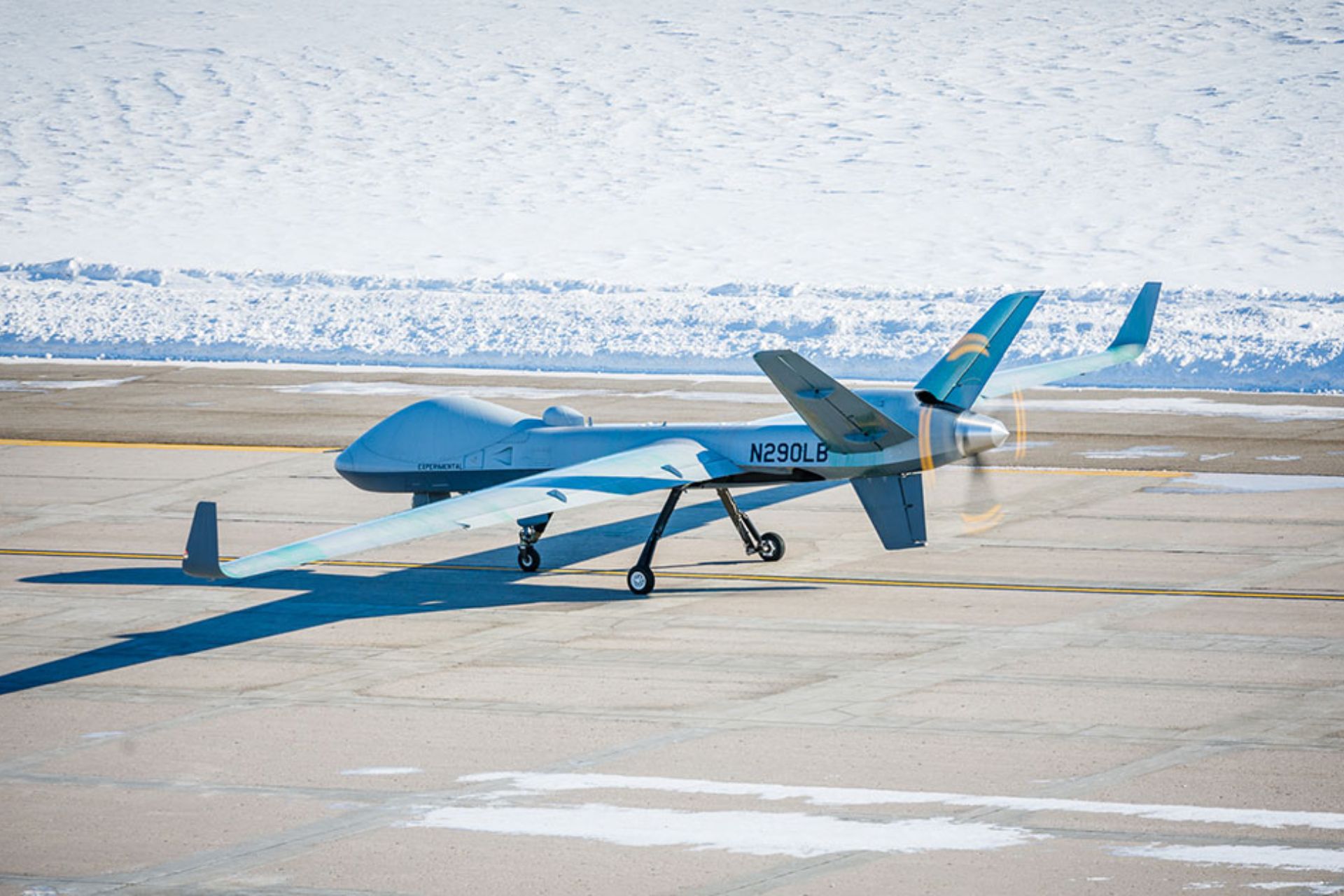
GA-ASI describes the aircraft as suitable for Arctic security patrols, infrastructure monitoring, environmental monitoring, search and rescue, and persistent ISR over land, sea, and subsurface targets (Picture source: GA-ASI)
The tests build on a program launched earlier at the Flight Test and Training Center in Grand Forks, North Dakota, where climate conditions make it possible to evaluate icing realistically. Engineers used several methods, including simulated ice shapes attached to critical aircraft surfaces and flights in naturally cold conditions, to measure how ice affects aerodynamic performance, propulsion, and onboard systems while validating anti-icing and de-icing measures. An earlier cold-weather validation effort also showed the aircraft cold-soaked below -21°C, then de-iced, started from a climate-controlled hangar, and flew in subzero ambient conditions.
On April 20, 2026, General Atomics Aeronautical Systems confirmed that the FIKI test campaign had been completed and that all objectives had been met. The company said the work was funded internally as part of its research and development activities. That approach reflects an effort to address certification requirements in advance of customer contracts while anticipating future military and civil use cases.
The MQ-9B SkyGuardian, the land-based version of the system, and its maritime variant SeaGuardian are built on a MALE architecture designed for persistent surveillance missions. The aircraft has endurance of more than 40 hours in some configurations, can operate at altitudes up to about 40,000 feet, and is equipped with a Lynx multi-mode synthetic aperture radar and an electro-optical/infrared sensor turret for continuous day-and-night observation. GA-ASI also presents the platform as compliant with STANAG 4671, which supports its use in certified airspace and helps explain why certification milestones matter to customers.
GA-ASI describes the aircraft as suitable for Arctic security patrols, infrastructure monitoring, environmental monitoring, search and rescue, and persistent ISR over land, sea, and subsurface targets. The platform’s automated takeoff and landing, remote control, and small support footprint are presented as advantages in remote regions where sustaining crewed operations is difficult. In this context, FIKI certification extends a capability set that already includes cold-start performance and de-icing in severe weather.
The maritime mission set is also expanding. GA-ASI and the U.S. Navy tested an expanded sonobuoy dispensing system for the MQ-9B SeaGuardian in January 2026, following earlier ASW-related demonstrations. That work points to a broader anti-submarine warfare role, which is relevant in the Arctic as well as in other maritime theaters. It also reinforces the idea that the platform is being developed as a multi-mission system rather than a single-purpose ISR asset.
The implications of this certification are operational as much as technical. Forces can plan intelligence, surveillance, and reconnaissance missions with fewer weather-related gaps, including in regions where icing would otherwise limit availability. This is particularly relevant for North Atlantic and North Pacific maritime patrols, border surveillance in cold regions, and Arctic operations where continuous presence matters more than short-duration sorties. The combination of endurance, satellite communications, and all-weather validation strengthens the MQ-9B’s role in those environments.
Canada remains a key reference point. The country has ordered 11 MQ-9B SkyGuardian systems for Arctic operations, and Canadian certification authorities have taken part in test phases intended to support their own approval process. That makes the FIKI milestone especially relevant for missions over the Canadian Arctic, where low temperatures and icing are routine constraints. Denmark, the United Kingdom, Belgium, Japan, and other users also appear in the broader MQ-9B customer base, reflecting a wider adoption pattern across NATO and partner states.
The broader strategic backdrop is the growing competition for influence and access in the Arctic. The region is seeing increased Russian and Chinese activity, while the United States and its allies seek to maintain continuous surveillance without exposing crews to extreme conditions. In that setting, the ability to operate in known icing conditions is not just a technical increment, but part of a wider effort to keep the MQ-9B relevant for Arctic security, maritime awareness, and long-endurance monitoring.
Written By Erwan Halna du Fretay – Defense Analyst, Army Recognition Group
Erwan Halna du Fretay holds a Master’s degree in International Relations and has experience studying conflicts and global arms transfers. His research interests lie in security and strategic studies, particularly the dynamics of the defense industry, the evolution of military technologies, and the strategic transformation of armed forces.