U.S. Army AH-64E Apache Attack Helicopters in Poland Demonstrate NATO’s Emerging Networked Strike Capability
{loadposition bannertop}
{loadposition sidebarpub}
U.S. Army AH-64E Apache attack helicopters conducted live fire training with Polish and British forces near Toruń, Poland, demonstrating how NATO is turning attack aviation into a faster and more integrated strike capability on its eastern flank, according to footage released by DVIDS on May 28, 2026. The exercise showed that the Alliance is preparing for high-intensity warfare where rapid target sharing, multinational coordination, and precision engagement could determine battlefield superiority against armored formations and air defense networks.
The training highlighted the AH-64E Apache’s evolution from a traditional attack helicopter into a networked combat platform able to connect sensors, ground units, and precision fires across a wider kill chain. For Poland, which is acquiring 96 AH-64E helicopters, the exercise marked another step toward becoming a major NATO hub for allied attack aviation and future concepts such as unmanned teaming, distributed targeting, and survivable deep-strike operations in contested European battlespace.
Related Topic: U.S. Army Apache Evolves from Cold War Tank Killer to Networked Combat Node Enabled by Anduril Altius-700
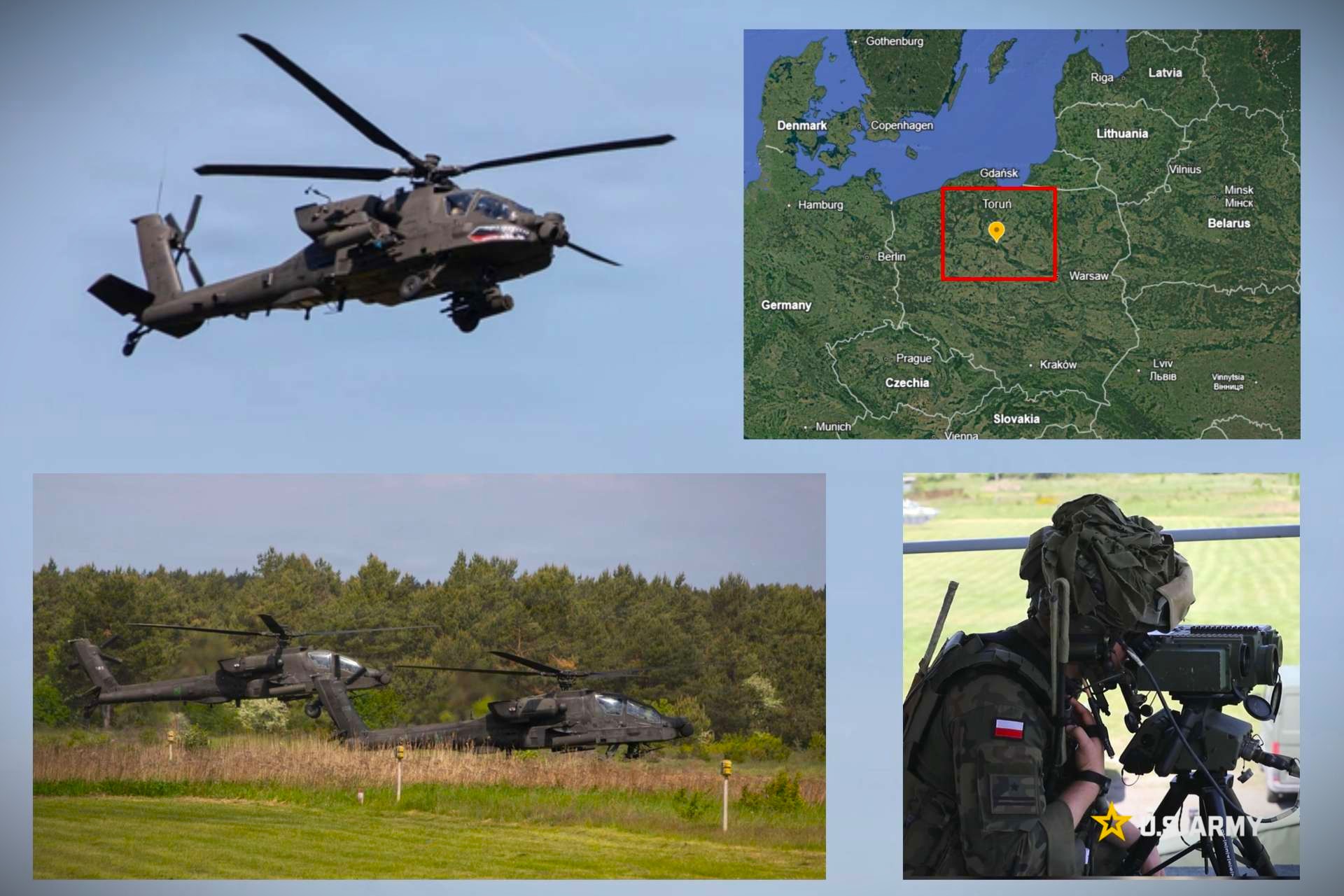
U.S., Polish, and British AH-64E Apache crews conducted live fire drills near Toruń, Poland, highlighting NATO’s growing focus on integrated, networked strike operations along its eastern flank (Picture Source: U.S. Army)
On May 28, 2026, the Defense Visual Information Distribution Service (DVIDS) released footage showing U.S. Army AH-64E Apache attack helicopters conducting live fire tables with Polish and British Armed Forces near Toruń, Poland. The training, carried out by soldiers assigned to the 12th Combat Aviation Brigade, took place in a strategic area of NATO’s eastern flank at a time when the Alliance is reinforcing its ability to deter, detect, and engage threats in Europe. Beyond the destruction of targets on a firing range, the event highlighted a wider transformation in allied attack aviation, where precision, interoperability, and networked strike capabilities are becoming central to NATO’s deterrence posture.
The AH-64E Apache remains one of the most capable attack helicopters in service, combining heavy firepower, advanced sensors, digital connectivity, and battlefield survivability. Designed to conduct close combat attack, armed reconnaissance, security operations, and support to ground maneuver forces, the Apache can engage armored vehicles, fortified positions, air defense assets, troop concentrations, and mobile battlefield targets. Its typical weapons package includes a 30 mm M230 chain gun, AGM-114 Hellfire missiles, 70 mm rockets, and advanced target acquisition systems, allowing crews to operate by day or night and in complex terrain. However, the latest generation of the Apache is no longer defined only by its weapons. The AH-64E has become a sensor-rich combat platform able to exchange data, support joint fires, and connect air and ground forces inside a broader kill chain.
The exercise near Toruń should therefore be seen as more than a live fire qualification event. It reflects the practical construction of a NATO attack aviation ecosystem in which U.S., Polish, and British forces are learning to operate through common procedures, shared targeting logic, and synchronized fire-control processes. In a high-intensity conflict, this type of interoperability would be essential to reduce the time between detection and engagement, especially against mobile armored formations, artillery systems, air defense platforms, or command posts. By conducting live fire tables together, allied crews and ground elements are rehearsing not only how to shoot accurately, but also how to coordinate target acquisition, weapons employment, and command decisions across national forces.
For Poland, the presence of the AH-64E carries particular significance. Warsaw is preparing to become one of the most important Apache operators in the world, with 96 AH-64E helicopters ordered to replace older Soviet-designed attack helicopters and strengthen its ability to support armored and mechanized formations. This acquisition is part of a broader Polish military modernization effort driven by the security environment created by Russia’s war against Ukraine and the renewed importance of NATO’s eastern defense line. The Polish Apache Initiative is therefore not only about receiving new aircraft. It is about absorbing a full operational culture, including training, maintenance, command and control, tactical employment, and integration with allied formations.
The British participation adds another important dimension to the exercise. The United Kingdom also operates the AH-64E and brings its own operational experience in attack helicopter employment, making the Toruń training part of a wider European Apache community rather than a purely bilateral U.S.-Polish activity. This matters because the effectiveness of attack aviation depends not only on the aircraft itself, but also on crews, ground controllers, logisticians, intelligence cells, and commanders understanding how to connect the helicopter to the wider battlefield. With U.S., Polish, and British forces training together, NATO is developing a common language for attack aviation in Europe, one that could be applied during multinational operations under V Corps or other allied command structures.
This live fire event also carries a clear geostrategic message. Poland sits at the center of NATO’s eastern flank, close to Belarus, Ukraine, and the Russian exclave of Kaliningrad, making its territory a key area for deterrence, reinforcement, and rapid response planning. The ability to operate advanced attack helicopters with allied forces on Polish soil strengthens NATO’s forward defense posture and demonstrates that the Alliance is moving beyond symbolic deployments. It is building integrated strike capability in the places where it would be needed most in a crisis. In this sense, the Apache is not only a tactical aircraft; it is part of a broader European theater architecture linking reconnaissance, command and control, long-range fires, air defense suppression, and ground maneuver.
The war in Ukraine has also reshaped how attack helicopters are viewed in modern combat. Rotary-wing aircraft remain powerful assets, but they now face dense networks of mobile air defense systems, electronic warfare, drones, counter-battery sensors, and persistent battlefield surveillance. This environment makes traditional helicopter tactics riskier and increases the need for standoff engagement, unmanned teaming, improved targeting data, and faster coordination with ground-based fires. The AH-64E’s relevance in this context depends on its ability to operate not as an isolated platform, but as a connected combat node that can receive information, share targets, and support precision effects before exposing itself to the most dangerous parts of the battlefield.
This is where the recent evolution of the Apache becomes especially important. As previously reported by Army Recognition Group, the U.S. Army is moving the AH-64E beyond its Cold War identity as a tank-killing helicopter and toward a networked combat node, including experiments with launched effects such as the Anduril Altius-700. This transformation changes the operational geometry of attack aviation. Instead of relying only on the crewed helicopter to move forward, identify targets, and engage them directly, future Apache operations could use unmanned systems to scout ahead, relay communications, detect threats, disrupt enemy networks, or support strikes before the aircraft enters the most contested zone. For NATO forces in Europe, this evolution could be decisive, because survivability will increasingly depend on extending reach while reducing the exposure of crews.
The Toruń live fire tables point to a larger shift in NATO’s military posture. The Alliance is not simply adding more equipment to its eastern flank; it is creating a connected precision-strike network where attack helicopters, ground units, intelligence systems, unmanned platforms, and long-range fires can operate together. The phrase “right round at the right time, in the right place” captures the operational logic behind this transition. Precision is no longer only a matter of weapon accuracy. It is the result of command speed, targeting quality, digital connectivity, multinational coordination, and the ability to act before the enemy can move, disperse, or strike first.
The AH-64E Apache live fire training near Toruń sends a message beyond the range itself. It shows that NATO is turning attack aviation into a shared and networked combat capability, with Poland emerging as one of its future centers of gravity in Europe. For the Polish Armed Forces, the Apache represents a major step toward deeper integration with U.S. and allied strike systems. For the British Armed Forces, it reinforces a common operational framework with other Apache users. For the United States and V Corps, it demonstrates that forward-deployed command structures in Europe are not only coordinating rotations, but shaping the future of allied deterrence. In an era where speed, precision, and interoperability may decide the outcome of the first days of a crisis, the Apache is becoming more than an attack helicopter; it is becoming one of NATO’s key instruments for connected battlefield dominance.
Written by Teoman S. Nicanci – Defense Analyst, Army Recognition Group
Teoman S. Nicanci holds degrees in Political Science, Comparative and International Politics, and International Relations and Diplomacy from leading Belgian universities, with research focused on Russian strategic behavior, defense technology, and modern warfare. He is a defense analyst at Army Recognition, specializing in the global defense industry, military armament, and emerging defense technologies.
{loadposition bannertop}
{loadposition sidebarpub}
U.S. Army AH-64E Apache attack helicopters conducted live fire training with Polish and British forces near Toruń, Poland, demonstrating how NATO is turning attack aviation into a faster and more integrated strike capability on its eastern flank, according to footage released by DVIDS on May 28, 2026. The exercise showed that the Alliance is preparing for high-intensity warfare where rapid target sharing, multinational coordination, and precision engagement could determine battlefield superiority against armored formations and air defense networks.
The training highlighted the AH-64E Apache’s evolution from a traditional attack helicopter into a networked combat platform able to connect sensors, ground units, and precision fires across a wider kill chain. For Poland, which is acquiring 96 AH-64E helicopters, the exercise marked another step toward becoming a major NATO hub for allied attack aviation and future concepts such as unmanned teaming, distributed targeting, and survivable deep-strike operations in contested European battlespace.
Related Topic: U.S. Army Apache Evolves from Cold War Tank Killer to Networked Combat Node Enabled by Anduril Altius-700
U.S., Polish, and British AH-64E Apache crews conducted live fire drills near Toruń, Poland, highlighting NATO’s growing focus on integrated, networked strike operations along its eastern flank (Picture Source: U.S. Army)
On May 28, 2026, the Defense Visual Information Distribution Service (DVIDS) released footage showing U.S. Army AH-64E Apache attack helicopters conducting live fire tables with Polish and British Armed Forces near Toruń, Poland. The training, carried out by soldiers assigned to the 12th Combat Aviation Brigade, took place in a strategic area of NATO’s eastern flank at a time when the Alliance is reinforcing its ability to deter, detect, and engage threats in Europe. Beyond the destruction of targets on a firing range, the event highlighted a wider transformation in allied attack aviation, where precision, interoperability, and networked strike capabilities are becoming central to NATO’s deterrence posture.
The AH-64E Apache remains one of the most capable attack helicopters in service, combining heavy firepower, advanced sensors, digital connectivity, and battlefield survivability. Designed to conduct close combat attack, armed reconnaissance, security operations, and support to ground maneuver forces, the Apache can engage armored vehicles, fortified positions, air defense assets, troop concentrations, and mobile battlefield targets. Its typical weapons package includes a 30 mm M230 chain gun, AGM-114 Hellfire missiles, 70 mm rockets, and advanced target acquisition systems, allowing crews to operate by day or night and in complex terrain. However, the latest generation of the Apache is no longer defined only by its weapons. The AH-64E has become a sensor-rich combat platform able to exchange data, support joint fires, and connect air and ground forces inside a broader kill chain.
The exercise near Toruń should therefore be seen as more than a live fire qualification event. It reflects the practical construction of a NATO attack aviation ecosystem in which U.S., Polish, and British forces are learning to operate through common procedures, shared targeting logic, and synchronized fire-control processes. In a high-intensity conflict, this type of interoperability would be essential to reduce the time between detection and engagement, especially against mobile armored formations, artillery systems, air defense platforms, or command posts. By conducting live fire tables together, allied crews and ground elements are rehearsing not only how to shoot accurately, but also how to coordinate target acquisition, weapons employment, and command decisions across national forces.
For Poland, the presence of the AH-64E carries particular significance. Warsaw is preparing to become one of the most important Apache operators in the world, with 96 AH-64E helicopters ordered to replace older Soviet-designed attack helicopters and strengthen its ability to support armored and mechanized formations. This acquisition is part of a broader Polish military modernization effort driven by the security environment created by Russia’s war against Ukraine and the renewed importance of NATO’s eastern defense line. The Polish Apache Initiative is therefore not only about receiving new aircraft. It is about absorbing a full operational culture, including training, maintenance, command and control, tactical employment, and integration with allied formations.
The British participation adds another important dimension to the exercise. The United Kingdom also operates the AH-64E and brings its own operational experience in attack helicopter employment, making the Toruń training part of a wider European Apache community rather than a purely bilateral U.S.-Polish activity. This matters because the effectiveness of attack aviation depends not only on the aircraft itself, but also on crews, ground controllers, logisticians, intelligence cells, and commanders understanding how to connect the helicopter to the wider battlefield. With U.S., Polish, and British forces training together, NATO is developing a common language for attack aviation in Europe, one that could be applied during multinational operations under V Corps or other allied command structures.
This live fire event also carries a clear geostrategic message. Poland sits at the center of NATO’s eastern flank, close to Belarus, Ukraine, and the Russian exclave of Kaliningrad, making its territory a key area for deterrence, reinforcement, and rapid response planning. The ability to operate advanced attack helicopters with allied forces on Polish soil strengthens NATO’s forward defense posture and demonstrates that the Alliance is moving beyond symbolic deployments. It is building integrated strike capability in the places where it would be needed most in a crisis. In this sense, the Apache is not only a tactical aircraft; it is part of a broader European theater architecture linking reconnaissance, command and control, long-range fires, air defense suppression, and ground maneuver.
The war in Ukraine has also reshaped how attack helicopters are viewed in modern combat. Rotary-wing aircraft remain powerful assets, but they now face dense networks of mobile air defense systems, electronic warfare, drones, counter-battery sensors, and persistent battlefield surveillance. This environment makes traditional helicopter tactics riskier and increases the need for standoff engagement, unmanned teaming, improved targeting data, and faster coordination with ground-based fires. The AH-64E’s relevance in this context depends on its ability to operate not as an isolated platform, but as a connected combat node that can receive information, share targets, and support precision effects before exposing itself to the most dangerous parts of the battlefield.
This is where the recent evolution of the Apache becomes especially important. As previously reported by Army Recognition Group, the U.S. Army is moving the AH-64E beyond its Cold War identity as a tank-killing helicopter and toward a networked combat node, including experiments with launched effects such as the Anduril Altius-700. This transformation changes the operational geometry of attack aviation. Instead of relying only on the crewed helicopter to move forward, identify targets, and engage them directly, future Apache operations could use unmanned systems to scout ahead, relay communications, detect threats, disrupt enemy networks, or support strikes before the aircraft enters the most contested zone. For NATO forces in Europe, this evolution could be decisive, because survivability will increasingly depend on extending reach while reducing the exposure of crews.
The Toruń live fire tables point to a larger shift in NATO’s military posture. The Alliance is not simply adding more equipment to its eastern flank; it is creating a connected precision-strike network where attack helicopters, ground units, intelligence systems, unmanned platforms, and long-range fires can operate together. The phrase “right round at the right time, in the right place” captures the operational logic behind this transition. Precision is no longer only a matter of weapon accuracy. It is the result of command speed, targeting quality, digital connectivity, multinational coordination, and the ability to act before the enemy can move, disperse, or strike first.
The AH-64E Apache live fire training near Toruń sends a message beyond the range itself. It shows that NATO is turning attack aviation into a shared and networked combat capability, with Poland emerging as one of its future centers of gravity in Europe. For the Polish Armed Forces, the Apache represents a major step toward deeper integration with U.S. and allied strike systems. For the British Armed Forces, it reinforces a common operational framework with other Apache users. For the United States and V Corps, it demonstrates that forward-deployed command structures in Europe are not only coordinating rotations, but shaping the future of allied deterrence. In an era where speed, precision, and interoperability may decide the outcome of the first days of a crisis, the Apache is becoming more than an attack helicopter; it is becoming one of NATO’s key instruments for connected battlefield dominance.
Written by Teoman S. Nicanci – Defense Analyst, Army Recognition Group
Teoman S. Nicanci holds degrees in Political Science, Comparative and International Politics, and International Relations and Diplomacy from leading Belgian universities, with research focused on Russian strategic behavior, defense technology, and modern warfare. He is a defense analyst at Army Recognition, specializing in the global defense industry, military armament, and emerging defense technologies.