Taiwan Begins Receiving US F-16V Block 70 Fighters to Expand Air Defense Capacity and Readiness
{loadposition bannertop}
{loadposition sidebarpub}
Taiwan began taking delivery of its new F-16V Block 70 fleet after the first two of 66 aircraft departed the United States for the island on August 17. The transfer starts the long-delayed induction of new-build F-16Vs that will expand Taiwan’s air defense capacity and integrate with its existing upgraded F-16 force.
Aircraft 6727 and 6728 are crossing the Pacific with aerial refueling support and at least one maintenance stop, according to sources cited by Taiwan’s Central News Agency on August 19, 2026. The aircraft belong to the NT$247.2 billion Peace Phoenix Soaring program and feature the AN/APG-83 AESA radar, Link 16 connectivity, conformal fuel tanks and General Electric F110 engines. They will join Taiwan’s 140 upgraded F-16A/B Block 20 aircraft as Lockheed Martin works to recover delays that pushed the 66-aircraft delivery program beyond its original 2026 schedule.
Related News: Taiwan to Receive 66 F-16V Fighter Jets by End of 2026
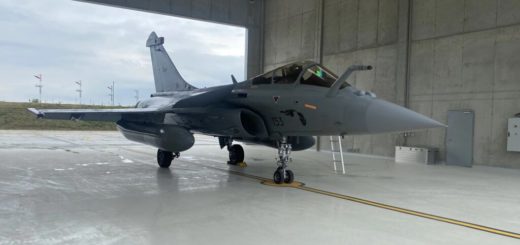
ROCAF F-16V Block 20 fighter in operational service. Taiwan’s upgraded Block 20 fleet will be complemented by 66 newly built F-16V Block 70 aircraft. (Picture source: ROCAF)
The aircraft are being acquired under the Peace Phoenix Soaring program, for which Taiwan allocated NT$247.2 billion between 2020 and 2026. Deliveries were initially expected to be completed by the end of 2026, but the schedule slipped because of the relocation and restart of the F-16 production line, workforce constraints, and supply-chain disruptions. Lockheed Martin subsequently increased production at its Greenville facility by introducing two shifts, with operations running for as much as 20 hours per day. Taiwan had already acknowledged in October 2025 that the full batch would not be delivered within the original timeframe.
According to sources cited by Taiwan’s Central News Agency on August 19, 2026, the first two aircraft left the United States on August 17 and are expected to reach the island after several flight stages adapted to range limitations and crew requirements. The new fighters should be distinguished from the F-16Vs already in Taiwanese service. Under the separate Peace Phoenix Rising program, Aerospace Industrial Development Corporation and Lockheed Martin converted 140 F-16A/B Block 20 aircraft to the F-16V configuration, completing the modernization in December 2023. The Block 70s are newly built airframes designed for a structural service life of 12,000 flight hours. Lockheed Martin states that this figure is more than 50 percent higher than that of earlier production F-16 designs, giving Taiwan an aircraft intended to remain in service for several decades.
At the core of the Block 70 configuration is Northrop Grumman’s AN/APG-83 Scalable Agile Beam Radar, an active electronically scanned array radar based on technologies derived from systems developed for newer U.S. fighter aircraft. It provides faster all-weather target acquisition, improved air and surface search functions, and more flexible electronic beam steering than mechanically scanned radars fitted to older F-16 variants. The aircraft also incorporates an upgraded mission computer and a high-resolution center pedestal display, allowing radar tracks, targeting data, and digital mapping to be integrated within a more unified cockpit architecture.
The 2019 U.S. Foreign Military Sales notification for Taiwan covered 66 F-16C/D Block 70 aircraft, along with 75 General Electric F110 engines and 75 Link 16 systems, including spares. This combination has direct operational relevance. Link 16 allows the fighters to exchange tactical tracks with other compatible airborne platforms, naval units, and command centers, reducing reliance on onboard sensors alone and enabling engagements based on a broader tactical picture. Conformal fuel tanks also increase fuel capacity without occupying the main underwing stations, extending endurance while preserving space for weapons or mission pods.
This additional endurance is already relevant to the ferry flight of the first aircraft. When Taiwan received its original F-16 Block 20s in 1997, the transfer from the continental United States required 19 aerial refuelings and was divided into several stages between Fort Worth, Hawaii, Guam, and Taiwan. The Block 70 changes this calculation. Conformal fuel tanks and other technical differences should allow a different refueling profile, although Taiwanese authorities have not disclosed the current route, the number of tanker contacts, or the total flight duration. These parameters remain sensitive while the transfer is still underway.
Operationally, the F-16V is intended to help Taiwan detect threats earlier, share tactical information more rapidly, and engage targets before they approach the most sensitive areas of Taiwanese airspace. The AN/APG-83 AESA radar can track multiple targets in a dense environment and improve the quality of the tracks presented to the pilot. Link 16 then enables these data to be exchanged with other fighters and ground-based command elements. For Taiwan, this combination may improve the coordination of interceptions against larger opposing formations while reducing the interval between detection and an engagement decision. The conformal fuel tanks also provide greater endurance for air defense patrols without occupying the main underwing stations.
The progressive introduction of the Block 70 comes as Taiwan seeks to maintain the credibility of its air defense in the face of near-continuous Chinese military pressure around the island. Operations by the People’s Liberation Army reduce warning times and place sustained demands on Taiwanese surveillance and interception assets. For Washington, the deliveries reflect the continued implementation of previously approved defense commitments despite industrial delays. For Beijing, the gradual expansion of Taiwan’s F-16V fleet adds another element to an increasingly networked defense architecture. The strategic effect, however, will depend on how quickly Taiwan can absorb the new aircraft, train crews, and integrate them into a force able to continue operating under pressure in one of the Indo-Pacific region’s most contested security environments.
Written By Erwan Halna du Fretay – Defense Analyst, Army Recognition GroupErwan Halna du Fretay holds a Master’s degree in International Relations and has experience studying conflicts and global arms transfers. His research interests lie in Security and strategic studies, particularly the dynamics of the defense industry, the evolution of military technologies, and the strategic transformation of armed forces.
{loadposition bannertop}
{loadposition sidebarpub}
Taiwan began taking delivery of its new F-16V Block 70 fleet after the first two of 66 aircraft departed the United States for the island on August 17. The transfer starts the long-delayed induction of new-build F-16Vs that will expand Taiwan’s air defense capacity and integrate with its existing upgraded F-16 force.
Aircraft 6727 and 6728 are crossing the Pacific with aerial refueling support and at least one maintenance stop, according to sources cited by Taiwan’s Central News Agency on August 19, 2026. The aircraft belong to the NT$247.2 billion Peace Phoenix Soaring program and feature the AN/APG-83 AESA radar, Link 16 connectivity, conformal fuel tanks and General Electric F110 engines. They will join Taiwan’s 140 upgraded F-16A/B Block 20 aircraft as Lockheed Martin works to recover delays that pushed the 66-aircraft delivery program beyond its original 2026 schedule.
Related News: Taiwan to Receive 66 F-16V Fighter Jets by End of 2026
ROCAF F-16V Block 20 fighter in operational service. Taiwan’s upgraded Block 20 fleet will be complemented by 66 newly built F-16V Block 70 aircraft. (Picture source: ROCAF)
The aircraft are being acquired under the Peace Phoenix Soaring program, for which Taiwan allocated NT$247.2 billion between 2020 and 2026. Deliveries were initially expected to be completed by the end of 2026, but the schedule slipped because of the relocation and restart of the F-16 production line, workforce constraints, and supply-chain disruptions. Lockheed Martin subsequently increased production at its Greenville facility by introducing two shifts, with operations running for as much as 20 hours per day. Taiwan had already acknowledged in October 2025 that the full batch would not be delivered within the original timeframe.
According to sources cited by Taiwan’s Central News Agency on August 19, 2026, the first two aircraft left the United States on August 17 and are expected to reach the island after several flight stages adapted to range limitations and crew requirements. The new fighters should be distinguished from the F-16Vs already in Taiwanese service. Under the separate Peace Phoenix Rising program, Aerospace Industrial Development Corporation and Lockheed Martin converted 140 F-16A/B Block 20 aircraft to the F-16V configuration, completing the modernization in December 2023. The Block 70s are newly built airframes designed for a structural service life of 12,000 flight hours. Lockheed Martin states that this figure is more than 50 percent higher than that of earlier production F-16 designs, giving Taiwan an aircraft intended to remain in service for several decades.
At the core of the Block 70 configuration is Northrop Grumman’s AN/APG-83 Scalable Agile Beam Radar, an active electronically scanned array radar based on technologies derived from systems developed for newer U.S. fighter aircraft. It provides faster all-weather target acquisition, improved air and surface search functions, and more flexible electronic beam steering than mechanically scanned radars fitted to older F-16 variants. The aircraft also incorporates an upgraded mission computer and a high-resolution center pedestal display, allowing radar tracks, targeting data, and digital mapping to be integrated within a more unified cockpit architecture.
The 2019 U.S. Foreign Military Sales notification for Taiwan covered 66 F-16C/D Block 70 aircraft, along with 75 General Electric F110 engines and 75 Link 16 systems, including spares. This combination has direct operational relevance. Link 16 allows the fighters to exchange tactical tracks with other compatible airborne platforms, naval units, and command centers, reducing reliance on onboard sensors alone and enabling engagements based on a broader tactical picture. Conformal fuel tanks also increase fuel capacity without occupying the main underwing stations, extending endurance while preserving space for weapons or mission pods.
This additional endurance is already relevant to the ferry flight of the first aircraft. When Taiwan received its original F-16 Block 20s in 1997, the transfer from the continental United States required 19 aerial refuelings and was divided into several stages between Fort Worth, Hawaii, Guam, and Taiwan. The Block 70 changes this calculation. Conformal fuel tanks and other technical differences should allow a different refueling profile, although Taiwanese authorities have not disclosed the current route, the number of tanker contacts, or the total flight duration. These parameters remain sensitive while the transfer is still underway.
Operationally, the F-16V is intended to help Taiwan detect threats earlier, share tactical information more rapidly, and engage targets before they approach the most sensitive areas of Taiwanese airspace. The AN/APG-83 AESA radar can track multiple targets in a dense environment and improve the quality of the tracks presented to the pilot. Link 16 then enables these data to be exchanged with other fighters and ground-based command elements. For Taiwan, this combination may improve the coordination of interceptions against larger opposing formations while reducing the interval between detection and an engagement decision. The conformal fuel tanks also provide greater endurance for air defense patrols without occupying the main underwing stations.
The progressive introduction of the Block 70 comes as Taiwan seeks to maintain the credibility of its air defense in the face of near-continuous Chinese military pressure around the island. Operations by the People’s Liberation Army reduce warning times and place sustained demands on Taiwanese surveillance and interception assets. For Washington, the deliveries reflect the continued implementation of previously approved defense commitments despite industrial delays. For Beijing, the gradual expansion of Taiwan’s F-16V fleet adds another element to an increasingly networked defense architecture. The strategic effect, however, will depend on how quickly Taiwan can absorb the new aircraft, train crews, and integrate them into a force able to continue operating under pressure in one of the Indo-Pacific region’s most contested security environments.
Written By Erwan Halna du Fretay – Defense Analyst, Army Recognition Group
Erwan Halna du Fretay holds a Master’s degree in International Relations and has experience studying conflicts and global arms transfers. His research interests lie in Security and strategic studies, particularly the dynamics of the defense industry, the evolution of military technologies, and the strategic transformation of armed forces.