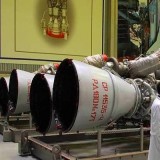
France fires Akeron LP missile from Tiger attack helicopter to test target lock for MkIII upgrade
{loadposition bannertop}
{loadposition sidebarpub}
France conducted the fourth Akeron LP development firing from a Tiger attack helicopter at DGA Essais en Vol in Cazaux, successfully combining pre-launch imaging acquisition, safe separation under aerodynamic disturbances, and target engagement. This test advanced the weapon system toward full Tiger MkIII integration by validating Lock-On Before Launch capabilities. The evaluation bridges basic flight trials and combat sequence interoperability.
The 35 kg multi-role guided missile features a tandem warhead exceeding 1,000 mm RHA penetration, a bidirectional RF data link, and an operational range scaling up to 12 km from helicopters. Developed under the OCCAR-managed MAST-F program by MBDA, Safran, and Thales, the weapon is scheduled for initial deliveries in 2028 to support modernized French and Spanish Tiger fleets.
Related topic: France develops new 68mm anti-drone rocket for Rafale fighter jets and Tiger attack helicopters
France fired an Akeron LP from a Tiger attack helicopter to validate pre-launch target lock and safe missile separation ahead of integration into the future Tiger MkIII standard. (Picture source: French MoD)
On September 25, 2026, France conducted the fourth Akeron LP development firing from a Tiger attack helicopter at DGA Essais en Vol in Cazaux, completing another functional step toward the Tiger MkIII integration. The seeker was activated before release, acquired the designated target in Lock-On Before Launch (LOBL) mode, and remained part of the engagement after the long-range multi-role guided missile separated through the Tiger’s rotor-induced and aerodynamic disturbances. The firing therefore combined three functions in one sequence: pre-launch imaging acquisition, safe helicopter separation and subsequent target engagement. It did not test the more demanding LOAL (Lock-On After Launch)/BLOS (Beyond Line of Sight) sequence using third-party target data, which remains a separate part of the Akeron LP’s intended architecture.
The four firings have each addressed a different engineering problem. On February 5, 2025, a ground-launched prototype confirmed aerodynamics, guidance, booster thrust, main-motor thrust, wing and fin deployment, and an 8 km ground range capability. The second firing, on March 19, 2025, used a Tiger test helicopter at Cazaux and an instrumented missile with a booster and telemetry equipment, concentrating on missile behavior and safe separation under rotor-induced disturbances. On March 24, 2026, a third ground launcher engaged a moving maritime target carried on a barge 6 km away, simultaneously exercising Safran’s semi-active laser guidance and returning seeker imagery throughout flight through the Thales data link. The September 2026 shot added an actual LOBL imaging engagement from the Tiger helicopter, moving testing from basic flight and separation toward an integrated helicopter weapon sequence.
The Akeron LP is a multi-role guided missile measuring 1.8 m long in its tactical canister, 150 mm in diameter, and weighing between 30 and 40 kg (OCCAR specifies a 35 kg ammunition weight). A twin launcher with ammunition weighs 120 kg and a quad launcher 200 kg, while interfaces include 14-inch suspension lugs and MIL-STD-1760. Its seeker combines semi-active laser, TV and uncooled infrared channels, and the operator can select flat, lofted or highly diving trajectories. The tandem multipurpose warhead, for its part, is rated above 1,000 mm RHA penetration and is intended for main battle tanks including ERA-equipped vehicles, lighter armor, structures, personnel and small surface craft. Furthermore, OCCAR’s 2026 planning data specifies a range of at least 12 km from Tiger helicopters and 20 km from a MALE RPAS drone flying at 25,000 ft, while the general MAST-F page lists more than 8 km from a hovering launch.
The missile’s main change from a conventional direct-fire helicopter weapon is that launch, target observation, and terminal control do not have to remain on the same aircraft. The Akeron LP supports LOBL and LOAL, fire-and-forget and man-in-the-loop control, mission abort, target updates, and three guidance channels: SAL, IR, and TV. Its bidirectional RF data link returns seeker imagery while accepting commands, allowing an operator to refine the impact point or update the target after launch. Third-party designation allows a UAV or another sensor to generate targeting information for a Tiger helicopter that does not itself have line of sight to the objective. The 360-degree data-link architecture is also intended to let the carrier maneuver after firing, instead of maintaining a fixed target bearing throughout the entire missile flight.
To exploit those functions, the Tiger MkIII’s sensors and communications upgrades are directly relevant to the Akeron LP’s effective range. The French-Spanish modernization covers 85 Tiger helicopters, including 67 French HAD-F and 18 Spanish HAD-S. The MkIII standard introduces digital avionics, tactical multifunction displays, a digital helmet, rewired internal architecture, Euroflir 510, and the capacity to interact with UAVs. This creates a practical route for supplying target data when terrain prevents the Tiger crew from seeing an objective directly. A target moving at 50 km/h, for example, travels 13.9 m every second, so a 40-second interval between the generation of targeting coordinates and terminal acquisition would permit 556 m of displacement if no subsequent update compensated for movement. That calculation illustrates why the Akeron LP’s RF link, LOAL seeker acquisition, and third-party updates are not secondary features: against mobile targets at the upper end of the missile’s range, they can determine whether the seeker reaches the correct search area at all.
The MAST-F is also a defined production program rather than a small development inventory. France selected the missile in 2020, OCCAR manages the program for France, and MBDA France is the prime contractor, with Safran responsible for the seeker and Thales for the data link. The contracted initial package contains 500 missiles, 100 modular twin or quad launchers and 27 fire-training simulators, plus development, qualification, integration and support. The program value in available information is €566 million through 2031, with initial deliveries scheduled for 2028 and Tiger MkIII equipment from 2029. The same architecture has already been transferred to unmanned ground vehicles under MARSEUS, a 36-month program running from December 2022 to November 2025 with a €27.299 million budget, including €25 million from the European Defence Fund. One configuration integrated the Akeron LP with Milrem Robotics’ Type-X, while the Arquus Drailer MARSEUS can carry as many as eight Akeron LP missiles. UAVs, including the Novadem NX70, supplied remote targeting, testing the same separation between sensor and shooter that the Akeron LP is intended to provide to Tiger MkIII helicopters.
Explore More Defense News
• Land Defense News• Naval Defense News• Defense Aerospace News
Written by Jérôme Brahy
Jérôme Brahy is a defense analyst and documentalist at Army Recognition. He specializes in naval modernization, aviation, drones, armored vehicles, and artillery, with a focus on strategic developments in the United States, China, Ukraine, Russia, South Korea, Türkiye, and Belgium. His analyses go beyond the facts, providing context, identifying key actors, and explaining why defense news matters on a global scale.
{loadposition bannertop}
{loadposition sidebarpub}
France conducted the fourth Akeron LP development firing from a Tiger attack helicopter at DGA Essais en Vol in Cazaux, successfully combining pre-launch imaging acquisition, safe separation under aerodynamic disturbances, and target engagement. This test advanced the weapon system toward full Tiger MkIII integration by validating Lock-On Before Launch capabilities. The evaluation bridges basic flight trials and combat sequence interoperability.
The 35 kg multi-role guided missile features a tandem warhead exceeding 1,000 mm RHA penetration, a bidirectional RF data link, and an operational range scaling up to 12 km from helicopters. Developed under the OCCAR-managed MAST-F program by MBDA, Safran, and Thales, the weapon is scheduled for initial deliveries in 2028 to support modernized French and Spanish Tiger fleets.
Related topic: France develops new 68mm anti-drone rocket for Rafale fighter jets and Tiger attack helicopters
France fired an Akeron LP from a Tiger attack helicopter to validate pre-launch target lock and safe missile separation ahead of integration into the future Tiger MkIII standard. (Picture source: French MoD)
On September 25, 2026, France conducted the fourth Akeron LP development firing from a Tiger attack helicopter at DGA Essais en Vol in Cazaux, completing another functional step toward the Tiger MkIII integration. The seeker was activated before release, acquired the designated target in Lock-On Before Launch (LOBL) mode, and remained part of the engagement after the long-range multi-role guided missile separated through the Tiger’s rotor-induced and aerodynamic disturbances. The firing therefore combined three functions in one sequence: pre-launch imaging acquisition, safe helicopter separation and subsequent target engagement. It did not test the more demanding LOAL (Lock-On After Launch)/BLOS (Beyond Line of Sight) sequence using third-party target data, which remains a separate part of the Akeron LP’s intended architecture.
The four firings have each addressed a different engineering problem. On February 5, 2025, a ground-launched prototype confirmed aerodynamics, guidance, booster thrust, main-motor thrust, wing and fin deployment, and an 8 km ground range capability. The second firing, on March 19, 2025, used a Tiger test helicopter at Cazaux and an instrumented missile with a booster and telemetry equipment, concentrating on missile behavior and safe separation under rotor-induced disturbances. On March 24, 2026, a third ground launcher engaged a moving maritime target carried on a barge 6 km away, simultaneously exercising Safran’s semi-active laser guidance and returning seeker imagery throughout flight through the Thales data link. The September 2026 shot added an actual LOBL imaging engagement from the Tiger helicopter, moving testing from basic flight and separation toward an integrated helicopter weapon sequence.
The Akeron LP is a multi-role guided missile measuring 1.8 m long in its tactical canister, 150 mm in diameter, and weighing between 30 and 40 kg (OCCAR specifies a 35 kg ammunition weight). A twin launcher with ammunition weighs 120 kg and a quad launcher 200 kg, while interfaces include 14-inch suspension lugs and MIL-STD-1760. Its seeker combines semi-active laser, TV and uncooled infrared channels, and the operator can select flat, lofted or highly diving trajectories. The tandem multipurpose warhead, for its part, is rated above 1,000 mm RHA penetration and is intended for main battle tanks including ERA-equipped vehicles, lighter armor, structures, personnel and small surface craft. Furthermore, OCCAR’s 2026 planning data specifies a range of at least 12 km from Tiger helicopters and 20 km from a MALE RPAS drone flying at 25,000 ft, while the general MAST-F page lists more than 8 km from a hovering launch.
The missile’s main change from a conventional direct-fire helicopter weapon is that launch, target observation, and terminal control do not have to remain on the same aircraft. The Akeron LP supports LOBL and LOAL, fire-and-forget and man-in-the-loop control, mission abort, target updates, and three guidance channels: SAL, IR, and TV. Its bidirectional RF data link returns seeker imagery while accepting commands, allowing an operator to refine the impact point or update the target after launch. Third-party designation allows a UAV or another sensor to generate targeting information for a Tiger helicopter that does not itself have line of sight to the objective. The 360-degree data-link architecture is also intended to let the carrier maneuver after firing, instead of maintaining a fixed target bearing throughout the entire missile flight.
To exploit those functions, the Tiger MkIII’s sensors and communications upgrades are directly relevant to the Akeron LP’s effective range. The French-Spanish modernization covers 85 Tiger helicopters, including 67 French HAD-F and 18 Spanish HAD-S. The MkIII standard introduces digital avionics, tactical multifunction displays, a digital helmet, rewired internal architecture, Euroflir 510, and the capacity to interact with UAVs. This creates a practical route for supplying target data when terrain prevents the Tiger crew from seeing an objective directly. A target moving at 50 km/h, for example, travels 13.9 m every second, so a 40-second interval between the generation of targeting coordinates and terminal acquisition would permit 556 m of displacement if no subsequent update compensated for movement. That calculation illustrates why the Akeron LP’s RF link, LOAL seeker acquisition, and third-party updates are not secondary features: against mobile targets at the upper end of the missile’s range, they can determine whether the seeker reaches the correct search area at all.
The MAST-F is also a defined production program rather than a small development inventory. France selected the missile in 2020, OCCAR manages the program for France, and MBDA France is the prime contractor, with Safran responsible for the seeker and Thales for the data link. The contracted initial package contains 500 missiles, 100 modular twin or quad launchers and 27 fire-training simulators, plus development, qualification, integration and support. The program value in available information is €566 million through 2031, with initial deliveries scheduled for 2028 and Tiger MkIII equipment from 2029. The same architecture has already been transferred to unmanned ground vehicles under MARSEUS, a 36-month program running from December 2022 to November 2025 with a €27.299 million budget, including €25 million from the European Defence Fund. One configuration integrated the Akeron LP with Milrem Robotics’ Type-X, while the Arquus Drailer MARSEUS can carry as many as eight Akeron LP missiles. UAVs, including the Novadem NX70, supplied remote targeting, testing the same separation between sensor and shooter that the Akeron LP is intended to provide to Tiger MkIII helicopters.
Explore More Defense News
• Land Defense News
• Naval Defense News
• Defense Aerospace News
Written by Jérôme Brahy
Jérôme Brahy is a defense analyst and documentalist at Army Recognition. He specializes in naval modernization, aviation, drones, armored vehicles, and artillery, with a focus on strategic developments in the United States, China, Ukraine, Russia, South Korea, Türkiye, and Belgium. His analyses go beyond the facts, providing context, identifying key actors, and explaining why defense news matters on a global scale.