British Eurofighter Typhoon Shoots Down Iranian Drone Approaching Qatari Territory
{loadposition bannertop}
{loadposition sidebarpub}
A Royal Air Force Typhoon deployed to Qatar shot down an Iranian drone on 1 March 2026 before it could enter Qatari airspace, according to the UK Ministry of Defence. The intercept underscores growing UAV threats across the Gulf and highlights the UK’s commitment to defending Qatari territory and regional stability.
On 1 March 2026, a Royal Air Force Typhoon operating from Qatar as part of the joint UK–Qatar Typhoon Squadron shot down an Iranian drone heading towards Qatari territory, based on a statement issued by the UK Ministry of Defence on its official X account. This intercept occurred against a regional backdrop where long-range drones and missiles are increasingly used as tools of coercion and signalling, turning Gulf airspace into a contested environment. By engaging the inbound unmanned aircraft before it could enter Qatari airspace, the joint squadron demonstrated that coalition skies around Doha and key bases will not be treated as permissive for hostile UAVs. The episode is significant both as a concrete example of allied air defence in action and as a political message about the UK’s determination to protect Qatari security and British interests in the region, as underlined by the Ministry of Defence’s communication.
Follow Army Recognition on Google News at this link
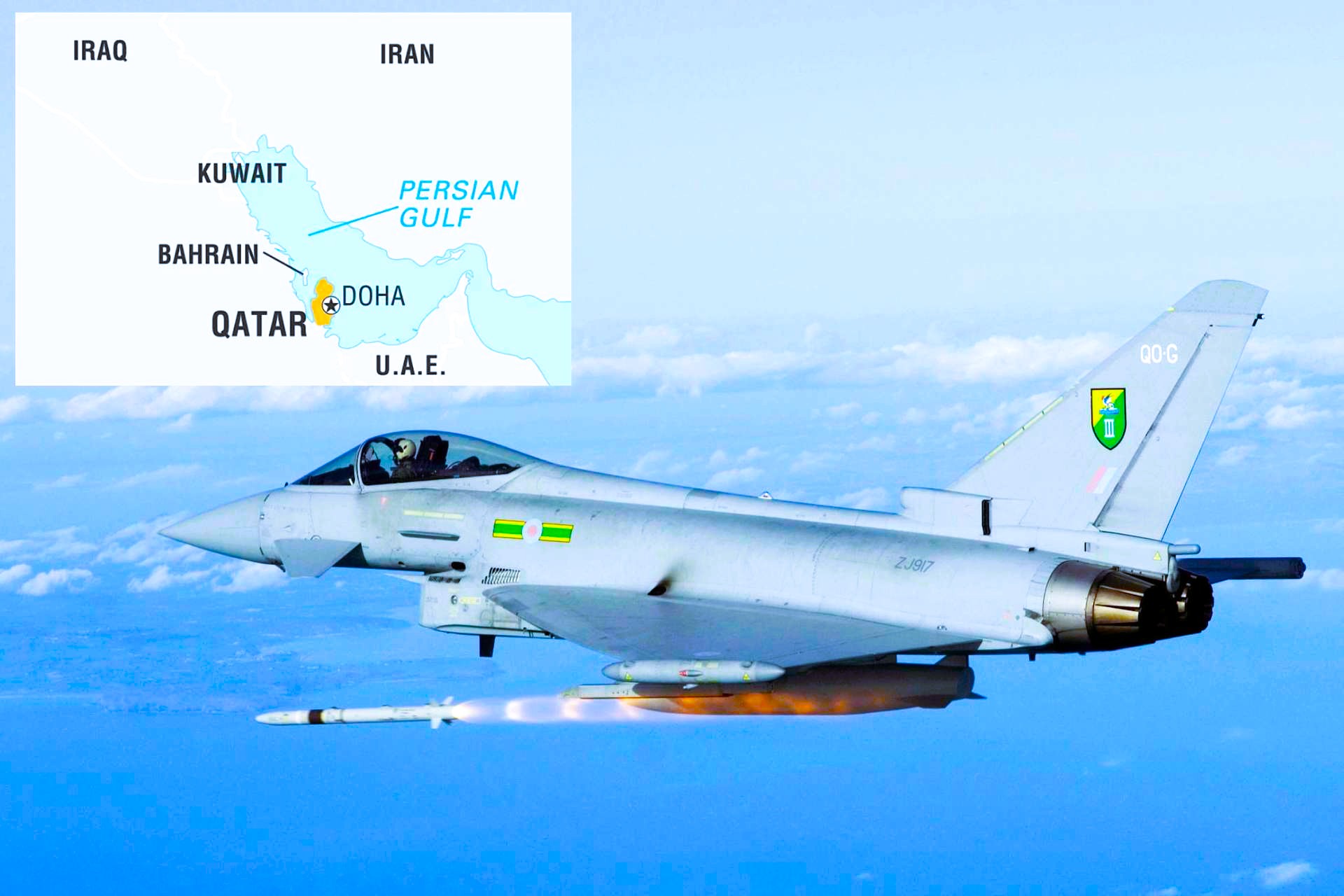
This image shows a 3(F) Squadron RAF Eurofighter Typhoon based at RAF Coningsby firing an ASRAAM missile at a Mirach target drone’s towed flare pack over the Aberporth range in Wales, and is for illustrative purposes only, not from the operation itself (Picture Source: Britannica / UK Ministry of Defence)
The Ministry of Defence explained that the Typhoon was conducting a defensive combat air patrol over Qatar when it was tasked to intercept the Iranian drone, which was on a heading towards Qatari territory. Operating in a defensive counter air posture, the fighter was likely integrated into a wider recognised air picture, receiving cueing from ground-based and airborne sensors via tactical datalinks such as Link 16. Within that kill chain, the Typhoon crew would have executed the classic sequence of detection, identification under strict rules of engagement, decision at the appropriate command level and engagement with an air-to-air weapon, followed by assessment of the intercept. This chain ensured that the drone was brought down outside Qatari airspace, reducing risks to populated areas and critical infrastructure while maintaining airspace integrity for friendly traffic.
The aircraft involved is understood to be a Typhoon FGR4 assigned to the joint UK–Qatar No. 12 Squadron detachment in Qatar, a mixed unit that combines RAF and Qatar Emiri Air Force personnel on a common Eurofighter platform. Since their deployment, these aircraft have provided a standing quick reaction alert–type capability in the Gulf, able to scramble rapidly or maintain airborne CAP orbits over key sectors. Based at Qatar’s main air hub and operating alongside Qatari and other allied assets, the squadron contributes not only aircraft but also shared tactics, techniques and procedures, building a common operational culture around the Typhoon. This binational construct gives Qatar access to RAF experience in high-end air defence operations, while allowing the UK to project a credible, combat-ready airpower presence into a strategically vital region.
From a technical standpoint, the Typhoon FGR4 is well suited to this kind of counter-UAS mission. Its Captor-M radar and associated processing can detect and track relatively small targets at medium ranges, while onboard electronic support measures and the infrared search and track system add passive detection options. The pilot’s helmet-mounted sight and wide field of view facilitate visual acquisition during the within visual range phase of an intercept, especially important when ROE demand positive identification of small, low-flying drones. Driven by two EJ200 turbofans with a high thrust-to-weight ratio, the aircraft can reposition quickly across its patrol box, executing high-G manoeuvres to build a favourable intercept geometry. On a typical air defence sortie in the region, the Typhoon would launch carrying a mixed air-to-air loadout, often combining beyond visual range missiles such as Meteor or AIM-120 AMRAAM with short-range ASRAAM, backed up by the 27 mm Mauser cannon, plus external tanks for endurance
The Ministry of Defence has stated only that an air-to-air missile was used to destroy the drone and has not disclosed which weapon was employed. In RAF service, the primary air-to-air armament for Typhoon currently consists of the MBDA Meteor for long-range, beyond visual range engagements, the AIM-120 AMRAAM still present on some loadouts, and the MBDA ASRAAM for within visual range combat. Meteor, with its ramjet propulsion, large no-escape zone and active radar seeker, is optimised for high-value airborne threats such as fighter aircraft or larger cruise missiles at extended ranges, allowing the Typhoon to prosecute targets well before they approach defended airspace. ASRAAM, by contrast, is a high off-boresight, imaging infrared missile designed to be cued rapidly once the target is visually or electro-optically acquired, providing a very agile and responsive option in the WVR regime. Against a single unmanned aircraft approaching a friendly airspace boundary, both weapons are technically capable of achieving a kill, but they would be employed in different engagement geometries and at different ranges depending on the tactical picture and ROE.
Based on the limited information released, many features of the scenario point towards a within visual range engagement profile. The Typhoon was on a defensive CAP close to Qatari airspace, operating under strict identification requirements and seeking to minimise the risk of debris over populated or sensitive areas, conditions that favour closing the distance before weapons release. In such a WVR context, ASRAAM’s high agility and imaging infrared seeker make it particularly suitable for engaging small, low-flying drones once they have been positively identified, and the weapon has already been demonstrated in RAF service against similar unmanned targets. Meteor would remain a powerful option if the engagement were initiated at longer range in a pure BVR intercept, but its extended range and cost profile make it a tool more commonly reserved for higher-value or more complex airborne threats. It therefore appears slightly more likely, from a tactical and doctrinal perspective, that a short-range missile such as ASRAAM was employed, although this remains an analytical assessment only; the absence of official confirmation suggests a deliberate decision by the Ministry of Defence not to disclose details of the weapons envelope and tactics applied by the joint squadron.
The shoot-down illustrates the role of UK Typhoons as a key manned layer within the wider integrated air and missile defence architecture in and around Qatar. Ground-based air defence systems and allied fighters provide outer and inner rings of protection, but a fast-jet CAP offers a uniquely flexible, reusable interceptor that can be retasked within minutes to new axes of approach. By neutralising a hostile drone before it could threaten Qatari airspace, the joint UK–Qatar Typhoon Squadron has demonstrated how manned fighters remain central to counter-UAS missions, especially in complex airspace where civil traffic, friendly military flights and multiple tracks must be deconflicted. The ability to swing quickly between barrier CAP, point defence of key assets and reactive vectoring against emerging threats ensures that Eurofighter formations can plug gaps that ground systems alone might not cover, particularly against low-observable, low-altitude drones exploiting terrain and radar coverage limits.
At the strategic level, this interception sends a clear signal that airspace around Qatar, its energy infrastructure and the multinational bases on its territory will be actively defended against long-range drones launched from outside the Gulf. For Iran and other regional actors, the event underlines that employing unmanned systems in a grey-zone role near Qatari airspace carries a real risk of interception and loss, even without escalating to wider offensive operations. For Doha, the performance of the joint Typhoon squadron reinforces the value of close defence cooperation with the UK in securing national airspace and the approaches to critical LNG terminals and air bases. For London, authorising the use of force in this scenario shows that deployed RAF units are not merely symbolic presences but integrated, combat-ready assets contributing to regional deterrence and reassurance of allies.
The downing of the Iranian drone by a Typhoon of the joint UK–Qatar Squadron stands as a concrete demonstration of how advanced fighters, modern air-to-air missiles and binational command arrangements combine to protect a small but strategically vital state at the heart of the Gulf. This engagement confirms the operational maturity of the Eurofighter force deployed to Qatar and highlights the importance of preserving a decisive manned interceptor capability alongside ground-based systems in any credible air defence posture. As long-range unmanned threats continue to proliferate and evolve, the ability of RAF and Qatari crews to detect, identify and, when required, engage hostile drones over the Gulf will shape both the effectiveness of regional air defence and the broader balance of power in the skies around Qatar.
Written by Teoman S. Nicanci – Defense Analyst, Army Recognition Group
Teoman S. Nicanci holds degrees in Political Science, Comparative and International Politics, and International Relations and Diplomacy from leading Belgian universities, with research focused on Russian strategic behavior, defense technology, and modern warfare. He is a defense analyst at Army Recognition, specializing in the global defense industry, military armament, and emerging defense technologies.
{loadposition bannertop}
{loadposition sidebarpub}
A Royal Air Force Typhoon deployed to Qatar shot down an Iranian drone on 1 March 2026 before it could enter Qatari airspace, according to the UK Ministry of Defence. The intercept underscores growing UAV threats across the Gulf and highlights the UK’s commitment to defending Qatari territory and regional stability.
On 1 March 2026, a Royal Air Force Typhoon operating from Qatar as part of the joint UK–Qatar Typhoon Squadron shot down an Iranian drone heading towards Qatari territory, based on a statement issued by the UK Ministry of Defence on its official X account. This intercept occurred against a regional backdrop where long-range drones and missiles are increasingly used as tools of coercion and signalling, turning Gulf airspace into a contested environment. By engaging the inbound unmanned aircraft before it could enter Qatari airspace, the joint squadron demonstrated that coalition skies around Doha and key bases will not be treated as permissive for hostile UAVs. The episode is significant both as a concrete example of allied air defence in action and as a political message about the UK’s determination to protect Qatari security and British interests in the region, as underlined by the Ministry of Defence’s communication.
This image shows a 3(F) Squadron RAF Eurofighter Typhoon based at RAF Coningsby firing an ASRAAM missile at a Mirach target drone’s towed flare pack over the Aberporth range in Wales, and is for illustrative purposes only, not from the operation itself (Picture Source: Britannica / UK Ministry of Defence)
The Ministry of Defence explained that the Typhoon was conducting a defensive combat air patrol over Qatar when it was tasked to intercept the Iranian drone, which was on a heading towards Qatari territory. Operating in a defensive counter air posture, the fighter was likely integrated into a wider recognised air picture, receiving cueing from ground-based and airborne sensors via tactical datalinks such as Link 16. Within that kill chain, the Typhoon crew would have executed the classic sequence of detection, identification under strict rules of engagement, decision at the appropriate command level and engagement with an air-to-air weapon, followed by assessment of the intercept. This chain ensured that the drone was brought down outside Qatari airspace, reducing risks to populated areas and critical infrastructure while maintaining airspace integrity for friendly traffic.
The aircraft involved is understood to be a Typhoon FGR4 assigned to the joint UK–Qatar No. 12 Squadron detachment in Qatar, a mixed unit that combines RAF and Qatar Emiri Air Force personnel on a common Eurofighter platform. Since their deployment, these aircraft have provided a standing quick reaction alert–type capability in the Gulf, able to scramble rapidly or maintain airborne CAP orbits over key sectors. Based at Qatar’s main air hub and operating alongside Qatari and other allied assets, the squadron contributes not only aircraft but also shared tactics, techniques and procedures, building a common operational culture around the Typhoon. This binational construct gives Qatar access to RAF experience in high-end air defence operations, while allowing the UK to project a credible, combat-ready airpower presence into a strategically vital region.
From a technical standpoint, the Typhoon FGR4 is well suited to this kind of counter-UAS mission. Its Captor-M radar and associated processing can detect and track relatively small targets at medium ranges, while onboard electronic support measures and the infrared search and track system add passive detection options. The pilot’s helmet-mounted sight and wide field of view facilitate visual acquisition during the within visual range phase of an intercept, especially important when ROE demand positive identification of small, low-flying drones. Driven by two EJ200 turbofans with a high thrust-to-weight ratio, the aircraft can reposition quickly across its patrol box, executing high-G manoeuvres to build a favourable intercept geometry. On a typical air defence sortie in the region, the Typhoon would launch carrying a mixed air-to-air loadout, often combining beyond visual range missiles such as Meteor or AIM-120 AMRAAM with short-range ASRAAM, backed up by the 27 mm Mauser cannon, plus external tanks for endurance
The Ministry of Defence has stated only that an air-to-air missile was used to destroy the drone and has not disclosed which weapon was employed. In RAF service, the primary air-to-air armament for Typhoon currently consists of the MBDA Meteor for long-range, beyond visual range engagements, the AIM-120 AMRAAM still present on some loadouts, and the MBDA ASRAAM for within visual range combat. Meteor, with its ramjet propulsion, large no-escape zone and active radar seeker, is optimised for high-value airborne threats such as fighter aircraft or larger cruise missiles at extended ranges, allowing the Typhoon to prosecute targets well before they approach defended airspace. ASRAAM, by contrast, is a high off-boresight, imaging infrared missile designed to be cued rapidly once the target is visually or electro-optically acquired, providing a very agile and responsive option in the WVR regime. Against a single unmanned aircraft approaching a friendly airspace boundary, both weapons are technically capable of achieving a kill, but they would be employed in different engagement geometries and at different ranges depending on the tactical picture and ROE.
Based on the limited information released, many features of the scenario point towards a within visual range engagement profile. The Typhoon was on a defensive CAP close to Qatari airspace, operating under strict identification requirements and seeking to minimise the risk of debris over populated or sensitive areas, conditions that favour closing the distance before weapons release. In such a WVR context, ASRAAM’s high agility and imaging infrared seeker make it particularly suitable for engaging small, low-flying drones once they have been positively identified, and the weapon has already been demonstrated in RAF service against similar unmanned targets. Meteor would remain a powerful option if the engagement were initiated at longer range in a pure BVR intercept, but its extended range and cost profile make it a tool more commonly reserved for higher-value or more complex airborne threats. It therefore appears slightly more likely, from a tactical and doctrinal perspective, that a short-range missile such as ASRAAM was employed, although this remains an analytical assessment only; the absence of official confirmation suggests a deliberate decision by the Ministry of Defence not to disclose details of the weapons envelope and tactics applied by the joint squadron.
The shoot-down illustrates the role of UK Typhoons as a key manned layer within the wider integrated air and missile defence architecture in and around Qatar. Ground-based air defence systems and allied fighters provide outer and inner rings of protection, but a fast-jet CAP offers a uniquely flexible, reusable interceptor that can be retasked within minutes to new axes of approach. By neutralising a hostile drone before it could threaten Qatari airspace, the joint UK–Qatar Typhoon Squadron has demonstrated how manned fighters remain central to counter-UAS missions, especially in complex airspace where civil traffic, friendly military flights and multiple tracks must be deconflicted. The ability to swing quickly between barrier CAP, point defence of key assets and reactive vectoring against emerging threats ensures that Eurofighter formations can plug gaps that ground systems alone might not cover, particularly against low-observable, low-altitude drones exploiting terrain and radar coverage limits.
At the strategic level, this interception sends a clear signal that airspace around Qatar, its energy infrastructure and the multinational bases on its territory will be actively defended against long-range drones launched from outside the Gulf. For Iran and other regional actors, the event underlines that employing unmanned systems in a grey-zone role near Qatari airspace carries a real risk of interception and loss, even without escalating to wider offensive operations. For Doha, the performance of the joint Typhoon squadron reinforces the value of close defence cooperation with the UK in securing national airspace and the approaches to critical LNG terminals and air bases. For London, authorising the use of force in this scenario shows that deployed RAF units are not merely symbolic presences but integrated, combat-ready assets contributing to regional deterrence and reassurance of allies.
The downing of the Iranian drone by a Typhoon of the joint UK–Qatar Squadron stands as a concrete demonstration of how advanced fighters, modern air-to-air missiles and binational command arrangements combine to protect a small but strategically vital state at the heart of the Gulf. This engagement confirms the operational maturity of the Eurofighter force deployed to Qatar and highlights the importance of preserving a decisive manned interceptor capability alongside ground-based systems in any credible air defence posture. As long-range unmanned threats continue to proliferate and evolve, the ability of RAF and Qatari crews to detect, identify and, when required, engage hostile drones over the Gulf will shape both the effectiveness of regional air defence and the broader balance of power in the skies around Qatar.
Written by Teoman S. Nicanci – Defense Analyst, Army Recognition Group
Teoman S. Nicanci holds degrees in Political Science, Comparative and International Politics, and International Relations and Diplomacy from leading Belgian universities, with research focused on Russian strategic behavior, defense technology, and modern warfare. He is a defense analyst at Army Recognition, specializing in the global defense industry, military armament, and emerging defense technologies.