Canada Moves to Acquire Saab GlobalEye Intelligence Aircraft for Arctic Defense
{loadposition bannertop}
{loadposition sidebarpub}
Canada has entered negotiations with Swedish defense company Saab to acquire the GlobalEye Airborne Early Warning and Control (AEW&C) aircraft as part of a broader effort to strengthen Arctic defense and reinforce North American air defense capabilities. Announced by Prime Minister Mark Carney on May 27, 2026, during the CANSEC defense exhibition in Ottawa, the move reflects growing concerns over Russia’s Arctic military buildup, China’s expanding Arctic strategy, and the need to modernize Canada’s contribution to NORAD’s continental defense mission.
The proposed acquisition would provide the Canadian Armed Forces with one of the most advanced airborne surveillance and command-and-control capabilities currently available. According to the Canadian government, GlobalEye would enhance Canada’s ability to detect, track, and deter threats across the Arctic and surrounding approaches while delivering real-time intelligence to Canadian and allied forces. The aircraft can monitor air, sea, and land activity simultaneously and detect targets at distances of up to 650 km.Related Topic: NATO eyes Swedish Saab GlobalEye to replace 14 E-3 AWACS planes in historic shift from the U.S.
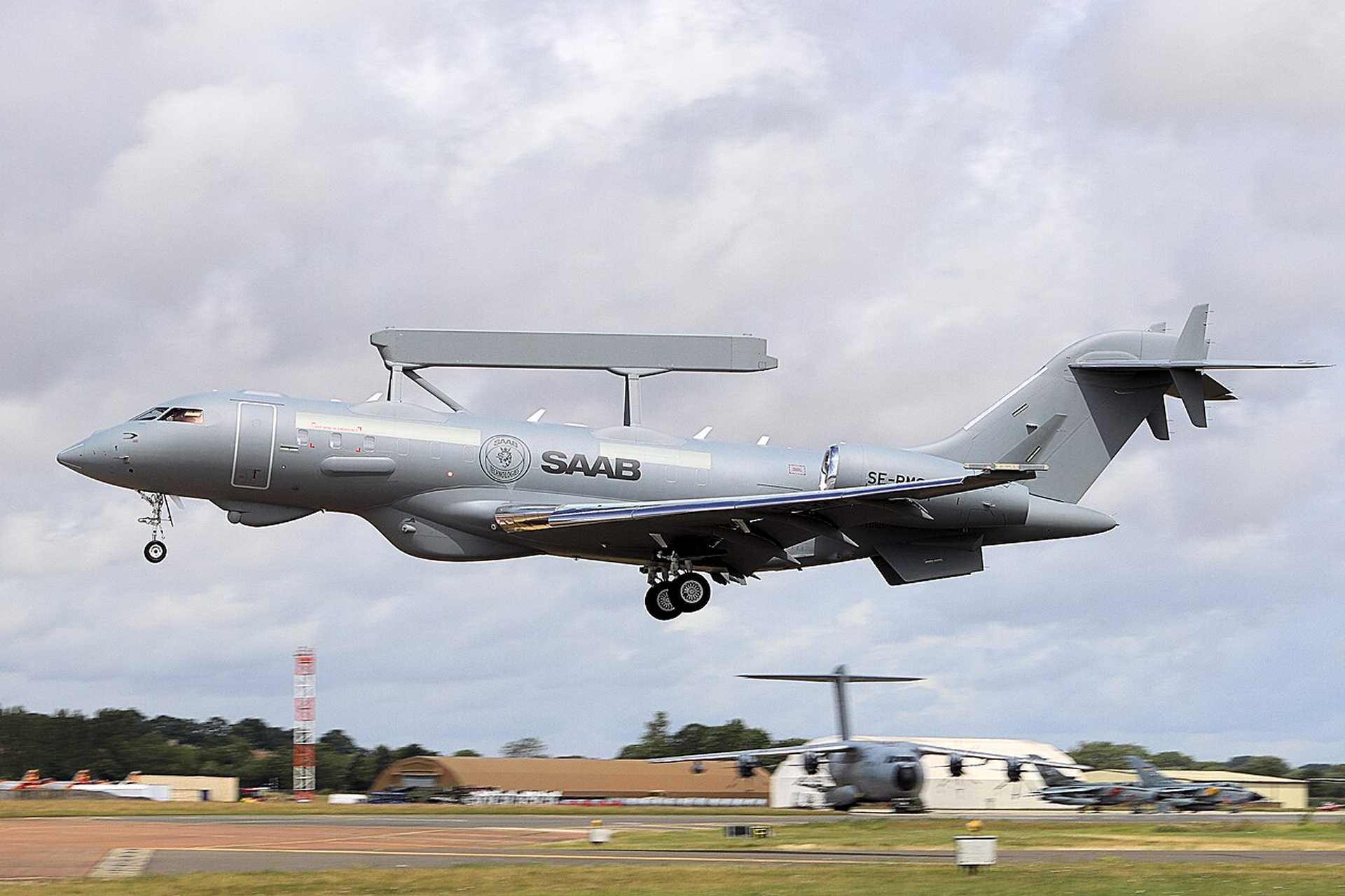
Saab GlobalEye is a next-generation Airborne Early Warning and Control (AEW&C) aircraft that combines long-range air, maritime, and ground surveillance with real-time command-and-control capabilities, enabling detection of threats at distances exceeding 650 km. (Picture source: Wikimedia)
The announcement comes at a time when the Arctic is emerging as one of the world’s most strategically contested regions. Russia has spent more than a decade rebuilding Cold War-era military infrastructure across its northern territories, including airfields, radar stations, missile defense sites, and naval facilities capable of supporting strategic bomber operations and long-range missile deployments. The region has become increasingly important to Moscow’s ability to project power into the North Atlantic and approach North America through northern air and maritime corridors.
At the same time, China has steadily increased its political, economic, and scientific presence in the Arctic, asserting its status as a “near-Arctic state.” Beijing’s investments in polar research, Arctic shipping routes, satellite infrastructure, and dual-use technologies have raised concerns among Western defense planners. While China’s Arctic presence remains limited compared with Russia’s, NATO and NORAD officials increasingly view Arctic developments through a broader strategic competition framework involving both powers.
Against this backdrop, Canada’s interest in the GlobalEye represents far more than a routine aircraft procurement. It is part of a larger effort to improve situational awareness across vast northern territories, where limited infrastructure, extreme weather conditions, and immense distances create persistent challenges for persistent surveillance. The aircraft would provide mobile sensor coverage in areas where ground-based radar systems alone cannot guarantee continuous monitoring.
The Canadian government has entered into negotiations with Saab to buy its GlobalEye airborne early warning platform, to be built on a Bombardier 6500 executive jet at Saab’s plant in Toronto.
The GlobalEye is built on the Bombardier Global 6000/6500 long-range business jet and integrates multiple surveillance systems into a single AEW&C aircraft. At its core is Saab’s Erieye Extended Range radar, an Active Electronically Scanned Array (AESA) system capable of detecting and tracking airborne threats over very large areas. Unlike conventional mechanically scanned radars, AESA technology offers greater resistance to jamming, faster target updates, improved reliability, and enhanced performance against low-observable and low-flying targets.
The aircraft’s surveillance capabilities extend well beyond traditional airborne warning missions. In addition to air surveillance, GlobalEye incorporates maritime surveillance radar, electro-optical sensors, electronic support measures, and advanced command-and-control systems. This enables operators to simultaneously monitor aircraft, ships, cruise missiles, ground vehicles, and electronic emissions from a single aircraft. The result is a comprehensive multi-domain intelligence picture that can be distributed in real time to military commanders, fighter aircraft, naval forces, and allied headquarters.
The comparison with the aging Boeing E-3 Sentry AWACS highlights why GlobalEye has attracted growing international attention. While the E-3 remains a highly capable airborne warning aircraft, its design dates back to the Cold War and focuses primarily on airspace surveillance. GlobalEye was developed for modern multi-domain operations, combining airborne early warning, maritime monitoring, electronic intelligence, and ground surveillance within a more fuel-efficient and lower-maintenance airframe. This allows military forces to perform a broader range of missions with fewer assets while maintaining persistent coverage over large operational areas.
For Canada, these capabilities have direct implications for NORAD modernization. The United States and Canada have launched major initiatives to upgrade the binational command’s ability to detect and respond to emerging threats, particularly advanced cruise missiles, hypersonic weapons, long-range unmanned aerial systems, and strategic bomber operations. Traditional radar networks provide essential coverage, but airborne surveillance assets add mobility, flexibility, and depth that fixed installations cannot match.
A GlobalEye fleet would significantly enhance NORAD’s layered sensor architecture by extending surveillance beyond the reach of ground-based systems and providing earlier warning of potential threats approaching North American airspace. By operating hundreds of kilometers from anticipated threat axes, the aircraft could detect hostile activity sooner, allowing fighter aircraft, missile defense systems, and command centers more time to respond.
In this episode of Let’s Talk About Tech we explore the critical role of Airborne Early Warning & Control (AEW&C) systems in modern defense.
The Arctic dimension of this capability is particularly important. Climate change is increasing access to northern shipping routes and opening previously inaccessible areas to commercial and military activity. As traffic across the Arctic Ocean and surrounding waterways increases, Canada faces growing demands to monitor aircraft, vessels, and other activities within its areas of responsibility. Persistent airborne surveillance offers a critical tool for maintaining sovereignty and ensuring rapid awareness of developing situations.
The aircraft could also play a key role in supporting Canadian military operations beyond homeland defense. GlobalEye’s ability to share real-time intelligence with allied forces makes it valuable for NATO missions, maritime security operations, expeditionary deployments, and coalition air campaigns. Its interoperability with Western command-and-control networks would strengthen Canada’s ability to contribute to multinational operations while improving coordination with key allies.
The selection of GlobalEye would also carry industrial significance. Because the aircraft is based on Bombardier’s Canadian-designed Global business jet family, the program could create opportunities for domestic aerospace companies in maintenance, support, systems integration, and long-term sustainment. Such industrial participation could strengthen Canada’s aerospace sector while supporting national defense objectives.
International demand for advanced airborne surveillance aircraft has increased significantly as militaries seek to improve battlefield awareness and shorten decision-making timelines. Existing GlobalEye operators include the United Arab Emirates, while Sweden has committed to the aircraft as part of its own defense modernization strategy. Several NATO members are also evaluating next-generation airborne surveillance solutions to address increasingly complex threat environments.
If negotiations result in a formal acquisition agreement, GlobalEye would become one of the most strategically important defense procurements undertaken by Canada in recent years. Beyond providing a new airborne surveillance capability, the aircraft would strengthen Canada’s contribution to NORAD modernization, improve Arctic defense, support continental security, and enhance the ability of Canadian and allied forces to detect and respond to threats across one of the world’s most challenging operational environments.
At a time when Russia continues to expand its military capabilities across the Arctic, and China pursues a long-term strategy to increase its influence in the polar region, Canada’s move to acquire the GlobalEye reflects a broader recognition that early warning, persistent surveillance, and information superiority are becoming decisive factors in North American defense. The aircraft’s combination of long-range detection, multi-domain intelligence collection, and real-time command-and-control capabilities would provide Canada with a powerful tool to protect its northern approaches and contribute to the security architecture defending the continent.
Explore More Defense News
• Land Defense News• Naval Defense News• Defense Aerospace NewsWritten by Alain Servaes – Chief Editor, Army Recognition GroupAlain Servaes is a former infantry non-commissioned officer and the founder of Army Recognition. With over 20 years in defense journalism, he provides expert analysis on military equipment, NATO operations, and the global defense industry.
{loadposition bannertop}
{loadposition sidebarpub}
Canada has entered negotiations with Swedish defense company Saab to acquire the GlobalEye Airborne Early Warning and Control (AEW&C) aircraft as part of a broader effort to strengthen Arctic defense and reinforce North American air defense capabilities. Announced by Prime Minister Mark Carney on May 27, 2026, during the CANSEC defense exhibition in Ottawa, the move reflects growing concerns over Russia’s Arctic military buildup, China’s expanding Arctic strategy, and the need to modernize Canada’s contribution to NORAD’s continental defense mission.
The proposed acquisition would provide the Canadian Armed Forces with one of the most advanced airborne surveillance and command-and-control capabilities currently available. According to the Canadian government, GlobalEye would enhance Canada’s ability to detect, track, and deter threats across the Arctic and surrounding approaches while delivering real-time intelligence to Canadian and allied forces. The aircraft can monitor air, sea, and land activity simultaneously and detect targets at distances of up to 650 km.
Related Topic: NATO eyes Swedish Saab GlobalEye to replace 14 E-3 AWACS planes in historic shift from the U.S.
Saab GlobalEye is a next-generation Airborne Early Warning and Control (AEW&C) aircraft that combines long-range air, maritime, and ground surveillance with real-time command-and-control capabilities, enabling detection of threats at distances exceeding 650 km. (Picture source: Wikimedia)
The announcement comes at a time when the Arctic is emerging as one of the world’s most strategically contested regions. Russia has spent more than a decade rebuilding Cold War-era military infrastructure across its northern territories, including airfields, radar stations, missile defense sites, and naval facilities capable of supporting strategic bomber operations and long-range missile deployments. The region has become increasingly important to Moscow’s ability to project power into the North Atlantic and approach North America through northern air and maritime corridors.
At the same time, China has steadily increased its political, economic, and scientific presence in the Arctic, asserting its status as a “near-Arctic state.” Beijing’s investments in polar research, Arctic shipping routes, satellite infrastructure, and dual-use technologies have raised concerns among Western defense planners. While China’s Arctic presence remains limited compared with Russia’s, NATO and NORAD officials increasingly view Arctic developments through a broader strategic competition framework involving both powers.
Against this backdrop, Canada’s interest in the GlobalEye represents far more than a routine aircraft procurement. It is part of a larger effort to improve situational awareness across vast northern territories, where limited infrastructure, extreme weather conditions, and immense distances create persistent challenges for persistent surveillance. The aircraft would provide mobile sensor coverage in areas where ground-based radar systems alone cannot guarantee continuous monitoring.
The Canadian government has entered into negotiations with Saab to buy its GlobalEye airborne early warning platform, to be built on a Bombardier 6500 executive jet at Saab’s plant in Toronto.
The GlobalEye is built on the Bombardier Global 6000/6500 long-range business jet and integrates multiple surveillance systems into a single AEW&C aircraft. At its core is Saab’s Erieye Extended Range radar, an Active Electronically Scanned Array (AESA) system capable of detecting and tracking airborne threats over very large areas. Unlike conventional mechanically scanned radars, AESA technology offers greater resistance to jamming, faster target updates, improved reliability, and enhanced performance against low-observable and low-flying targets.
The aircraft’s surveillance capabilities extend well beyond traditional airborne warning missions. In addition to air surveillance, GlobalEye incorporates maritime surveillance radar, electro-optical sensors, electronic support measures, and advanced command-and-control systems. This enables operators to simultaneously monitor aircraft, ships, cruise missiles, ground vehicles, and electronic emissions from a single aircraft. The result is a comprehensive multi-domain intelligence picture that can be distributed in real time to military commanders, fighter aircraft, naval forces, and allied headquarters.
The comparison with the aging Boeing E-3 Sentry AWACS highlights why GlobalEye has attracted growing international attention. While the E-3 remains a highly capable airborne warning aircraft, its design dates back to the Cold War and focuses primarily on airspace surveillance. GlobalEye was developed for modern multi-domain operations, combining airborne early warning, maritime monitoring, electronic intelligence, and ground surveillance within a more fuel-efficient and lower-maintenance airframe. This allows military forces to perform a broader range of missions with fewer assets while maintaining persistent coverage over large operational areas.
For Canada, these capabilities have direct implications for NORAD modernization. The United States and Canada have launched major initiatives to upgrade the binational command’s ability to detect and respond to emerging threats, particularly advanced cruise missiles, hypersonic weapons, long-range unmanned aerial systems, and strategic bomber operations. Traditional radar networks provide essential coverage, but airborne surveillance assets add mobility, flexibility, and depth that fixed installations cannot match.
A GlobalEye fleet would significantly enhance NORAD’s layered sensor architecture by extending surveillance beyond the reach of ground-based systems and providing earlier warning of potential threats approaching North American airspace. By operating hundreds of kilometers from anticipated threat axes, the aircraft could detect hostile activity sooner, allowing fighter aircraft, missile defense systems, and command centers more time to respond.
In this episode of Let’s Talk About Tech we explore the critical role of Airborne Early Warning & Control (AEW&C) systems in modern defense.
The Arctic dimension of this capability is particularly important. Climate change is increasing access to northern shipping routes and opening previously inaccessible areas to commercial and military activity. As traffic across the Arctic Ocean and surrounding waterways increases, Canada faces growing demands to monitor aircraft, vessels, and other activities within its areas of responsibility. Persistent airborne surveillance offers a critical tool for maintaining sovereignty and ensuring rapid awareness of developing situations.
The aircraft could also play a key role in supporting Canadian military operations beyond homeland defense. GlobalEye’s ability to share real-time intelligence with allied forces makes it valuable for NATO missions, maritime security operations, expeditionary deployments, and coalition air campaigns. Its interoperability with Western command-and-control networks would strengthen Canada’s ability to contribute to multinational operations while improving coordination with key allies.
The selection of GlobalEye would also carry industrial significance. Because the aircraft is based on Bombardier’s Canadian-designed Global business jet family, the program could create opportunities for domestic aerospace companies in maintenance, support, systems integration, and long-term sustainment. Such industrial participation could strengthen Canada’s aerospace sector while supporting national defense objectives.
International demand for advanced airborne surveillance aircraft has increased significantly as militaries seek to improve battlefield awareness and shorten decision-making timelines. Existing GlobalEye operators include the United Arab Emirates, while Sweden has committed to the aircraft as part of its own defense modernization strategy. Several NATO members are also evaluating next-generation airborne surveillance solutions to address increasingly complex threat environments.
If negotiations result in a formal acquisition agreement, GlobalEye would become one of the most strategically important defense procurements undertaken by Canada in recent years. Beyond providing a new airborne surveillance capability, the aircraft would strengthen Canada’s contribution to NORAD modernization, improve Arctic defense, support continental security, and enhance the ability of Canadian and allied forces to detect and respond to threats across one of the world’s most challenging operational environments.
At a time when Russia continues to expand its military capabilities across the Arctic, and China pursues a long-term strategy to increase its influence in the polar region, Canada’s move to acquire the GlobalEye reflects a broader recognition that early warning, persistent surveillance, and information superiority are becoming decisive factors in North American defense. The aircraft’s combination of long-range detection, multi-domain intelligence collection, and real-time command-and-control capabilities would provide Canada with a powerful tool to protect its northern approaches and contribute to the security architecture defending the continent.
Explore More Defense News
• Land Defense News
• Naval Defense News
• Defense Aerospace News
Written by Alain Servaes – Chief Editor, Army Recognition Group
Alain Servaes is a former infantry non-commissioned officer and the founder of Army Recognition. With over 20 years in defense journalism, he provides expert analysis on military equipment, NATO operations, and the global defense industry.