French Navy receives first Pilatus PC-24 jet at Landivisiau for Rafale fighter pilot training
{loadposition bannertop}
{loadposition sidebarpub}
The French Navy has received its first Pilatus PC-24 at BAN Landivisiau to replace the aging Falcon 10MER fleet, marking a major shift in how French Naval Aviation supports fighter pilot training and operational transport missions. Announced on May 7, 2026, the transition strengthens long-term readiness for Rafale Marine crews by replacing increasingly obsolete aircraft with a modern jet better suited to current European airspace regulations, dispersed operations, and lower sustainment demands.
The PC-24 gives Escadrille 57S a more flexible platform for IFR training, liaison transport, logistics flights, and radar-calibration missions while reducing dependence on frontline combat aircraft for procedural training tasks. Its short-field capability, modern Honeywell glass cockpit, and contractor-supported sustainment model also reflect a wider European move toward commercially supported multi-role aircraft that improve operational availability and reduce lifecycle costs without sacrificing mission effectiveness.
Related topic: French Navy Set to Receive PC-24 Jets to Improve Operations from Short and Unpaved Airstrips
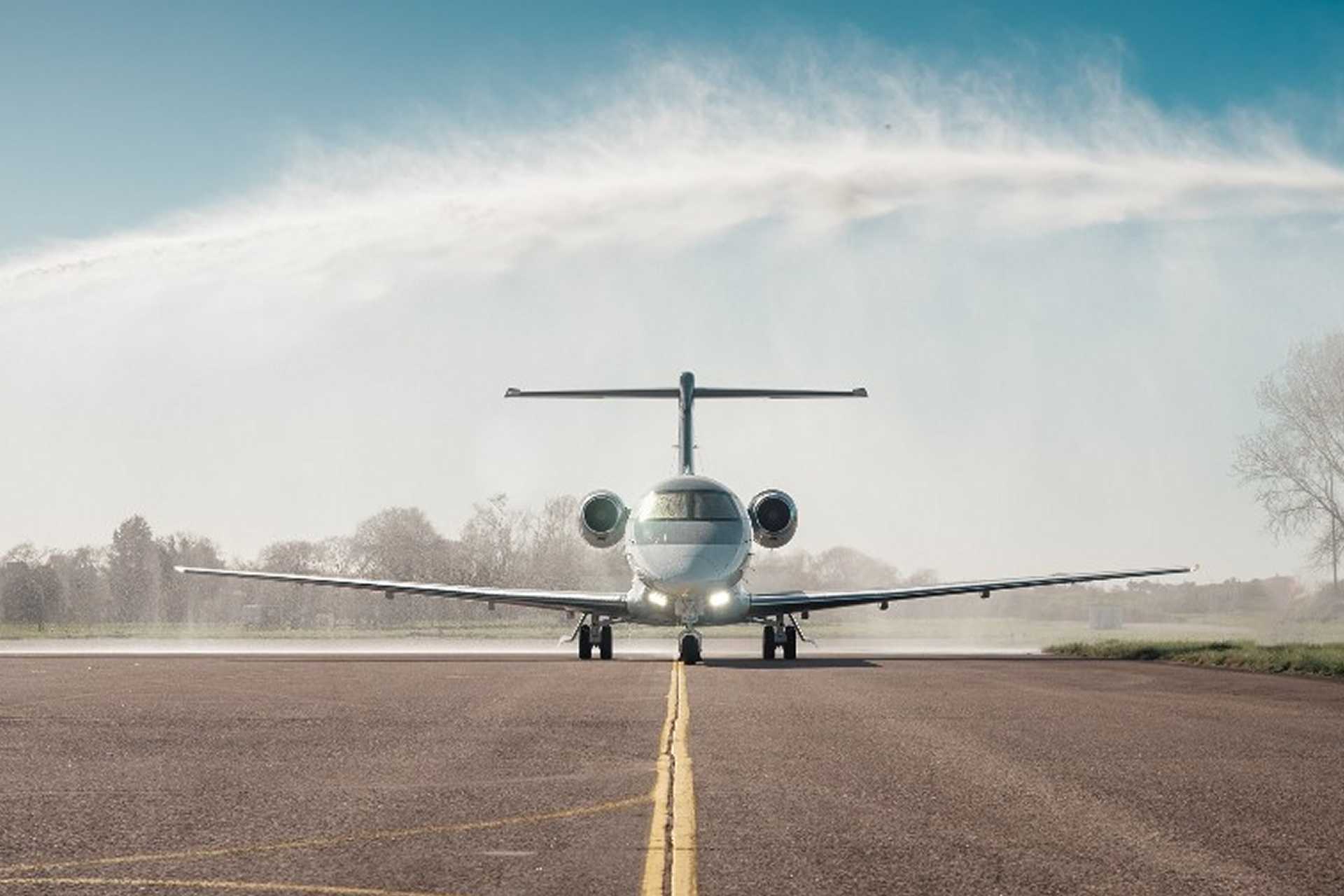
The Pilatus PC-24 was selected to train Rafale Marine pilots because it provides modern IFR avionics, lower operating costs, short-runway flexibility, and procedural training capabilities better suited to current European airspace requirements than the aging Falcon 10MER fleet. (Picture source: French Navy)
On May 8, 2026, the French Navy received the first Pilatus PC-24 assigned to Escadrille 57S at Naval Air Base BAN Landivisiau, beginning the replacement of the Dassault Falcon 10MER fleet after fifty-one years of service within French Naval Aviation. The aircraft, registered F-HJAH, is the first of three PC-24s acquired through a French Military Aviation Maintenance Directorate (DMAé) contract with Jet Aviation France covering acquisition, leasing, maintenance, and continuing airworthiness management. Delivered initially to Jet Aviation at Le Bourget in March 2026, the aircraft entered service after completion of its naval configuration.
The replacement addresses structural aging, avionics obsolescence, ADS-B and CPDLC compliance requirements, declining spare-part availability, and increasing sustainment costs affecting the Falcon 10MER fleet rather than operational shortcomings. The program also reflects a shift toward contractor-supported military aviation using commercially certified aircraft and civilian sustainment structures instead of sovereign military-owned support fleets. Escadrille 57S operates from BAN Landivisiau, the main base for Rafale Marine carrier aviation units, but functions primarily as a procedural training and support squadron.
Its core mission consists of IFR qualification and recurrency training for naval fighter pilots, especially crews returning from the Franco-American training pipeline at Meridian, Mississippi. IFR (Instrument Flight Rules) refers to flight operations conducted primarily by reference to cockpit instruments rather than external visual cues. Under IFR conditions, pilots navigate, control altitude, maintain separation, and execute approaches using onboard avionics, navigation systems, air traffic control instructions, and published procedures. In military aviation, IFR qualification is essential because crews must operate in poor weather, at night, above cloud layers, or inside heavily controlled civilian airspace where precise procedural compliance is required.
Pilots transitioning from U.S Navy procedures require retraining for French and European operational standards involving dense civilian-controlled airspace, maritime approaches, low-level navigation, and French military IFR doctrine. The squadron also conducts periodic instrument qualification checks for operational Rafale Marine crews and performs liaison flights, radar-calibration sorties, transport of senior naval personnel, and urgent logistics transport missions. Before replacement planning, the six operational Falcon 10MER aircraft accumulated nearly 1,800 annual flight hours while reducing reliance on frontline fighter aircraft for procedural training missions.
The Falcon 10MER entered French Navy service in April 1975 after the procurement of seven modified Dassault Falcon 10 business jets configured for instrument training, liaison transport, and radar-calibration missions supporting embarked aviation units. The aircraft retained the civilian Falcon 10’s Mach 0.86 cruise performance while integrating dual controls, IFR training systems, TACAN navigation equipment, and military communications systems. Modernization programs included EFIS cockpit integration, GNSS compatibility upgrades, TCAS Mk-2, GPWS, and FMS modernization to maintain compatibility with civilian aviation regulations.
By 2025, however, the fleet faced increasing difficulties integrating ADS-B and CPDLC requirements, while the shrinking global Falcon 10 fleet reduced spare-part availability and increased sustainment dependence on Sabena Technics and dedicated naval maintenance personnel at Landivisiau. French naval authorities concluded that deeper modernization no longer justified the cost for aircraft approaching fifty years of operational service. Developed by Pilatus Aircraft, the Pilatus PC-24 first flew on May 11, 2015, and received EASA and FAA certification on December 7, 2017.
This Swiss light business jet is powered by two Williams FJ44-4A turbofan engines producing 15.57 kN each and operates with a maximum takeoff weight of 8,300 kg and a maximum landing weight of 7,665 kg. Maximum cruise speed reaches 815 km/h, with operational range extending to 3,769 km with four passengers or 3,400 km with six passengers under NBAA IFR reserves. The aircraft operates up to 45,000 ft and uses Honeywell Primus Epic avionics with four 12-inch displays, synthetic vision capability, and single-pilot IFR certification. Takeoff distance reaches 856 meters and landing distance 718 meters over a 15-meter obstacle, while certification for gravel, grass, snow-covered, and semi-prepared runways expands access to secondary airfields.
The modular cabin, 1.30 x 1.25 meter cargo door, and 1,134 kg payload capacity allow passenger, cargo, medevac, and mixed-role configurations. French naval evaluations narrowed the Falcon 10MER replacement competition primarily to the Pilatus PC-24 and Embraer Phenom 300. Although the Falcon 10MER retained superior cruise-speed performance, the French Navy prioritized sustainment predictability, certification compliance, and operational flexibility. The PC-24’s short-field performance allows operations from dispersed regional airfields inaccessible to many business jets in the same category, while the cargo door permits transport of maintenance equipment and urgent freight without assigning larger transport aircraft.
French authorities also considered cockpit commonality relevant because the Honeywell avionics architecture more closely resembles modern military and civilian glass-cockpit aircraft used by Rafale Marine crews. Single-pilot IFR certification reduces manpower requirements, while the aircraft’s broad civilian support ecosystem improves long-term access to spare parts, certified maintenance facilities, and avionics support infrastructure compared with the aging Falcon 10MER fleet. The DMAé sustainment arrangement differs from traditional French military procurement because the fleet remains contractor-supported throughout its operational life rather than entering a sovereign military sustainment chain.
Under the contract, Jet Aviation France, a subsidiary of General Dynamics, provides leasing, maintenance, line and base support, and continuing airworthiness management while stationing technical personnel directly at Landivisiau. French authorities assessed that maintaining an independent military sustainment structure for only three aircraft would create disproportionate infrastructure and personnel costs. The arrangement reduces the need for sovereign spare-part inventories and specialized maintenance expertise, but it also introduces partial dependence on civilian logistics systems, contractor personnel, and commercial aerospace supply chains during prolonged high-intensity contingencies or broader mobilization scenarios.
The French Navy joins a growing group of governmental and military PC-24 operators that includes the Qatar Emiri Air Force, Swiss federal aviation services, Swedish air ambulance organizations, Australian RFDS operators, and multiple police aviation services. Spain selected the aircraft for both the Spanish Air Force and Spanish Naval Aviation replacement programs scheduled between 2026 and 2027, while Indonesia announced plans in February 2026 to procure twelve PC-24s for transport training and ministerial liaison missions.
By Q1 2024, more than 212 PC-24s had been delivered globally, creating a broader sustainment ecosystem than most specialized military support aircraft fleets. The transition from the Falcon 10MER to the PC-24, therefore, reflects a broader European trend toward replacing aging Cold War-era support aircraft with commercially supported multi-role aircraft optimized for regulatory compliance, sustainment efficiency, operational flexibility, and reduced lifecycle cost rather than high-performance military specialization.
Written by Jérôme Brahy
Jérôme Brahy is a defense analyst and documentalist at Army Recognition. He specializes in naval modernization, aviation, drones, armored vehicles, and artillery, with a focus on strategic developments in the United States, China, Ukraine, Russia, Türkiye, and Belgium. His analyses go beyond the facts, providing context, identifying key actors, and explaining why defense news matters on a global scale.
{loadposition bannertop}
{loadposition sidebarpub}
The French Navy has received its first Pilatus PC-24 at BAN Landivisiau to replace the aging Falcon 10MER fleet, marking a major shift in how French Naval Aviation supports fighter pilot training and operational transport missions. Announced on May 7, 2026, the transition strengthens long-term readiness for Rafale Marine crews by replacing increasingly obsolete aircraft with a modern jet better suited to current European airspace regulations, dispersed operations, and lower sustainment demands.
The PC-24 gives Escadrille 57S a more flexible platform for IFR training, liaison transport, logistics flights, and radar-calibration missions while reducing dependence on frontline combat aircraft for procedural training tasks. Its short-field capability, modern Honeywell glass cockpit, and contractor-supported sustainment model also reflect a wider European move toward commercially supported multi-role aircraft that improve operational availability and reduce lifecycle costs without sacrificing mission effectiveness.
Related topic: French Navy Set to Receive PC-24 Jets to Improve Operations from Short and Unpaved Airstrips
The Pilatus PC-24 was selected to train Rafale Marine pilots because it provides modern IFR avionics, lower operating costs, short-runway flexibility, and procedural training capabilities better suited to current European airspace requirements than the aging Falcon 10MER fleet. (Picture source: French Navy)
On May 8, 2026, the French Navy received the first Pilatus PC-24 assigned to Escadrille 57S at Naval Air Base BAN Landivisiau, beginning the replacement of the Dassault Falcon 10MER fleet after fifty-one years of service within French Naval Aviation. The aircraft, registered F-HJAH, is the first of three PC-24s acquired through a French Military Aviation Maintenance Directorate (DMAé) contract with Jet Aviation France covering acquisition, leasing, maintenance, and continuing airworthiness management. Delivered initially to Jet Aviation at Le Bourget in March 2026, the aircraft entered service after completion of its naval configuration.
The replacement addresses structural aging, avionics obsolescence, ADS-B and CPDLC compliance requirements, declining spare-part availability, and increasing sustainment costs affecting the Falcon 10MER fleet rather than operational shortcomings. The program also reflects a shift toward contractor-supported military aviation using commercially certified aircraft and civilian sustainment structures instead of sovereign military-owned support fleets. Escadrille 57S operates from BAN Landivisiau, the main base for Rafale Marine carrier aviation units, but functions primarily as a procedural training and support squadron.
Its core mission consists of IFR qualification and recurrency training for naval fighter pilots, especially crews returning from the Franco-American training pipeline at Meridian, Mississippi. IFR (Instrument Flight Rules) refers to flight operations conducted primarily by reference to cockpit instruments rather than external visual cues. Under IFR conditions, pilots navigate, control altitude, maintain separation, and execute approaches using onboard avionics, navigation systems, air traffic control instructions, and published procedures. In military aviation, IFR qualification is essential because crews must operate in poor weather, at night, above cloud layers, or inside heavily controlled civilian airspace where precise procedural compliance is required.
Pilots transitioning from U.S Navy procedures require retraining for French and European operational standards involving dense civilian-controlled airspace, maritime approaches, low-level navigation, and French military IFR doctrine. The squadron also conducts periodic instrument qualification checks for operational Rafale Marine crews and performs liaison flights, radar-calibration sorties, transport of senior naval personnel, and urgent logistics transport missions. Before replacement planning, the six operational Falcon 10MER aircraft accumulated nearly 1,800 annual flight hours while reducing reliance on frontline fighter aircraft for procedural training missions.
The Falcon 10MER entered French Navy service in April 1975 after the procurement of seven modified Dassault Falcon 10 business jets configured for instrument training, liaison transport, and radar-calibration missions supporting embarked aviation units. The aircraft retained the civilian Falcon 10’s Mach 0.86 cruise performance while integrating dual controls, IFR training systems, TACAN navigation equipment, and military communications systems. Modernization programs included EFIS cockpit integration, GNSS compatibility upgrades, TCAS Mk-2, GPWS, and FMS modernization to maintain compatibility with civilian aviation regulations.
By 2025, however, the fleet faced increasing difficulties integrating ADS-B and CPDLC requirements, while the shrinking global Falcon 10 fleet reduced spare-part availability and increased sustainment dependence on Sabena Technics and dedicated naval maintenance personnel at Landivisiau. French naval authorities concluded that deeper modernization no longer justified the cost for aircraft approaching fifty years of operational service. Developed by Pilatus Aircraft, the Pilatus PC-24 first flew on May 11, 2015, and received EASA and FAA certification on December 7, 2017.
This Swiss light business jet is powered by two Williams FJ44-4A turbofan engines producing 15.57 kN each and operates with a maximum takeoff weight of 8,300 kg and a maximum landing weight of 7,665 kg. Maximum cruise speed reaches 815 km/h, with operational range extending to 3,769 km with four passengers or 3,400 km with six passengers under NBAA IFR reserves. The aircraft operates up to 45,000 ft and uses Honeywell Primus Epic avionics with four 12-inch displays, synthetic vision capability, and single-pilot IFR certification. Takeoff distance reaches 856 meters and landing distance 718 meters over a 15-meter obstacle, while certification for gravel, grass, snow-covered, and semi-prepared runways expands access to secondary airfields.
The modular cabin, 1.30 x 1.25 meter cargo door, and 1,134 kg payload capacity allow passenger, cargo, medevac, and mixed-role configurations. French naval evaluations narrowed the Falcon 10MER replacement competition primarily to the Pilatus PC-24 and Embraer Phenom 300. Although the Falcon 10MER retained superior cruise-speed performance, the French Navy prioritized sustainment predictability, certification compliance, and operational flexibility. The PC-24’s short-field performance allows operations from dispersed regional airfields inaccessible to many business jets in the same category, while the cargo door permits transport of maintenance equipment and urgent freight without assigning larger transport aircraft.
French authorities also considered cockpit commonality relevant because the Honeywell avionics architecture more closely resembles modern military and civilian glass-cockpit aircraft used by Rafale Marine crews. Single-pilot IFR certification reduces manpower requirements, while the aircraft’s broad civilian support ecosystem improves long-term access to spare parts, certified maintenance facilities, and avionics support infrastructure compared with the aging Falcon 10MER fleet. The DMAé sustainment arrangement differs from traditional French military procurement because the fleet remains contractor-supported throughout its operational life rather than entering a sovereign military sustainment chain.
Under the contract, Jet Aviation France, a subsidiary of General Dynamics, provides leasing, maintenance, line and base support, and continuing airworthiness management while stationing technical personnel directly at Landivisiau. French authorities assessed that maintaining an independent military sustainment structure for only three aircraft would create disproportionate infrastructure and personnel costs. The arrangement reduces the need for sovereign spare-part inventories and specialized maintenance expertise, but it also introduces partial dependence on civilian logistics systems, contractor personnel, and commercial aerospace supply chains during prolonged high-intensity contingencies or broader mobilization scenarios.
The French Navy joins a growing group of governmental and military PC-24 operators that includes the Qatar Emiri Air Force, Swiss federal aviation services, Swedish air ambulance organizations, Australian RFDS operators, and multiple police aviation services. Spain selected the aircraft for both the Spanish Air Force and Spanish Naval Aviation replacement programs scheduled between 2026 and 2027, while Indonesia announced plans in February 2026 to procure twelve PC-24s for transport training and ministerial liaison missions.
By Q1 2024, more than 212 PC-24s had been delivered globally, creating a broader sustainment ecosystem than most specialized military support aircraft fleets. The transition from the Falcon 10MER to the PC-24, therefore, reflects a broader European trend toward replacing aging Cold War-era support aircraft with commercially supported multi-role aircraft optimized for regulatory compliance, sustainment efficiency, operational flexibility, and reduced lifecycle cost rather than high-performance military specialization.
Written by Jérôme Brahy
Jérôme Brahy is a defense analyst and documentalist at Army Recognition. He specializes in naval modernization, aviation, drones, armored vehicles, and artillery, with a focus on strategic developments in the United States, China, Ukraine, Russia, Türkiye, and Belgium. His analyses go beyond the facts, providing context, identifying key actors, and explaining why defense news matters on a global scale.