Ireland Bolsters Air Corps Fleet with New Dassault Falcon 6X Aircraft for Enhanced Global Reach
{loadposition bannertop}
{loadposition sidebarpub}
The Irish Air Corps has taken delivery of a new Dassault Falcon 6X strategic reach aircraft at Casement Aerodrome, strengthening Ireland’s ability to deploy teams and conduct evacuations worldwide. The aircraft gives Dublin a fast, long-range option when commercial air travel is disrupted or unsuitable for sensitive state missions.
On 16 December 2025, the Irish Air Corps took delivery of a new Dassault Falcon 6X “strategic reach” aircraft at Casement Aerodrome, as reported by the Department of Defence of Ireland. The arrival adds a long-range jet option to an air fleet already being renewed, following the delivery earlier in the year of a third Airbus C-295. For Dublin, the key issue is not prestige travel but responsiveness: moving decision-makers, specialist teams, and patients quickly, and conducting evacuations when commercial routes are disrupted or inappropriate.
Follow Army Recognition on Google News at this link
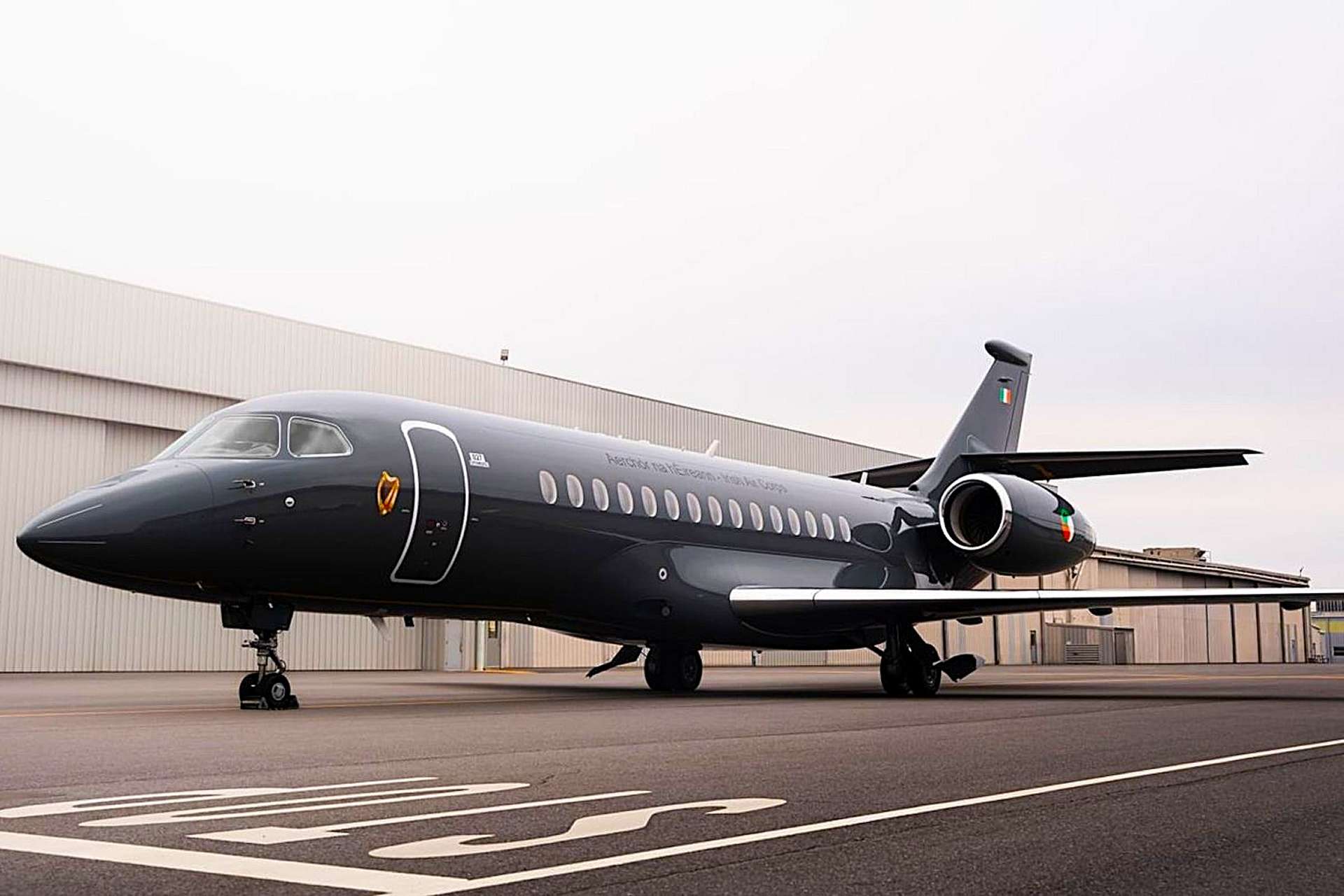
Ireland’s Air Corps has taken delivery of a new Falcon 6X long-range jet, boosting its ability to conduct evacuations, medical flights, and overseas missions when commercial travel is unavailable or unsuitable (Picture Source: Irish Department of Defence)
The Falcon 6X is a long-range, large-cabin twinjet designed for fast intercontinental transit, and the Irish configuration is intended to support government transport, airlift tasks and medical missions rather than a single niche role. The Department of Defence states a total capacity of 17 people with a passenger capacity of 14, and frames the aircraft as a replacement for the Learjet 45 that entered Air Corps service in 2004. Technically, the published performance figures point to why the platform was selected for “strategic reach”: a range of 5,500 nautical miles at Mach 0.80 (about 10,186 km), a maximum operating speed of Mach 0.90, and a certified ceiling of 51,000 ft. The take-off and landing distances given by the Irish authorities, 5,115 ft and 2,440 ft respectively, support operations from a wider set of runways than heavier transport aircraft, while two Pratt & Whitney PW812D engines anchor the performance and fuel-efficiency profile described in the official notes. Cabin dimensions also matter for the missions Ireland is emphasising: a 6 ft 6 in cabin height, 8 ft 6 in width, and more than 40 ft of cabin length (excluding flight deck and baggage) provide space for mission kits and patient movement, backed by 155 ft³ of baggage volume.
Dublin’s messaging around the delivery is tightly linked to a wider capability-refresh effort and to a procurement process designed to withstand scrutiny. The aircraft was manufactured in France by Dassault Aviation S.A., and the delivery ceremony at Casement Aerodrome brought together senior defence leadership and the project team, including Aileen Nolan (Assistant Secretary General of the Department of Defence, representing the Minister), Air Corps commander Brigadier General Rory O’Connor, and Dassault representatives. The Department of Defence says the acquisition followed a tender competition under the negotiated procedure set out in Defence and Security Directive 2009/81/EC, an EU framework created to coordinate sensitive defence and security procurement while protecting member-state security requirements.
The stated cost is about €53 million excluding VAT, with initial operational availability anticipated in Q1 2026, signalling that training, certification, mission-fit work and integration into national tasking cycles remain part of the near-term roadmap. In parallel, the Air Corps has been taking delivery of C-295s to reinforce air mobility and broader utility tasks, and independent reporting has linked those aircraft to a larger multi-year fleet expansion package, context that underlines the Falcon 6X as one piece of a broader force-development trajectory rather than a stand-alone purchase.
The tactical value of a long-range jet for a small air arm is less about mass lift and more about time, access, and control of the timeline. Minister for Defence Helen McEntee described the aircraft as enabling an “independent and flexible air transport service” for the State, and outlined a mission set that includes evacuating Irish citizens from critical situations, air-ambulance transfers, medical evacuation or repatriation of Defence Forces personnel from overseas missions, and logistics support for moving supplies to deployed contingents. In practical terms, the combination of high cruise speed, long range and high-altitude capability can compress response times for crises at distance, while secure communications and a modern avionics suite, highlighted in the official notes, support operations where information assurance and command connectivity are non-negotiable. The runway performance published by the Department of Defence also strengthens tactical flexibility: the aircraft can potentially use a larger number of diversion and recovery options than bigger transports, which is relevant for medical flights, rapid tasking changes, or evacuations routed through smaller airfields.
The Falcon 6X arrival is being positioned as a sovereignty and readiness enabler, not simply a transport upgrade. The Department of Defence ties the aircraft directly to Ireland’s “national and international obligations,” and frames the platform as a way to sustain government action and overseas Defence Forces support without relying exclusively on commercial schedules or ad hoc charter availability. The Chief of Staff, Lieutenant General Rossa Mulcahy, also linked the aircraft to institutional change, describing its introduction as part of the Air Corps’ progression “toward becoming an Air Force,” and emphasising how range, performance and onboard systems can extend support to citizens and deployed personnel globally with greater speed and flexibility.
From a geostrategic perspective, this kind of asset strengthens Ireland’s ability to manage contingencies that are time-sensitive and politically exposed, such as citizen evacuation or urgent medical transfer, while reinforcing a broader message of sustained investment in air capability, visible in the concurrent C-295 deliveries and the emphasis on “strategic reach” as a national requirement.
The delivery of the Falcon 6X gives Ireland a dedicated long-range tool built around rapid response, medical support and sovereign mobility, backed by published performance figures that place transatlantic reach firmly within routine planning. With an acquisition cost of about €53 million (excluding VAT) and entry into service expected in early 2026, the key test now shifts to how quickly the Air Corps can convert the platform’s range, cabin volume and secure systems into repeatable mission outputs across evacuations, medevac and overseas support.
{loadposition bannertop}
{loadposition sidebarpub}
The Irish Air Corps has taken delivery of a new Dassault Falcon 6X strategic reach aircraft at Casement Aerodrome, strengthening Ireland’s ability to deploy teams and conduct evacuations worldwide. The aircraft gives Dublin a fast, long-range option when commercial air travel is disrupted or unsuitable for sensitive state missions.
On 16 December 2025, the Irish Air Corps took delivery of a new Dassault Falcon 6X “strategic reach” aircraft at Casement Aerodrome, as reported by the Department of Defence of Ireland. The arrival adds a long-range jet option to an air fleet already being renewed, following the delivery earlier in the year of a third Airbus C-295. For Dublin, the key issue is not prestige travel but responsiveness: moving decision-makers, specialist teams, and patients quickly, and conducting evacuations when commercial routes are disrupted or inappropriate.
Ireland’s Air Corps has taken delivery of a new Falcon 6X long-range jet, boosting its ability to conduct evacuations, medical flights, and overseas missions when commercial travel is unavailable or unsuitable (Picture Source: Irish Department of Defence)
The Falcon 6X is a long-range, large-cabin twinjet designed for fast intercontinental transit, and the Irish configuration is intended to support government transport, airlift tasks and medical missions rather than a single niche role. The Department of Defence states a total capacity of 17 people with a passenger capacity of 14, and frames the aircraft as a replacement for the Learjet 45 that entered Air Corps service in 2004. Technically, the published performance figures point to why the platform was selected for “strategic reach”: a range of 5,500 nautical miles at Mach 0.80 (about 10,186 km), a maximum operating speed of Mach 0.90, and a certified ceiling of 51,000 ft. The take-off and landing distances given by the Irish authorities, 5,115 ft and 2,440 ft respectively, support operations from a wider set of runways than heavier transport aircraft, while two Pratt & Whitney PW812D engines anchor the performance and fuel-efficiency profile described in the official notes. Cabin dimensions also matter for the missions Ireland is emphasising: a 6 ft 6 in cabin height, 8 ft 6 in width, and more than 40 ft of cabin length (excluding flight deck and baggage) provide space for mission kits and patient movement, backed by 155 ft³ of baggage volume.
Dublin’s messaging around the delivery is tightly linked to a wider capability-refresh effort and to a procurement process designed to withstand scrutiny. The aircraft was manufactured in France by Dassault Aviation S.A., and the delivery ceremony at Casement Aerodrome brought together senior defence leadership and the project team, including Aileen Nolan (Assistant Secretary General of the Department of Defence, representing the Minister), Air Corps commander Brigadier General Rory O’Connor, and Dassault representatives. The Department of Defence says the acquisition followed a tender competition under the negotiated procedure set out in Defence and Security Directive 2009/81/EC, an EU framework created to coordinate sensitive defence and security procurement while protecting member-state security requirements.
The stated cost is about €53 million excluding VAT, with initial operational availability anticipated in Q1 2026, signalling that training, certification, mission-fit work and integration into national tasking cycles remain part of the near-term roadmap. In parallel, the Air Corps has been taking delivery of C-295s to reinforce air mobility and broader utility tasks, and independent reporting has linked those aircraft to a larger multi-year fleet expansion package, context that underlines the Falcon 6X as one piece of a broader force-development trajectory rather than a stand-alone purchase.
The tactical value of a long-range jet for a small air arm is less about mass lift and more about time, access, and control of the timeline. Minister for Defence Helen McEntee described the aircraft as enabling an “independent and flexible air transport service” for the State, and outlined a mission set that includes evacuating Irish citizens from critical situations, air-ambulance transfers, medical evacuation or repatriation of Defence Forces personnel from overseas missions, and logistics support for moving supplies to deployed contingents. In practical terms, the combination of high cruise speed, long range and high-altitude capability can compress response times for crises at distance, while secure communications and a modern avionics suite, highlighted in the official notes, support operations where information assurance and command connectivity are non-negotiable. The runway performance published by the Department of Defence also strengthens tactical flexibility: the aircraft can potentially use a larger number of diversion and recovery options than bigger transports, which is relevant for medical flights, rapid tasking changes, or evacuations routed through smaller airfields.
The Falcon 6X arrival is being positioned as a sovereignty and readiness enabler, not simply a transport upgrade. The Department of Defence ties the aircraft directly to Ireland’s “national and international obligations,” and frames the platform as a way to sustain government action and overseas Defence Forces support without relying exclusively on commercial schedules or ad hoc charter availability. The Chief of Staff, Lieutenant General Rossa Mulcahy, also linked the aircraft to institutional change, describing its introduction as part of the Air Corps’ progression “toward becoming an Air Force,” and emphasising how range, performance and onboard systems can extend support to citizens and deployed personnel globally with greater speed and flexibility.
From a geostrategic perspective, this kind of asset strengthens Ireland’s ability to manage contingencies that are time-sensitive and politically exposed, such as citizen evacuation or urgent medical transfer, while reinforcing a broader message of sustained investment in air capability, visible in the concurrent C-295 deliveries and the emphasis on “strategic reach” as a national requirement.
The delivery of the Falcon 6X gives Ireland a dedicated long-range tool built around rapid response, medical support and sovereign mobility, backed by published performance figures that place transatlantic reach firmly within routine planning. With an acquisition cost of about €53 million (excluding VAT) and entry into service expected in early 2026, the key test now shifts to how quickly the Air Corps can convert the platform’s range, cabin volume and secure systems into repeatable mission outputs across evacuations, medevac and overseas support.