Israel Reveals F-16I Sufa Jet Armed with RAMPAGE Missiles During Operation Lion’s Roar Against Iran
{loadposition bannertop}
{loadposition sidebarpub}
The Israel Defense Forces released images of an Israeli Air Force F-16I Sufa armed with RAMPAGE stand-off missiles ahead of a strike under Operation Lion’s Roar targeting Iran. The loadout highlights Israel’s long-range strike planning and signals how advanced airpower is being configured for operations against heavily defended state adversaries.
On 28 February 2026, the Israel Defense Forces (IDF) released a series of photographs showing an F-16I Sufa preparing for a strike mission against targets in Iran under Operation Lion’s Roar. Published on the IDF’s official Farsi-language account on X, the images depict the aircraft carrying RAMPAGE air-launched missiles, live beyond-visual-range “Slammer” air-to-air missiles and large 600-gallon external fuel tanks, highlighting the long-range, high-threat profile of the mission. This official release offers a rare, real-time glimpse into how Israel configures one of its main strike platforms for deep operations against a state adversary with layered air defences. The combination of F-16I Sufa and RAMPAGE missiles, showcased directly by the IDF via social media, provides important indicators of the capabilities and concepts now being employed in the ongoing Israeli–United States campaign against Iran.
Follow Army Recognition on Google News at this link
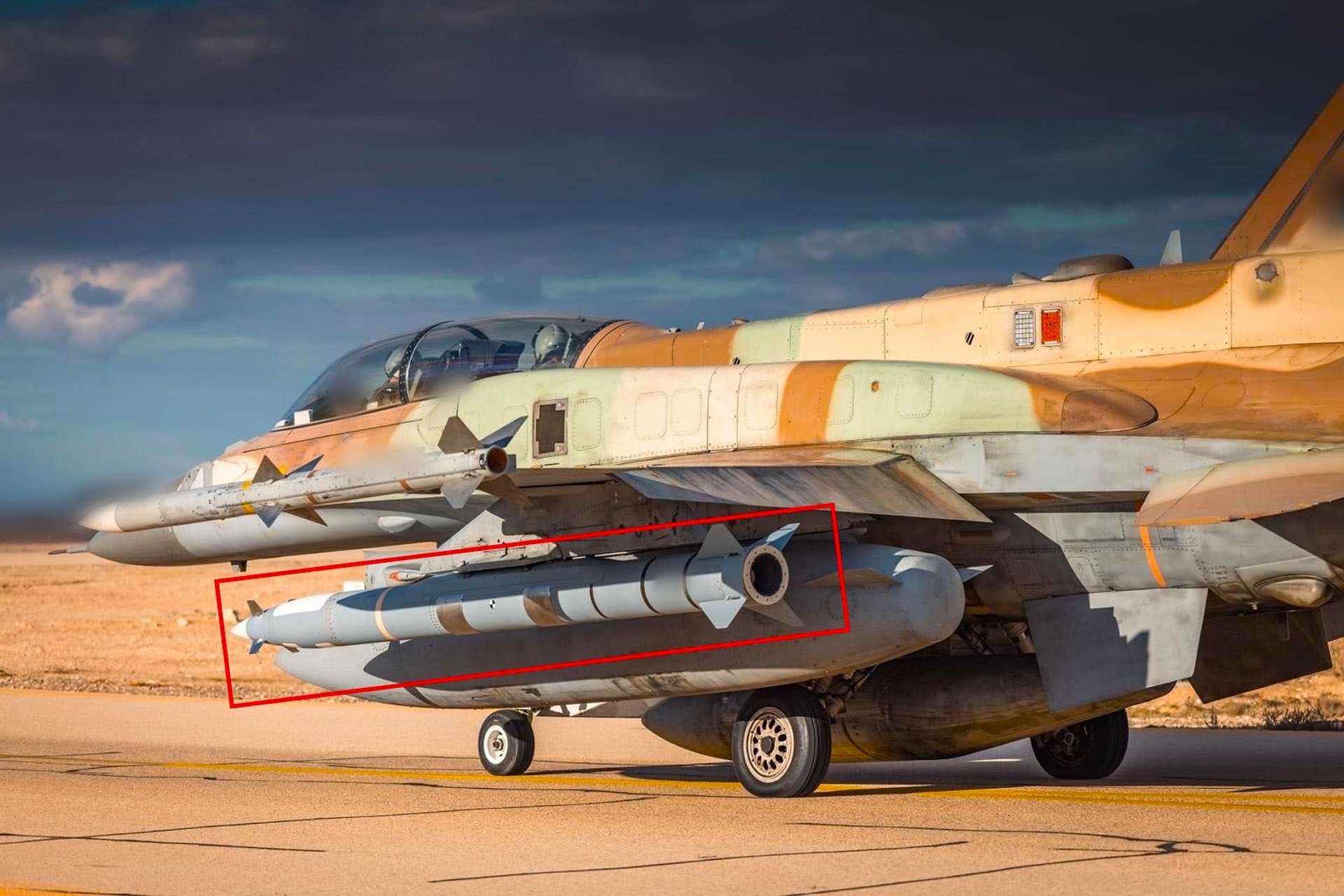
The Israel Defense Forces released official images of an F-16I Sufa armed with RAMPAGE stand-off missiles and extended range fuel tanks ahead of a long-range strike mission against targets in Iran under Operation Lion’s Roar (Picture Source: IDF)
The newly released imagery shows a twin-seat F-16I Sufa in full combat configuration, taxiing with conformal fuel tanks along the fuselage, three external fuel tanks, including two underwing and one centreline 600-gallon tanks, and a mixed weapons load optimised for stand-off strike and self-defence. On the inboard pylons, the aircraft carries RAMPAGE stand-off missiles; the outer stations are fitted with live AIM-120-class “Slammer” air-to-air missiles, ensuring the jet retains the ability to defend itself against hostile aircraft during ingress or egress. This layout, coupled with the extended fuel configuration, is consistent with a mission profile reaching deep into Iranian airspace, where crews must balance payload, range and survivability under the threat of long-range surface-to-air missile (SAM) systems and potential fighter interception. While precise targets and flight routes remain classified, the loadout strongly suggests a carefully planned, long-range strike conducted in a contested environment.
The F-16I Sufa itself is a heavily customised evolution of the F-16D Block 52+, designed specifically for the Israeli Air Force’s long-range and precision-strike requirements. It incorporates conformal fuel tanks that significantly extend combat radius without occupying underwing hardpoints, enabling simultaneous carriage of fuel and a substantial weapons load. The two-seat cockpit allows workload sharing between pilot and weapon systems officer during complex missions, particularly when employing multiple stand-off munitions and coordinating with other platforms. The aircraft is equipped with an advanced multi-mode radar suitable for all-weather ground attack, a comprehensive Israeli-developed electronic warfare suite, secure data-links and modern mission computers, making it well adapted to penetrating or skirting dense air-defence networks. In combination with the three 600-gallon tanks seen in the images, the Sufa can undertake extended-range sorties with greater flexibility for route selection, loitering and potential retasking in flight.
At the centre of attention in these photographs is the RAMPAGE air-launched missile, a weapon that blends the characteristics of a precision artillery rocket and a stand-off air-to-surface missile. Developed jointly by Israeli industry on the basis of a guided artillery rocket family, RAMPAGE is designed to deliver a roughly 150-kilogram multi-purpose warhead over distances in the 150–250-kilometre class, depending on launch altitude and speed. Guided by an inertial navigation system coupled to satellite navigation, with programmable impact profiles and anti-jamming features, the missile follows a high-speed quasi-ballistic trajectory that complicates interception for many medium-range SAM systems. Its warhead options and steep terminal dive profiles are optimised for engaging fixed, high-value targets such as radar sites, hardened command posts, ammunition depots and airfield infrastructure, including runways and shelters. In practical terms, this means an F-16I can launch RAMPAGE well outside the engagement envelope of many Iranian air-defence batteries, yet still deliver precise effects on critical nodes of the adversary’s military architecture.
From a tactical perspective, pairing the F-16I Sufa with RAMPAGE in the context of Operation Lion’s Roar appears designed to exploit the strengths of both platform and weapon. The Sufa’s conformal fuel tanks and 600-gallon external tanks extend combat radius and loiter time, enabling ingress along indirect routes or extended time in holding patterns while waiting for coordination with other assets. RAMPAGE’s stand-off range allows the aircraft to remain outside the densest Iranian air-defence bubbles while still engaging fixed, high-value targets such as long-range radar, surface-to-air missile batteries, communications hubs and logistics infrastructure. Supersonic terminal speed and the option for steep-angle impact complicate interception and increase effectiveness against hardened or partially buried structures. The presence of live beyond-visual-range air-to-air missiles on the photographed aircraft suggests a mission profile that anticipates potential aerial opposition or the need for self-protection during withdrawal, underlining that even stand-off strikes against fixed ground targets are being planned under conditions of contested airspace.
Strategically, the decision to publicise images of such a mission during an ongoing, high-intensity campaign appears calibrated to send multiple signals. According to official statements, Operation Lion’s Roar represents the Israeli component of a broader U.S.–Israeli operation aimed at striking hundreds of Iranian targets, including elements of the country’s air-defence network, ballistic-missile infrastructure and command-and-control sites. Showcasing an F-16I configured with RAMPAGE missiles and extended fuel tanks underlines that Israel is relying not only on its most modern platforms, but also on upgraded legacy aircraft capable of delivering repeated, long-range precision strikes. For Tehran, the message is that key strategic assets can be engaged from outside their most robust defensive rings, and that the inventory of stand-off munitions available to Israel is both diversified and combat-proven. These images illustrate how conventional air power and stand-off missiles are being combined to pursue strategic objectives at depth, with all the associated risks of escalation in an already volatile regional context.
The official release of imagery showing an F-16I Sufa armed with RAMPAGE missiles and 600-gallon tanks on an Iran strike mission offers more than a simple snapshot of a single sortie; it reveals core elements of Israel’s current deep-strike doctrine. By pairing a long-range, heavily modified fighter with a precision stand-off weapon capable of reaching hardened targets from well beyond many SAM envelopes, the IDF demonstrates a preference for operations that seek to impose sustained pressure on critical infrastructure while limiting aircraft exposure. This episode reinforces the centrality of extended-range strike fighters and versatile stand-off munitions in future conflicts where states must reach distant, defended targets under intense political and operational constraints. It also underlines the growing importance of carefully managed public communication: in releasing these images, Israel not only documents its capabilities but also shapes perceptions of deterrence, resilience and intent at a moment when any miscalculation could have far-reaching consequences across the region.
{loadposition bannertop}
{loadposition sidebarpub}
The Israel Defense Forces released images of an Israeli Air Force F-16I Sufa armed with RAMPAGE stand-off missiles ahead of a strike under Operation Lion’s Roar targeting Iran. The loadout highlights Israel’s long-range strike planning and signals how advanced airpower is being configured for operations against heavily defended state adversaries.
On 28 February 2026, the Israel Defense Forces (IDF) released a series of photographs showing an F-16I Sufa preparing for a strike mission against targets in Iran under Operation Lion’s Roar. Published on the IDF’s official Farsi-language account on X, the images depict the aircraft carrying RAMPAGE air-launched missiles, live beyond-visual-range “Slammer” air-to-air missiles and large 600-gallon external fuel tanks, highlighting the long-range, high-threat profile of the mission. This official release offers a rare, real-time glimpse into how Israel configures one of its main strike platforms for deep operations against a state adversary with layered air defences. The combination of F-16I Sufa and RAMPAGE missiles, showcased directly by the IDF via social media, provides important indicators of the capabilities and concepts now being employed in the ongoing Israeli–United States campaign against Iran.
The Israel Defense Forces released official images of an F-16I Sufa armed with RAMPAGE stand-off missiles and extended range fuel tanks ahead of a long-range strike mission against targets in Iran under Operation Lion’s Roar (Picture Source: IDF)
The newly released imagery shows a twin-seat F-16I Sufa in full combat configuration, taxiing with conformal fuel tanks along the fuselage, three external fuel tanks, including two underwing and one centreline 600-gallon tanks, and a mixed weapons load optimised for stand-off strike and self-defence. On the inboard pylons, the aircraft carries RAMPAGE stand-off missiles; the outer stations are fitted with live AIM-120-class “Slammer” air-to-air missiles, ensuring the jet retains the ability to defend itself against hostile aircraft during ingress or egress. This layout, coupled with the extended fuel configuration, is consistent with a mission profile reaching deep into Iranian airspace, where crews must balance payload, range and survivability under the threat of long-range surface-to-air missile (SAM) systems and potential fighter interception. While precise targets and flight routes remain classified, the loadout strongly suggests a carefully planned, long-range strike conducted in a contested environment.
The F-16I Sufa itself is a heavily customised evolution of the F-16D Block 52+, designed specifically for the Israeli Air Force’s long-range and precision-strike requirements. It incorporates conformal fuel tanks that significantly extend combat radius without occupying underwing hardpoints, enabling simultaneous carriage of fuel and a substantial weapons load. The two-seat cockpit allows workload sharing between pilot and weapon systems officer during complex missions, particularly when employing multiple stand-off munitions and coordinating with other platforms. The aircraft is equipped with an advanced multi-mode radar suitable for all-weather ground attack, a comprehensive Israeli-developed electronic warfare suite, secure data-links and modern mission computers, making it well adapted to penetrating or skirting dense air-defence networks. In combination with the three 600-gallon tanks seen in the images, the Sufa can undertake extended-range sorties with greater flexibility for route selection, loitering and potential retasking in flight.
At the centre of attention in these photographs is the RAMPAGE air-launched missile, a weapon that blends the characteristics of a precision artillery rocket and a stand-off air-to-surface missile. Developed jointly by Israeli industry on the basis of a guided artillery rocket family, RAMPAGE is designed to deliver a roughly 150-kilogram multi-purpose warhead over distances in the 150–250-kilometre class, depending on launch altitude and speed. Guided by an inertial navigation system coupled to satellite navigation, with programmable impact profiles and anti-jamming features, the missile follows a high-speed quasi-ballistic trajectory that complicates interception for many medium-range SAM systems. Its warhead options and steep terminal dive profiles are optimised for engaging fixed, high-value targets such as radar sites, hardened command posts, ammunition depots and airfield infrastructure, including runways and shelters. In practical terms, this means an F-16I can launch RAMPAGE well outside the engagement envelope of many Iranian air-defence batteries, yet still deliver precise effects on critical nodes of the adversary’s military architecture.
From a tactical perspective, pairing the F-16I Sufa with RAMPAGE in the context of Operation Lion’s Roar appears designed to exploit the strengths of both platform and weapon. The Sufa’s conformal fuel tanks and 600-gallon external tanks extend combat radius and loiter time, enabling ingress along indirect routes or extended time in holding patterns while waiting for coordination with other assets. RAMPAGE’s stand-off range allows the aircraft to remain outside the densest Iranian air-defence bubbles while still engaging fixed, high-value targets such as long-range radar, surface-to-air missile batteries, communications hubs and logistics infrastructure. Supersonic terminal speed and the option for steep-angle impact complicate interception and increase effectiveness against hardened or partially buried structures. The presence of live beyond-visual-range air-to-air missiles on the photographed aircraft suggests a mission profile that anticipates potential aerial opposition or the need for self-protection during withdrawal, underlining that even stand-off strikes against fixed ground targets are being planned under conditions of contested airspace.
Strategically, the decision to publicise images of such a mission during an ongoing, high-intensity campaign appears calibrated to send multiple signals. According to official statements, Operation Lion’s Roar represents the Israeli component of a broader U.S.–Israeli operation aimed at striking hundreds of Iranian targets, including elements of the country’s air-defence network, ballistic-missile infrastructure and command-and-control sites. Showcasing an F-16I configured with RAMPAGE missiles and extended fuel tanks underlines that Israel is relying not only on its most modern platforms, but also on upgraded legacy aircraft capable of delivering repeated, long-range precision strikes. For Tehran, the message is that key strategic assets can be engaged from outside their most robust defensive rings, and that the inventory of stand-off munitions available to Israel is both diversified and combat-proven. These images illustrate how conventional air power and stand-off missiles are being combined to pursue strategic objectives at depth, with all the associated risks of escalation in an already volatile regional context.
The official release of imagery showing an F-16I Sufa armed with RAMPAGE missiles and 600-gallon tanks on an Iran strike mission offers more than a simple snapshot of a single sortie; it reveals core elements of Israel’s current deep-strike doctrine. By pairing a long-range, heavily modified fighter with a precision stand-off weapon capable of reaching hardened targets from well beyond many SAM envelopes, the IDF demonstrates a preference for operations that seek to impose sustained pressure on critical infrastructure while limiting aircraft exposure. This episode reinforces the centrality of extended-range strike fighters and versatile stand-off munitions in future conflicts where states must reach distant, defended targets under intense political and operational constraints. It also underlines the growing importance of carefully managed public communication: in releasing these images, Israel not only documents its capabilities but also shapes perceptions of deterrence, resilience and intent at a moment when any miscalculation could have far-reaching consequences across the region.