Russia uses Dubai Airshow 2025 to secure defense exports and support postwar industry
{loadposition bannertop}
{loadposition sidebarpub}
Russia is preparing a major, wartime-shaped showcase at Dubai Airshow 2025, led by the Su-57E and a full lineup of air defense, missile and unmanned systems. The display is aimed at reestablishing Russia’s position in global arms markets and signaling that its combat experience now drives export strategy.
According to the Rostec State Corporation, on 14 November 2025, Rosoboronexport JSC will host the single Russian exhibit at Dubai Airshow 2025, filling a 1,000 m² national pavilion and surrounding static park with more than 850 products, including over 30 full-scale systems drawn from the United Aircraft Corporation, United Engine Corporation, Almaz-Antey and Tactical Missiles Corporation. For Moscow, this is not just another trade fair; it is a public stress test of Russia’s wartime aerospace industry in front of Gulf buyers and Western rivals.Follow Army Recognition on Google News at this link
Russia’s Su-57E on display in Dubai showcases its low-observable design, internal weapons bays and advanced ISR suite, offering long-range air-to-air and precision strike capabilities refined through high-intensity combat (Picture source: UAC Press Service).
On the flight line, the contrast is explicit: Bloomberg has already framed the show as a rare face-off between Washington’s F-35 and Russia’s Su-57E, with both fifth-generation jets flying in the same Gulf sky as competing answers to stealth airpower. Rosoboronexport’s pavilion, long pushed to the margins during the early Ukraine fighting, is back at center stage, this time anchored by aircraft and weapons whose performance has been hammered out over nearly four years of high-intensity war.
The star of Russia’s presence is the Su-57E, the export variant of Russia’s fifth-generation “Felon” fighter, which was shown in the Middle East for the first time in a full flight display. Designed around low-observable shaping, internal weapons bays and a blended fuselage, the Su-57E carries up to six air-to-air missiles internally and additional weapons on recessed under-fuselage stations. Open sources describe it as equipped with a multi-band sensor suite and active electronically scanned radar, combined with high-maneuverability flight controls and super-cruise capable engines derived from the AL-41 family. Rosoboronexport is aggressively pitching not just aircraft deliveries but localized Su-57E production and technology transfer, promising partners the chance to assemble and eventually develop their own next-generation derivatives.
What makes the fighter more than a showpiece is the weapons package parked alongside it. Tactical Missiles Corporation is showing the RVV-MD2 short-range air-to-air missile and the RVV-BD long-range missile, the export version of the R-37M. The RVV-BD is advertised with a reach of up to 200 km and a 60 kg blast-fragmentation warhead, giving the Su-57E the ability to threaten tankers and AEW aircraft while remaining outside most escort fighters’ engagement zones. Paired with internally carried Kh-38MLE and Kh-69 precision-strike missiles, and the modular Grom-E1, the aircraft offers a combined air-superiority and deep-strike profile that directly targets Western assumptions about Russian limitations in networked, stand-off air warfare.
Russia is careful, however, to surround its stealth flagship with more immediately accessible platforms. The Russian Knights aerobatic team’s Su-35S display doubles as a live advertisement for the “4.5-generation” backbone fighter that many export customers still see as the affordable alternative to Western stealth. The Su-35S’ Irbis-E passive electronically scanned array radar is credited with detecting a 3 m² target at 350–400 km and tracking dozens of contacts, while its twin 117S (AL-41F1S) engines provide up to 14,500 kgf of thrust with thrust-vectoring for extreme post-stall maneuvers. Nearby, United Engine Corporation is promoting the newer Item 177S engine as a growth option, promising lower fuel burn and longer service life for future upgrades and other combat aircraft.
At the lighter end of the spectrum, the Yak-130M makes its world debut in Dubai as both an advanced trainer and a true light-attack platform. The upgraded variant receives an onboard radar, a targeting pod, and the President-S130 self-protection suite, plus an expanded weapons menu that includes RVV-MD air-to-air missiles and KAB-250LG-E and K08BE guided bombs for precision strikes. In practice, that allows air forces with limited budgets to use the Yak-130M to train pilots for high-end fighters while still fielding a credible close-air-support and counter-insurgency asset using the same cockpit and mission systems.
Rotary-wing and strike-missile offerings draw directly on Ukraine battlefield experience. The Ka-52 reconnaissance/attack helicopter, already notorious on both sides of the front, flies in the demonstration program with its coaxial rotor system enabling rapid pivots, lateral sidesteps and steep dives that are hard to match for conventional tail-rotor designs. The centerpiece weapon here is the 305E (LMUR) light multipurpose guided missile, a 14.5 km-range, datalink-guided weapon used operationally in Ukraine to allow Ka-52 crews to engage armor and air-defense targets from outside most MANPADS envelopes. Together with Kh-38MLE and other guided rockets, the Ka-52 package directly markets a combat-tested answer to Western Apache and Tiger fleets.
Unmanned systems and loitering munitions underline how far Russia’s air campaign has evolved. Orlan-10E and Orlan-30 UAVs are shown as reconnaissance and artillery-spotting platforms, mirroring their real role in Ukraine, where Orlan systems have underpinned Russia’s kill chain by locating Ukrainian guns and feeding targeting data to tube artillery and Lancet strikes. On the same stand, Rosoboronexport is displaying the export Lancet-E and KUB-2-2E loitering munitions, explicitly presented as derivatives of systems that have logged thousands of operational strikes against artillery, radar and air-defense systems. For Gulf and African customers anxious about swarm threats and proxy wars, “combat-proven” loitering munitions with modular payloads are clearly a core sales pitch.
Russia is also, for the first time at Dubai, wheeling in full-scale air-defense systems. The Pantsir-SMD-E variant on display builds on the widely exported Pantsir-S1, dozens of which were delivered to the UAE between 2009 and 2013. The SMD-E combines up to 48 very-short-range TKB-1055 missiles with up to 12 longer-range 57E6 interceptors on a single combat module, optimized for massed UAVs and precision-guided munitions. That layered loadout, coupled with updated radar and EO sensors, is explicitly tailored to the drone-saturated threat picture that the Gulf has watched unfold over Ukraine and the Red Sea. Complementing it are Verba MANPADS and the SKVP airspace-control system for counter-UAV detection, rounding out a defensive ecosystem that Russia wants to position as a cheaper alternative to Western SHORAD architectures.
All of this hardware sits atop a deeper economic story. According to SIPRI’s latest arms-transfer trend data, Russian arms exports fell by 64% between 2015–19 and 2020–24, dropping Moscow to third place behind the United States and France, with only 11% of global exports. At the same time, Russia’s own war economy has pushed defense spending toward 7.5–8% of GDP and expanded the military-industrial workforce to roughly 3.5–4 million people, or about 20% of all manufacturing jobs. Those factories now run around-the-clock to feed the Ukraine front. When the guns eventually fall quieter, the Kremlin faces a familiar post-Soviet problem: how to keep its vast arms complex employed without crashing regional economies built on war orders.
Dubai Airshow is therefore not just a demonstration of Russian technology; it is an exercise in future shock absorption. Rosoboronexport officials highlight “technology cooperation” and local production lines as the most in-demand model for partners, precisely because such long-term industrial projects can smooth a transition from peak war output to a more sustainable export-driven footing once large-scale operations in Ukraine eventually wind down. The appearance of systems heavily advertised as “combat-proven” is part of that strategy: each Lancet strike video and each Ka-52 LMUR engagement becomes marketing collateral for a post-war export campaign.
Ukraine is pursuing a parallel path with drones. Kyiv has already announced plans to loosen its 2022 arms-export embargo and position itself as “Europe’s drone hub,” enabling joint drone factories and controlled exports once frontline needs are met. President Volodymyr Zelensky has asked Western partners to earmark 0.25% of their GDP for Ukrainian weapons production and plans to export military production technologies, particularly for drones and missiles, under the “Build with Ukraine” program. In September, Ukraine launched its first joint drone production line in Denmark, with more European sites planned, while officials say nearly 60% of the weapons now used by Ukrainian forces are domestically produced. Like Russia at Dubai, Kyiv is trying to convert brutal, real-time combat experience into a long-term industrial and export advantage.
{loadposition bannertop}
{loadposition sidebarpub}
Russia is preparing a major, wartime-shaped showcase at Dubai Airshow 2025, led by the Su-57E and a full lineup of air defense, missile and unmanned systems. The display is aimed at reestablishing Russia’s position in global arms markets and signaling that its combat experience now drives export strategy.
According to the Rostec State Corporation, on 14 November 2025, Rosoboronexport JSC will host the single Russian exhibit at Dubai Airshow 2025, filling a 1,000 m² national pavilion and surrounding static park with more than 850 products, including over 30 full-scale systems drawn from the United Aircraft Corporation, United Engine Corporation, Almaz-Antey and Tactical Missiles Corporation. For Moscow, this is not just another trade fair; it is a public stress test of Russia’s wartime aerospace industry in front of Gulf buyers and Western rivals.
Follow Army Recognition on Google News at this link
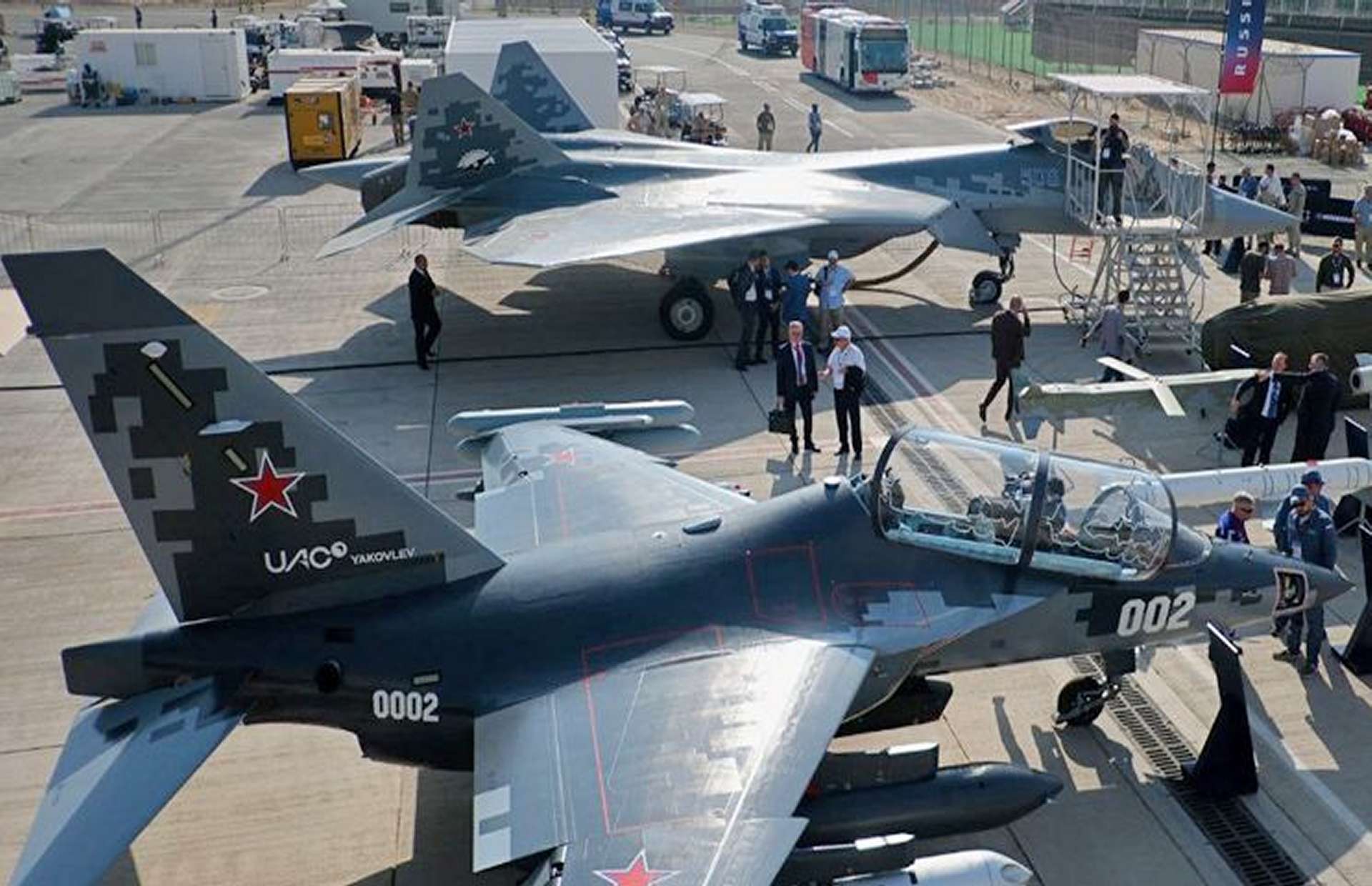
Russia’s Su-57E on display in Dubai showcases its low-observable design, internal weapons bays and advanced ISR suite, offering long-range air-to-air and precision strike capabilities refined through high-intensity combat (Picture source: UAC Press Service).
On the flight line, the contrast is explicit: Bloomberg has already framed the show as a rare face-off between Washington’s F-35 and Russia’s Su-57E, with both fifth-generation jets flying in the same Gulf sky as competing answers to stealth airpower. Rosoboronexport’s pavilion, long pushed to the margins during the early Ukraine fighting, is back at center stage, this time anchored by aircraft and weapons whose performance has been hammered out over nearly four years of high-intensity war.
The star of Russia’s presence is the Su-57E, the export variant of Russia’s fifth-generation “Felon” fighter, which was shown in the Middle East for the first time in a full flight display. Designed around low-observable shaping, internal weapons bays and a blended fuselage, the Su-57E carries up to six air-to-air missiles internally and additional weapons on recessed under-fuselage stations. Open sources describe it as equipped with a multi-band sensor suite and active electronically scanned radar, combined with high-maneuverability flight controls and super-cruise capable engines derived from the AL-41 family. Rosoboronexport is aggressively pitching not just aircraft deliveries but localized Su-57E production and technology transfer, promising partners the chance to assemble and eventually develop their own next-generation derivatives.
What makes the fighter more than a showpiece is the weapons package parked alongside it. Tactical Missiles Corporation is showing the RVV-MD2 short-range air-to-air missile and the RVV-BD long-range missile, the export version of the R-37M. The RVV-BD is advertised with a reach of up to 200 km and a 60 kg blast-fragmentation warhead, giving the Su-57E the ability to threaten tankers and AEW aircraft while remaining outside most escort fighters’ engagement zones. Paired with internally carried Kh-38MLE and Kh-69 precision-strike missiles, and the modular Grom-E1, the aircraft offers a combined air-superiority and deep-strike profile that directly targets Western assumptions about Russian limitations in networked, stand-off air warfare.
Russia is careful, however, to surround its stealth flagship with more immediately accessible platforms. The Russian Knights aerobatic team’s Su-35S display doubles as a live advertisement for the “4.5-generation” backbone fighter that many export customers still see as the affordable alternative to Western stealth. The Su-35S’ Irbis-E passive electronically scanned array radar is credited with detecting a 3 m² target at 350–400 km and tracking dozens of contacts, while its twin 117S (AL-41F1S) engines provide up to 14,500 kgf of thrust with thrust-vectoring for extreme post-stall maneuvers. Nearby, United Engine Corporation is promoting the newer Item 177S engine as a growth option, promising lower fuel burn and longer service life for future upgrades and other combat aircraft.
At the lighter end of the spectrum, the Yak-130M makes its world debut in Dubai as both an advanced trainer and a true light-attack platform. The upgraded variant receives an onboard radar, a targeting pod, and the President-S130 self-protection suite, plus an expanded weapons menu that includes RVV-MD air-to-air missiles and KAB-250LG-E and K08BE guided bombs for precision strikes. In practice, that allows air forces with limited budgets to use the Yak-130M to train pilots for high-end fighters while still fielding a credible close-air-support and counter-insurgency asset using the same cockpit and mission systems.
Rotary-wing and strike-missile offerings draw directly on Ukraine battlefield experience. The Ka-52 reconnaissance/attack helicopter, already notorious on both sides of the front, flies in the demonstration program with its coaxial rotor system enabling rapid pivots, lateral sidesteps and steep dives that are hard to match for conventional tail-rotor designs. The centerpiece weapon here is the 305E (LMUR) light multipurpose guided missile, a 14.5 km-range, datalink-guided weapon used operationally in Ukraine to allow Ka-52 crews to engage armor and air-defense targets from outside most MANPADS envelopes. Together with Kh-38MLE and other guided rockets, the Ka-52 package directly markets a combat-tested answer to Western Apache and Tiger fleets.
Unmanned systems and loitering munitions underline how far Russia’s air campaign has evolved. Orlan-10E and Orlan-30 UAVs are shown as reconnaissance and artillery-spotting platforms, mirroring their real role in Ukraine, where Orlan systems have underpinned Russia’s kill chain by locating Ukrainian guns and feeding targeting data to tube artillery and Lancet strikes. On the same stand, Rosoboronexport is displaying the export Lancet-E and KUB-2-2E loitering munitions, explicitly presented as derivatives of systems that have logged thousands of operational strikes against artillery, radar and air-defense systems. For Gulf and African customers anxious about swarm threats and proxy wars, “combat-proven” loitering munitions with modular payloads are clearly a core sales pitch.
Russia is also, for the first time at Dubai, wheeling in full-scale air-defense systems. The Pantsir-SMD-E variant on display builds on the widely exported Pantsir-S1, dozens of which were delivered to the UAE between 2009 and 2013. The SMD-E combines up to 48 very-short-range TKB-1055 missiles with up to 12 longer-range 57E6 interceptors on a single combat module, optimized for massed UAVs and precision-guided munitions. That layered loadout, coupled with updated radar and EO sensors, is explicitly tailored to the drone-saturated threat picture that the Gulf has watched unfold over Ukraine and the Red Sea. Complementing it are Verba MANPADS and the SKVP airspace-control system for counter-UAV detection, rounding out a defensive ecosystem that Russia wants to position as a cheaper alternative to Western SHORAD architectures.
All of this hardware sits atop a deeper economic story. According to SIPRI’s latest arms-transfer trend data, Russian arms exports fell by 64% between 2015–19 and 2020–24, dropping Moscow to third place behind the United States and France, with only 11% of global exports. At the same time, Russia’s own war economy has pushed defense spending toward 7.5–8% of GDP and expanded the military-industrial workforce to roughly 3.5–4 million people, or about 20% of all manufacturing jobs. Those factories now run around-the-clock to feed the Ukraine front. When the guns eventually fall quieter, the Kremlin faces a familiar post-Soviet problem: how to keep its vast arms complex employed without crashing regional economies built on war orders.
Dubai Airshow is therefore not just a demonstration of Russian technology; it is an exercise in future shock absorption. Rosoboronexport officials highlight “technology cooperation” and local production lines as the most in-demand model for partners, precisely because such long-term industrial projects can smooth a transition from peak war output to a more sustainable export-driven footing once large-scale operations in Ukraine eventually wind down. The appearance of systems heavily advertised as “combat-proven” is part of that strategy: each Lancet strike video and each Ka-52 LMUR engagement becomes marketing collateral for a post-war export campaign.
Ukraine is pursuing a parallel path with drones. Kyiv has already announced plans to loosen its 2022 arms-export embargo and position itself as “Europe’s drone hub,” enabling joint drone factories and controlled exports once frontline needs are met. President Volodymyr Zelensky has asked Western partners to earmark 0.25% of their GDP for Ukrainian weapons production and plans to export military production technologies, particularly for drones and missiles, under the “Build with Ukraine” program. In September, Ukraine launched its first joint drone production line in Denmark, with more European sites planned, while officials say nearly 60% of the weapons now used by Ukrainian forces are domestically produced. Like Russia at Dubai, Kyiv is trying to convert brutal, real-time combat experience into a long-term industrial and export advantage.