Serbian MiG-29 Fighter Jet Seen With Chinese CM-400AKG Missiles Reshaping Balkan Airpower Balance
{loadposition bannertop}
{loadposition sidebarpub}
A newly circulated image appears to show a Serbian Air Force MiG-29SM equipped with Chinese CM-400AKG long-range air-to-surface missiles. If confirmed, the configuration could significantly expand Serbia’s standoff strike reach and alter the regional airpower balance in the Balkans.
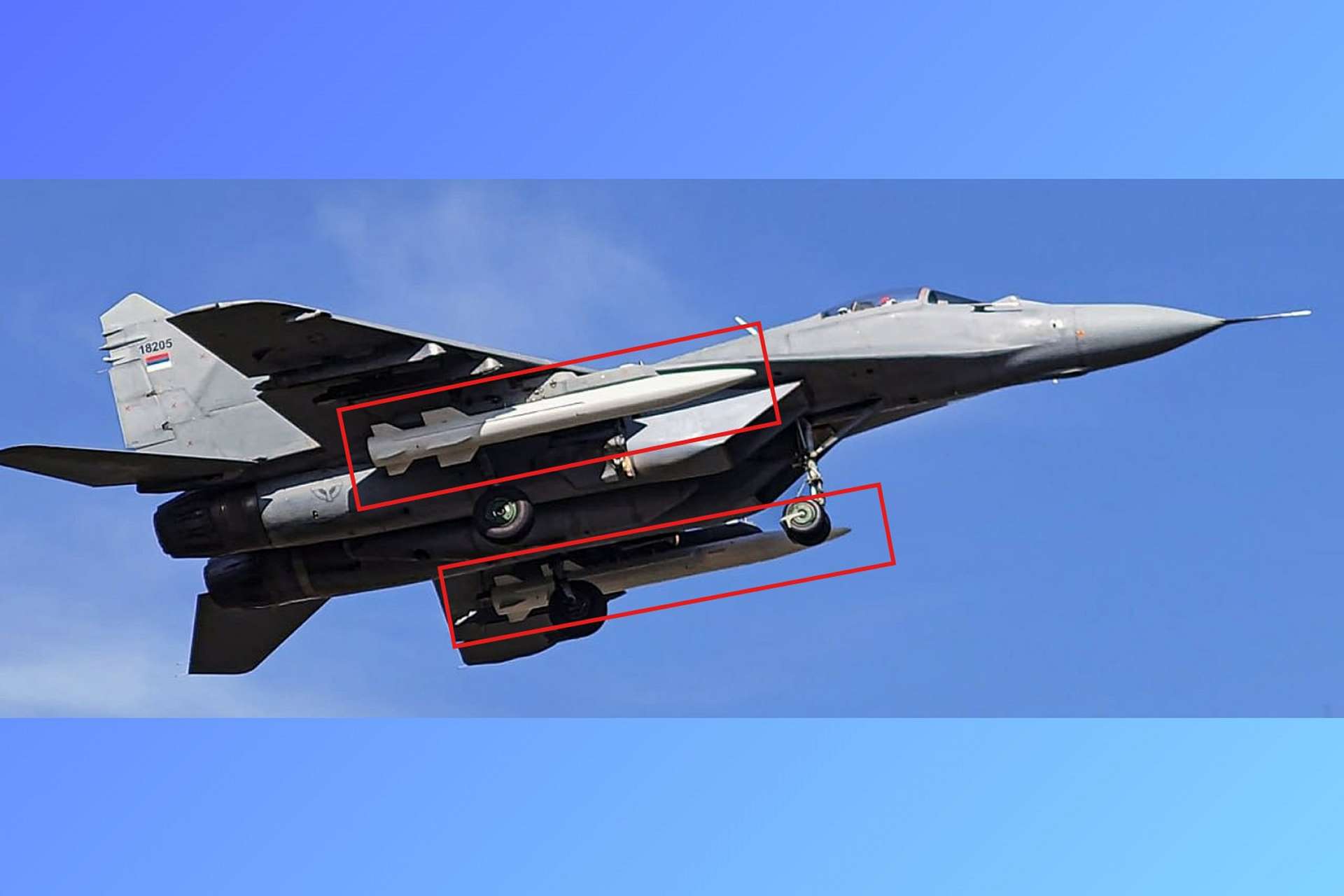
As of 9 March 2026, a single image circulating on social media has drawn sustained attention to what appears to be a Serbian Air Force MiG-29SM carrying Chinese CM-400AKG long-range air-to-surface missiles, a configuration that, if confirmed, would represent a notable evolution in Belgrade’s combat aviation posture. The relevance of this image lies not only in the possible appearance of a new munition, but in the suggestion that Serbia may be broadening the operational role of its Fulcrum fleet from air-policing and interception toward standoff precision strike. In the European context, such a development would be important because it would associate a high-speed Chinese air-launched strike weapon with a front-line fighter operated in the Balkans. At present, however, no official governmental confirmation has been issued, and the assessment therefore remains based on the available image.
Follow Army Recognition on Google News at this link
A circulating image appears to show a Serbian Air Force MiG-29SM carrying Chinese CM-400AKG long-range strike missiles, suggesting a possible expansion of Serbia’s standoff attack capability if confirmed (Picture Source: Social Media)
What makes the sighting important is less the image itself than what it may indicate about the progress of weapons integration. In military aviation, the visible carriage of a missile under a fighter’s wing or fuselage station does not automatically demonstrate full operational certification, but it can suggest that at least part of the stores-management, pylon compatibility, and carriage-clearance process has advanced. If Serbia has indeed integrated the CM-400AKG onto its MiG-29SM aircraft, the implication would be that the platform is being adapted for a broader mission set that includes standoff attack rather than remaining confined to its traditional role as an air-superiority and quick-reaction-alert aircraft.
The missile visible at the center of the image constitutes a central element of the reported development. The CM-400AKG has been described in Chinese export literature as a high-speed, air-launched strike weapon intended for engagement of high-value fixed targets and, in some descriptions, maritime objectives. Open technical references generally indicate a diameter of approximately 0.4 meters and a range between 100 and 240 kilometers, with warhead configurations reportedly including a 150-kilogram blast-fragmentation type and a 200-kilogram penetration variant. These parameters suggest that the missile represents more than a symbolic addition, positioning it instead as a standoff weapon intended to strike defended targets from launch ranges that could reduce the aircraft’s exposure to short-range air-defense systems.”
The terminology applied to the CM-400AKG warrants particular precision. In public discourse, the missile is frequently characterized as hypersonic, while some reports also describe it as ballistic. A more rigorous formulation would identify it as a very-high-speed air-launched strike missile featuring a high-altitude release profile and a steep terminal attack trajectory that imparts quasi-ballistic or semi-ballistic characteristics. The available Chinese technical descriptions do support the assessment that its speed and flight profile differ markedly from those of more conventional air-launched cruise missiles. They do not, however, justify treating all reported performance claims as definitively established.
Its reported guidance architecture also contributes to its operational relevance. Export-related descriptions indicate that the missile uses a guidance architecture combining inertial navigation and satellite updates, with optional terminal guidance modes that have been reported to include infrared, television, and passive-radiation homing. In practical aviation terms, this means the weapon is suited to a strike sequence in which the launch aircraft does not need to remain in close proximity to the target during the terminal phase. That matters operationally because it improves launch-platform survivability, reduces exposure time inside hostile engagement zones, and allows the aircraft to employ a fire-and-turn-away profile after release rather than fly deep into defended airspace.
For Serbia’s MiG-29SM fleet, the importance lies in the transformation of mission profile rather than in airframe novelty. The MiG-29 was originally conceived as a twin-engine air-superiority fighter optimized for high agility, rapid climb, and front-line interception. Serbia’s upgraded aircraft have already shown a broader weapons envelope than the earliest baseline Fulcrum variants, but the potential carriage of the CM-400AKG would push that evolution further by assigning the aircraft a more pronounced strike function. In doctrinal terms, that would move the Serbian MiG-29SM closer to a true multirole employment profile, where sortie generation, navigation precision, release-parameter management, electronic survivability, and target handoff become as important as classical beyond-visual-range or within-visual-range fighter performance.
At the tactical level, a MiG-29 armed with a high-speed standoff missile can generate operational pressure without necessarily entering the densest layers of an adversary’s air-defense system. Even a modest inventory of such weapons can complicate defensive planning because it allows attacks against fixed assets such as command posts, radar installations, logistics nodes, ammunition depots, bridges, or air-base infrastructure from positions that shorten exposure and compress defender reaction time. The missile’s reported flight behavior, especially its high-energy terminal phase, would also create a different interception challenge than slower subsonic threats, making it relevant not only as a strike asset but as a tool of coercive signaling.
At the regional level, the appearance of such a weapon on Serbian fighters would likely be interpreted as a move toward greater standoff lethality and more credible precision-strike capacity. It would not by itself transform Serbia into a dominant regional airpower, and it would not eliminate the enduring limitations associated with fleet size, sustainment, pilot availability, or the age of the platform. Nevertheless, it would oblige neighboring military planners to think more seriously about hardening, dispersal, runway recovery, radar survivability, and the resilience of fixed military infrastructure. In that respect, the psychological and planning effects of the missile may be almost as important as the missile’s physical range.
The strategic and geostrategic dimension is equally important. If this integration is genuine and operationally meaningful, Serbia would be illustrating a particularly hybrid force-development model that blends Russian-designed combat aircraft, Chinese air-launched strike munitions, and a broader modernization trajectory that has also included the acquisition of Western platforms. Such a posture would reinforce Belgrade’s preference for diversified procurement and strategic flexibility rather than exclusive dependence on one defense-industrial sphere. In wider European terms, the importance would lie in the appearance of Chinese-origin high-speed strike technology on a regional fighter fleet operating in a politically sensitive theater, a combination that would be followed closely by both military planners and policymakers concerned with defense alignment, escalation control, and the diffusion of advanced standoff weapons.
What this image may ultimately reveal is not merely the addition of a new missile, but a change in the philosophy of Serbian airpower. If the MiG-29SM has indeed been adapted to employ the CM-400AKG, Serbia would be moving part of its fighter force toward a more credible standoff strike role, one that combines the speed and responsiveness of a legacy interceptor with the reach and deterrent value of a modern precision munition. Until official confirmation is issued, restraint remains appropriate, yet the implications are already substantial: the Balkan air picture would no longer be shaped only by fighter numbers and air-policing readiness, but increasingly by the ability to deliver fast, long-range precision effects from the air with limited warning and considerable political impact.
Written by Teoman S. Nicanci – Defense Analyst, Army Recognition Group
Teoman S. Nicanci holds degrees in Political Science, Comparative and International Politics, and International Relations and Diplomacy from leading Belgian universities, with research focused on Russian strategic behavior, defense technology, and modern warfare. He is a defense analyst at Army Recognition, specializing in the global defense industry, military armament, and emerging defense technologies.
{loadposition bannertop}
{loadposition sidebarpub}
A newly circulated image appears to show a Serbian Air Force MiG-29SM equipped with Chinese CM-400AKG long-range air-to-surface missiles. If confirmed, the configuration could significantly expand Serbia’s standoff strike reach and alter the regional airpower balance in the Balkans.
As of 9 March 2026, a single image circulating on social media has drawn sustained attention to what appears to be a Serbian Air Force MiG-29SM carrying Chinese CM-400AKG long-range air-to-surface missiles, a configuration that, if confirmed, would represent a notable evolution in Belgrade’s combat aviation posture. The relevance of this image lies not only in the possible appearance of a new munition, but in the suggestion that Serbia may be broadening the operational role of its Fulcrum fleet from air-policing and interception toward standoff precision strike. In the European context, such a development would be important because it would associate a high-speed Chinese air-launched strike weapon with a front-line fighter operated in the Balkans. At present, however, no official governmental confirmation has been issued, and the assessment therefore remains based on the available image.
A circulating image appears to show a Serbian Air Force MiG-29SM carrying Chinese CM-400AKG long-range strike missiles, suggesting a possible expansion of Serbia’s standoff attack capability if confirmed (Picture Source: Social Media)
What makes the sighting important is less the image itself than what it may indicate about the progress of weapons integration. In military aviation, the visible carriage of a missile under a fighter’s wing or fuselage station does not automatically demonstrate full operational certification, but it can suggest that at least part of the stores-management, pylon compatibility, and carriage-clearance process has advanced. If Serbia has indeed integrated the CM-400AKG onto its MiG-29SM aircraft, the implication would be that the platform is being adapted for a broader mission set that includes standoff attack rather than remaining confined to its traditional role as an air-superiority and quick-reaction-alert aircraft.
The missile visible at the center of the image constitutes a central element of the reported development. The CM-400AKG has been described in Chinese export literature as a high-speed, air-launched strike weapon intended for engagement of high-value fixed targets and, in some descriptions, maritime objectives. Open technical references generally indicate a diameter of approximately 0.4 meters and a range between 100 and 240 kilometers, with warhead configurations reportedly including a 150-kilogram blast-fragmentation type and a 200-kilogram penetration variant. These parameters suggest that the missile represents more than a symbolic addition, positioning it instead as a standoff weapon intended to strike defended targets from launch ranges that could reduce the aircraft’s exposure to short-range air-defense systems.”
The terminology applied to the CM-400AKG warrants particular precision. In public discourse, the missile is frequently characterized as hypersonic, while some reports also describe it as ballistic. A more rigorous formulation would identify it as a very-high-speed air-launched strike missile featuring a high-altitude release profile and a steep terminal attack trajectory that imparts quasi-ballistic or semi-ballistic characteristics. The available Chinese technical descriptions do support the assessment that its speed and flight profile differ markedly from those of more conventional air-launched cruise missiles. They do not, however, justify treating all reported performance claims as definitively established.
Its reported guidance architecture also contributes to its operational relevance. Export-related descriptions indicate that the missile uses a guidance architecture combining inertial navigation and satellite updates, with optional terminal guidance modes that have been reported to include infrared, television, and passive-radiation homing. In practical aviation terms, this means the weapon is suited to a strike sequence in which the launch aircraft does not need to remain in close proximity to the target during the terminal phase. That matters operationally because it improves launch-platform survivability, reduces exposure time inside hostile engagement zones, and allows the aircraft to employ a fire-and-turn-away profile after release rather than fly deep into defended airspace.
For Serbia’s MiG-29SM fleet, the importance lies in the transformation of mission profile rather than in airframe novelty. The MiG-29 was originally conceived as a twin-engine air-superiority fighter optimized for high agility, rapid climb, and front-line interception. Serbia’s upgraded aircraft have already shown a broader weapons envelope than the earliest baseline Fulcrum variants, but the potential carriage of the CM-400AKG would push that evolution further by assigning the aircraft a more pronounced strike function. In doctrinal terms, that would move the Serbian MiG-29SM closer to a true multirole employment profile, where sortie generation, navigation precision, release-parameter management, electronic survivability, and target handoff become as important as classical beyond-visual-range or within-visual-range fighter performance.
At the tactical level, a MiG-29 armed with a high-speed standoff missile can generate operational pressure without necessarily entering the densest layers of an adversary’s air-defense system. Even a modest inventory of such weapons can complicate defensive planning because it allows attacks against fixed assets such as command posts, radar installations, logistics nodes, ammunition depots, bridges, or air-base infrastructure from positions that shorten exposure and compress defender reaction time. The missile’s reported flight behavior, especially its high-energy terminal phase, would also create a different interception challenge than slower subsonic threats, making it relevant not only as a strike asset but as a tool of coercive signaling.
At the regional level, the appearance of such a weapon on Serbian fighters would likely be interpreted as a move toward greater standoff lethality and more credible precision-strike capacity. It would not by itself transform Serbia into a dominant regional airpower, and it would not eliminate the enduring limitations associated with fleet size, sustainment, pilot availability, or the age of the platform. Nevertheless, it would oblige neighboring military planners to think more seriously about hardening, dispersal, runway recovery, radar survivability, and the resilience of fixed military infrastructure. In that respect, the psychological and planning effects of the missile may be almost as important as the missile’s physical range.
The strategic and geostrategic dimension is equally important. If this integration is genuine and operationally meaningful, Serbia would be illustrating a particularly hybrid force-development model that blends Russian-designed combat aircraft, Chinese air-launched strike munitions, and a broader modernization trajectory that has also included the acquisition of Western platforms. Such a posture would reinforce Belgrade’s preference for diversified procurement and strategic flexibility rather than exclusive dependence on one defense-industrial sphere. In wider European terms, the importance would lie in the appearance of Chinese-origin high-speed strike technology on a regional fighter fleet operating in a politically sensitive theater, a combination that would be followed closely by both military planners and policymakers concerned with defense alignment, escalation control, and the diffusion of advanced standoff weapons.
What this image may ultimately reveal is not merely the addition of a new missile, but a change in the philosophy of Serbian airpower. If the MiG-29SM has indeed been adapted to employ the CM-400AKG, Serbia would be moving part of its fighter force toward a more credible standoff strike role, one that combines the speed and responsiveness of a legacy interceptor with the reach and deterrent value of a modern precision munition. Until official confirmation is issued, restraint remains appropriate, yet the implications are already substantial: the Balkan air picture would no longer be shaped only by fighter numbers and air-policing readiness, but increasingly by the ability to deliver fast, long-range precision effects from the air with limited warning and considerable political impact.
Written by Teoman S. Nicanci – Defense Analyst, Army Recognition Group
Teoman S. Nicanci holds degrees in Political Science, Comparative and International Politics, and International Relations and Diplomacy from leading Belgian universities, with research focused on Russian strategic behavior, defense technology, and modern warfare. He is a defense analyst at Army Recognition, specializing in the global defense industry, military armament, and emerging defense technologies.