South Korea to Deliver First Locally Developed KF-21 Boramae Fighter Jets to its Air Force in 2026
{loadposition bannertop}
{loadposition sidebarpub}
South Korea will begin delivering its first indigenous KF-21 Boramae fighter jets to the Republic of Korea Air Force this year, according to reporting by Korea JoongAng Daily on January 2, 2026. The milestone underscores Seoul’s push for defense self-reliance and positions its aerospace industry for a larger role in the global fighter market.
South Korea is preparing to hand over the first production KF-21 Boramae fighter jets to the Republic of Korea Air Force in 2026, according to a January 2, 2026, report by Korea JoongAng Daily. Developed by Korea Aerospace Industries, the twin-engine multirole fighter represents the most technically demanding weapons program ever pursued domestically, reflecting years of investment aimed at reducing reliance on foreign combat aircraft while strengthening export competitiveness.Follow Army Recognition on Google News at this link
South Korea’s KF-21 Boramae on static display during DX Korea 2023 in Seoul, highlighting the nation’s latest indigenous fighter program to international audiences. The aircraft’s public appearance underlines its readiness for production and export. (Picture source: Wikimedia)
The development of the KF-21 dates back to 2010, when Seoul launched the KF-X (Korean Fighter eXperimental) program to replace its aging F-4 and F-5 fleets and reduce dependence on foreign aircraft. After several years of design evaluation, wind tunnel testing, and international collaboration, the prototype was unveiled in April 2021. The aircraft made its first flight in July 2022, beginning an extensive flight-test campaign involving six prototypes. Over the next two years, the fleet logged over 2,000 flight hours, validating flight envelope parameters, radar performance, avionics integration, and weapons testing.
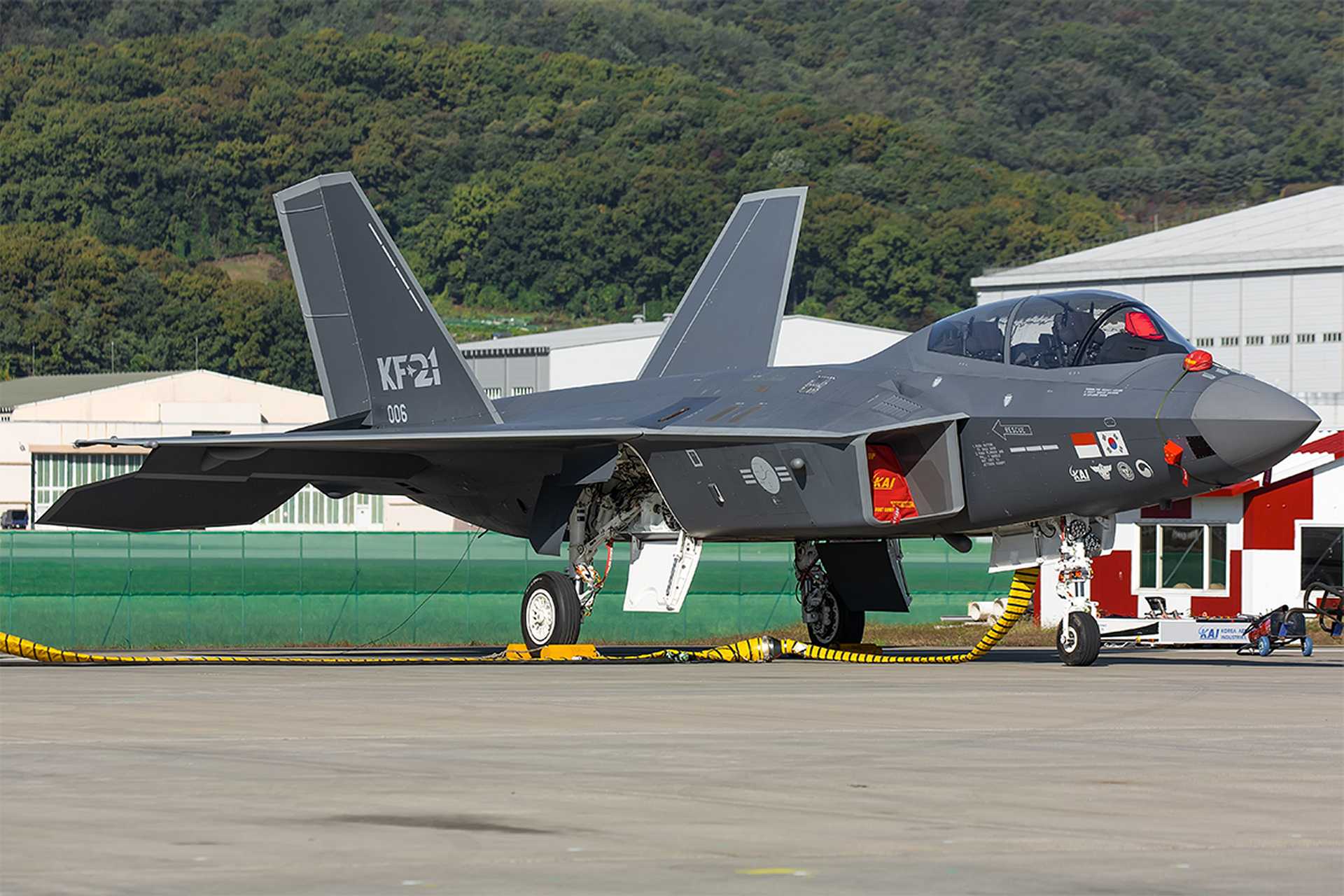
The KF-21 is a 4.5-generation multirole fighter designed with stealth shaping, advanced fly-by-wire controls, and an active electronically scanned array (AESA) radar. While it does not feature internal weapons bays, future blocks are expected to introduce more advanced stealth and sensor-fusion capabilities, positioning it between the F-16 and F-35 in capability and cost. Its twin-engine configuration gives it a combat radius suitable for regional operations and enhances survivability during high-intensity missions.
KAI began production of the first 20 Block-I aircraft in July 2024, following the successful conclusion of the prototype testing phase. These initial units are expected to achieve limited operational capability in 2026, with full operational capability anticipated by 2028. The Republic of Korea Air Force plans to acquire at least 120 units by the early 2030s, with future blocks expected to expand the platform’s roles and introduce more indigenous subsystems, including electronic warfare suites and integration of air-to-air/air-to-ground missiles.
Export prospects for the KF-21 are drawing growing international interest. As a cost-effective alternative to Western fifth-generation fighters, the Boramae is well positioned to meet the requirements of air forces seeking modern capabilities without the strategic and financial constraints associated with U.S. export approvals or complex maintenance ecosystems. Countries such as Indonesia – a development partner in the KF-X program – as well as the Philippines, Malaysia, and several Middle Eastern nations have been identified as potential customers. While Indonesia has delayed some of its financial commitments, it remains a participant in the program, potentially opening the door to joint production or regional transfer.
What sets the KF-21 apart in the export arena is its balance of modern performance, affordability, and low political entanglement. The aircraft is expected to undercut the cost of the F-35 while offering regional air forces a path to operate high-performance fighters without the full operational and training burdens typically associated with U.S.-made platforms. Moreover, South Korea’s growing reputation as a reliable defense exporter, boosted by recent successes with the K9 howitzer and K2 tank, lends credibility to Boramae’s export ambitions.
In a global landscape where defense industrial independence and regional deterrence capabilities are increasingly prioritized, the KF-21 marks a strategic transformation for South Korea. Its successful delivery to the ROKAF in 2026 will not only strengthen the nation’s air power but also reinforce its position as a rising aerospace power with growing influence in the Indo-Pacific and beyond.
Compared with other recent fighter developments around the world, the KF-21 reflects a broader trend toward indigenous combat aircraft programs, particularly among middle- and emerging-power nations aiming to reduce reliance on Western suppliers. India’s Tejas Mk1A, for example, is already in limited squadron service and serves as a stepping stone toward the more advanced Tejas Mk2 and AMCA (Advanced Medium Combat Aircraft). However, both Indian projects continue to face delays in propulsion integration and radar maturity. Meanwhile, Turkey’s TF-X Kaan fighter, developed by Turkish Aerospace Industries, conducted taxi tests in 2023 and is aiming for a first flight in 2026, but still lags the KF-21 in maturity and production readiness.
China’s fifth-generation J-20 and the newer FC-31 have made significant strides in serial production, but their closed development environment, lack of transparency, and reliance on imported engines for years have raised questions about true performance metrics. In contrast, the KF-21’s development timeline has been far more transparent, with a clear structure for flight testing and production milestones.
Europe is also advancing its own next-generation fighter efforts, most notably with the Franco-German-Spanish Future Combat Air System (FCAS) and the British-led Tempest program under the Global Combat Air Programme (GCAP), which includes Japan and Italy. These sixth-generation initiatives, however, are long-term ventures, with first flights not expected before 2030-2035, placing the KF-21 in a sweet spot of availability for countries seeking near-term capability upgrades.
Even the U.S. Next Generation Air Dominance (NGAD) program, while progressing under high secrecy, is years away from fielded platforms. This leaves the KF-21 as one of the few advanced fighters entering production and operational service in the 2020s, along with China’s J-20 and the U.S. F-35, but with the key difference of targeting affordability and non-aligned customers.
With its technological maturity, competitive pricing, and realistic timelines, the KF-21 stands uniquely positioned to dominate the niche between legacy fourth-generation fighters and the unaffordable cutting edge of stealth aviation. For South Korea, it represents more than an aircraft – it is a declaration of strategic and industrial capability, and a tool of geopolitical influence poised to shape airpower balances far beyond the Korean Peninsula.Written by Alain Servaes – Chief Editor, Army Recognition GroupAlain Servaes is a former infantry non-commissioned officer and the founder of Army Recognition. With over 20 years in defense journalism, he provides expert analysis on military equipment, NATO operations, and the global defense industry.
{loadposition bannertop}
{loadposition sidebarpub}
South Korea will begin delivering its first indigenous KF-21 Boramae fighter jets to the Republic of Korea Air Force this year, according to reporting by Korea JoongAng Daily on January 2, 2026. The milestone underscores Seoul’s push for defense self-reliance and positions its aerospace industry for a larger role in the global fighter market.
South Korea is preparing to hand over the first production KF-21 Boramae fighter jets to the Republic of Korea Air Force in 2026, according to a January 2, 2026, report by Korea JoongAng Daily. Developed by Korea Aerospace Industries, the twin-engine multirole fighter represents the most technically demanding weapons program ever pursued domestically, reflecting years of investment aimed at reducing reliance on foreign combat aircraft while strengthening export competitiveness.
Follow Army Recognition on Google News at this link
South Korea’s KF-21 Boramae on static display during DX Korea 2023 in Seoul, highlighting the nation’s latest indigenous fighter program to international audiences. The aircraft’s public appearance underlines its readiness for production and export. (Picture source: Wikimedia)
The development of the KF-21 dates back to 2010, when Seoul launched the KF-X (Korean Fighter eXperimental) program to replace its aging F-4 and F-5 fleets and reduce dependence on foreign aircraft. After several years of design evaluation, wind tunnel testing, and international collaboration, the prototype was unveiled in April 2021. The aircraft made its first flight in July 2022, beginning an extensive flight-test campaign involving six prototypes. Over the next two years, the fleet logged over 2,000 flight hours, validating flight envelope parameters, radar performance, avionics integration, and weapons testing.
The KF-21 is a 4.5-generation multirole fighter designed with stealth shaping, advanced fly-by-wire controls, and an active electronically scanned array (AESA) radar. While it does not feature internal weapons bays, future blocks are expected to introduce more advanced stealth and sensor-fusion capabilities, positioning it between the F-16 and F-35 in capability and cost. Its twin-engine configuration gives it a combat radius suitable for regional operations and enhances survivability during high-intensity missions.
KAI began production of the first 20 Block-I aircraft in July 2024, following the successful conclusion of the prototype testing phase. These initial units are expected to achieve limited operational capability in 2026, with full operational capability anticipated by 2028. The Republic of Korea Air Force plans to acquire at least 120 units by the early 2030s, with future blocks expected to expand the platform’s roles and introduce more indigenous subsystems, including electronic warfare suites and integration of air-to-air/air-to-ground missiles.
Export prospects for the KF-21 are drawing growing international interest. As a cost-effective alternative to Western fifth-generation fighters, the Boramae is well positioned to meet the requirements of air forces seeking modern capabilities without the strategic and financial constraints associated with U.S. export approvals or complex maintenance ecosystems. Countries such as Indonesia – a development partner in the KF-X program – as well as the Philippines, Malaysia, and several Middle Eastern nations have been identified as potential customers. While Indonesia has delayed some of its financial commitments, it remains a participant in the program, potentially opening the door to joint production or regional transfer.
What sets the KF-21 apart in the export arena is its balance of modern performance, affordability, and low political entanglement. The aircraft is expected to undercut the cost of the F-35 while offering regional air forces a path to operate high-performance fighters without the full operational and training burdens typically associated with U.S.-made platforms. Moreover, South Korea’s growing reputation as a reliable defense exporter, boosted by recent successes with the K9 howitzer and K2 tank, lends credibility to Boramae’s export ambitions.
In a global landscape where defense industrial independence and regional deterrence capabilities are increasingly prioritized, the KF-21 marks a strategic transformation for South Korea. Its successful delivery to the ROKAF in 2026 will not only strengthen the nation’s air power but also reinforce its position as a rising aerospace power with growing influence in the Indo-Pacific and beyond.
Compared with other recent fighter developments around the world, the KF-21 reflects a broader trend toward indigenous combat aircraft programs, particularly among middle- and emerging-power nations aiming to reduce reliance on Western suppliers. India’s Tejas Mk1A, for example, is already in limited squadron service and serves as a stepping stone toward the more advanced Tejas Mk2 and AMCA (Advanced Medium Combat Aircraft). However, both Indian projects continue to face delays in propulsion integration and radar maturity. Meanwhile, Turkey’s TF-X Kaan fighter, developed by Turkish Aerospace Industries, conducted taxi tests in 2023 and is aiming for a first flight in 2026, but still lags the KF-21 in maturity and production readiness.
China’s fifth-generation J-20 and the newer FC-31 have made significant strides in serial production, but their closed development environment, lack of transparency, and reliance on imported engines for years have raised questions about true performance metrics. In contrast, the KF-21’s development timeline has been far more transparent, with a clear structure for flight testing and production milestones.
Europe is also advancing its own next-generation fighter efforts, most notably with the Franco-German-Spanish Future Combat Air System (FCAS) and the British-led Tempest program under the Global Combat Air Programme (GCAP), which includes Japan and Italy. These sixth-generation initiatives, however, are long-term ventures, with first flights not expected before 2030-2035, placing the KF-21 in a sweet spot of availability for countries seeking near-term capability upgrades.
Even the U.S. Next Generation Air Dominance (NGAD) program, while progressing under high secrecy, is years away from fielded platforms. This leaves the KF-21 as one of the few advanced fighters entering production and operational service in the 2020s, along with China’s J-20 and the U.S. F-35, but with the key difference of targeting affordability and non-aligned customers.
With its technological maturity, competitive pricing, and realistic timelines, the KF-21 stands uniquely positioned to dominate the niche between legacy fourth-generation fighters and the unaffordable cutting edge of stealth aviation. For South Korea, it represents more than an aircraft – it is a declaration of strategic and industrial capability, and a tool of geopolitical influence poised to shape airpower balances far beyond the Korean Peninsula.
Written by Alain Servaes – Chief Editor, Army Recognition Group
Alain Servaes is a former infantry non-commissioned officer and the founder of Army Recognition. With over 20 years in defense journalism, he provides expert analysis on military equipment, NATO operations, and the global defense industry.