Spain and Poland jointly approve €5.4 billion Airbus A330 MRTT tanker fleet procurement
{loadposition bannertop}
{loadposition sidebarpub}
On August 25, 2026, Spain’s Council of Ministers authorized a seven-year framework agreement valued at up to €5.4 billion for a joint acquisition with Poland of at least seven Airbus A330 Multi Role Tanker Transport (MRTT) aircraft. The procurement allocates four aircraft to Poland and three to Spain, utilizing Spanish production positions to ensure operational delivery by the 2030 deadline. The initiative addresses a critical capability gap for the Polish Air Force by providing sovereign aerial refueling for its expanding fleet of 115 combat aircraft, including F-16 and F-35A fighters.
The €5.4 billion framework ceiling covers up to seven Airbus A330 MRTT airframes alongside comprehensive logistical support, training, infrastructure, and long-term sustainment through 2030. Financed in part through the European Union’s Security Action for Europe (SAFE) mechanism, the dual-role aircraft will deliver up to 111,000 kg of fuel capacity, 45 tonnes of non-fuel payload, and strategic transport for up to 300 personnel.
Related topic: Finland joins NATO Airbus A330 MRTT Multinational Tanker Fleet for F-35 refuelling operations
Polish Defense Minister Władysław Kosiniak-Kamysz said that the A330 MRTT procurement program covers at least seven aircraft and confirmed that four are intended for Poland, leaving three aircraft for Spain, although Madrid has not yet formally confirmed it. (Picture source: French Air Force)
On August 25, 2026, Spain’s Council of Ministers authorized a seven-year framework agreement with a maximum value of €5.4 billion ($6.3 billion) for the joint acquisition with Poland of several Airbus A330 Multi Role Tanker Transport (MRTT) aircraft and the logistical support needed to introduce them into service by the end of 2030. Polish Defense Minister Władysław Kosiniak-Kamysz then announced on August 26 that the procurement concerns “at least seven” aircraft and confirmed that four are intended for Poland, leaving three associated with Spain, although Madrid has not yet formally fixed that number. The bilateral track began with a memorandum signed on May 29, 2026, and continued during Kosiniak-Kamysz’s June 22-23 visit to Madrid for talks with Spanish Defense Minister Margarita Robles and a visit to Airbus’s Getafe conversion facilities.
Warsaw had initially examined a purchase of two MRTTs, but Spain’s decision to make production and delivery positions available allowed Poland to raise the planned force to four aircraft while remaining inside the SAFE implementation window ending in 2030. Poland has access to roughly €43.7 billion in SAFE financing, but there is still no fixed Polish contract value, no division of the €5.4 billion framework ceiling between Warsaw and Madrid, and no final aircraft configuration. The scale of the ceiling is therefore misleading if treated as an aircraft price: €5.4 billion divided by seven equals €771.4 million per aircraft, while Italy’s 2026 €1.393 billion contract for six A330 MRTTs and integrated support averages €232.2 million per aircraft at program level.
The difference is €539.2 million per aircraft, or a factor of 3.32, which may indicate that the Spanish ceiling covers a much broader contractual envelope than an initial seven-aircraft purchase. For Poland, the acquisition addresses a clear imbalance between the size of the combat-air fleet and the absence of nationally controlled aerial refueling. The Polish Air Force operates 47 F-16C/D Block 52+ fighters, is introducing 32 F-35A Husarz jets, and plans to field 36 FA-50PLs, producing a combined force of 115 combat aircraft across those three fleets, but its heavy transport force consists of six C-130 Hercules, and there is no dedicated tanker. The tanker requirement dates to the Karkonosze program launched around 2008, postponed around 2010, and subsequently pursued through multinational arrangements before Poland withdrew from the effort that became NATO’s Multinational MRTT Fleet in 2015-2016.
The original requirement already included both boom and hose-and-drogue refueling plus cargo, passenger, and medical transport functions, which explains why the A330 MRTT fits a requirement broader than simply refueling fighters. The boom is particularly important because both the F-16 and F-35A use receptacle refueling. The Airbus Military Aerial Refuelling Boom System (ARBS) transfers up to 3,600 kg of fuel per minute, which means that once stable contact is established, 5,000 kg can be transferred in 83 seconds, 7,000 kg in 117 seconds, and 10,000 kg in 167 seconds. For a formation of four fighters each taking 5,000 kg, the pure fuel-transfer time at maximum flow is 5.6 minutes, before accounting for sequencing, approach, stabilization, and separation.
That matters operationally because a tanker orbit can restore fuel consumed during high-speed intercepts, extend combat air patrols, allow aircraft to remain forward without returning to base, and reduce the number of intermediate stops required when fighters deploy from Poland to the Middle East, Arctic, or other NATO operating areas. Four tankers nevertheless provide limited redundancy: one unavailable aircraft cuts fleet strength to 75%, two unavailable aircraft to 50%, and if two aircraft are committed simultaneously, only two remain for maintenance reserve, training or another operation. The A330 MRTT would also increase the scale of Poland’s strategic air mobility by an order of magnitude compared with relying principally on C-130s.
The European tanker aircraft is 58.8 m long, has a 60.3-m wingspan and a height of 17.4 m, with a maximum takeoff weight of 233,000 kg, maximum landing weight of 182,000 kg and maximum fuel capacity of 111,000 kg. The newer A330 MRTT+ raises maximum takeoff weight to 242 tonnes, uses the A330-800neo airframe and Rolls-Royce Trent 7000 engines, and reduces fuel consumption by 8% while retaining roughly 95% commonality with the existing MRTT family. Poland is expected to receive an A330neo-derived configuration, although the final standard has not yet been fixed. The baseline MRTT cruises at Mach 0.82 and operates to 12,600 m or 41,500 ft. Takeoff distance at maximum takeoff weight is 2,800 m and landing distance at maximum landing weight is 1,750 m, placing runway length and pavement strength among the infrastructure factors Poland will have to address at any permanent or dispersal base.
Ferry range reaches 16,100 km with no payload, falls to 12,000 km with 20 tonnes, 10,200 km with 30 tonnes and 8,400 km with 40 tonnes. A representative mission profile allows one aircraft to refuel four fighters together with 25 tonnes of payload and 50 passengers over 5,200 km, while another profile supports four fighters over 6,700 km without the additional payload. At a mission radius above 2,300 km, the tanker can still offload roughly 70 tonnes, and at roughly 1,850 km it can transfer more than 50 tonnes while retaining sufficient fuel for recovery. The aircraft’s refueling architecture is one of the most consequential configuration choices because Poland’s national requirement and NATO interoperability do not rely on the same interface. The Airbus ARBS operates between 180 and 325 knots and transfers up to 3,600 kg/min to receptacle-equipped aircraft such as the F-16, F-35, F-15, C-17, P-8 and E-7.
Two Cobham 905E underwing pods provide probe-and-drogue refueling, each using a 25.9-m hose and transferring up to 1,300 kg/min between 185 and 350 knots. If both wing pods are used simultaneously, the theoretical combined transfer rate reaches 2,600 kg/min, allowing two probe-equipped receivers to take fuel at the same time. An optional Cobham 805E fuselage refueling unit adds a centerline hose with a maximum rate of 1,800 kg/min, also across the 185-350-knot envelope. That system extends compatibility to aircraft including the Eurofighter Typhoon, Rafale, F/A-18, Mirage 2000, Gripen and A400M. The optional UARRSI receptacle allows the MRTT itself to receive fuel from another boom-equipped tanker, which is relevant for very long missions because it permits tanker endurance to be extended beyond the limitations imposed by its own initial fuel load.
Airbus’s A3R automatic refueling system further automates receiver tracking and boom contact, and Singapore achieved full operational certification in February 2026. For Poland, a boom-only aircraft would satisfy the national F-16 and F-35 requirement but would exclude a large part of the probe-equipped NATO receiver fleet. Fitting both boom and underwing pods would make each Polish aircraft usable for national missions, coalition fighter support, and dual-receiver refueling without assigning different aircraft to different refueling standards. The strategic-airlift component is similarly measurable. Because the A330 MRTT stores its 111,000 kg of fuel in the aircraft’s standard tanks, tanker conversion does not consume the main passenger deck or lower cargo compartments with auxiliary fuel tanks. Up to 45,000 kg of non-fuel payload remains available, including roughly 37,000 kg in the lower cargo hold.
The Airbus Military Aerial Refuelling Boom System (ARBS) operates between 180 and 325 knots and transfers up to 3,600 kg/min to receptacle-equipped aircraft, including the F-16, F-35, F-15, C-17, P-8, and E-7. (Picture source: Army Recognition)
That hold accommodates 27 LD3 containers or eight NATO-standard pallets measuring 2.23 x 2.74 m, giving Poland the ability to move personnel and sustainment loads on the same sortie that accompanies fighter deployments. Passenger capacity reaches roughly 300 personnel in a standard high-capacity configuration. Existing national layouts vary, with 266 seats in Singaporean aircraft, 267 in German/MMF configuration, and 291 on RAF Voyager aircraft, while maximum-density arrangements can reach roughly 380 passengers. At 300 seats per aircraft, a four-aircraft Polish force has a theoretical single-wave passenger capacity of 1,200 people. Three available aircraft reduce that figure to 900 and two to 600. Using the 45-tonne non-fuel payload limit, the corresponding theoretical fleet capacities are 180 tonnes with four aircraft, 135 tonnes with three and 90 tonnes with two.
Medical layouts can combine six intensive-care beds, 34 additional patient beds, 20 medical staff seats and 100 passenger seats, while alternative arrangements can carry up to 130 stretchers. The same four aircraft could therefore move a fighter detachment, its technicians and spare parts outward, support aerial refueling during the deployment and return configured for personnel or medical evacuation, reducing the requirement for separate strategic transport sorties. Spain’s current three-aircraft fleet illustrates why fleet size matters separately from individual aircraft performance. Madrid authorized €810 million in 2021 for three former Iberia A330-200 airliners, their conversion to MRTT configuration and associated logistics, spares, training, mission hardware and software, giving an arithmetic program average of €270 million per aircraft.
Spain purchased the A330s after Iberia reduced its commercial fleet during the COVID-19 period, sending one aircraft directly to Getafe for conversion while the other two remained temporarily available for passenger transport. The first converted MRTT entered service with Ala 45 at Torrejón de Ardoz in April 2025 and the second followed in October 2025, while the third continued through conversion and acceptance. Spain’s aircraft initially used hose-and-drogue rather than boom refueling, matching the needs of fighters such as the Eurofighter and EF-18. They have endurance exceeding 18 hours and range near 16,000 km, allowing the same fleet to support tactical refueling and intercontinental transport. For instance, one Spanish MRTT completed a non-stop flight of roughly 11,600 km from China to Spain in more than 15 hours, while Spain has also used the type in long-distance deployments toward Australia.
The three aircraft also support approximately 4,500 Spanish personnel deployed abroad while covering tanker training, strategic transport, fighter deployments and contingency evacuation. In a three-aircraft fleet, one aircraft in maintenance removes 33.3% of the inventory, and two remove 66.7%. If Spain adds three aircraft, one unavailable aircraft would reduce a six-aircraft fleet by only 16.7%, two by 33.3% and three by 50%, giving Ala 45 substantially more room to separate training, transport and tanker tasks instead of rotating the same few airframes among them. The €5.4 billion framework ceiling should therefore be judged against actual procurement benchmarks rather than treated as a seven-aircraft invoice. Italy finalized a €1.393 billion contract excluding VAT in May 2026 for six A330 MRTTs and integrated logistical support over 122 months, down €14.8 million from an initial estimate of €1.408 billion.
Two Cobham 905E underwing pods can be fitted for probe-equipped receivers, with each pod using a 25.9-m flexible fuel hose, operating between 185 and 350 knots and transferring up to 1,300 kg/min. (Picture source: Army Recognition)
That produces an arithmetic program average of €232.2 million per aircraft. Spain’s 2021 three-aircraft program averaged €270 million. At Spain’s earlier average, seven aircraft would equal €1.89 billion, which is €3.51 billion below the new ceiling and represents only 35% of it. At Italy’s 2026 average, seven aircraft would equal €1.625 billion, leaving €3.775 billion below the framework maximum. Conversely, €5.4 billion divided by seven produces €771.4 million per aircraft, which is €539.2 million higher than Italy’s program average and €501.4 million higher than Spain’s 2021 average. The new framework can therefore accommodate much more than seven bare aircraft. Its value can absorb new-production airframes, MRTT+ configuration changes, refueling booms, wing pods, defensive aids, secure communications, mission systems, spare engines, simulators, training, ground support equipment, infrastructure, initial spares, contractor support and additional call-off orders over seven years.
The central cost question is not whether an A330 MRTT costs €771 million, but how much of the €5.4 billion ceiling Poland and Spain will actually convert into signed orders and how much of each national package will be aircraft acquisition rather than support and capability introduction. Poland is also choosing national ownership instead of returning to the NATO Multinational MRTT Fleet, which by July 2026 had expanded to nine participating countries and was moving toward 12 aircraft. Finland joined on July 7, 2026, alongside Belgium, Czechia, Denmark, Germany, Luxembourg, the Netherlands, Norway and Sweden.
Under that model, participating countries buy annual flying-hour allocations rather than individual aircraft, while OCCAR manages acquisition, the NATO Support and Procurement Agency (NSPA) handles lifecycle support, and the Multinational MRTT Unit operates the fleet. The arrangement spreads the cost of hangars, simulators, maintenance personnel, spare engines, mission planning, and refueling-system specialists among several governments. Poland’s model does the opposite: Warsaw would fund those fixed costs for only four aircraft but gain direct control over all four rather than rely on shared scheduling and allocated hours. Fleet depth differs significantly.
Poland would own four aircraft, while MMF participants collectively draw from a planned force of 12, but those 12 are shared among nine countries and cannot all be treated as available to one participant. The broader A330 MRTT support base partly offsets the risks of Poland operating a small sovereign fleet. By 2026, the family had reached 19 operator nations, more than 90 aircraft ordered and roughly 66 delivered, while Airbus was expanding annual conversion capacity from five to seven aircraft by adding a second conversion center at Seville alongside Getafe. Poland is therefore accepting the cost of national crews, maintenance, infrastructure, and sustainment in exchange for direct tasking authority over four aircraft, rather than purchasing a fractional share of a larger NATO pool.
Written by Jérôme Brahy
Jérôme Brahy is a defense analyst and documentalist at Army Recognition. He specializes in naval modernization, aviation, drones, armored vehicles, and artillery, with a focus on strategic developments in the United States, China, Ukraine, Russia, Türkiye, and Belgium. His analyses go beyond the facts, providing context, identifying key actors, and explaining why defense news matters on a global scale.
Explore More Defense News
• Land Defense News• Naval Defense News• Defense Aerospace News
{loadposition bannertop}
{loadposition sidebarpub}
On August 25, 2026, Spain’s Council of Ministers authorized a seven-year framework agreement valued at up to €5.4 billion for a joint acquisition with Poland of at least seven Airbus A330 Multi Role Tanker Transport (MRTT) aircraft. The procurement allocates four aircraft to Poland and three to Spain, utilizing Spanish production positions to ensure operational delivery by the 2030 deadline. The initiative addresses a critical capability gap for the Polish Air Force by providing sovereign aerial refueling for its expanding fleet of 115 combat aircraft, including F-16 and F-35A fighters.
The €5.4 billion framework ceiling covers up to seven Airbus A330 MRTT airframes alongside comprehensive logistical support, training, infrastructure, and long-term sustainment through 2030. Financed in part through the European Union’s Security Action for Europe (SAFE) mechanism, the dual-role aircraft will deliver up to 111,000 kg of fuel capacity, 45 tonnes of non-fuel payload, and strategic transport for up to 300 personnel.
Related topic: Finland joins NATO Airbus A330 MRTT Multinational Tanker Fleet for F-35 refuelling operations
Polish Defense Minister Władysław Kosiniak-Kamysz said that the A330 MRTT procurement program covers at least seven aircraft and confirmed that four are intended for Poland, leaving three aircraft for Spain, although Madrid has not yet formally confirmed it. (Picture source: French Air Force)
On August 25, 2026, Spain’s Council of Ministers authorized a seven-year framework agreement with a maximum value of €5.4 billion ($6.3 billion) for the joint acquisition with Poland of several Airbus A330 Multi Role Tanker Transport (MRTT) aircraft and the logistical support needed to introduce them into service by the end of 2030. Polish Defense Minister Władysław Kosiniak-Kamysz then announced on August 26 that the procurement concerns “at least seven” aircraft and confirmed that four are intended for Poland, leaving three associated with Spain, although Madrid has not yet formally fixed that number. The bilateral track began with a memorandum signed on May 29, 2026, and continued during Kosiniak-Kamysz’s June 22-23 visit to Madrid for talks with Spanish Defense Minister Margarita Robles and a visit to Airbus’s Getafe conversion facilities.
Warsaw had initially examined a purchase of two MRTTs, but Spain’s decision to make production and delivery positions available allowed Poland to raise the planned force to four aircraft while remaining inside the SAFE implementation window ending in 2030. Poland has access to roughly €43.7 billion in SAFE financing, but there is still no fixed Polish contract value, no division of the €5.4 billion framework ceiling between Warsaw and Madrid, and no final aircraft configuration. The scale of the ceiling is therefore misleading if treated as an aircraft price: €5.4 billion divided by seven equals €771.4 million per aircraft, while Italy’s 2026 €1.393 billion contract for six A330 MRTTs and integrated support averages €232.2 million per aircraft at program level.
The difference is €539.2 million per aircraft, or a factor of 3.32, which may indicate that the Spanish ceiling covers a much broader contractual envelope than an initial seven-aircraft purchase. For Poland, the acquisition addresses a clear imbalance between the size of the combat-air fleet and the absence of nationally controlled aerial refueling. The Polish Air Force operates 47 F-16C/D Block 52+ fighters, is introducing 32 F-35A Husarz jets, and plans to field 36 FA-50PLs, producing a combined force of 115 combat aircraft across those three fleets, but its heavy transport force consists of six C-130 Hercules, and there is no dedicated tanker. The tanker requirement dates to the Karkonosze program launched around 2008, postponed around 2010, and subsequently pursued through multinational arrangements before Poland withdrew from the effort that became NATO’s Multinational MRTT Fleet in 2015-2016.
The original requirement already included both boom and hose-and-drogue refueling plus cargo, passenger, and medical transport functions, which explains why the A330 MRTT fits a requirement broader than simply refueling fighters. The boom is particularly important because both the F-16 and F-35A use receptacle refueling. The Airbus Military Aerial Refuelling Boom System (ARBS) transfers up to 3,600 kg of fuel per minute, which means that once stable contact is established, 5,000 kg can be transferred in 83 seconds, 7,000 kg in 117 seconds, and 10,000 kg in 167 seconds. For a formation of four fighters each taking 5,000 kg, the pure fuel-transfer time at maximum flow is 5.6 minutes, before accounting for sequencing, approach, stabilization, and separation.
That matters operationally because a tanker orbit can restore fuel consumed during high-speed intercepts, extend combat air patrols, allow aircraft to remain forward without returning to base, and reduce the number of intermediate stops required when fighters deploy from Poland to the Middle East, Arctic, or other NATO operating areas. Four tankers nevertheless provide limited redundancy: one unavailable aircraft cuts fleet strength to 75%, two unavailable aircraft to 50%, and if two aircraft are committed simultaneously, only two remain for maintenance reserve, training or another operation. The A330 MRTT would also increase the scale of Poland’s strategic air mobility by an order of magnitude compared with relying principally on C-130s.
The European tanker aircraft is 58.8 m long, has a 60.3-m wingspan and a height of 17.4 m, with a maximum takeoff weight of 233,000 kg, maximum landing weight of 182,000 kg and maximum fuel capacity of 111,000 kg. The newer A330 MRTT+ raises maximum takeoff weight to 242 tonnes, uses the A330-800neo airframe and Rolls-Royce Trent 7000 engines, and reduces fuel consumption by 8% while retaining roughly 95% commonality with the existing MRTT family. Poland is expected to receive an A330neo-derived configuration, although the final standard has not yet been fixed. The baseline MRTT cruises at Mach 0.82 and operates to 12,600 m or 41,500 ft. Takeoff distance at maximum takeoff weight is 2,800 m and landing distance at maximum landing weight is 1,750 m, placing runway length and pavement strength among the infrastructure factors Poland will have to address at any permanent or dispersal base.
Ferry range reaches 16,100 km with no payload, falls to 12,000 km with 20 tonnes, 10,200 km with 30 tonnes and 8,400 km with 40 tonnes. A representative mission profile allows one aircraft to refuel four fighters together with 25 tonnes of payload and 50 passengers over 5,200 km, while another profile supports four fighters over 6,700 km without the additional payload. At a mission radius above 2,300 km, the tanker can still offload roughly 70 tonnes, and at roughly 1,850 km it can transfer more than 50 tonnes while retaining sufficient fuel for recovery. The aircraft’s refueling architecture is one of the most consequential configuration choices because Poland’s national requirement and NATO interoperability do not rely on the same interface. The Airbus ARBS operates between 180 and 325 knots and transfers up to 3,600 kg/min to receptacle-equipped aircraft such as the F-16, F-35, F-15, C-17, P-8 and E-7.
Two Cobham 905E underwing pods provide probe-and-drogue refueling, each using a 25.9-m hose and transferring up to 1,300 kg/min between 185 and 350 knots. If both wing pods are used simultaneously, the theoretical combined transfer rate reaches 2,600 kg/min, allowing two probe-equipped receivers to take fuel at the same time. An optional Cobham 805E fuselage refueling unit adds a centerline hose with a maximum rate of 1,800 kg/min, also across the 185-350-knot envelope. That system extends compatibility to aircraft including the Eurofighter Typhoon, Rafale, F/A-18, Mirage 2000, Gripen and A400M. The optional UARRSI receptacle allows the MRTT itself to receive fuel from another boom-equipped tanker, which is relevant for very long missions because it permits tanker endurance to be extended beyond the limitations imposed by its own initial fuel load.
Airbus’s A3R automatic refueling system further automates receiver tracking and boom contact, and Singapore achieved full operational certification in February 2026. For Poland, a boom-only aircraft would satisfy the national F-16 and F-35 requirement but would exclude a large part of the probe-equipped NATO receiver fleet. Fitting both boom and underwing pods would make each Polish aircraft usable for national missions, coalition fighter support, and dual-receiver refueling without assigning different aircraft to different refueling standards. The strategic-airlift component is similarly measurable. Because the A330 MRTT stores its 111,000 kg of fuel in the aircraft’s standard tanks, tanker conversion does not consume the main passenger deck or lower cargo compartments with auxiliary fuel tanks. Up to 45,000 kg of non-fuel payload remains available, including roughly 37,000 kg in the lower cargo hold.
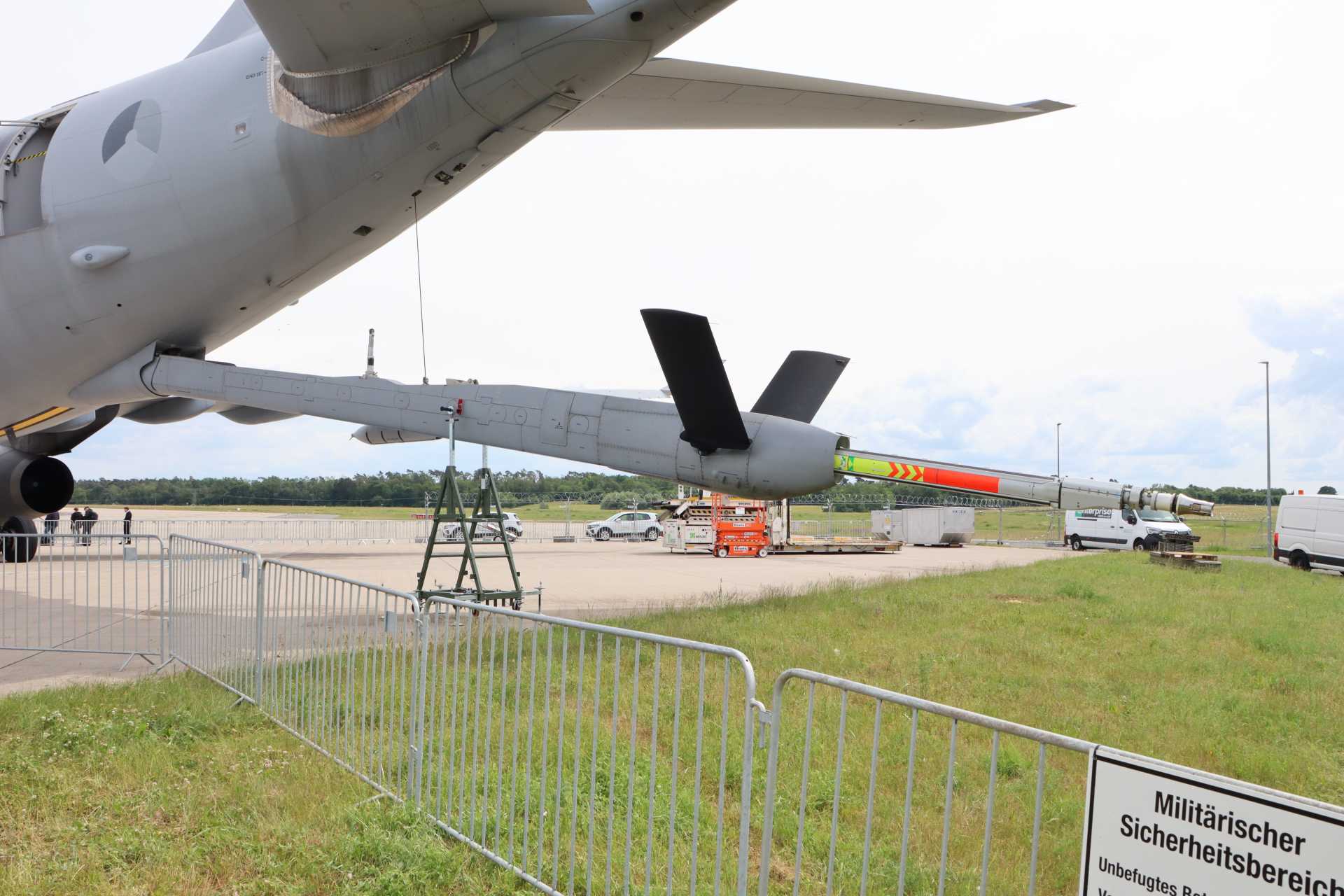
The Airbus Military Aerial Refuelling Boom System (ARBS) operates between 180 and 325 knots and transfers up to 3,600 kg/min to receptacle-equipped aircraft, including the F-16, F-35, F-15, C-17, P-8, and E-7. (Picture source: Army Recognition)
That hold accommodates 27 LD3 containers or eight NATO-standard pallets measuring 2.23 x 2.74 m, giving Poland the ability to move personnel and sustainment loads on the same sortie that accompanies fighter deployments. Passenger capacity reaches roughly 300 personnel in a standard high-capacity configuration. Existing national layouts vary, with 266 seats in Singaporean aircraft, 267 in German/MMF configuration, and 291 on RAF Voyager aircraft, while maximum-density arrangements can reach roughly 380 passengers. At 300 seats per aircraft, a four-aircraft Polish force has a theoretical single-wave passenger capacity of 1,200 people. Three available aircraft reduce that figure to 900 and two to 600. Using the 45-tonne non-fuel payload limit, the corresponding theoretical fleet capacities are 180 tonnes with four aircraft, 135 tonnes with three and 90 tonnes with two.
Medical layouts can combine six intensive-care beds, 34 additional patient beds, 20 medical staff seats and 100 passenger seats, while alternative arrangements can carry up to 130 stretchers. The same four aircraft could therefore move a fighter detachment, its technicians and spare parts outward, support aerial refueling during the deployment and return configured for personnel or medical evacuation, reducing the requirement for separate strategic transport sorties. Spain’s current three-aircraft fleet illustrates why fleet size matters separately from individual aircraft performance. Madrid authorized €810 million in 2021 for three former Iberia A330-200 airliners, their conversion to MRTT configuration and associated logistics, spares, training, mission hardware and software, giving an arithmetic program average of €270 million per aircraft.
Spain purchased the A330s after Iberia reduced its commercial fleet during the COVID-19 period, sending one aircraft directly to Getafe for conversion while the other two remained temporarily available for passenger transport. The first converted MRTT entered service with Ala 45 at Torrejón de Ardoz in April 2025 and the second followed in October 2025, while the third continued through conversion and acceptance. Spain’s aircraft initially used hose-and-drogue rather than boom refueling, matching the needs of fighters such as the Eurofighter and EF-18. They have endurance exceeding 18 hours and range near 16,000 km, allowing the same fleet to support tactical refueling and intercontinental transport. For instance, one Spanish MRTT completed a non-stop flight of roughly 11,600 km from China to Spain in more than 15 hours, while Spain has also used the type in long-distance deployments toward Australia.
The three aircraft also support approximately 4,500 Spanish personnel deployed abroad while covering tanker training, strategic transport, fighter deployments and contingency evacuation. In a three-aircraft fleet, one aircraft in maintenance removes 33.3% of the inventory, and two remove 66.7%. If Spain adds three aircraft, one unavailable aircraft would reduce a six-aircraft fleet by only 16.7%, two by 33.3% and three by 50%, giving Ala 45 substantially more room to separate training, transport and tanker tasks instead of rotating the same few airframes among them. The €5.4 billion framework ceiling should therefore be judged against actual procurement benchmarks rather than treated as a seven-aircraft invoice. Italy finalized a €1.393 billion contract excluding VAT in May 2026 for six A330 MRTTs and integrated logistical support over 122 months, down €14.8 million from an initial estimate of €1.408 billion.
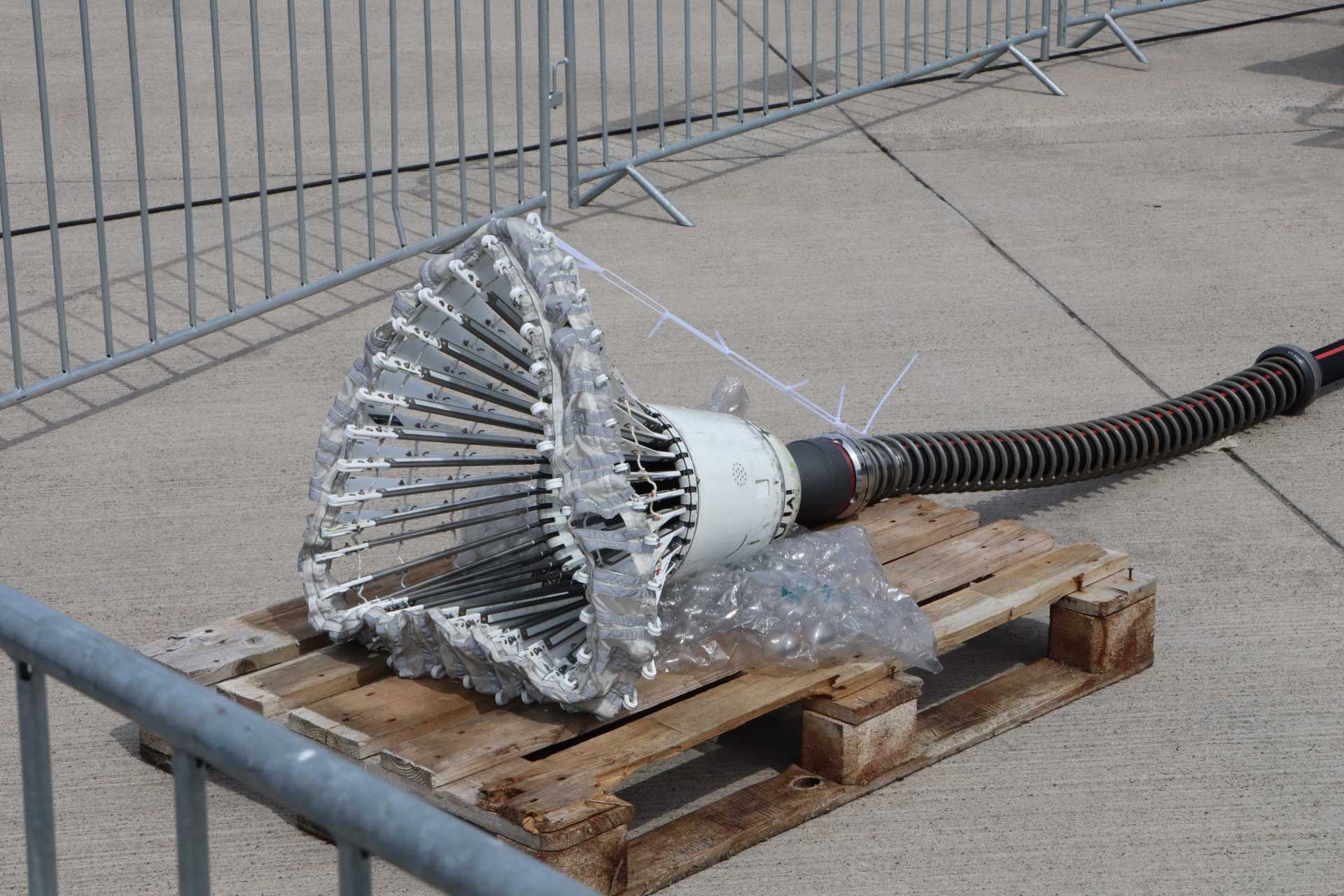
Two Cobham 905E underwing pods can be fitted for probe-equipped receivers, with each pod using a 25.9-m flexible fuel hose, operating between 185 and 350 knots and transferring up to 1,300 kg/min. (Picture source: Army Recognition)
That produces an arithmetic program average of €232.2 million per aircraft. Spain’s 2021 three-aircraft program averaged €270 million. At Spain’s earlier average, seven aircraft would equal €1.89 billion, which is €3.51 billion below the new ceiling and represents only 35% of it. At Italy’s 2026 average, seven aircraft would equal €1.625 billion, leaving €3.775 billion below the framework maximum. Conversely, €5.4 billion divided by seven produces €771.4 million per aircraft, which is €539.2 million higher than Italy’s program average and €501.4 million higher than Spain’s 2021 average. The new framework can therefore accommodate much more than seven bare aircraft. Its value can absorb new-production airframes, MRTT+ configuration changes, refueling booms, wing pods, defensive aids, secure communications, mission systems, spare engines, simulators, training, ground support equipment, infrastructure, initial spares, contractor support and additional call-off orders over seven years.
The central cost question is not whether an A330 MRTT costs €771 million, but how much of the €5.4 billion ceiling Poland and Spain will actually convert into signed orders and how much of each national package will be aircraft acquisition rather than support and capability introduction. Poland is also choosing national ownership instead of returning to the NATO Multinational MRTT Fleet, which by July 2026 had expanded to nine participating countries and was moving toward 12 aircraft. Finland joined on July 7, 2026, alongside Belgium, Czechia, Denmark, Germany, Luxembourg, the Netherlands, Norway and Sweden.
Under that model, participating countries buy annual flying-hour allocations rather than individual aircraft, while OCCAR manages acquisition, the NATO Support and Procurement Agency (NSPA) handles lifecycle support, and the Multinational MRTT Unit operates the fleet. The arrangement spreads the cost of hangars, simulators, maintenance personnel, spare engines, mission planning, and refueling-system specialists among several governments. Poland’s model does the opposite: Warsaw would fund those fixed costs for only four aircraft but gain direct control over all four rather than rely on shared scheduling and allocated hours. Fleet depth differs significantly.
Poland would own four aircraft, while MMF participants collectively draw from a planned force of 12, but those 12 are shared among nine countries and cannot all be treated as available to one participant. The broader A330 MRTT support base partly offsets the risks of Poland operating a small sovereign fleet. By 2026, the family had reached 19 operator nations, more than 90 aircraft ordered and roughly 66 delivered, while Airbus was expanding annual conversion capacity from five to seven aircraft by adding a second conversion center at Seville alongside Getafe. Poland is therefore accepting the cost of national crews, maintenance, infrastructure, and sustainment in exchange for direct tasking authority over four aircraft, rather than purchasing a fractional share of a larger NATO pool.
Written by Jérôme Brahy
Jérôme Brahy is a defense analyst and documentalist at Army Recognition. He specializes in naval modernization, aviation, drones, armored vehicles, and artillery, with a focus on strategic developments in the United States, China, Ukraine, Russia, Türkiye, and Belgium. His analyses go beyond the facts, providing context, identifying key actors, and explaining why defense news matters on a global scale.
Explore More Defense News
• Land Defense News
• Naval Defense News
• Defense Aerospace News