Taiwan Air Force Mirage 2000 Fighter Jet Scramble From Hsinchu During China Military Drills
{loadposition bannertop}
{loadposition sidebarpub}
A Taiwanese Air Force Mirage 2000 fighter jet launched from Hsinchu Air Base on December 30, 2025, as the People’s Liberation Army ramped up large-scale drills around Taiwan. The sortie highlights how Taiwan is sustaining round-the-clock air defense readiness amid sustained Chinese military pressure.
A Mirage 2000 fighter assigned to Taiwan’s Air Force thundered off the runway at Hsinchu Air Base on Monday under heightened alert conditions, according to Taiwanese defense officials. The takeoff came as the People’s Liberation Army expanded joint exercises involving aircraft, naval vessels, and missile forces operating around Taiwan, a pattern that has increasingly tested the island’s air defense response and pilot endurance.Follow Army Recognition on Google News at this link
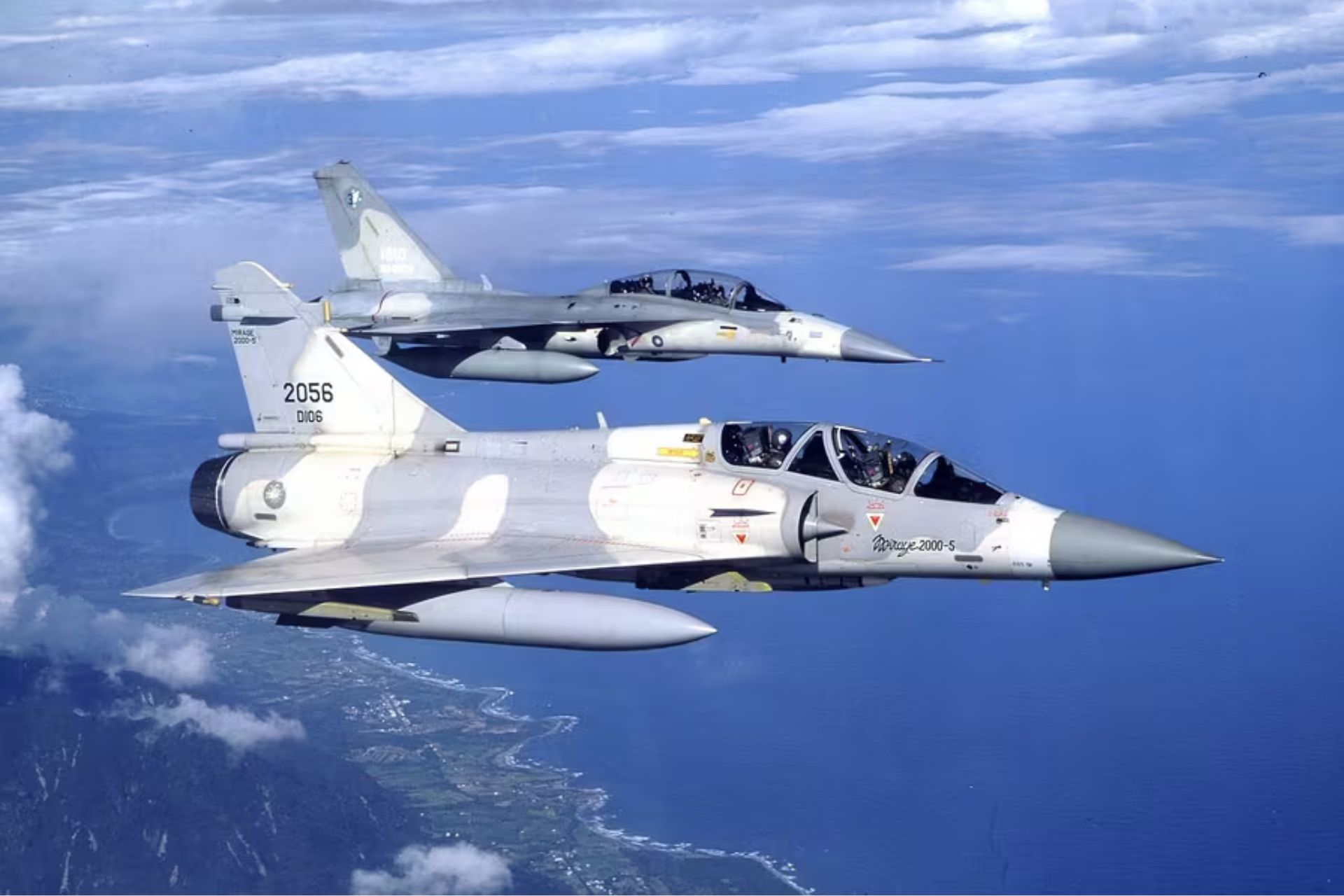
Although no longer the newest fighter in Taiwan’s inventory, the Mirage 2000 remains a critical element of quick reaction alert duties, complementing upgraded F-16V fighters and Indigenous Defense Fighters in a layered air defense system (Picture source: Taiwan Air Force)
The launch from Hsinchu was part of an active air defense response cycle, triggered by a sharp increase in Chinese aircraft and naval movements near the Taiwan Strait median line and in waters north and south of the island. In such conditions, every Mirage 2000 sortie serves an immediate operational role in interception and identification, while also signaling that Taiwan’s airspace remains contested and actively defended despite Beijing’s efforts to impose a new normal through constant military pressure.
Hsinchu Air Base remains a cornerstone of Taiwan’s air defense posture. Positioned on the island’s northwest coast, the base is closely associated with Taiwan’s Mirage 2000 fleet and sits within reach of Chinese long-range precision strike systems. Keeping Hsinchu operational during high-intensity drills demonstrates Taiwan’s focus on air base survivability, rapid turnaround, and the ability to sustain flight operations under crisis-like conditions.
Taiwan operates the Mirage 2000-5EI, an export variant of the Mirage 2000-5 family developed by Dassault Aviation in France. Taiwan ordered 60 aircraft in the mid-1990s, with deliveries completed by 1998, and the type has been in frontline service since 1997. Although no longer the newest fighter in Taiwan’s inventory, the Mirage 2000 remains a critical element of quick reaction alert duties, complementing upgraded F-16V fighters and Indigenous Defense Fighters in a layered air defense system.
Technically, the Mirage 2000-5 series is a fourth-generation, single-engine, delta-wing multirole fighter optimized for air defense. The aircraft is powered by an SNECMA M53-P2 afterburning turbofan engine delivering up to 95 kN of thrust, allowing a maximum speed of Mach 2.2 and a service ceiling of around 17,000 meters. These performance characteristics are particularly relevant in Taiwan’s air defense mission set, where rapid climb and high-speed interception are essential against fast-moving targets approaching from multiple vectors.
The Mirage 2000-5’s combat value lies in its avionics and weapons integration. Equipped with the Thales RDY multimode radar, the aircraft can track and engage multiple targets simultaneously in look-down and shoot-down conditions. Its ability to employ MICA EM active radar-guided and MICA IR infrared-guided missiles gives the pilot true “fire-and-forget” capability, enabling beyond-visual-range engagements while maneuvering or switching to new threats. For close combat, the aircraft retains Magic 2 infrared-guided missiles and twin 30 mm DEFA cannons, ensuring lethality across the engagement spectrum.
During China’s current drills, which emphasize blockade rehearsal and multi-axis pressure rather than a single decisive strike, such capabilities are particularly valuable. Mirage 2000s launched from Hsinchu can rapidly police airspace over the Taiwan Strait, force PLA aircraft to react, and complicate Chinese air operations by denying uncontested access near Taiwan’s coastline. Even when no weapons are fired, the presence of armed interceptors imposes tactical friction and intelligence uncertainty on the opposing force.
Sustaining these operations also reflects Taiwan’s investment in keeping the Mirage fleet viable well into the late 2020s. Despite challenges linked to maintenance costs and spare parts for an older European platform, Taiwan has continued to support the aircraft through life-extension measures and upgrades, recognizing that endurance and sortie generation are as decisive as headline-grabbing new acquisitions in a prolonged coercion campaign.
From a strategic perspective, the Mirage 2000 takeoff highlights the endurance contest now unfolding across the Strait. China’s drills are designed not only to rehearse military options but also to drain Taiwan’s resources and test its ability to maintain readiness over time. Taiwan’s answer, visible in the steady rhythm of launches and recoveries at bases like Hsinchu, is to demonstrate that its air force can absorb pressure without surrendering control of its airspace or operational tempo.
As the Mirage 2000 climbed away from the runway on December 30, it offered a clear snapshot of Taiwan’s defensive reality. The platform may date back decades, but in the hands of trained crews, supported by resilient infrastructure, it remains a frontline interceptor. In the face of expanding Chinese drills, each takeoff reinforces the same message: Taiwan’s air defense network is active, layered, and prepared to respond, sortie by sortie.
{loadposition bannertop}
{loadposition sidebarpub}
A Taiwanese Air Force Mirage 2000 fighter jet launched from Hsinchu Air Base on December 30, 2025, as the People’s Liberation Army ramped up large-scale drills around Taiwan. The sortie highlights how Taiwan is sustaining round-the-clock air defense readiness amid sustained Chinese military pressure.
A Mirage 2000 fighter assigned to Taiwan’s Air Force thundered off the runway at Hsinchu Air Base on Monday under heightened alert conditions, according to Taiwanese defense officials. The takeoff came as the People’s Liberation Army expanded joint exercises involving aircraft, naval vessels, and missile forces operating around Taiwan, a pattern that has increasingly tested the island’s air defense response and pilot endurance.
Follow Army Recognition on Google News at this link
Although no longer the newest fighter in Taiwan’s inventory, the Mirage 2000 remains a critical element of quick reaction alert duties, complementing upgraded F-16V fighters and Indigenous Defense Fighters in a layered air defense system (Picture source: Taiwan Air Force)
The launch from Hsinchu was part of an active air defense response cycle, triggered by a sharp increase in Chinese aircraft and naval movements near the Taiwan Strait median line and in waters north and south of the island. In such conditions, every Mirage 2000 sortie serves an immediate operational role in interception and identification, while also signaling that Taiwan’s airspace remains contested and actively defended despite Beijing’s efforts to impose a new normal through constant military pressure.
Hsinchu Air Base remains a cornerstone of Taiwan’s air defense posture. Positioned on the island’s northwest coast, the base is closely associated with Taiwan’s Mirage 2000 fleet and sits within reach of Chinese long-range precision strike systems. Keeping Hsinchu operational during high-intensity drills demonstrates Taiwan’s focus on air base survivability, rapid turnaround, and the ability to sustain flight operations under crisis-like conditions.
Taiwan operates the Mirage 2000-5EI, an export variant of the Mirage 2000-5 family developed by Dassault Aviation in France. Taiwan ordered 60 aircraft in the mid-1990s, with deliveries completed by 1998, and the type has been in frontline service since 1997. Although no longer the newest fighter in Taiwan’s inventory, the Mirage 2000 remains a critical element of quick reaction alert duties, complementing upgraded F-16V fighters and Indigenous Defense Fighters in a layered air defense system.
Technically, the Mirage 2000-5 series is a fourth-generation, single-engine, delta-wing multirole fighter optimized for air defense. The aircraft is powered by an SNECMA M53-P2 afterburning turbofan engine delivering up to 95 kN of thrust, allowing a maximum speed of Mach 2.2 and a service ceiling of around 17,000 meters. These performance characteristics are particularly relevant in Taiwan’s air defense mission set, where rapid climb and high-speed interception are essential against fast-moving targets approaching from multiple vectors.
The Mirage 2000-5’s combat value lies in its avionics and weapons integration. Equipped with the Thales RDY multimode radar, the aircraft can track and engage multiple targets simultaneously in look-down and shoot-down conditions. Its ability to employ MICA EM active radar-guided and MICA IR infrared-guided missiles gives the pilot true “fire-and-forget” capability, enabling beyond-visual-range engagements while maneuvering or switching to new threats. For close combat, the aircraft retains Magic 2 infrared-guided missiles and twin 30 mm DEFA cannons, ensuring lethality across the engagement spectrum.
During China’s current drills, which emphasize blockade rehearsal and multi-axis pressure rather than a single decisive strike, such capabilities are particularly valuable. Mirage 2000s launched from Hsinchu can rapidly police airspace over the Taiwan Strait, force PLA aircraft to react, and complicate Chinese air operations by denying uncontested access near Taiwan’s coastline. Even when no weapons are fired, the presence of armed interceptors imposes tactical friction and intelligence uncertainty on the opposing force.
Sustaining these operations also reflects Taiwan’s investment in keeping the Mirage fleet viable well into the late 2020s. Despite challenges linked to maintenance costs and spare parts for an older European platform, Taiwan has continued to support the aircraft through life-extension measures and upgrades, recognizing that endurance and sortie generation are as decisive as headline-grabbing new acquisitions in a prolonged coercion campaign.
From a strategic perspective, the Mirage 2000 takeoff highlights the endurance contest now unfolding across the Strait. China’s drills are designed not only to rehearse military options but also to drain Taiwan’s resources and test its ability to maintain readiness over time. Taiwan’s answer, visible in the steady rhythm of launches and recoveries at bases like Hsinchu, is to demonstrate that its air force can absorb pressure without surrendering control of its airspace or operational tempo.
As the Mirage 2000 climbed away from the runway on December 30, it offered a clear snapshot of Taiwan’s defensive reality. The platform may date back decades, but in the hands of trained crews, supported by resilient infrastructure, it remains a frontline interceptor. In the face of expanding Chinese drills, each takeoff reinforces the same message: Taiwan’s air defense network is active, layered, and prepared to respond, sortie by sortie.