Türkiye’s ANKA III Stealth Drone Set to Gain Air-to-Air Strike Role With MURAD AESA Radar Integration
{loadposition bannertop}
{loadposition sidebarpub}
Türkiye is preparing to integrate ASELSAN’s MURAD AESA radar onto the ANKA III stealth unmanned combat aerial vehicle, enabling a future air-to-air engagement role. The move signals Ankara’s intent to push its low-observable drone fleet beyond strike missions and into contested airspace dominance.
On 30 November 2025, Türkiye’s Kızılelma unmanned fighter demonstrated the beyond-visual-range air-to-air potential of ASELSAN’s MURAD AESA radar during a landmark Black Sea trial as reported by Army Recognition. In early January 2026, ASELSAN followed this milestone by confirming via its official communication channels that the MURAD 100-A AESA nose radar, already flown on F-16 Özgür, Bayraktar AKINCI and Kızılelma, is now being prepared for integration on Turkish Aerospace’s ANKA III stealth UCAV. This step links a high-performance, nationally developed radar family with a low-observable flying-wing drone designed for deep strike and electronic warfare.
Follow Army Recognition on Google News at this link
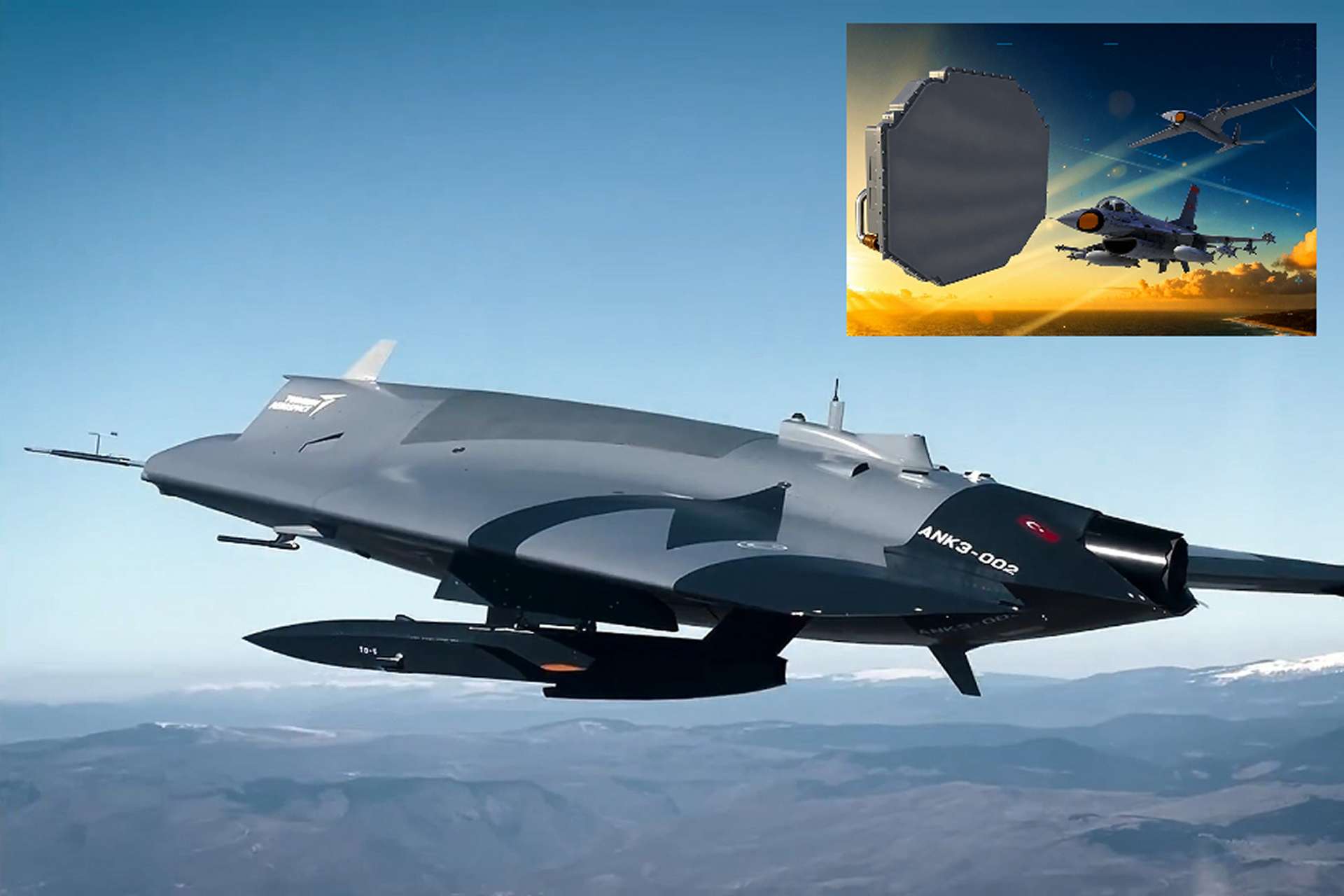
Türkiye is moving to equip its ANKA III stealth unmanned combat aircraft with ASELSAN’s MURAD AESA radar, a step that would give the flying-wing drone a credible air-to-air combat role alongside its deep strike and electronic warfare missions (Picture Source: Aselsan / Turkish Aerospace Industries)
At the centre of this evolution stands the MURAD radar family, of which MURAD 100-A is the fighter and UAV nose-mounted variant and MURAD 110-A is the reference fire-control configuration formally described by ASELSAN. According to ASELSAN, the radar is designed to provide both surveillance and fire-control functions, delivering situational awareness, threat identification, prioritisation, engagement and missile guidance in a single system. It operates over a wide frequency band with high aspect-angle coverage, uses gallium nitride power amplification, and relies on digital beamforming at sub-array level and time-interleaved operation to manage simultaneous air-to-air and air-to-ground tasks.
ASELSAN lists capabilities such as beyond-visual-range missile guidance, all-aspect and high-aspect search, multiple and agile target tracking, helicopter detection and weather modes on the air-to-air side, complemented by high-resolution stripmap and spotlight SAR, ground moving-target indication and tracking, ground mapping, fixed-target track and air-to-ground ranging. By using many solid-state transmit-receive modules in the antenna, the radar minimises the operational impact of individual failures and maintains high availability in combat, a feature particularly attractive for unmanned platforms expected to stay on station for long periods.
For Baykar’s AKINCI UCAV, which combines a high-altitude long-endurance airframe with a payload capacity in the order of 1.5 tonnes, a service ceiling of around 40,000 ft and endurance exceeding 24 hours, the integration of MURAD 100-A already represents a qualitative step beyond electro-optical and SAR-only sensor suites. With an AESA fire-control radar on board, AKINCI is no longer limited to acting as a long-endurance strike drone or surveillance platform; it can generate and maintain its own air and surface tracks, provide mid-course guidance updates to precision munitions and contribute to electronic-attack and electronic-support tasks using agile beam steering and adaptive waveforms.
As ASELSAN’s AESA line moves into serial production from chip to final system, the same hardware can receive incremental software upgrades to add new modes, such as higher-resolution SAR mapping, more refined moving-target indication or collaborative targeting algorithms. In that sense, the AKINCI fleet can be progressively upgraded in parallel with ANKA III and Kızılelma, sharing radar modes and threat libraries without major structural changes and creating a common “sensor language” across manned and unmanned platforms.
ANKA III itself has followed an accelerated but structured development cycle that now converges naturally with MURAD integration. Turkish Aerospace records indicate that the flying-wing UCAV programme entered its design and systems-requirements phase in 2022 and achieved its first flight in December 2023, after which it moved rapidly through flight-test milestones. TAI specifies a length of 8.9 m, wingspan of 13.1 m and height of 2.6 m, with a maximum take-off weight of 7,250 kg and a payload capacity of 1,600 kg carried on internal and external weapon stations. Powered by a turbofan engine, the aircraft has a service ceiling of 40,000 ft, a maximum speed of 0.7 Mach at 30,000 ft and a combat radius of 1,075 km in air-to-air configuration or 750 km in air-to-ground configuration. TAI also highlights multirole air-to-air and air-to-ground configurations, low radar observability, high subsonic speed, common avionics architecture and ground segment with ANKA and AKSUNGUR, manned-unmanned teaming, and swarm technologies supported by artificial intelligence.
ANKA III is designed to carry search and targeting payloads such as an electro-optical targeting system, AESA radar and IR search-and-track, alongside a full spectrum of laser-, imaging-infrared- and INS/GPS-guided air-to-ground munitions, radar- or imaging-infrared-guided air-to-air missiles, and electronic-warfare payloads including COMINT, ELINT, electronic support measures and electronic attack. From a technical standpoint, fitting a sizeable AESA antenna into this slender flying-wing design will likely require refinements either in the nose volume for a conventional planar array or through distributed leading-edge arrays, a configuration made possible by the modularity of AESA and attractive for missions requiring wide-angle SAR and electronic-warfare coverage.
The operational benchmark for what MURAD can deliver on a combat UAV is Kızılelma. It has been reported that the radar’s progressive integration on the unmanned fighter, notably an autumn 2025 campaign where Kızılelma tested MURAD in flight together with the TOYGUN electro-optical system, and a subsequent trial where it simulated an F-16 kill using the Gökdoğan beyond-visual-range missile cued by the radar. A later live-fire engagement on 30 November 2025 over the Black Sea saw Kızılelma detect, track and destroy a high-speed aerial target with a Gökdoğan missile guided by MURAD, widely presented as the first recorded BVR air-to-air kill by a jet-powered UAV. This sequence illustrates how the same radar family can support air-to-air combat on a fast, manoeuvring unmanned fighter.
On ANKA III, which trades peak speed for endurance, payload and low observability, MURAD’s strengths will be exploited differently: extended-range detection with long on-station times, persistent SAR mapping and electronic-support measures, and the ability to illuminate or support engagements for other shooters in the network, including Kızılelma, AKINCI or manned fighters. In terms of development logic, this mirrors the path followed by several air forces that first introduced AESA radars on manned fighters and then migrated the technology to high-end drones, but with the notable distinction that in this case the radar, missile and platforms are all produced within one national industrial base.
Strategically, the decision to bring MURAD 100-A onto ANKA III extends Türkiye’s ambition to build a layered, sovereign sensor and air-defence architecture. Within this framework, a stealthy flying-wing UCAV equipped with an AESA fire-control radar can operate as a forward-deployed extension of national air-surveillance and strike networks, relaying high-quality tracks, contributing to electronic attack and supporting beyond-visual-range engagements without risking a pilot. Militarily, this complicates adversary planning in contested regions such as the Eastern Mediterranean, the Black Sea or the Middle East, where air-defence systems must now account for long-endurance, radar-equipped unmanned platforms operating in concert with manned fighters and surface-based sensors. Geopolitically, the fact that MURAD is produced domestically from GaN technology upwards and has been designed from the outset for both fighter aircraft and UCAVs reduces exposure to external export restrictions and positions Türkiye as a supplier of complete, radar-equipped unmanned combat systems for partners seeking alternatives to US or European solutions.
By moving MURAD 100-A from F-16 Özgür, AKINCI and Kızılelma onto the ANKA III stealth UCAV, ASELSAN and Turkish Aerospace are effectively turning a series of separate flight campaigns into a coherent, multi-platform radar ecosystem. The combination of ANKA III’s low-observable flying-wing design and officially documented multirole payload capacity with a national AESA fire-control radar signals that Türkiye’s unmanned airpower is entering a new phase in which drones are no longer just weapon carriers or ISR assets but fully integrated contributors to air superiority, electronic warfare and long-range strike. For regional air forces and international observers, the forthcoming ANKA III configuration with MURAD 100-A will be a key indicator of how quickly this vision translates into deployable capability, and of how far a nationally controlled radar and UCAV industry can reshape the balance between manned and unmanned air combat in the coming decade.
Written by Teoman S. Nicanci – Defense Analyst, Army Recognition Group
Teoman S. Nicanci holds degrees in Political Science, Comparative and International Politics, and International Relations and Diplomacy from leading Belgian universities, with research focused on Russian strategic behavior, defense technology, and modern warfare. He is a defense analyst at Army Recognition, specializing in the global defense industry, military armament, and emerging defense technologies.
{loadposition bannertop}
{loadposition sidebarpub}
Türkiye is preparing to integrate ASELSAN’s MURAD AESA radar onto the ANKA III stealth unmanned combat aerial vehicle, enabling a future air-to-air engagement role. The move signals Ankara’s intent to push its low-observable drone fleet beyond strike missions and into contested airspace dominance.
On 30 November 2025, Türkiye’s Kızılelma unmanned fighter demonstrated the beyond-visual-range air-to-air potential of ASELSAN’s MURAD AESA radar during a landmark Black Sea trial as reported by Army Recognition. In early January 2026, ASELSAN followed this milestone by confirming via its official communication channels that the MURAD 100-A AESA nose radar, already flown on F-16 Özgür, Bayraktar AKINCI and Kızılelma, is now being prepared for integration on Turkish Aerospace’s ANKA III stealth UCAV. This step links a high-performance, nationally developed radar family with a low-observable flying-wing drone designed for deep strike and electronic warfare.
Türkiye is moving to equip its ANKA III stealth unmanned combat aircraft with ASELSAN’s MURAD AESA radar, a step that would give the flying-wing drone a credible air-to-air combat role alongside its deep strike and electronic warfare missions (Picture Source: Aselsan / Turkish Aerospace Industries)
At the centre of this evolution stands the MURAD radar family, of which MURAD 100-A is the fighter and UAV nose-mounted variant and MURAD 110-A is the reference fire-control configuration formally described by ASELSAN. According to ASELSAN, the radar is designed to provide both surveillance and fire-control functions, delivering situational awareness, threat identification, prioritisation, engagement and missile guidance in a single system. It operates over a wide frequency band with high aspect-angle coverage, uses gallium nitride power amplification, and relies on digital beamforming at sub-array level and time-interleaved operation to manage simultaneous air-to-air and air-to-ground tasks.
ASELSAN lists capabilities such as beyond-visual-range missile guidance, all-aspect and high-aspect search, multiple and agile target tracking, helicopter detection and weather modes on the air-to-air side, complemented by high-resolution stripmap and spotlight SAR, ground moving-target indication and tracking, ground mapping, fixed-target track and air-to-ground ranging. By using many solid-state transmit-receive modules in the antenna, the radar minimises the operational impact of individual failures and maintains high availability in combat, a feature particularly attractive for unmanned platforms expected to stay on station for long periods.
For Baykar’s AKINCI UCAV, which combines a high-altitude long-endurance airframe with a payload capacity in the order of 1.5 tonnes, a service ceiling of around 40,000 ft and endurance exceeding 24 hours, the integration of MURAD 100-A already represents a qualitative step beyond electro-optical and SAR-only sensor suites. With an AESA fire-control radar on board, AKINCI is no longer limited to acting as a long-endurance strike drone or surveillance platform; it can generate and maintain its own air and surface tracks, provide mid-course guidance updates to precision munitions and contribute to electronic-attack and electronic-support tasks using agile beam steering and adaptive waveforms.
As ASELSAN’s AESA line moves into serial production from chip to final system, the same hardware can receive incremental software upgrades to add new modes, such as higher-resolution SAR mapping, more refined moving-target indication or collaborative targeting algorithms. In that sense, the AKINCI fleet can be progressively upgraded in parallel with ANKA III and Kızılelma, sharing radar modes and threat libraries without major structural changes and creating a common “sensor language” across manned and unmanned platforms.
ANKA III itself has followed an accelerated but structured development cycle that now converges naturally with MURAD integration. Turkish Aerospace records indicate that the flying-wing UCAV programme entered its design and systems-requirements phase in 2022 and achieved its first flight in December 2023, after which it moved rapidly through flight-test milestones. TAI specifies a length of 8.9 m, wingspan of 13.1 m and height of 2.6 m, with a maximum take-off weight of 7,250 kg and a payload capacity of 1,600 kg carried on internal and external weapon stations. Powered by a turbofan engine, the aircraft has a service ceiling of 40,000 ft, a maximum speed of 0.7 Mach at 30,000 ft and a combat radius of 1,075 km in air-to-air configuration or 750 km in air-to-ground configuration. TAI also highlights multirole air-to-air and air-to-ground configurations, low radar observability, high subsonic speed, common avionics architecture and ground segment with ANKA and AKSUNGUR, manned-unmanned teaming, and swarm technologies supported by artificial intelligence.
ANKA III is designed to carry search and targeting payloads such as an electro-optical targeting system, AESA radar and IR search-and-track, alongside a full spectrum of laser-, imaging-infrared- and INS/GPS-guided air-to-ground munitions, radar- or imaging-infrared-guided air-to-air missiles, and electronic-warfare payloads including COMINT, ELINT, electronic support measures and electronic attack. From a technical standpoint, fitting a sizeable AESA antenna into this slender flying-wing design will likely require refinements either in the nose volume for a conventional planar array or through distributed leading-edge arrays, a configuration made possible by the modularity of AESA and attractive for missions requiring wide-angle SAR and electronic-warfare coverage.
The operational benchmark for what MURAD can deliver on a combat UAV is Kızılelma. It has been reported that the radar’s progressive integration on the unmanned fighter, notably an autumn 2025 campaign where Kızılelma tested MURAD in flight together with the TOYGUN electro-optical system, and a subsequent trial where it simulated an F-16 kill using the Gökdoğan beyond-visual-range missile cued by the radar. A later live-fire engagement on 30 November 2025 over the Black Sea saw Kızılelma detect, track and destroy a high-speed aerial target with a Gökdoğan missile guided by MURAD, widely presented as the first recorded BVR air-to-air kill by a jet-powered UAV. This sequence illustrates how the same radar family can support air-to-air combat on a fast, manoeuvring unmanned fighter.
On ANKA III, which trades peak speed for endurance, payload and low observability, MURAD’s strengths will be exploited differently: extended-range detection with long on-station times, persistent SAR mapping and electronic-support measures, and the ability to illuminate or support engagements for other shooters in the network, including Kızılelma, AKINCI or manned fighters. In terms of development logic, this mirrors the path followed by several air forces that first introduced AESA radars on manned fighters and then migrated the technology to high-end drones, but with the notable distinction that in this case the radar, missile and platforms are all produced within one national industrial base.
Strategically, the decision to bring MURAD 100-A onto ANKA III extends Türkiye’s ambition to build a layered, sovereign sensor and air-defence architecture. Within this framework, a stealthy flying-wing UCAV equipped with an AESA fire-control radar can operate as a forward-deployed extension of national air-surveillance and strike networks, relaying high-quality tracks, contributing to electronic attack and supporting beyond-visual-range engagements without risking a pilot. Militarily, this complicates adversary planning in contested regions such as the Eastern Mediterranean, the Black Sea or the Middle East, where air-defence systems must now account for long-endurance, radar-equipped unmanned platforms operating in concert with manned fighters and surface-based sensors. Geopolitically, the fact that MURAD is produced domestically from GaN technology upwards and has been designed from the outset for both fighter aircraft and UCAVs reduces exposure to external export restrictions and positions Türkiye as a supplier of complete, radar-equipped unmanned combat systems for partners seeking alternatives to US or European solutions.
By moving MURAD 100-A from F-16 Özgür, AKINCI and Kızılelma onto the ANKA III stealth UCAV, ASELSAN and Turkish Aerospace are effectively turning a series of separate flight campaigns into a coherent, multi-platform radar ecosystem. The combination of ANKA III’s low-observable flying-wing design and officially documented multirole payload capacity with a national AESA fire-control radar signals that Türkiye’s unmanned airpower is entering a new phase in which drones are no longer just weapon carriers or ISR assets but fully integrated contributors to air superiority, electronic warfare and long-range strike. For regional air forces and international observers, the forthcoming ANKA III configuration with MURAD 100-A will be a key indicator of how quickly this vision translates into deployable capability, and of how far a nationally controlled radar and UCAV industry can reshape the balance between manned and unmanned air combat in the coming decade.
Written by Teoman S. Nicanci – Defense Analyst, Army Recognition Group
Teoman S. Nicanci holds degrees in Political Science, Comparative and International Politics, and International Relations and Diplomacy from leading Belgian universities, with research focused on Russian strategic behavior, defense technology, and modern warfare. He is a defense analyst at Army Recognition, specializing in the global defense industry, military armament, and emerging defense technologies.