Türkiye’s Baykar Ramps Up Akinci Combat Drone Production Toward 120 Units by 2026
{loadposition bannertop}
{loadposition sidebarpub}
Baykar has delivered 110 Bayraktar Akinci unmanned combat aerial vehicles and plans to raise that total to 120 by the end of 2026, according to reporting from its Flight Training and Test Center in western Türkiye.
Reporting from Ihlas News Agency in early January 2026 places the Baykar Akinci program at a measured but revealing inflection point, with 110 aircraft delivered so far and a stated objective of reaching a total of 120 by the end of 2026, a figure that offers insight not just into production output, but into how testing, training, sustainment, and operational expansion are being managed in parallel as the platform’s role continues to broaden.
Follow Army Recognition on Google News at this link
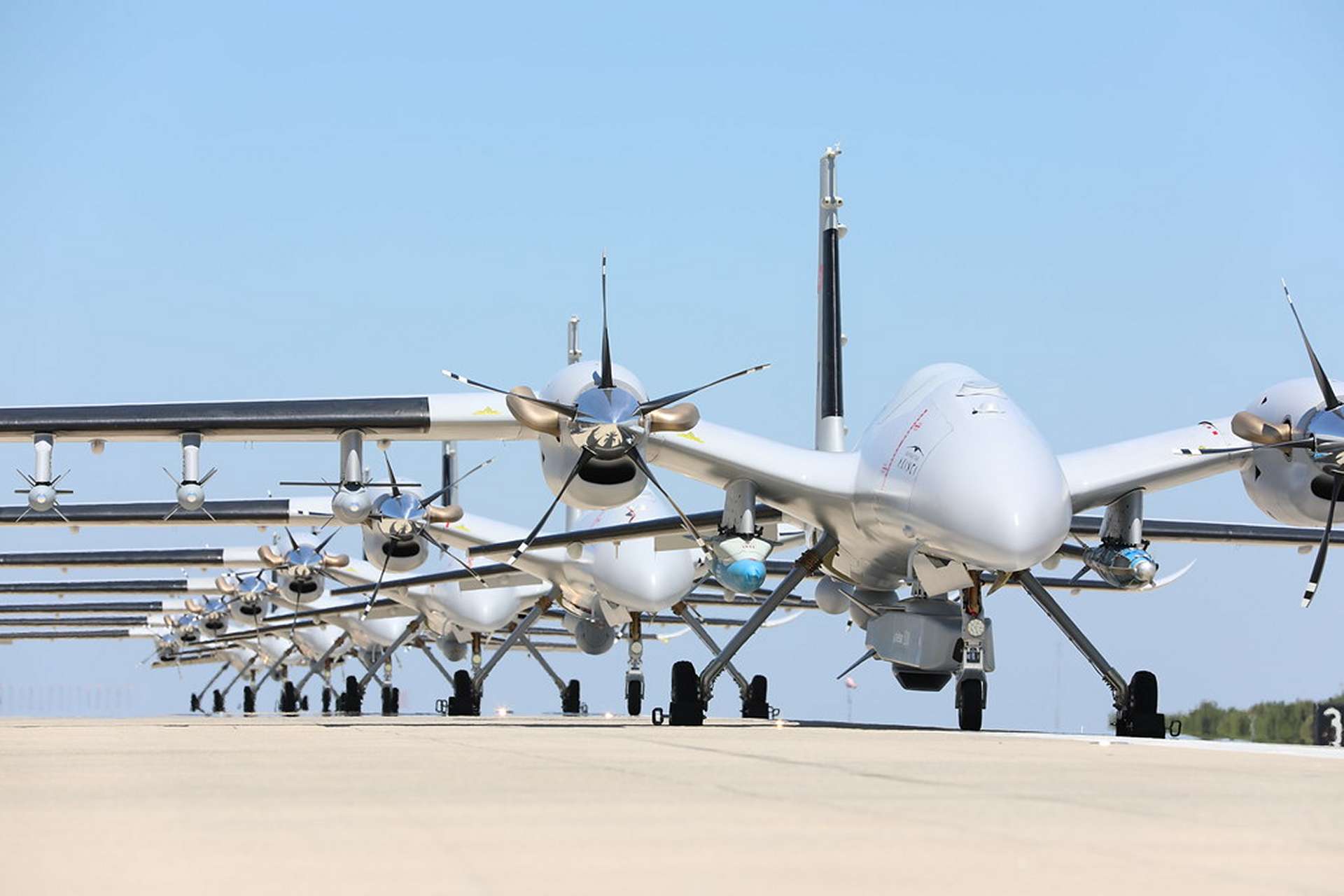
The Bayraktar Akinci is a high-altitude, long-endurance unmanned combat aircraft designed to conduct strike, intelligence, surveillance, and reconnaissance missions with a heavy weapons payload and satellite-controlled range (Picture Source: Baykar Technologies)
The significance of the new figure is not only the number itself, but what it implies about Baykar’s ability to keep the entire delivery ecosystem moving. IHA describes Çorlu as a combined test-and-training hub where flight trials for both Akinci and the jet-powered Kizilelma continue day and night, with roughly 200 personnel supporting the tempo. In the visuals filmed at the center, the message is industrial as much as it is operational: Akinci is being pushed through a steady pipeline while Kizilelma remains in a demanding test phase, an overlap that only works when production discipline, flight-test scheduling, and training capacity are synchronized.
IHA’s reporting also adds rare detail on the human throughput behind the program, describing a structured syllabus that moves candidates through theory, simulator phases, and live flying before certification. The agency notes that pilot candidates earn qualification after completing 30 sorties, with pilot training described as a five-month course and technician training as a four-month track. This matters because every incremental delivery draws on the same finite resources: instructors, simulators, maintenance tooling, spares, and the acceptance teams that validate aircraft configuration before handover. A year-end climb from 110 to 120 therefore reads as a practical indicator that Baykar and its customers expect the downstream elements, not just the airframe line, to remain in step.
The export dimension was not presented as an afterthought. In the same IHA dispatch, Baykar’s representative states that Akinci is being used in 13 countries in addition to the Turkish Armed Forces, and that more than 2,000 personnel have received Akinci pilot and technician training since 2021. For prospective buyers, this is the kind of operational signal that often matters more than a polished brochure: delivery counts are rising while a training and sustainment framework is being publicly emphasized, implying confidence that new operators can be brought online without degrading readiness for earlier customers.
What makes the additional Akinci deliveries especially relevant to the aerospace domain is the platform’s expanding mission identity. Recent months have seen the aircraft showcased as a precision-effects carrier that can generate repeated strikes with lighter, UAV-optimized munitions. Army Recognition reported on 14 December 2025 that Baykar released footage of an Akinci PT-7 conducting a live-fire campaign with three indigenous guided munitions, launching two BOZOK laser-guided miniature munitions and one KAYI-30, each achieving direct hits in the same test sequence. The operational logic is simple and compelling: miniature precision weapons allow a long-endurance UCAV to prosecute multiple targets per orbit while conserving larger, costlier missiles for scenarios where standoff range or heavier effects are essential. In a conflict environment where time-sensitive targets appear and disappear quickly, a drone that can stay on station and strike repeatedly with small guided rounds becomes less a niche asset and more a persistent source of precision fire support.
Baykar has also been explicit about broadening the Akinci’s weapons compatibility beyond a single munition family. Army Recognition reported on 27 December 2025 that Baykar announced successful firings involving three Turkish-made precision guidance technologies, including the MAM-T smart munition, the LAÇIN-82 guidance kit, and the TEBER-82 Winged Guidance Kit, with the company describing bullseye hits during live tests. While such statements are naturally framed to highlight success, the trend line is what matters for capability assessment: Akinci is being positioned as a mature multi-weapon UCAV, able to shift between lightweight smart munitions and heavier guided bomb classes depending on mission requirements and rules of engagement.
The more strategically disruptive shift, however, is the platform’s entry into electronic warfare roles once associated with specialized crewed aircraft. Army Recognition reported on 27 October 2025 that Akinci has been integrated with Aselsan’s ANTIDOT 2-U electronic support and electronic attack pod combination, described as a two-pod solution in which the ES pod detects, classifies, records and geolocates hostile radar emissions while the EA pod applies jamming and deception effects to disrupt threat systems. If this capability is fielded across a growing fleet, each additional Akinci delivery is no longer simply another ISR-strike tail. It can also become an unmanned node that helps build the electromagnetic picture, pressures hostile radar networks, and supports suppression concepts by reducing the burden on scarce manned electronic warfare assets.
This capability expansion also connects to how Baykar and its partners have been marketing the broader Akinci ecosystem. Army Recognition reported on 18 June 2025 that LBA Systems, the joint venture between Baykar and Italy’s Leonardo, unveiled the Akinci PT-10 configuration at the Paris Airshow with an extensive payload display spanning air-to-air missiles, cruise missiles, and precision-guided bombs, framing the aircraft as a multi-domain combat node rather than a single-mission drone. The display was deliberately maximalist, but it reflected a clear industrial narrative: the Akinci family is being pitched as modular and growth-oriented, able to absorb sensors, weapons, and mission systems that pull it closer to roles once dominated by higher-end crewed platforms.
IHA’s visit to Çorlu also reinforced the parallel development track that Baykar is pursuing, with the agency quoting Halil Akar stating that five Kizilelma prototypes and two serial-production aircraft have been produced. The broader implication for Akinci is straightforward. As Kizilelma continues through the demanding work of maturing a jet-powered UCAV concept, Akinci remains the aircraft expected to carry the day-to-day operational load, not just for Türkiye but for a widening set of export users. That makes the year-end delivery objective more than a headline. It is a statement that Baykar believes its workhorse fleet can keep expanding while new mission kits, new munitions, and new electronic warfare payloads are introduced without slowing the pipeline.
The data points form a coherent picture: Baykar is not merely adding airframes, it is widening what those airframes can do. A delivered total rising to 120 by the end of 2026, paired with demonstrated miniature-precision strike tests and visible steps toward unmanned electronic warfare, suggests an operational concept where Akinci provides persistence, scalable precision effects, and electromagnetic pressure in the same campaign plan. For air forces facing radar-dense battlespaces and the rising cost of precision inventories, that combination is precisely where the next tranche of Akinci deliveries could have a disproportionate impact.
Written by Teoman S. Nicanci – Defense Analyst, Army Recognition Group
Teoman S. Nicanci holds degrees in Political Science, Comparative and International Politics, and International Relations and Diplomacy from leading Belgian universities, with research focused on Russian strategic behavior, defense technology, and modern warfare. He is a defense analyst at Army Recognition, specializing in the global defense industry, military armament, and emerging defense technologies.
{loadposition bannertop}
{loadposition sidebarpub}
Baykar has delivered 110 Bayraktar Akinci unmanned combat aerial vehicles and plans to raise that total to 120 by the end of 2026, according to reporting from its Flight Training and Test Center in western Türkiye.
Reporting from Ihlas News Agency in early January 2026 places the Baykar Akinci program at a measured but revealing inflection point, with 110 aircraft delivered so far and a stated objective of reaching a total of 120 by the end of 2026, a figure that offers insight not just into production output, but into how testing, training, sustainment, and operational expansion are being managed in parallel as the platform’s role continues to broaden.
The Bayraktar Akinci is a high-altitude, long-endurance unmanned combat aircraft designed to conduct strike, intelligence, surveillance, and reconnaissance missions with a heavy weapons payload and satellite-controlled range (Picture Source: Baykar Technologies)
The significance of the new figure is not only the number itself, but what it implies about Baykar’s ability to keep the entire delivery ecosystem moving. IHA describes Çorlu as a combined test-and-training hub where flight trials for both Akinci and the jet-powered Kizilelma continue day and night, with roughly 200 personnel supporting the tempo. In the visuals filmed at the center, the message is industrial as much as it is operational: Akinci is being pushed through a steady pipeline while Kizilelma remains in a demanding test phase, an overlap that only works when production discipline, flight-test scheduling, and training capacity are synchronized.
IHA’s reporting also adds rare detail on the human throughput behind the program, describing a structured syllabus that moves candidates through theory, simulator phases, and live flying before certification. The agency notes that pilot candidates earn qualification after completing 30 sorties, with pilot training described as a five-month course and technician training as a four-month track. This matters because every incremental delivery draws on the same finite resources: instructors, simulators, maintenance tooling, spares, and the acceptance teams that validate aircraft configuration before handover. A year-end climb from 110 to 120 therefore reads as a practical indicator that Baykar and its customers expect the downstream elements, not just the airframe line, to remain in step.
The export dimension was not presented as an afterthought. In the same IHA dispatch, Baykar’s representative states that Akinci is being used in 13 countries in addition to the Turkish Armed Forces, and that more than 2,000 personnel have received Akinci pilot and technician training since 2021. For prospective buyers, this is the kind of operational signal that often matters more than a polished brochure: delivery counts are rising while a training and sustainment framework is being publicly emphasized, implying confidence that new operators can be brought online without degrading readiness for earlier customers.
What makes the additional Akinci deliveries especially relevant to the aerospace domain is the platform’s expanding mission identity. Recent months have seen the aircraft showcased as a precision-effects carrier that can generate repeated strikes with lighter, UAV-optimized munitions. Army Recognition reported on 14 December 2025 that Baykar released footage of an Akinci PT-7 conducting a live-fire campaign with three indigenous guided munitions, launching two BOZOK laser-guided miniature munitions and one KAYI-30, each achieving direct hits in the same test sequence. The operational logic is simple and compelling: miniature precision weapons allow a long-endurance UCAV to prosecute multiple targets per orbit while conserving larger, costlier missiles for scenarios where standoff range or heavier effects are essential. In a conflict environment where time-sensitive targets appear and disappear quickly, a drone that can stay on station and strike repeatedly with small guided rounds becomes less a niche asset and more a persistent source of precision fire support.
Baykar has also been explicit about broadening the Akinci’s weapons compatibility beyond a single munition family. Army Recognition reported on 27 December 2025 that Baykar announced successful firings involving three Turkish-made precision guidance technologies, including the MAM-T smart munition, the LAÇIN-82 guidance kit, and the TEBER-82 Winged Guidance Kit, with the company describing bullseye hits during live tests. While such statements are naturally framed to highlight success, the trend line is what matters for capability assessment: Akinci is being positioned as a mature multi-weapon UCAV, able to shift between lightweight smart munitions and heavier guided bomb classes depending on mission requirements and rules of engagement.
The more strategically disruptive shift, however, is the platform’s entry into electronic warfare roles once associated with specialized crewed aircraft. Army Recognition reported on 27 October 2025 that Akinci has been integrated with Aselsan’s ANTIDOT 2-U electronic support and electronic attack pod combination, described as a two-pod solution in which the ES pod detects, classifies, records and geolocates hostile radar emissions while the EA pod applies jamming and deception effects to disrupt threat systems. If this capability is fielded across a growing fleet, each additional Akinci delivery is no longer simply another ISR-strike tail. It can also become an unmanned node that helps build the electromagnetic picture, pressures hostile radar networks, and supports suppression concepts by reducing the burden on scarce manned electronic warfare assets.
This capability expansion also connects to how Baykar and its partners have been marketing the broader Akinci ecosystem. Army Recognition reported on 18 June 2025 that LBA Systems, the joint venture between Baykar and Italy’s Leonardo, unveiled the Akinci PT-10 configuration at the Paris Airshow with an extensive payload display spanning air-to-air missiles, cruise missiles, and precision-guided bombs, framing the aircraft as a multi-domain combat node rather than a single-mission drone. The display was deliberately maximalist, but it reflected a clear industrial narrative: the Akinci family is being pitched as modular and growth-oriented, able to absorb sensors, weapons, and mission systems that pull it closer to roles once dominated by higher-end crewed platforms.
IHA’s visit to Çorlu also reinforced the parallel development track that Baykar is pursuing, with the agency quoting Halil Akar stating that five Kizilelma prototypes and two serial-production aircraft have been produced. The broader implication for Akinci is straightforward. As Kizilelma continues through the demanding work of maturing a jet-powered UCAV concept, Akinci remains the aircraft expected to carry the day-to-day operational load, not just for Türkiye but for a widening set of export users. That makes the year-end delivery objective more than a headline. It is a statement that Baykar believes its workhorse fleet can keep expanding while new mission kits, new munitions, and new electronic warfare payloads are introduced without slowing the pipeline.
The data points form a coherent picture: Baykar is not merely adding airframes, it is widening what those airframes can do. A delivered total rising to 120 by the end of 2026, paired with demonstrated miniature-precision strike tests and visible steps toward unmanned electronic warfare, suggests an operational concept where Akinci provides persistence, scalable precision effects, and electromagnetic pressure in the same campaign plan. For air forces facing radar-dense battlespaces and the rising cost of precision inventories, that combination is precisely where the next tranche of Akinci deliveries could have a disproportionate impact.
Written by Teoman S. Nicanci – Defense Analyst, Army Recognition Group
Teoman S. Nicanci holds degrees in Political Science, Comparative and International Politics, and International Relations and Diplomacy from leading Belgian universities, with research focused on Russian strategic behavior, defense technology, and modern warfare. He is a defense analyst at Army Recognition, specializing in the global defense industry, military armament, and emerging defense technologies.