U.S. Air Force proves F-35A maritime strike capability in Alaska’s harsh weather
{loadposition bannertop}
{loadposition sidebarpub}
U.S. Air Force Alaskan Command conducted a high-intensity joint force simulation in the Gulf of Alaska on December 9 under Operation TUNDRA MERLIN, incorporating F-35A fighter jet operations, according to information released December 10, 2025. The exercise tested precision maritime strike coordination and highlighted the role of fifth-generation aircraft in strengthening U.S. homeland defense across the Arctic.
U.S. Air Force Alaskan Command, operating under U.S. Northern Command, executed a high-intensity joint force simulation in the Gulf of Alaska on December 9, 2025, as part of Operation TUNDRA MERLIN, U.S. officials said in a Department of War release. The exercise integrated F-35A Lightning II fighter jets into precision maritime strike scenarios, validating joint command-and-control performance and combat readiness under extreme Arctic weather conditions within the Alaskan Theater of Operations.Follow Army Recognition on Google News at this link
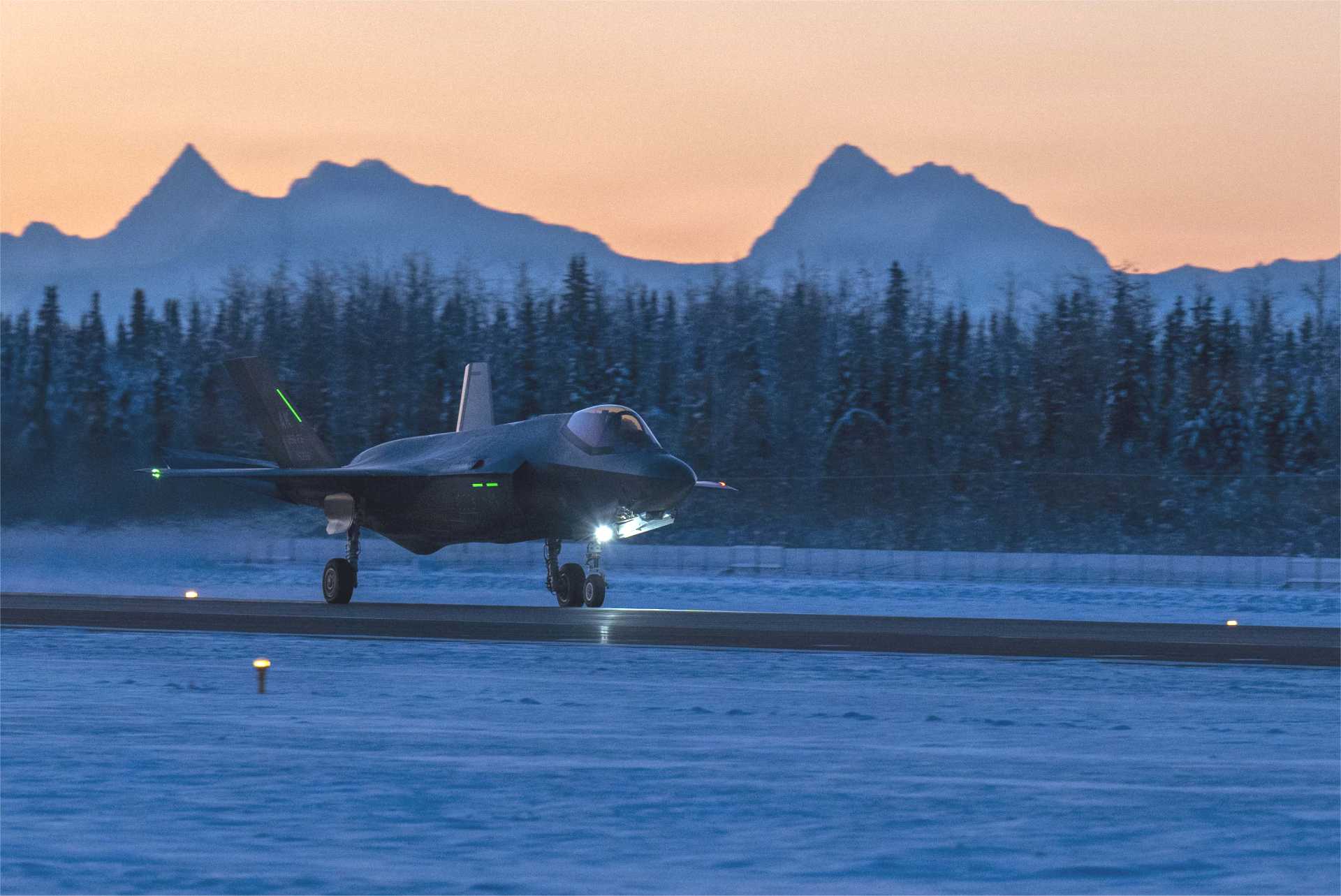
A U.S. Air Force F-35A Lightning II from the 354th Fighter Wing touches down at Eielson Air Force Base, Alaska, following Arctic flight operations during Operation TUNDRA MERLIN on December 9, 2025. (Picture source: U.S. Department of War)
Operation TUNDRA MERLIN focused on the seamless employment of multi-domain assets across air and maritime domains in coordination with U.S. Strategic Command, U.S. Indo-Pacific Command, the U.S. Coast Guard Arctic District, and the Alaska Air National Guard. Central to the scenario was the use of real-world Arctic conditions to simulate standoff strikes against hostile maritime targets while demonstrating rapid cross-command control handovers and persistent operational endurance.
The inclusion of F-35A Lightning II fighter jets from the 354th Fighter Wing highlighted the tactical flexibility of fifth-generation platforms in sub-zero environments. The F-35 is uniquely equipped with thermal management systems, specialized fuel handling, and advanced environmental controls that allow it to operate reliably in freezing temperatures common across the Arctic and sub-Arctic regions. The aircraft’s internal systems are engineered with self-heating components and robust de-icing capabilities. At the same time, its composite airframe minimizes the thermal expansion and contraction challenges that often affect metallic aircraft under rapid temperature changes, in Arctic conditions, where visibility, radar interference, and mechanical stress challenge legacy platforms, the F-35’s sensor fusion and low-observable technology provide a decisive advantage for air dominance, surveillance, and strike coordination.
Operating from Eielson Air Force Base in Alaska, the F-35s conducted escort and combat air patrols in support of two B-52 Stratofortress bombers executing long-range simulated maritime strikes. Their role in this exercise extended beyond air cover, integrating into the targeting and threat-identification loop via onboard Distributed Aperture and Electro-Optical Targeting Systems. The F-35’s ability to share real-time data with other platforms in an area marked by limited satellite and radar coverage proved essential to maintaining situational awareness throughout the mission. The fighters were also tested for their ability to rapidly generate combat airpower under Arctic ramp conditions, where ice buildup and wind chill pose hazards to both airframes and personnel.
Alaska’s geographic location continues to serve as a strategic anchor point for U.S. power projection and homeland defense. Positioned at the junction of the Asia-Pacific and Arctic regions, the state provides direct access to both the Western Pacific and the Northern Approaches to North America. The Alaskan Theater of Operations encompasses critical early warning infrastructure, aerial defense nodes, and long-range radar networks, including the North Warning System and elements of the Missile Defense System. It also remains within reach of potential adversary missile systems and submarine patrol routes, making the region vital to maintaining deterrence and rapid response capability. The growing presence of Russian and Chinese naval operations in the Bering Sea and Arctic Circle further reinforces the need for operations like TUNDRA MERLIN, which allow U.S. forces to rehearse real-world interdiction and joint command scenarios in the harshest operational environment.
Simulated targeting support for the bombers was provided by the U.S. Navy and the USCG Cutter Kimball, while KC-135 Stratotankers delivered aerial refueling from the 168th Wing. A HC-130J Combat King II aircraft was assigned for personnel recovery readiness. The 611th Air Operations Center executed operational control for the exercise, transferring bomber command to the 613th AOC under USINDOPACOM upon exit from the AKTO—demonstrating real-time interoperability across combatant command boundaries.
With receding sea ice opening new naval corridors through the Arctic and foreign military operations expanding in the region, exercises like Operation TUNDRA MERLIN signal a shift in U.S. posture. The Arctic is no longer viewed as a buffer zone but as a forward operating space that requires persistent presence and readiness. The ability to simulate precision strikes and conduct joint operations in this environment reflects the Department of Defense’s growing emphasis on Arctic deterrence, situational awareness, and force integration under contested and extreme conditions.
Operation TUNDRA MERLIN represents not only a validation of joint interoperability but also a strategic rehearsal for future conflict scenarios in which Arctic maritime incursions could threaten U.S. territory. With Alaska serving as a launch pad for power projection across both hemispheres, the readiness of U.S. forces to detect, track, and respond to threats in this harsh environment is becoming a cornerstone of homeland defense strategy.Written by Alain Servaes – Chief Editor, Army Recognition GroupAlain Servaes is a former infantry non-commissioned officer and the founder of Army Recognition. With over 20 years in defense journalism, he provides expert analysis on military equipment, NATO operations, and the global defense industry.
{loadposition bannertop}
{loadposition sidebarpub}
U.S. Air Force Alaskan Command conducted a high-intensity joint force simulation in the Gulf of Alaska on December 9 under Operation TUNDRA MERLIN, incorporating F-35A fighter jet operations, according to information released December 10, 2025. The exercise tested precision maritime strike coordination and highlighted the role of fifth-generation aircraft in strengthening U.S. homeland defense across the Arctic.
U.S. Air Force Alaskan Command, operating under U.S. Northern Command, executed a high-intensity joint force simulation in the Gulf of Alaska on December 9, 2025, as part of Operation TUNDRA MERLIN, U.S. officials said in a Department of War release. The exercise integrated F-35A Lightning II fighter jets into precision maritime strike scenarios, validating joint command-and-control performance and combat readiness under extreme Arctic weather conditions within the Alaskan Theater of Operations.
Follow Army Recognition on Google News at this link
A U.S. Air Force F-35A Lightning II from the 354th Fighter Wing touches down at Eielson Air Force Base, Alaska, following Arctic flight operations during Operation TUNDRA MERLIN on December 9, 2025. (Picture source: U.S. Department of War)
Operation TUNDRA MERLIN focused on the seamless employment of multi-domain assets across air and maritime domains in coordination with U.S. Strategic Command, U.S. Indo-Pacific Command, the U.S. Coast Guard Arctic District, and the Alaska Air National Guard. Central to the scenario was the use of real-world Arctic conditions to simulate standoff strikes against hostile maritime targets while demonstrating rapid cross-command control handovers and persistent operational endurance.
The inclusion of F-35A Lightning II fighter jets from the 354th Fighter Wing highlighted the tactical flexibility of fifth-generation platforms in sub-zero environments. The F-35 is uniquely equipped with thermal management systems, specialized fuel handling, and advanced environmental controls that allow it to operate reliably in freezing temperatures common across the Arctic and sub-Arctic regions. The aircraft’s internal systems are engineered with self-heating components and robust de-icing capabilities. At the same time, its composite airframe minimizes the thermal expansion and contraction challenges that often affect metallic aircraft under rapid temperature changes, in Arctic conditions, where visibility, radar interference, and mechanical stress challenge legacy platforms, the F-35’s sensor fusion and low-observable technology provide a decisive advantage for air dominance, surveillance, and strike coordination.
Operating from Eielson Air Force Base in Alaska, the F-35s conducted escort and combat air patrols in support of two B-52 Stratofortress bombers executing long-range simulated maritime strikes. Their role in this exercise extended beyond air cover, integrating into the targeting and threat-identification loop via onboard Distributed Aperture and Electro-Optical Targeting Systems. The F-35’s ability to share real-time data with other platforms in an area marked by limited satellite and radar coverage proved essential to maintaining situational awareness throughout the mission. The fighters were also tested for their ability to rapidly generate combat airpower under Arctic ramp conditions, where ice buildup and wind chill pose hazards to both airframes and personnel.
Alaska’s geographic location continues to serve as a strategic anchor point for U.S. power projection and homeland defense. Positioned at the junction of the Asia-Pacific and Arctic regions, the state provides direct access to both the Western Pacific and the Northern Approaches to North America. The Alaskan Theater of Operations encompasses critical early warning infrastructure, aerial defense nodes, and long-range radar networks, including the North Warning System and elements of the Missile Defense System. It also remains within reach of potential adversary missile systems and submarine patrol routes, making the region vital to maintaining deterrence and rapid response capability. The growing presence of Russian and Chinese naval operations in the Bering Sea and Arctic Circle further reinforces the need for operations like TUNDRA MERLIN, which allow U.S. forces to rehearse real-world interdiction and joint command scenarios in the harshest operational environment.
Simulated targeting support for the bombers was provided by the U.S. Navy and the USCG Cutter Kimball, while KC-135 Stratotankers delivered aerial refueling from the 168th Wing. A HC-130J Combat King II aircraft was assigned for personnel recovery readiness. The 611th Air Operations Center executed operational control for the exercise, transferring bomber command to the 613th AOC under USINDOPACOM upon exit from the AKTO—demonstrating real-time interoperability across combatant command boundaries.
With receding sea ice opening new naval corridors through the Arctic and foreign military operations expanding in the region, exercises like Operation TUNDRA MERLIN signal a shift in U.S. posture. The Arctic is no longer viewed as a buffer zone but as a forward operating space that requires persistent presence and readiness. The ability to simulate precision strikes and conduct joint operations in this environment reflects the Department of Defense’s growing emphasis on Arctic deterrence, situational awareness, and force integration under contested and extreme conditions.
Operation TUNDRA MERLIN represents not only a validation of joint interoperability but also a strategic rehearsal for future conflict scenarios in which Arctic maritime incursions could threaten U.S. territory. With Alaska serving as a launch pad for power projection across both hemispheres, the readiness of U.S. forces to detect, track, and respond to threats in this harsh environment is becoming a cornerstone of homeland defense strategy.
Written by Alain Servaes – Chief Editor, Army Recognition Group
Alain Servaes is a former infantry non-commissioned officer and the founder of Army Recognition. With over 20 years in defense journalism, he provides expert analysis on military equipment, NATO operations, and the global defense industry.