U.S. B-2 Bombers Hit Underground IRGC Command Bunker in Tehran With 30,000-lb GBU-57 Bunker Buster Bombs
{loadposition bannertop}
{loadposition sidebarpub}
On April 7, 2026, The Wall Street Journal reported that U.S. B-2 Spirit stealth bombers struck an underground Islamic Revolutionary Guard Corps compound in Tehran with GBU-57 Massive Ordnance Penetrators during Operation Epic Fury, a campaign that also included the rescue of a downed American airman inside Iran.
The reported mission drew immediate attention because it suggested that Washington had fused time-sensitive intelligence, strategic long-range aviation, and hardened-target defeat in the middle of an active personnel recovery operation. If confirmed in full, the strike would stand among the clearest recent demonstrations of the United States’ ability to reach protected command infrastructure deep inside hostile territory and engage it with specialized conventional firepower.
Read Also: U.S. B-2 Bomber and Navy Carrier Fighters Execute Strategic Long-Range Maritime Strike Drill
U.S. B-2 Spirit bombers reportedly struck a hardened Islamic Revolutionary Guard Corps bunker near Tehran with GBU-57 Massive Ordnance Penetrator during Operation Epic Fury, highlighting Washington’s ability to rapidly target deeply buried leadership sites during an active rescue mission (Picture Source: U.S. Air Force / Britannica)
According to The Wall Street Journal, Admiral Brad Cooper, commander of U.S. Central Command, ordered B-2 bombers to launch a round-trip mission from Whiteman Air Force Base after intelligence reportedly identified a large concentration of senior IRGC commanders inside an underground bunker in Tehran. The significance of that decision lies in the compressed operational timeline. This was not described as a pre-planned strike against static infrastructure scheduled well in advance, but as a dynamic attack against a fleeting leadership target whose military value depended on immediate execution. Such an operation points to a highly responsive kill chain linking intelligence collection, command authorization, bomber tasking, aerial refueling support, and terminal weapons employment across intercontinental distance.
The reported strike also fits into the broader rhythm of Operation Epic Fury, which unfolded while U.S. forces were conducting a rescue mission for a downed F-15E airman inside Iran. Separate Wall Street Journal reporting indicated that American bombers dropped approximately one hundred 2,000-pound-class bombs during the recovery effort to prevent Iranian forces from converging on the rescue area. In that context, the B-2 mission appears to have formed part of a wider U.S. operational design aimed at imposing simultaneous dilemmas on Iranian decision-makers: shielding the recovery corridor, disrupting hostile maneuver, and exploiting a narrow window to strike an underground command node tied to the IRGC’s senior leadership.
From an airpower perspective, the selection of the B-2 Spirit was fully aligned with the target profile. The aircraft was conceived as a long-range, low-observable penetration bomber built to enter heavily defended airspace while carrying precision-guided ordnance inside internal weapons bays. Its stealth characteristics, intercontinental reach, and capacity to deliver very heavy munitions make it one of the few platforms able to prosecute hardened targets located near the political and military center of an adversary state. Launching from the continental United States rather than from a forward base adds another layer to the strategic message. It shows that the United States can generate combat power directly from its homeland, sustain the sortie through aerial refueling, strike deep inside Iranian territory, and recover the aircraft without depending on regional basing that could be politically constrained or militarily exposed.
What the B-2 reportedly released over Tehran is equally central to understanding the operation. The GBU-57 Massive Ordnance Penetrator, commonly known as the MOP, is a 30,000-pound precision-guided hard-target defeat weapon engineered specifically for the destruction of hardened and deeply buried facilities. Unlike standard penetrating bombs, the GBU-57 is designed to combine exceptional mass, reinforced casing structure, and delayed fuze sequencing to drive through layers of earth, rock, and reinforced concrete before detonation. Its employment strongly indicates that the target was assessed not simply as an underground shelter, but as a deeply protected command installation requiring one of the most specialized conventional bunker-busting munitions in the American inventory.
This strike would also extend a combat pattern already established during Operation Midnight Hammer. On June 22, 2025, seven B-2 bombers reportedly dropped fourteen GBU-57 bombs against Iranian nuclear-related sites, marking the first operational use of the weapon in combat. That earlier mission demonstrated that the B-2 and GBU-57 pairing was no longer a theoretical option reserved for contingency planning against the most demanding aimpoints, but an operationally credible tool for defeating hardened Iranian infrastructure. The reported attack on the IRGC bunker near Tehran suggests that the same strike architecture can now be applied not only against strategic facilities, but also against protected leadership compounds and command-and-control nodes identified through time-sensitive intelligence.
At the operational level, the reported attack places renewed pressure on one of Iran’s long-standing assumptions: that underground military architecture can preserve command continuity under sustained U.S. air attack. For years, Tehran has invested in buried facilities to protect senior leaders, safeguard communications, and preserve decision-making capacity during crisis or war. A successful bunker-busting strike against an IRGC compound near Tehran would indicate that depth, fortification, and proximity to the regime’s political center no longer provide the level of sanctuary they once did. That would compel Iranian planners to consider wider dispersal of leadership, greater communications discipline, additional redundancy in command networks, and a more fragmented posture for wartime control.
The strategic implications extend well beyond the immediate strike. For U.S. allies, the operation reinforces the credibility of American conventional deterrence by showing that Washington retains a unique capacity to hold hardened and deeply buried targets at risk without resorting to nuclear signaling. For adversaries, it is a reminder that the United States can synchronize distinct operational functions in a single battlespace, combining combat search and rescue, deep-strike aviation, and leadership targeting under conditions of escalation. That level of integration is not merely a display of firepower; it reflects a mature joint-force ability to impose multiple pressures on an opponent at once, forcing defensive reactions across several layers of command and maneuver simultaneously.
The reported B-2 strike near Tehran stands out because it concentrates several of the most powerful attributes of U.S. military power into one mission: strategic reach, stealth penetration, precision hard-target defeat, rapid exploitation of time-sensitive intelligence, and the ability to continue offensive operations while recovering personnel behind enemy lines. After Operation Midnight Hammer introduced the GBU-57 into combat against hardened Iranian facilities, this new mission points to a broader willingness by Washington to apply the same capability directly against the regime’s protected military leadership architecture. The message delivered by such an operation is blunt, unmistakable, and strategically resonant: even the deepest bunker cannot be assumed secure when the United States decides to act with speed, precision, and overwhelming operational confidence.
Written by Teoman S. Nicanci – Defense Analyst, Army Recognition Group
Teoman S. Nicanci holds degrees in Political Science, Comparative and International Politics, and International Relations and Diplomacy from leading Belgian universities, with research focused on Russian strategic behavior, defense technology, and modern warfare. He is a defense analyst at Army Recognition, specializing in the global defense industry, military armament, and emerging defense technologies.
{loadposition bannertop}
{loadposition sidebarpub}
On April 7, 2026, The Wall Street Journal reported that U.S. B-2 Spirit stealth bombers struck an underground Islamic Revolutionary Guard Corps compound in Tehran with GBU-57 Massive Ordnance Penetrators during Operation Epic Fury, a campaign that also included the rescue of a downed American airman inside Iran.
The reported mission drew immediate attention because it suggested that Washington had fused time-sensitive intelligence, strategic long-range aviation, and hardened-target defeat in the middle of an active personnel recovery operation. If confirmed in full, the strike would stand among the clearest recent demonstrations of the United States’ ability to reach protected command infrastructure deep inside hostile territory and engage it with specialized conventional firepower.
Read Also: U.S. B-2 Bomber and Navy Carrier Fighters Execute Strategic Long-Range Maritime Strike Drill
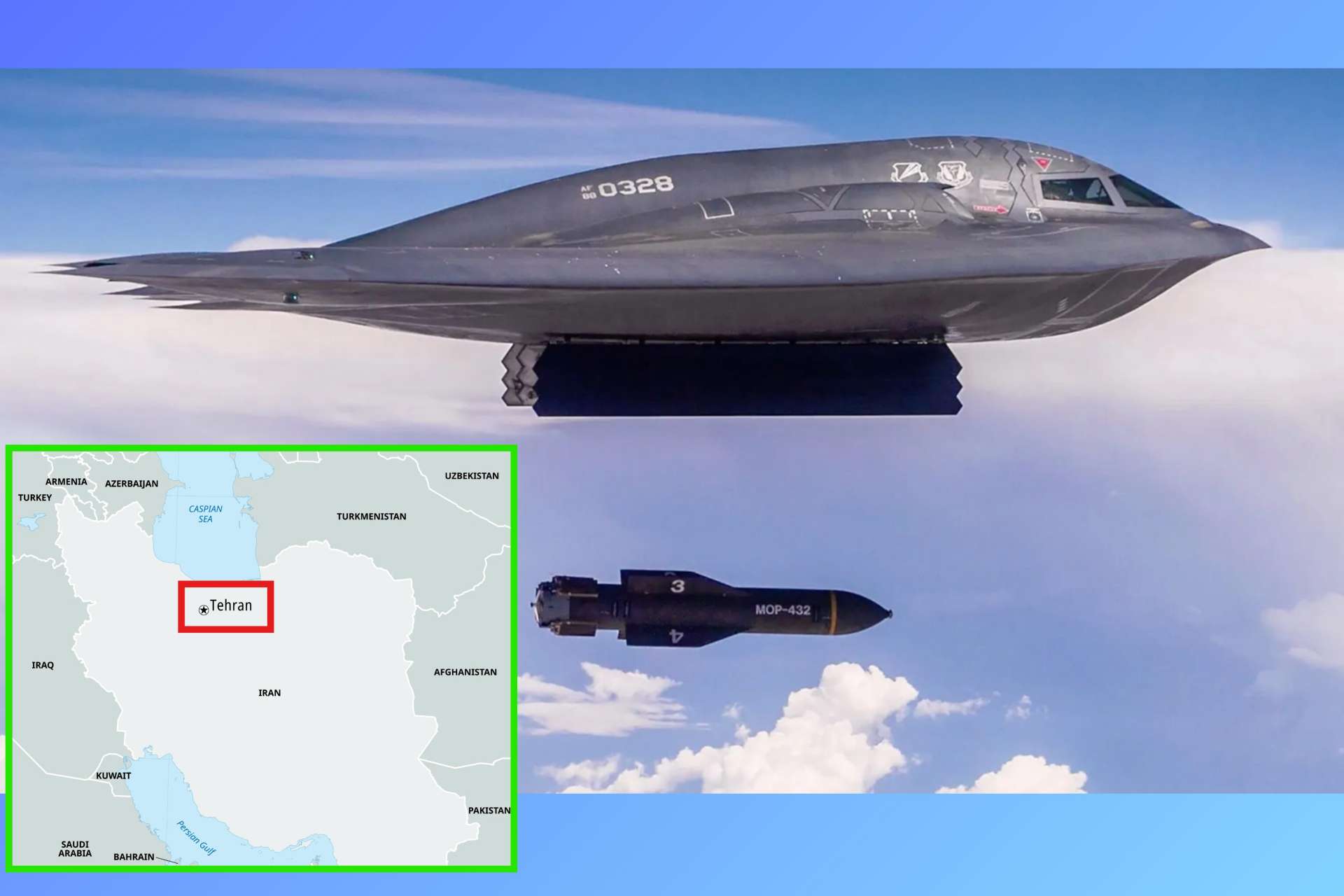
U.S. B-2 Spirit bombers reportedly struck a hardened Islamic Revolutionary Guard Corps bunker near Tehran with GBU-57 Massive Ordnance Penetrator during Operation Epic Fury, highlighting Washington’s ability to rapidly target deeply buried leadership sites during an active rescue mission (Picture Source: U.S. Air Force / Britannica)
According to The Wall Street Journal, Admiral Brad Cooper, commander of U.S. Central Command, ordered B-2 bombers to launch a round-trip mission from Whiteman Air Force Base after intelligence reportedly identified a large concentration of senior IRGC commanders inside an underground bunker in Tehran. The significance of that decision lies in the compressed operational timeline. This was not described as a pre-planned strike against static infrastructure scheduled well in advance, but as a dynamic attack against a fleeting leadership target whose military value depended on immediate execution. Such an operation points to a highly responsive kill chain linking intelligence collection, command authorization, bomber tasking, aerial refueling support, and terminal weapons employment across intercontinental distance.
The reported strike also fits into the broader rhythm of Operation Epic Fury, which unfolded while U.S. forces were conducting a rescue mission for a downed F-15E airman inside Iran. Separate Wall Street Journal reporting indicated that American bombers dropped approximately one hundred 2,000-pound-class bombs during the recovery effort to prevent Iranian forces from converging on the rescue area. In that context, the B-2 mission appears to have formed part of a wider U.S. operational design aimed at imposing simultaneous dilemmas on Iranian decision-makers: shielding the recovery corridor, disrupting hostile maneuver, and exploiting a narrow window to strike an underground command node tied to the IRGC’s senior leadership.
From an airpower perspective, the selection of the B-2 Spirit was fully aligned with the target profile. The aircraft was conceived as a long-range, low-observable penetration bomber built to enter heavily defended airspace while carrying precision-guided ordnance inside internal weapons bays. Its stealth characteristics, intercontinental reach, and capacity to deliver very heavy munitions make it one of the few platforms able to prosecute hardened targets located near the political and military center of an adversary state. Launching from the continental United States rather than from a forward base adds another layer to the strategic message. It shows that the United States can generate combat power directly from its homeland, sustain the sortie through aerial refueling, strike deep inside Iranian territory, and recover the aircraft without depending on regional basing that could be politically constrained or militarily exposed.
What the B-2 reportedly released over Tehran is equally central to understanding the operation. The GBU-57 Massive Ordnance Penetrator, commonly known as the MOP, is a 30,000-pound precision-guided hard-target defeat weapon engineered specifically for the destruction of hardened and deeply buried facilities. Unlike standard penetrating bombs, the GBU-57 is designed to combine exceptional mass, reinforced casing structure, and delayed fuze sequencing to drive through layers of earth, rock, and reinforced concrete before detonation. Its employment strongly indicates that the target was assessed not simply as an underground shelter, but as a deeply protected command installation requiring one of the most specialized conventional bunker-busting munitions in the American inventory.
This strike would also extend a combat pattern already established during Operation Midnight Hammer. On June 22, 2025, seven B-2 bombers reportedly dropped fourteen GBU-57 bombs against Iranian nuclear-related sites, marking the first operational use of the weapon in combat. That earlier mission demonstrated that the B-2 and GBU-57 pairing was no longer a theoretical option reserved for contingency planning against the most demanding aimpoints, but an operationally credible tool for defeating hardened Iranian infrastructure. The reported attack on the IRGC bunker near Tehran suggests that the same strike architecture can now be applied not only against strategic facilities, but also against protected leadership compounds and command-and-control nodes identified through time-sensitive intelligence.
At the operational level, the reported attack places renewed pressure on one of Iran’s long-standing assumptions: that underground military architecture can preserve command continuity under sustained U.S. air attack. For years, Tehran has invested in buried facilities to protect senior leaders, safeguard communications, and preserve decision-making capacity during crisis or war. A successful bunker-busting strike against an IRGC compound near Tehran would indicate that depth, fortification, and proximity to the regime’s political center no longer provide the level of sanctuary they once did. That would compel Iranian planners to consider wider dispersal of leadership, greater communications discipline, additional redundancy in command networks, and a more fragmented posture for wartime control.
The strategic implications extend well beyond the immediate strike. For U.S. allies, the operation reinforces the credibility of American conventional deterrence by showing that Washington retains a unique capacity to hold hardened and deeply buried targets at risk without resorting to nuclear signaling. For adversaries, it is a reminder that the United States can synchronize distinct operational functions in a single battlespace, combining combat search and rescue, deep-strike aviation, and leadership targeting under conditions of escalation. That level of integration is not merely a display of firepower; it reflects a mature joint-force ability to impose multiple pressures on an opponent at once, forcing defensive reactions across several layers of command and maneuver simultaneously.
The reported B-2 strike near Tehran stands out because it concentrates several of the most powerful attributes of U.S. military power into one mission: strategic reach, stealth penetration, precision hard-target defeat, rapid exploitation of time-sensitive intelligence, and the ability to continue offensive operations while recovering personnel behind enemy lines. After Operation Midnight Hammer introduced the GBU-57 into combat against hardened Iranian facilities, this new mission points to a broader willingness by Washington to apply the same capability directly against the regime’s protected military leadership architecture. The message delivered by such an operation is blunt, unmistakable, and strategically resonant: even the deepest bunker cannot be assumed secure when the United States decides to act with speed, precision, and overwhelming operational confidence.
Written by Teoman S. Nicanci – Defense Analyst, Army Recognition Group
Teoman S. Nicanci holds degrees in Political Science, Comparative and International Politics, and International Relations and Diplomacy from leading Belgian universities, with research focused on Russian strategic behavior, defense technology, and modern warfare. He is a defense analyst at Army Recognition, specializing in the global defense industry, military armament, and emerging defense technologies.