U.S. B-52H Test of AGM-181 Nuclear Stealth Cruise Missile Signals Deep Strike Capability in Denied Airspace
{loadposition bannertop}
{loadposition sidebarpub}
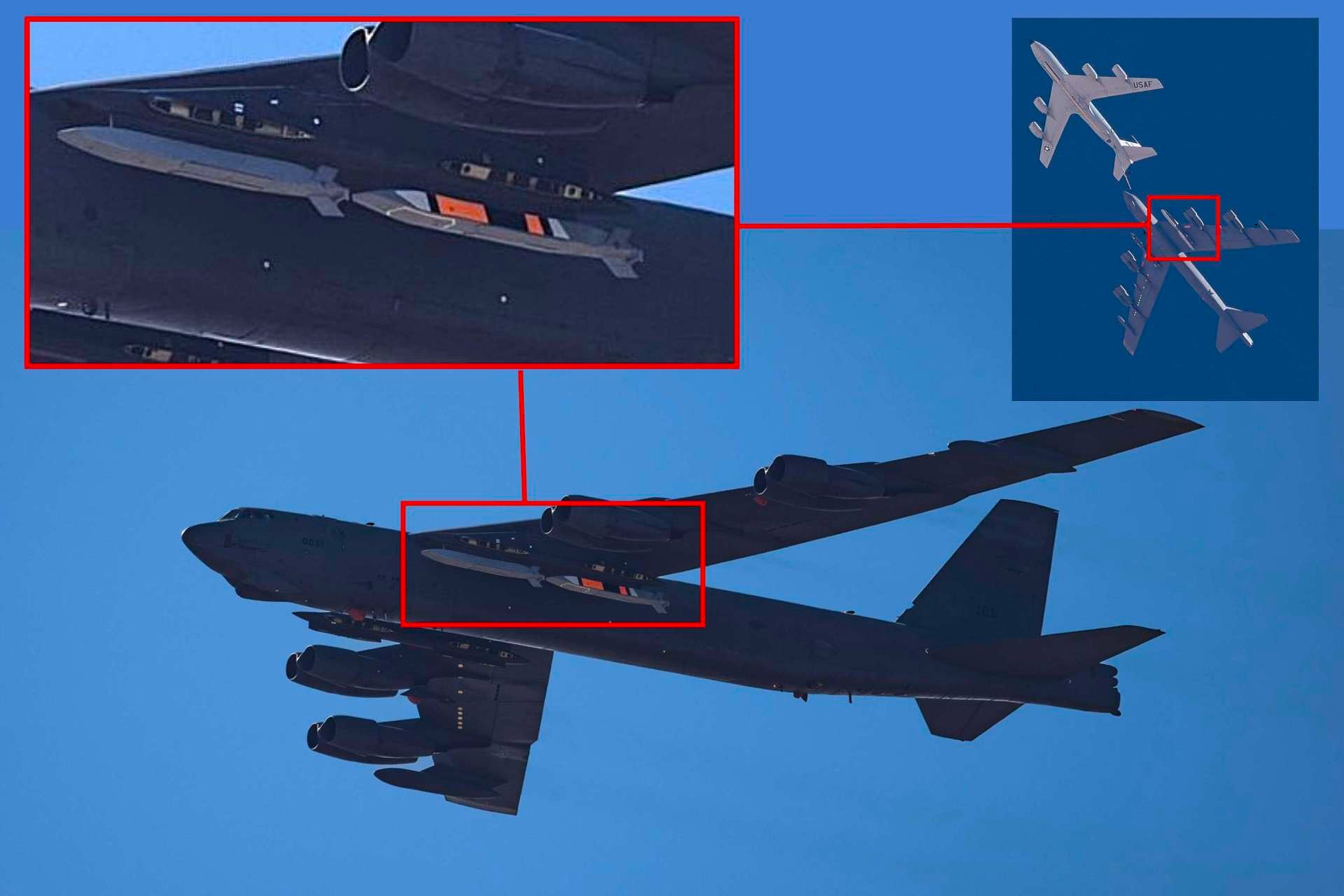
A U.S. Air Force B-52H was photographed over California on March 21, 2026, carrying two AGM-181 Long Range Stand Off test articles, confirming active progress in integrating the next-generation nuclear cruise missile. The AGM-181 will replace the aging AGM-86B and restore the bomber fleet’s ability to strike heavily defended strategic targets from standoff range.
The imagery, captured by photographer Jarod Hamilton, shows the LRSO program has entered sustained flight testing and carriage operations. This phase marks a shift from isolated demonstrations to continuous validation of performance and integration. The missile is planned for both the B-52 and B-21, expanding its role across the future bomber force. It is designed to penetrate advanced integrated air defenses from long range and reinforce the credibility of U.S. nuclear deterrence.
Read Also: U.S. B-52H Loaded With AGM-158 Cruise Missiles Signals Operation Epic Fury Long-Range Strike Posture
A U.S. B-52H bomber has been spotted carrying AGM-181 LRSO test missiles, signaling progress toward replacing the AGM-86B and strengthening future nuclear stand-off deterrence (Picture Source: Jarod Hamilton on X)
What stands out in this latest sighting is not simply that another test flight occurred, but that the B-52H continues to serve as the visible bridge between the legacy and future generations of U.S. air-launched nuclear deterrence. The aircraft seen in the recent imagery carried two AGM-181 test articles, and repeated public appearances of this configuration suggest the program has entered a more mature and outwardly visible phase of carriage and integration activity. The B-52H remains central to that process because the Air Force still relies on it as a long-range heavy bomber able to carry large cruise-missile loads while operating from well outside the densest threat zones.
The missile at the center of this effort is far more than a routine replacement item. The AGM-181 LRSO is being developed to succeed the AGM-86B ALCM as the future nuclear air-launched cruise missile for the U.S. bomber force, with integration planned for both the B-52 and the B-21. According to the Air Force Nuclear Weapons Center, the weapon is intended to attack strategic targets from a significant stand-off range while remaining survivable against modern integrated air defense systems, making it a critical component of the U.S. strategic deterrence mission. That design logic reflects the changing realities of great-power competition, where range alone is no longer enough and survivability against layered defenses is now essential.
That requirement is exactly why the AGM-86B can no longer remain the long-term solution. The ALCM entered service during the Cold War and gave the B-52 the ability to threaten strategic targets without forcing the bomber into the heart of hostile air-defense networks. It remains the current nuclear-armed cruise missile deployed on the aircraft, but it belongs to an earlier technological and strategic era. U.S. Air Force notes that 1,715 AGM-86B missiles were produced and that the inventory was later reduced, with retirement planned around 2030 as the LRSO takes over the mission. The issue is not that the AGM-86 failed, but that the U.S. must now preserve the same stand-off principle against much more capable adversaries.
The B-52H is uniquely suited to embody that continuity. For all its age, the Stratofortress remains one of the most adaptable combat aircraft ever fielded by the United States. Its endurance, payload, and long-established role as a cruise-missile carrier have repeatedly allowed it to remain relevant through changing eras of air warfare. Air Force data state that the aircraft can carry up to 20 AGM-86B missiles on a mix of wing pylons and an internal rotary launcher, illustrating why it has long been a central platform for massed stand-off strike. With the AGM-181, the same bomber is being prepared to support a much more modern deterrent architecture, extending the operational life of a proven launch platform while updating the weapon it carries.
That operational logic has deep roots in U.S. combat history. In January 1991, B-52Gs flew one of the most notable long-range bomber missions of the Gulf War, launching AGM-86C conventional cruise missiles against Iraqi targets in Operation Senior Surprise, also known as Secret Squirrel. The mission demonstrated the practical value of using bombers as distant launch platforms able to generate strategic effects without crossing into the most dangerous concentrations of enemy defenses. That experience remains highly relevant when assessing today’s LRSO effort: the missile type has changed, and the strategic purpose is nuclear rather than conventional, but the core U.S. advantage remains the ability to strike from range while complicating an opponent’s entire defensive calculus.
That same logic also helps explain why recent B-52 activities associated in recent Army Recognition reporting with Operation Epic Fury matter. In those reports, the bomber appeared linked to long-range cruise-missile strike posture using conventional weapons from the JASSM family, reinforcing the aircraft’s continuing relevance as a visible instrument of American power projection. The comparison should not blur roles, since the AGM-181 is dedicated to the nuclear mission while JASSM serves conventional strike requirements. But the doctrinal link is important: in both cases, the United States is relying on the B-52 as a platform that can remain outside the most lethal air-defense envelope while still holding valuable targets at risk. That is a persistent American strength, and one that potential adversaries must continue to factor into their planning.
The wider strategic implications are substantial. The LRSO program sits inside a broader modernization drive across the U.S. nuclear triad, and public acquisition reporting has already pointed to a fiscal year 2027 low-rate initial production decision for the missile. In parallel, the W80-4 warhead modernization effort is being advanced to support the system. Together, these developments show that Washington is not merely sustaining an old deterrent model, but upgrading it for a period defined by peer competition, more resilient enemy defenses, and rising pressure on the credibility of extended deterrence commitments. For allies, that signals continuity. For adversaries, it signals that the U.S. bomber force will remain able to project nuclear stand-off power in the face of increasingly complex denial environments.
The latest B-52H AGM-181 sighting therefore matters far beyond the imagery itself. It shows the United States methodically transitioning from a Cold War cruise missile to a more survivable and strategically relevant successor while preserving the combat utility of one of its most enduring bombers. By aligning the B-52H with the AGM-181, the U.S. is reinforcing a long-proven formula in American airpower: keep the bomber at range, let the missile penetrate, and maintain the ability to impose intolerable risk on any adversary. In an era of tightening strategic competition, that is not just modernization. It is a clear demonstration that U.S. deterrence is being actively strengthened, not merely preserved.
Written by Teoman S. Nicanci – Defense Analyst, Army Recognition Group
Teoman S. Nicanci holds degrees in Political Science, Comparative and International Politics, and International Relations and Diplomacy from leading Belgian universities, with research focused on Russian strategic behavior, defense technology, and modern warfare. He is a defense analyst at Army Recognition, specializing in the global defense industry, military armament, and emerging defense technologies.
{loadposition bannertop}
{loadposition sidebarpub}
A U.S. Air Force B-52H was photographed over California on March 21, 2026, carrying two AGM-181 Long Range Stand Off test articles, confirming active progress in integrating the next-generation nuclear cruise missile. The AGM-181 will replace the aging AGM-86B and restore the bomber fleet’s ability to strike heavily defended strategic targets from standoff range.
The imagery, captured by photographer Jarod Hamilton, shows the LRSO program has entered sustained flight testing and carriage operations. This phase marks a shift from isolated demonstrations to continuous validation of performance and integration. The missile is planned for both the B-52 and B-21, expanding its role across the future bomber force. It is designed to penetrate advanced integrated air defenses from long range and reinforce the credibility of U.S. nuclear deterrence.
Read Also: U.S. B-52H Loaded With AGM-158 Cruise Missiles Signals Operation Epic Fury Long-Range Strike Posture
A U.S. B-52H bomber has been spotted carrying AGM-181 LRSO test missiles, signaling progress toward replacing the AGM-86B and strengthening future nuclear stand-off deterrence (Picture Source: Jarod Hamilton on X)
What stands out in this latest sighting is not simply that another test flight occurred, but that the B-52H continues to serve as the visible bridge between the legacy and future generations of U.S. air-launched nuclear deterrence. The aircraft seen in the recent imagery carried two AGM-181 test articles, and repeated public appearances of this configuration suggest the program has entered a more mature and outwardly visible phase of carriage and integration activity. The B-52H remains central to that process because the Air Force still relies on it as a long-range heavy bomber able to carry large cruise-missile loads while operating from well outside the densest threat zones.
The missile at the center of this effort is far more than a routine replacement item. The AGM-181 LRSO is being developed to succeed the AGM-86B ALCM as the future nuclear air-launched cruise missile for the U.S. bomber force, with integration planned for both the B-52 and the B-21. According to the Air Force Nuclear Weapons Center, the weapon is intended to attack strategic targets from a significant stand-off range while remaining survivable against modern integrated air defense systems, making it a critical component of the U.S. strategic deterrence mission. That design logic reflects the changing realities of great-power competition, where range alone is no longer enough and survivability against layered defenses is now essential.
That requirement is exactly why the AGM-86B can no longer remain the long-term solution. The ALCM entered service during the Cold War and gave the B-52 the ability to threaten strategic targets without forcing the bomber into the heart of hostile air-defense networks. It remains the current nuclear-armed cruise missile deployed on the aircraft, but it belongs to an earlier technological and strategic era. U.S. Air Force notes that 1,715 AGM-86B missiles were produced and that the inventory was later reduced, with retirement planned around 2030 as the LRSO takes over the mission. The issue is not that the AGM-86 failed, but that the U.S. must now preserve the same stand-off principle against much more capable adversaries.
The B-52H is uniquely suited to embody that continuity. For all its age, the Stratofortress remains one of the most adaptable combat aircraft ever fielded by the United States. Its endurance, payload, and long-established role as a cruise-missile carrier have repeatedly allowed it to remain relevant through changing eras of air warfare. Air Force data state that the aircraft can carry up to 20 AGM-86B missiles on a mix of wing pylons and an internal rotary launcher, illustrating why it has long been a central platform for massed stand-off strike. With the AGM-181, the same bomber is being prepared to support a much more modern deterrent architecture, extending the operational life of a proven launch platform while updating the weapon it carries.
That operational logic has deep roots in U.S. combat history. In January 1991, B-52Gs flew one of the most notable long-range bomber missions of the Gulf War, launching AGM-86C conventional cruise missiles against Iraqi targets in Operation Senior Surprise, also known as Secret Squirrel. The mission demonstrated the practical value of using bombers as distant launch platforms able to generate strategic effects without crossing into the most dangerous concentrations of enemy defenses. That experience remains highly relevant when assessing today’s LRSO effort: the missile type has changed, and the strategic purpose is nuclear rather than conventional, but the core U.S. advantage remains the ability to strike from range while complicating an opponent’s entire defensive calculus.
That same logic also helps explain why recent B-52 activities associated in recent Army Recognition reporting with Operation Epic Fury matter. In those reports, the bomber appeared linked to long-range cruise-missile strike posture using conventional weapons from the JASSM family, reinforcing the aircraft’s continuing relevance as a visible instrument of American power projection. The comparison should not blur roles, since the AGM-181 is dedicated to the nuclear mission while JASSM serves conventional strike requirements. But the doctrinal link is important: in both cases, the United States is relying on the B-52 as a platform that can remain outside the most lethal air-defense envelope while still holding valuable targets at risk. That is a persistent American strength, and one that potential adversaries must continue to factor into their planning.
The wider strategic implications are substantial. The LRSO program sits inside a broader modernization drive across the U.S. nuclear triad, and public acquisition reporting has already pointed to a fiscal year 2027 low-rate initial production decision for the missile. In parallel, the W80-4 warhead modernization effort is being advanced to support the system. Together, these developments show that Washington is not merely sustaining an old deterrent model, but upgrading it for a period defined by peer competition, more resilient enemy defenses, and rising pressure on the credibility of extended deterrence commitments. For allies, that signals continuity. For adversaries, it signals that the U.S. bomber force will remain able to project nuclear stand-off power in the face of increasingly complex denial environments.
The latest B-52H AGM-181 sighting therefore matters far beyond the imagery itself. It shows the United States methodically transitioning from a Cold War cruise missile to a more survivable and strategically relevant successor while preserving the combat utility of one of its most enduring bombers. By aligning the B-52H with the AGM-181, the U.S. is reinforcing a long-proven formula in American airpower: keep the bomber at range, let the missile penetrate, and maintain the ability to impose intolerable risk on any adversary. In an era of tightening strategic competition, that is not just modernization. It is a clear demonstration that U.S. deterrence is being actively strengthened, not merely preserved.
Written by Teoman S. Nicanci – Defense Analyst, Army Recognition Group
Teoman S. Nicanci holds degrees in Political Science, Comparative and International Politics, and International Relations and Diplomacy from leading Belgian universities, with research focused on Russian strategic behavior, defense technology, and modern warfare. He is a defense analyst at Army Recognition, specializing in the global defense industry, military armament, and emerging defense technologies.