U.S. F-16C Combat Loadout Deployed in Operation Epic Fury Reveals Standoff Strike and Electronic Warfare Role
{loadposition bannertop}
{loadposition sidebarpub}
On April 3, 2026, the U.S. Defense Visual Information Distribution Service published a photograph taken on March 29 showing a U.S. Air Force F-16 Fighting Falcon launching for a combat sortie during Operation Epic Fury from an undisclosed location.
Far from being a routine takeoff image, the photograph is notable because it appears to capture a deliberately configured combat loadout that blends standoff strike, electronic warfare, self-escort, and extended reach in a single Viper package. That makes the image especially relevant at a moment when Army Recognition had already reported the movement of Angry Kitten-equipped F-16CJ Vipers toward the Middle East amid tensions involving Iran.
Read Also: U.S. Seeks Hardened Anti-Jam GPS Guidance for JASSM Cruise Missile in Electronic Warfare Conditions
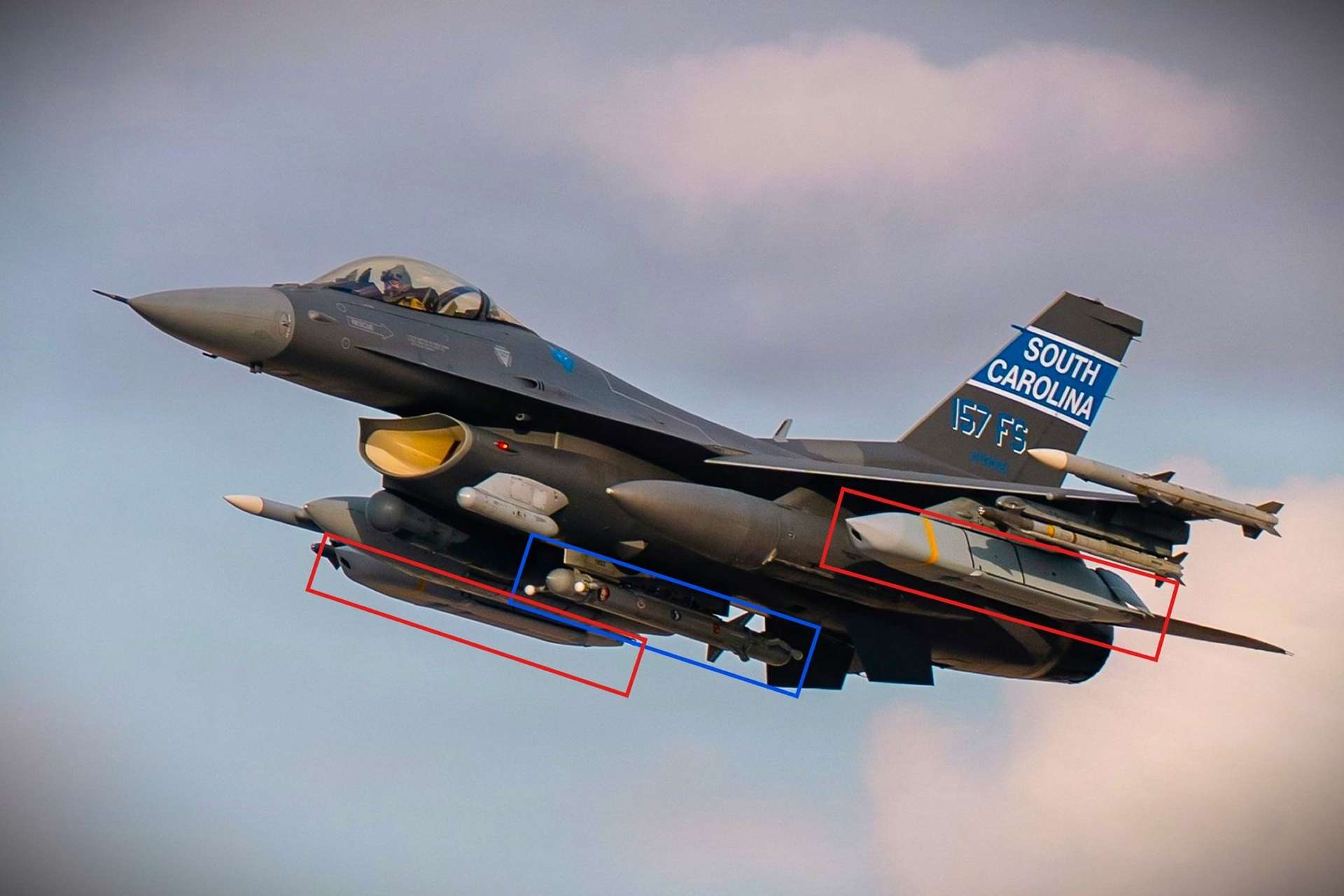
A newly released Operation Epic Fury image appears to show a U.S. Air Force F-16 Fighting Falcon configured with AGM-158 JASSM missiles and an Angry Kitten electronic warfare pod, indicating a self-escorting standoff strike role in a contested air-defense environment near Iran (Picture Source: U.S. Air Force)
The tail markings visible on the vertical stabilizer strongly suggest the aircraft is most probably a U.S. Air Force F-16C assigned to the 157th Fighter Squadron, part of the South Carolina Air National Guard’s 169th Fighter Wing and its Swamp Fox community, a unit that officially operates F-16C/D Block 52 aircraft and specializes in Suppression of Enemy Air Defenses and Destruction of Enemy Air Defenses missions. That identification matters because it frames the aircraft not simply as another multirole fighter on a regional deployment, but as a Viper from a formation whose institutional value to U.S. combat aviation lies in its experience operating in contested radar and missile environments.
What appears visible in the image is a notably balanced and highly purposeful configuration: two AGM-158 JASSMs, an Angry Kitten pod, two AIM-120 AMRAAMs, AIM-9X short-range missiles on the wingtips, and two external fuel tanks. In aviation terms, this is not the signature of a pure defensive counter-air sortie and not the signature of a stripped-down strike run either. It is the loadout of a self-escorting strike aircraft built to transit range, survive in a dense threat envelope, retain beyond-visual-range and within-visual-range options, and still deliver meaningful long-range effects without immediate dependence on a fully sanitized air corridor.
The two JASSMs are the first major clue to the sortie’s likely purpose. Official U.S. Air Force reporting defines JASSM as a low observable standoff air-launched cruise missile intended to keep aircrews out of range of hostile air defenses, while official testing by the Air National Guard confirmed the F-16/JASSM combination as a way to keep fourth-generation aircraft relevant in major combat operations alongside fifth-generation assets. A dual-JASSM fit on one F-16 points to mission planning centered either on dual-aimpoint prosecution against separate high-value targets or on a two-shot allocation against one especially well-defended objective where redundancy and kill probability matter. In an Iran scenario, that logic aligns most naturally with preplanned strikes against fixed but heavily protected nodes such as command-and-control infrastructure, air-defense architecture, or missile-support facilities rather than fleeting battlefield targets.
The Angry Kitten pod is the second and arguably most revealing part of the configuration. AFRL has described the pod as a rapidly reprogrammable electronic attack system whose mission data files can be updated overnight, and Air Combat Command recommended converting pods into combat systems able to provide attack capabilities against enemy radio-frequency threat systems rather than merely simulate them. That matters operationally because it transforms the jet from a simple standoff missile carrier into a platform able to contribute to electromagnetic battlespace shaping during ingress, weapons employment, and egress. In practical terms, the pod would be expected to complicate hostile radar cueing, disrupt elements of the enemy sensing and tracking chain, and reduce the quality of the air-defense picture available to Iranian operators at precisely the moment a JASSM-armed aircraft is positioning for launch.
The JASSM plus Angry Kitten pairing suggests two especially plausible mission families over or around Iran. The first is a stand-off precision strike mission against defended fixed targets, in which the F-16 remains outside the densest surface-to-air engagement zones while still delivering strategic effect. The second is a corridor-opening or package-support mission in which the aircraft uses its electronic warfare fit to degrade hostile radar performance and preserve survivability for a wider strike formation. The AIM-120 and AIM-9X fit reinforces that interpretation, because it shows the jet was prepared to defend itself against airborne threats rather than rely exclusively on escort cover. This is classic U.S. airpower logic: flexible packaging, layered effects, and the ability to combine kinetic and non-kinetic pressure in a single sortie design.
Just as important is what this loadout says about the enduring combat value of the F-16 itself. The South Carolina Block 52 fleet is officially described as multirole, with air-to-air and air-to-ground mission capacity, yet this image shows how far that flexibility can be stretched when modern standoff weapons and adaptable electronic warfare pods are added to a mature fighter airframe. This is not the classic Cold War image of a lightly loaded Viper dashing low and fast; it is a far more contemporary expression of the type, configured as a networked shooter, self-escort fighter, and electronic warfare contributor at once. Once again circling back to just how definitively multirole the F-16 is, this photograph underlines why the aircraft remains such a valuable instrument of U.S. combat aviation in a high-threat theater.
Seen through a professional operational lens, the Operation Epic Fury photograph is more than a striking image of a departing fighter. It is a compact visual summary of how the United States continues to extract serious combat leverage from the F-16CJ by fusing reach, electronic attack, self-protection, and tactical flexibility into one coherent package. If the loadout in this image is any indication, the message is clear: U.S. airpower retains the ability to present Iran with a difficult and layered problem set long before an adversary ever gets a clean shot at the launch aircraft.
Written by Teoman S. Nicanci – Defense Analyst, Army Recognition Group
Teoman S. Nicanci holds degrees in Political Science, Comparative and International Politics, and International Relations and Diplomacy from leading Belgian universities, with research focused on Russian strategic behavior, defense technology, and modern warfare. He is a defense analyst at Army Recognition, specializing in the global defense industry, military armament, and emerging defense technologies.
{loadposition bannertop}
{loadposition sidebarpub}
On April 3, 2026, the U.S. Defense Visual Information Distribution Service published a photograph taken on March 29 showing a U.S. Air Force F-16 Fighting Falcon launching for a combat sortie during Operation Epic Fury from an undisclosed location.
Far from being a routine takeoff image, the photograph is notable because it appears to capture a deliberately configured combat loadout that blends standoff strike, electronic warfare, self-escort, and extended reach in a single Viper package. That makes the image especially relevant at a moment when Army Recognition had already reported the movement of Angry Kitten-equipped F-16CJ Vipers toward the Middle East amid tensions involving Iran.
Read Also: U.S. Seeks Hardened Anti-Jam GPS Guidance for JASSM Cruise Missile in Electronic Warfare Conditions
A newly released Operation Epic Fury image appears to show a U.S. Air Force F-16 Fighting Falcon configured with AGM-158 JASSM missiles and an Angry Kitten electronic warfare pod, indicating a self-escorting standoff strike role in a contested air-defense environment near Iran (Picture Source: U.S. Air Force)
The tail markings visible on the vertical stabilizer strongly suggest the aircraft is most probably a U.S. Air Force F-16C assigned to the 157th Fighter Squadron, part of the South Carolina Air National Guard’s 169th Fighter Wing and its Swamp Fox community, a unit that officially operates F-16C/D Block 52 aircraft and specializes in Suppression of Enemy Air Defenses and Destruction of Enemy Air Defenses missions. That identification matters because it frames the aircraft not simply as another multirole fighter on a regional deployment, but as a Viper from a formation whose institutional value to U.S. combat aviation lies in its experience operating in contested radar and missile environments.
What appears visible in the image is a notably balanced and highly purposeful configuration: two AGM-158 JASSMs, an Angry Kitten pod, two AIM-120 AMRAAMs, AIM-9X short-range missiles on the wingtips, and two external fuel tanks. In aviation terms, this is not the signature of a pure defensive counter-air sortie and not the signature of a stripped-down strike run either. It is the loadout of a self-escorting strike aircraft built to transit range, survive in a dense threat envelope, retain beyond-visual-range and within-visual-range options, and still deliver meaningful long-range effects without immediate dependence on a fully sanitized air corridor.
The two JASSMs are the first major clue to the sortie’s likely purpose. Official U.S. Air Force reporting defines JASSM as a low observable standoff air-launched cruise missile intended to keep aircrews out of range of hostile air defenses, while official testing by the Air National Guard confirmed the F-16/JASSM combination as a way to keep fourth-generation aircraft relevant in major combat operations alongside fifth-generation assets. A dual-JASSM fit on one F-16 points to mission planning centered either on dual-aimpoint prosecution against separate high-value targets or on a two-shot allocation against one especially well-defended objective where redundancy and kill probability matter. In an Iran scenario, that logic aligns most naturally with preplanned strikes against fixed but heavily protected nodes such as command-and-control infrastructure, air-defense architecture, or missile-support facilities rather than fleeting battlefield targets.
The Angry Kitten pod is the second and arguably most revealing part of the configuration. AFRL has described the pod as a rapidly reprogrammable electronic attack system whose mission data files can be updated overnight, and Air Combat Command recommended converting pods into combat systems able to provide attack capabilities against enemy radio-frequency threat systems rather than merely simulate them. That matters operationally because it transforms the jet from a simple standoff missile carrier into a platform able to contribute to electromagnetic battlespace shaping during ingress, weapons employment, and egress. In practical terms, the pod would be expected to complicate hostile radar cueing, disrupt elements of the enemy sensing and tracking chain, and reduce the quality of the air-defense picture available to Iranian operators at precisely the moment a JASSM-armed aircraft is positioning for launch.
The JASSM plus Angry Kitten pairing suggests two especially plausible mission families over or around Iran. The first is a stand-off precision strike mission against defended fixed targets, in which the F-16 remains outside the densest surface-to-air engagement zones while still delivering strategic effect. The second is a corridor-opening or package-support mission in which the aircraft uses its electronic warfare fit to degrade hostile radar performance and preserve survivability for a wider strike formation. The AIM-120 and AIM-9X fit reinforces that interpretation, because it shows the jet was prepared to defend itself against airborne threats rather than rely exclusively on escort cover. This is classic U.S. airpower logic: flexible packaging, layered effects, and the ability to combine kinetic and non-kinetic pressure in a single sortie design.
Just as important is what this loadout says about the enduring combat value of the F-16 itself. The South Carolina Block 52 fleet is officially described as multirole, with air-to-air and air-to-ground mission capacity, yet this image shows how far that flexibility can be stretched when modern standoff weapons and adaptable electronic warfare pods are added to a mature fighter airframe. This is not the classic Cold War image of a lightly loaded Viper dashing low and fast; it is a far more contemporary expression of the type, configured as a networked shooter, self-escort fighter, and electronic warfare contributor at once. Once again circling back to just how definitively multirole the F-16 is, this photograph underlines why the aircraft remains such a valuable instrument of U.S. combat aviation in a high-threat theater.
Seen through a professional operational lens, the Operation Epic Fury photograph is more than a striking image of a departing fighter. It is a compact visual summary of how the United States continues to extract serious combat leverage from the F-16CJ by fusing reach, electronic attack, self-protection, and tactical flexibility into one coherent package. If the loadout in this image is any indication, the message is clear: U.S. airpower retains the ability to present Iran with a difficult and layered problem set long before an adversary ever gets a clean shot at the launch aircraft.
Written by Teoman S. Nicanci – Defense Analyst, Army Recognition Group
Teoman S. Nicanci holds degrees in Political Science, Comparative and International Politics, and International Relations and Diplomacy from leading Belgian universities, with research focused on Russian strategic behavior, defense technology, and modern warfare. He is a defense analyst at Army Recognition, specializing in the global defense industry, military armament, and emerging defense technologies.