U.S. Special Operations Awards $19.4M for MH-47G Chinook Block II Helicopters Through 2030
{loadposition bannertop}
{loadposition sidebarpub}
U.S. Special Operations Command has awarded Boeing a $19.4 million modification to continue MH-47G Block II Chinook production in Ridley Park, Pennsylvania, with work running through November 2030. The action sustains SOCOM’s heavy assault helicopter fleet, a critical capability for long-range special operations missions in contested environments.
U.S. Special Operations Command has funded another MH-47G heavy-lift helicopter procurement action, sustaining the force’s ability to insert and extract special operations teams at range under darkness and adverse weather. A $19.421 million firm-fixed-price modification awarded to Boeing in Ridley Park, Pennsylvania, adds funding to an existing delivery order for MH-47G rotary-wing aircraft, with work expected to run through November 2030. While the award notice does not specify aircraft quantity or configuration, the timeline and contracting vehicle signal continued momentum behind SOCOM’s plan to recapitalize its heavy assault fleet for deep-penetration missions.Follow Army Recognition on Google News at this link
An MH-47G Chinook mounts a crew-served 7,62mm defensive guns, typically M134 miniguns forward and M240 machine guns aft, delivering high-volume suppressive fire to cover SOF insertions and extractions (Picture source: U.S. DoW).
The small value of this modification is a building block inside a much larger multi-year buy. In November 2025, Boeing received an $877.7 million firm-fixed-price delivery order for MH-47G procurement in support of USSOCOM, also scheduled to be completed by November 2030 and executed primarily at Ridley Park. The February 2026 modification appears to extend or refine that production effort, potentially covering long-lead items, integration work, or incremental funding typical of aircraft procurement profiles, even when the public announcement does not break out line items.
For SOCOM, the MH-47G is not simply another Chinook. It is the command’s heavy assault helicopter optimized for special operations aviation: long-range infiltration and exfiltration, air assault, resupply, and sling-load operations across austere and complex terrain. SOCOM rotary-wing program material describes an employment set that also includes shipboard and platform operations, urban missions, over-water profiles, parachute support, forward arming and refueling point operations, mass-casualty response, and combat search and rescue. That breadth matters because SOF missions routinely begin as intelligence-driven raids or recoveries and end as logistics or casualty evacuation problems under threat.
The current modernization push is tied to the Chinook Block II baseline, which is designed to recover payload and range eroded by decades of weight growth and added mission systems. The U.S. Army’s Block II rapid fielding effort highlights a 54,000-pound maximum gross weight and frames Block II as enabling greater payload, extended range, and improved sustainability for contested logistics and standoff operations. Boeing’s H-47 Block II description points to a strengthened structure, redesigned fuel tanks, improved drivetrain, and open avionics architecture intended to increase lift, extend range, and preserve growth margins for future upgrades. Block II improvements are associated with an upgraded drivetrain, reinforced airframe, and enhanced fuel system that expand mission radius at 54,000 pounds.
What turns that improved airframe into a SOF penetrator is the MH-47G mission equipment stack and the way it reduces crew workload at the edge of the envelope. USSOCOM’s Program Executive Office Rotary Wing has described integration of advanced flight controls through an Active Parallel Actuator Subsystem designed to provide tactile cueing that helps prevent pilots from exceeding aircraft limits, increasing safety and operational usage while reducing workload during demanding phases of low-level flight. The same modernization effort includes survivability upgrades and mission equipment work focused on software updates, aircraft survivability equipment improvements, degraded visual environment integration, next-generation tactical communications, and sensor data fusion.
A key enabler of the MH-47G’s tactical niche is its terrain-following and terrain-avoidance sensing, which allows it to fly low and fast without surrendering survivability to weather or darkness. The AN/APQ-187 Silent Knight radar is a low-probability-of-intercept and low-probability-of-detection multi-mode radar built to support safe low-level flight in adverse environments, including over water and difficult terrain. Its design supports operation from 100 to 1,000 feet above ground level across a wide speed range, with modes spanning terrain following and avoidance, weather detection, ground mapping, and maritime detection. The compact one-box radar configuration keeps weight and integration penalties manageable while giving crews the ability to exploit terrain masking and minimize exposure time inside engagement zones.
SOCOM needs the MH-47G because it fills a gap that neither medium assault helicopters nor fixed-wing mobility can cover in the first hours of a time-sensitive mission. The aircraft can move heavier and bulkier mission packages, such as multiple vehicles, sustainment loads, breaching equipment, or specialized teams, while still supporting precision insertion techniques and low-signature profiles. It also supports distributed concepts in which SOF teams may have to launch from distant bases, refuel and rearm forward, and then reposition rapidly for extraction, all while maintaining communications and situational awareness in cluttered electromagnetic environments. SOCOM frames the MH-47 as a multi-role infiltrator, resupplier, and recovery platform rather than a single-mission transport.
The fleet context explains why even a relatively small contract action matters. The Army’s fiscal planning documents state that the H-47 Block II renewal and new-build effort is structured to rebuild or replace 69 MH-47G special operations aircraft, replacing an aging fleet with airframe components dating back more than 45 years. Boeing has indicated that, as of mid-2024, the U.S. Army Special Operations Aviation Command had 46 MH-47G Block II aircraft under contract, underscoring that recapitalization is already well underway, even if not all airframes are delivered in the new configuration yet.
The February 2026 modification, therefore, represents continuity of production tempo and modernization stability through the end of the decade rather than a stand-alone purchase. Firm-fixed-price contracting places cost risk on the contractor and typically reflects a mature configuration and stable supply chain, important attributes for a platform that SOCOM relies on for global rapid response. With deliveries and work running to 2030, the MH-47G remains a cornerstone capability for deep insertion, contested resupply, and high-risk personnel recovery missions as SOCOM adapts its rotary-wing force to the threat environment of the 2030s.
{loadposition bannertop}
{loadposition sidebarpub}
U.S. Special Operations Command has awarded Boeing a $19.4 million modification to continue MH-47G Block II Chinook production in Ridley Park, Pennsylvania, with work running through November 2030. The action sustains SOCOM’s heavy assault helicopter fleet, a critical capability for long-range special operations missions in contested environments.
U.S. Special Operations Command has funded another MH-47G heavy-lift helicopter procurement action, sustaining the force’s ability to insert and extract special operations teams at range under darkness and adverse weather. A $19.421 million firm-fixed-price modification awarded to Boeing in Ridley Park, Pennsylvania, adds funding to an existing delivery order for MH-47G rotary-wing aircraft, with work expected to run through November 2030. While the award notice does not specify aircraft quantity or configuration, the timeline and contracting vehicle signal continued momentum behind SOCOM’s plan to recapitalize its heavy assault fleet for deep-penetration missions.
Follow Army Recognition on Google News at this link
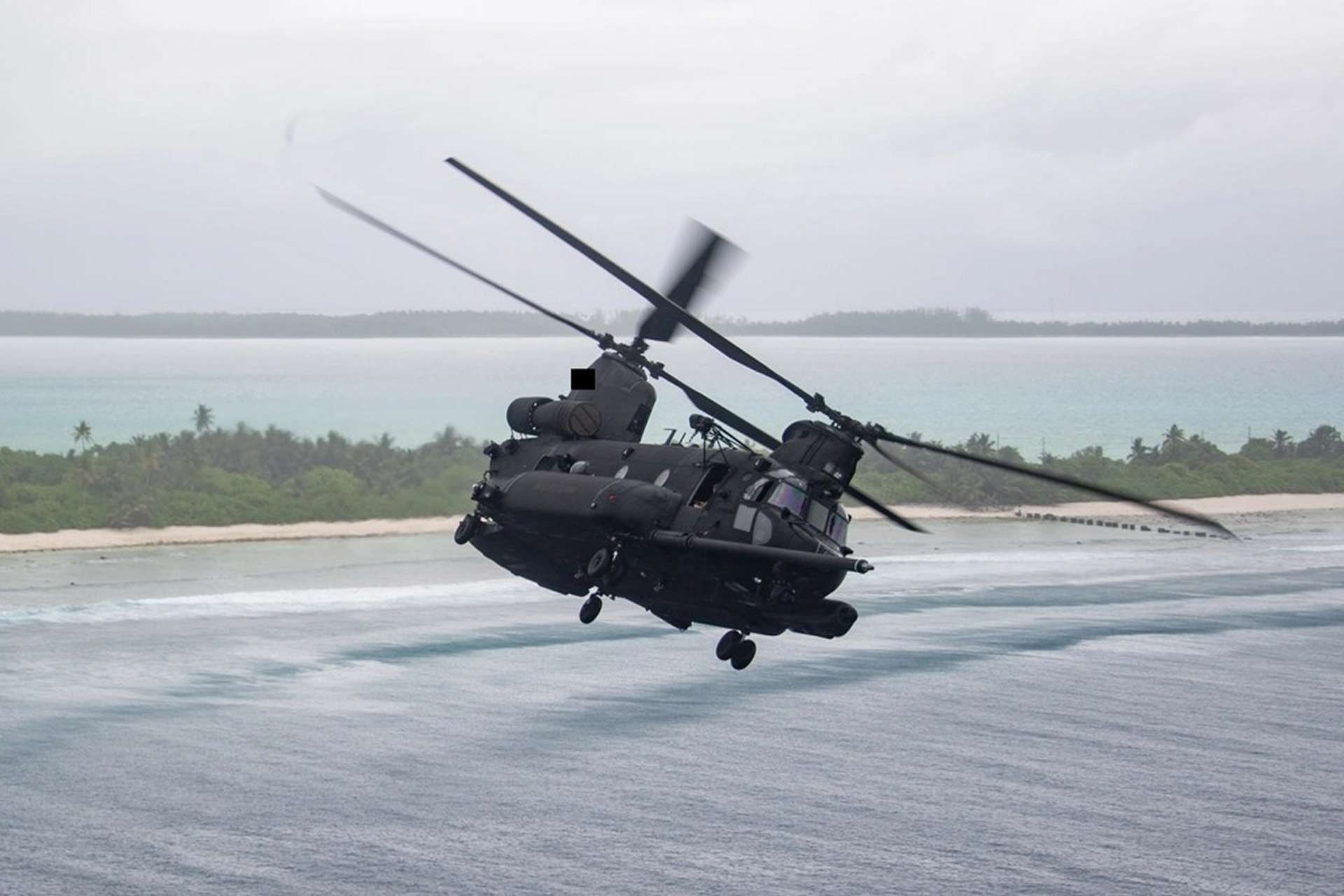
An MH-47G Chinook mounts a crew-served 7,62mm defensive guns, typically M134 miniguns forward and M240 machine guns aft, delivering high-volume suppressive fire to cover SOF insertions and extractions (Picture source: U.S. DoW).
The small value of this modification is a building block inside a much larger multi-year buy. In November 2025, Boeing received an $877.7 million firm-fixed-price delivery order for MH-47G procurement in support of USSOCOM, also scheduled to be completed by November 2030 and executed primarily at Ridley Park. The February 2026 modification appears to extend or refine that production effort, potentially covering long-lead items, integration work, or incremental funding typical of aircraft procurement profiles, even when the public announcement does not break out line items.
For SOCOM, the MH-47G is not simply another Chinook. It is the command’s heavy assault helicopter optimized for special operations aviation: long-range infiltration and exfiltration, air assault, resupply, and sling-load operations across austere and complex terrain. SOCOM rotary-wing program material describes an employment set that also includes shipboard and platform operations, urban missions, over-water profiles, parachute support, forward arming and refueling point operations, mass-casualty response, and combat search and rescue. That breadth matters because SOF missions routinely begin as intelligence-driven raids or recoveries and end as logistics or casualty evacuation problems under threat.
The current modernization push is tied to the Chinook Block II baseline, which is designed to recover payload and range eroded by decades of weight growth and added mission systems. The U.S. Army’s Block II rapid fielding effort highlights a 54,000-pound maximum gross weight and frames Block II as enabling greater payload, extended range, and improved sustainability for contested logistics and standoff operations. Boeing’s H-47 Block II description points to a strengthened structure, redesigned fuel tanks, improved drivetrain, and open avionics architecture intended to increase lift, extend range, and preserve growth margins for future upgrades. Block II improvements are associated with an upgraded drivetrain, reinforced airframe, and enhanced fuel system that expand mission radius at 54,000 pounds.
What turns that improved airframe into a SOF penetrator is the MH-47G mission equipment stack and the way it reduces crew workload at the edge of the envelope. USSOCOM’s Program Executive Office Rotary Wing has described integration of advanced flight controls through an Active Parallel Actuator Subsystem designed to provide tactile cueing that helps prevent pilots from exceeding aircraft limits, increasing safety and operational usage while reducing workload during demanding phases of low-level flight. The same modernization effort includes survivability upgrades and mission equipment work focused on software updates, aircraft survivability equipment improvements, degraded visual environment integration, next-generation tactical communications, and sensor data fusion.
A key enabler of the MH-47G’s tactical niche is its terrain-following and terrain-avoidance sensing, which allows it to fly low and fast without surrendering survivability to weather or darkness. The AN/APQ-187 Silent Knight radar is a low-probability-of-intercept and low-probability-of-detection multi-mode radar built to support safe low-level flight in adverse environments, including over water and difficult terrain. Its design supports operation from 100 to 1,000 feet above ground level across a wide speed range, with modes spanning terrain following and avoidance, weather detection, ground mapping, and maritime detection. The compact one-box radar configuration keeps weight and integration penalties manageable while giving crews the ability to exploit terrain masking and minimize exposure time inside engagement zones.
SOCOM needs the MH-47G because it fills a gap that neither medium assault helicopters nor fixed-wing mobility can cover in the first hours of a time-sensitive mission. The aircraft can move heavier and bulkier mission packages, such as multiple vehicles, sustainment loads, breaching equipment, or specialized teams, while still supporting precision insertion techniques and low-signature profiles. It also supports distributed concepts in which SOF teams may have to launch from distant bases, refuel and rearm forward, and then reposition rapidly for extraction, all while maintaining communications and situational awareness in cluttered electromagnetic environments. SOCOM frames the MH-47 as a multi-role infiltrator, resupplier, and recovery platform rather than a single-mission transport.
The fleet context explains why even a relatively small contract action matters. The Army’s fiscal planning documents state that the H-47 Block II renewal and new-build effort is structured to rebuild or replace 69 MH-47G special operations aircraft, replacing an aging fleet with airframe components dating back more than 45 years. Boeing has indicated that, as of mid-2024, the U.S. Army Special Operations Aviation Command had 46 MH-47G Block II aircraft under contract, underscoring that recapitalization is already well underway, even if not all airframes are delivered in the new configuration yet.
The February 2026 modification, therefore, represents continuity of production tempo and modernization stability through the end of the decade rather than a stand-alone purchase. Firm-fixed-price contracting places cost risk on the contractor and typically reflects a mature configuration and stable supply chain, important attributes for a platform that SOCOM relies on for global rapid response. With deliveries and work running to 2030, the MH-47G remains a cornerstone capability for deep insertion, contested resupply, and high-risk personnel recovery missions as SOCOM adapts its rotary-wing force to the threat environment of the 2030s.