US Air Force to purchase 150 Collaborative Combat Aircraft by 2031 to support F-35 and F-47 operations
{loadposition bannertop}
{loadposition sidebarpub}
The U.S. Air Force plans to acquire more than 150 Collaborative Combat Aircraft before FY2031, according to budget testimony delivered to Congress on April 29, 2026, marking a major shift from experimental drone development toward operational combat integration alongside the F-35 and future F-47. The expansion reflects growing concern inside the Pentagon over missile capacity, pilot shortages, and the ability to sustain air combat losses during a prolonged conflict against a peer adversary such as China.
The CCA program is designed to give U.S. fighter formations greater combat mass by deploying autonomous aircraft as missile carriers, ISR platforms, electronic warfare assets, and decoys operating with crewed fighters. General Atomics’ YFQ-42A Dark Merlin and Anduril’s YFQ-44A Fury are already flying prototypes, highlighting how the Air Force is rapidly advancing survivable autonomous systems intended to penetrate contested airspace and strengthen future NATO airpower operations.
Related topic: Netherlands finances two US Air Force CCA prototypes to develop F-35 drone-teaming experience
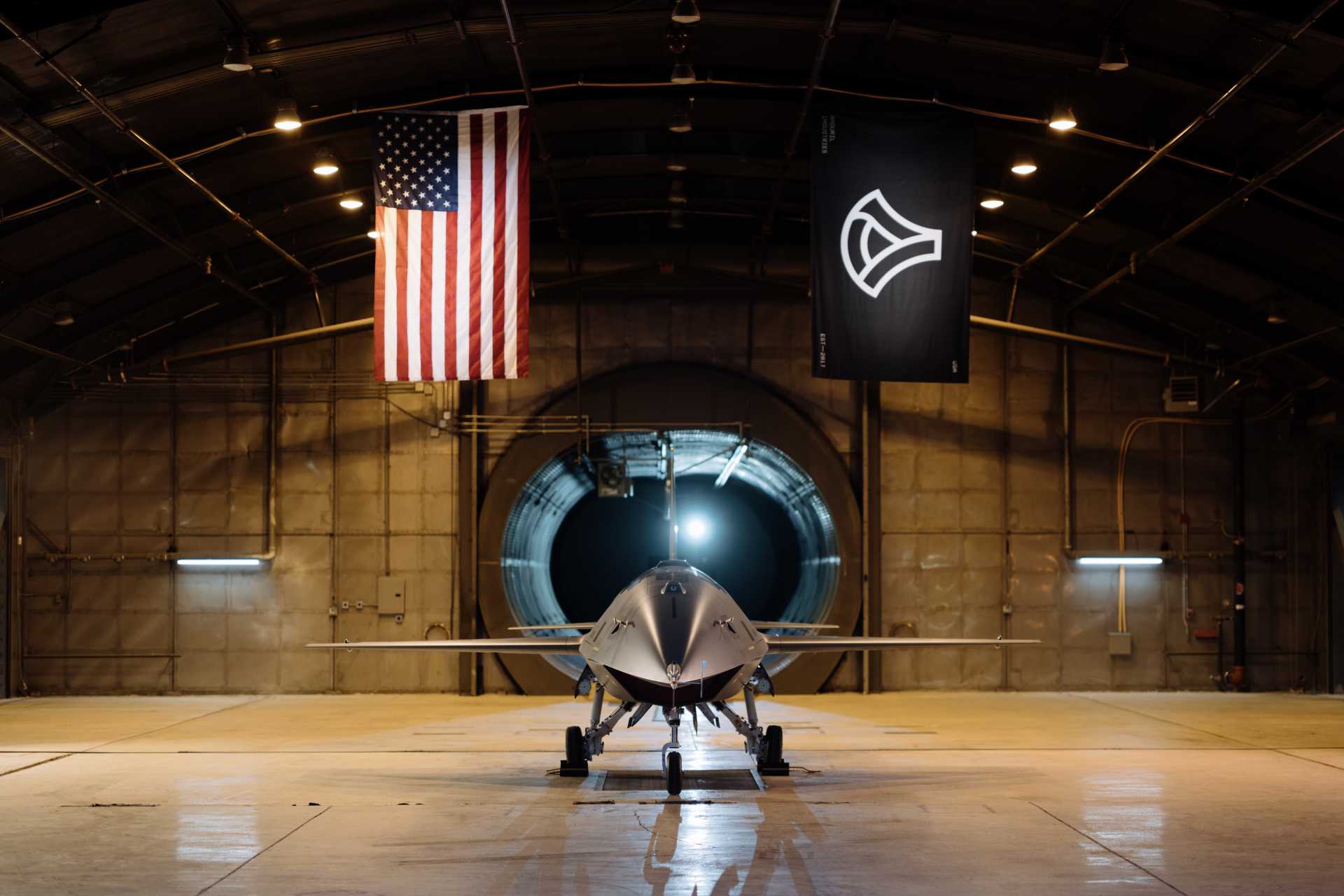
Anduril’s YFQ-44A Fury, the second official CCA Increment 1 design, has already completed flight testing and captive-carry missile trials with AIM-120 AMRAAMs, as it is optimized for aggressive maneuvering and autonomous air combat support missions. (Picture source: US DoD)
During the presentation of its FY2027 budget request to the Senate and the House of Representatives on April 29, 2026, the U.S. Air Force confirmed that it plans to procure more than 150 Collaborative Combat Aircraft (CCAs) before fiscal year 2031 (FY2031) while increasing CCA funding from $891 million enacted in FY2026 to $1.431 billion in FY2027. The increase marks the transition of the program from experimental autonomy development toward operational force expansion tied directly to tactical force structure planning.
Troy Meink, Secretary of the Air Force, and General Kenneth S. Wilsbach, Chief of Staff for the U.S. Air Force, identified both the CCA and the F-47 as its two principal modernization priorities while emphasizing that programs failing affordability or production objectives should be considered unsuccessful regardless of technical performance. The shift reflects new Pentagon concerns regarding tactical aircraft inventory depth, industrial production rates, pilot availability, and missile expenditure during a prolonged peer conflict. The “150+” procurement objective likely includes Increment 1 low-rate production aircraft, operational experimentation fleets, training inventories, and initial operational squadrons.
Unlike the B-21, which remains in low-rate production, and the F-47, which is still in engineering and manufacturing development (funded at more than $5 billion in FY2027), CCA prototypes are already flying while the US Air Force develops doctrine and human-machine teaming concepts in parallel. It is important to note that earlier references to roughly 1,000 CCAs primarily reflected conceptual force structure assumptions, which involved two autonomous aircraft paired with each advanced fighter rather than funded procurement planning. The current framework instead links budget authority, testing, and acquisition planning inside a defined Future Years Defense Program (FYDP) structure extending through 2031.
Operationally, the U.S. Air Force increasingly views the Collaborative Combat Aircraft (CCA) as a new method to restore tactical force capacity rather than replacing crewed fighters, as once prophesied by Elon Musk. Fighters such as the F-35A carry limited internal missile loads in low-observable configuration, while Indo-Pacific scenarios involve long engagement distances, dense integrated air defenses, and large Chinese missile inventories. CCAs are therefore intended to function as distributed missile magazines, ISR assets, passive targeting nodes, stand-in jammers, and decoys supporting F-35A, F-22, F-15EX, and future F-47 formations.
For the U.S. Air Force, the operational logic centers on increasing “affordable mass” without proportionally increasing procurement and sustainment costs associated with crewed fighters or expanding pilot requirements during high-intensity warfare. Actually, there are two unmanned fighters selected for the CCA program. The first, General Atomics’ YFQ-42A Dark Merlin, evolved from the XQ-67A Off-Board Sensing Station developed for the Air Force Research Laboratory and uses a modular “common chassis” architecture intended to simplify production and mission adaptation.
The aircraft prioritizes endurance and persistence, with a long fuselage, dorsal intake, internal payload bay, and low-observable shaping optimized for ISR, passive targeting, electronic warfare, and stand-off missile support. Estimates indicate a combat radius exceeding 1,300 kilometers in a subsonic flight regime while supporting internal carriage of AIM-120 AMRAAM missiles and sensor payloads. The first pre-production prototype flew on August 27, 2025, and the aircraft is currently undergoing developmental testing in California and operational experimentation at Nellis AFB.
On the other hand, Anduril’s YFQ-44A Fury reflects a more maneuver-oriented and fighter-adjacent design philosophy focused on tactical responsiveness and closer integration with crewed fighters. Created by Blue Force Technologies before its acquisition by Anduril, the aircraft integrates the company’s Lattice autonomy architecture and uses a single Williams FJ44-4M turbofan producing roughly 17.8 kN of thrust. Available estimates indicate speeds approaching Mach 0.95, sustained maneuvering at 4.5 g, peak maneuvering up to 9 g, operations up to 15,200 meters altitude, and a maximum gross takeoff weight near 2,270 kilograms.
The US Air Force initiated AIM-120 captive-carry testing during 2026, indicating a rapid progression toward active weapons employment, escort operations, electronic warfare support, and forward interception missions. The U.S. Air Force has progressively moved away from earlier “attritable” autonomous aircraft concepts because purely expendable systems were assessed as unlikely to survive inside modern contested air defense environments. Increment 1 CCAs are therefore substantially larger and more survivable than earlier loyal wingman demonstrators such as the XQ-58A Valkyrie, with current planning emphasizing low-observable shaping, internal payload bays, survivability, and autonomous penetration capability.
Developed by General Atomics Aeronautical Systems, the YFQ-42A Dark Merlin, the first official Increment 1 CCA contender, emphasizes modular payloads, autonomous teaming, and relatively low procurement cost for ISR, air-to-air support, strike, and electronic warfare missions. (Picture source: US DoD)
Increment 2 discussions increasingly reference deeper penetration operations, higher autonomy levels, and more advanced stealth characteristics. Northrop Grumman’s reported YFQ-48A effort appears aligned with this transition toward survivable semi-autonomous aircraft derived from experience with the X-47B and B-21. Operational experimentation is proceeding simultaneously with the CCA development through the Experimental Operations Unit (EOU) at Nellis AFB under Air Combat Command authority. Current experimentation includes distributed targeting, sensor fusion, command delegation, communications resilience, pilot workload management, and human-machine teaming procedures under degraded electronic warfare conditions.
The USAF is attempting to determine how many autonomous CCAs a single pilot can supervise during combat operations and what levels of autonomous authority remain acceptable during communications disruption. These command integration and autonomy control issues increasingly appear more difficult than the engineering challenges associated with building the aircraft themselves, making the EOU both a test organization and a doctrinal development structure for future U.S. autonomous tactical aviation.
More interestingly, the Netherlands formally joined Increment 1 experimentation in April 2026 by financing two prototypes assigned to the Nellis Experimental Operations Unit following a Letter of Intent signed on October 16, 2025, and a subsequent Letter of Acceptance process completed in 2026. Dutch personnel will now receive a direct access to operational testing, command-and-control experimentation, sensor fusion integration, and autonomy procedures, likely linked to future F-35A operations, while the aircraft remain U.S-operated assets.
The arrangement reflects wider NATO interest in autonomous force multiplication for smaller fighter fleets, as demonstrated by the Turkish Kizilelma and the Australian MQ-28A Ghost Bat. Simultaneously, US Air Force leadership increasingly identifies industrial scalability rather than technical feasibility as the program’s principal challenge, emphasizing affordability, modular systems, open architectures, supply chain resilience, and production capacity as essential requirements for fielding hundreds of survivable autonomous aircraft during sustained high-intensity warfare.
Written by Jérôme Brahy
Jérôme Brahy is a defense analyst and documentalist at Army Recognition. He specializes in naval modernization, aviation, drones, armored vehicles, and artillery, with a focus on strategic developments in the United States, China, Ukraine, Russia, Türkiye, and Belgium. His analyses go beyond the facts, providing context, identifying key actors, and explaining why defense news matters on a global scale.
{loadposition bannertop}
{loadposition sidebarpub}
The U.S. Air Force plans to acquire more than 150 Collaborative Combat Aircraft before FY2031, according to budget testimony delivered to Congress on April 29, 2026, marking a major shift from experimental drone development toward operational combat integration alongside the F-35 and future F-47. The expansion reflects growing concern inside the Pentagon over missile capacity, pilot shortages, and the ability to sustain air combat losses during a prolonged conflict against a peer adversary such as China.
The CCA program is designed to give U.S. fighter formations greater combat mass by deploying autonomous aircraft as missile carriers, ISR platforms, electronic warfare assets, and decoys operating with crewed fighters. General Atomics’ YFQ-42A Dark Merlin and Anduril’s YFQ-44A Fury are already flying prototypes, highlighting how the Air Force is rapidly advancing survivable autonomous systems intended to penetrate contested airspace and strengthen future NATO airpower operations.
Related topic: Netherlands finances two US Air Force CCA prototypes to develop F-35 drone-teaming experience
Anduril’s YFQ-44A Fury, the second official CCA Increment 1 design, has already completed flight testing and captive-carry missile trials with AIM-120 AMRAAMs, as it is optimized for aggressive maneuvering and autonomous air combat support missions. (Picture source: US DoD)
During the presentation of its FY2027 budget request to the Senate and the House of Representatives on April 29, 2026, the U.S. Air Force confirmed that it plans to procure more than 150 Collaborative Combat Aircraft (CCAs) before fiscal year 2031 (FY2031) while increasing CCA funding from $891 million enacted in FY2026 to $1.431 billion in FY2027. The increase marks the transition of the program from experimental autonomy development toward operational force expansion tied directly to tactical force structure planning.
Troy Meink, Secretary of the Air Force, and General Kenneth S. Wilsbach, Chief of Staff for the U.S. Air Force, identified both the CCA and the F-47 as its two principal modernization priorities while emphasizing that programs failing affordability or production objectives should be considered unsuccessful regardless of technical performance. The shift reflects new Pentagon concerns regarding tactical aircraft inventory depth, industrial production rates, pilot availability, and missile expenditure during a prolonged peer conflict. The “150+” procurement objective likely includes Increment 1 low-rate production aircraft, operational experimentation fleets, training inventories, and initial operational squadrons.
Unlike the B-21, which remains in low-rate production, and the F-47, which is still in engineering and manufacturing development (funded at more than $5 billion in FY2027), CCA prototypes are already flying while the US Air Force develops doctrine and human-machine teaming concepts in parallel. It is important to note that earlier references to roughly 1,000 CCAs primarily reflected conceptual force structure assumptions, which involved two autonomous aircraft paired with each advanced fighter rather than funded procurement planning. The current framework instead links budget authority, testing, and acquisition planning inside a defined Future Years Defense Program (FYDP) structure extending through 2031.
Operationally, the U.S. Air Force increasingly views the Collaborative Combat Aircraft (CCA) as a new method to restore tactical force capacity rather than replacing crewed fighters, as once prophesied by Elon Musk. Fighters such as the F-35A carry limited internal missile loads in low-observable configuration, while Indo-Pacific scenarios involve long engagement distances, dense integrated air defenses, and large Chinese missile inventories. CCAs are therefore intended to function as distributed missile magazines, ISR assets, passive targeting nodes, stand-in jammers, and decoys supporting F-35A, F-22, F-15EX, and future F-47 formations.
For the U.S. Air Force, the operational logic centers on increasing “affordable mass” without proportionally increasing procurement and sustainment costs associated with crewed fighters or expanding pilot requirements during high-intensity warfare. Actually, there are two unmanned fighters selected for the CCA program. The first, General Atomics’ YFQ-42A Dark Merlin, evolved from the XQ-67A Off-Board Sensing Station developed for the Air Force Research Laboratory and uses a modular “common chassis” architecture intended to simplify production and mission adaptation.
The aircraft prioritizes endurance and persistence, with a long fuselage, dorsal intake, internal payload bay, and low-observable shaping optimized for ISR, passive targeting, electronic warfare, and stand-off missile support. Estimates indicate a combat radius exceeding 1,300 kilometers in a subsonic flight regime while supporting internal carriage of AIM-120 AMRAAM missiles and sensor payloads. The first pre-production prototype flew on August 27, 2025, and the aircraft is currently undergoing developmental testing in California and operational experimentation at Nellis AFB.
On the other hand, Anduril’s YFQ-44A Fury reflects a more maneuver-oriented and fighter-adjacent design philosophy focused on tactical responsiveness and closer integration with crewed fighters. Created by Blue Force Technologies before its acquisition by Anduril, the aircraft integrates the company’s Lattice autonomy architecture and uses a single Williams FJ44-4M turbofan producing roughly 17.8 kN of thrust. Available estimates indicate speeds approaching Mach 0.95, sustained maneuvering at 4.5 g, peak maneuvering up to 9 g, operations up to 15,200 meters altitude, and a maximum gross takeoff weight near 2,270 kilograms.
The US Air Force initiated AIM-120 captive-carry testing during 2026, indicating a rapid progression toward active weapons employment, escort operations, electronic warfare support, and forward interception missions. The U.S. Air Force has progressively moved away from earlier “attritable” autonomous aircraft concepts because purely expendable systems were assessed as unlikely to survive inside modern contested air defense environments. Increment 1 CCAs are therefore substantially larger and more survivable than earlier loyal wingman demonstrators such as the XQ-58A Valkyrie, with current planning emphasizing low-observable shaping, internal payload bays, survivability, and autonomous penetration capability.
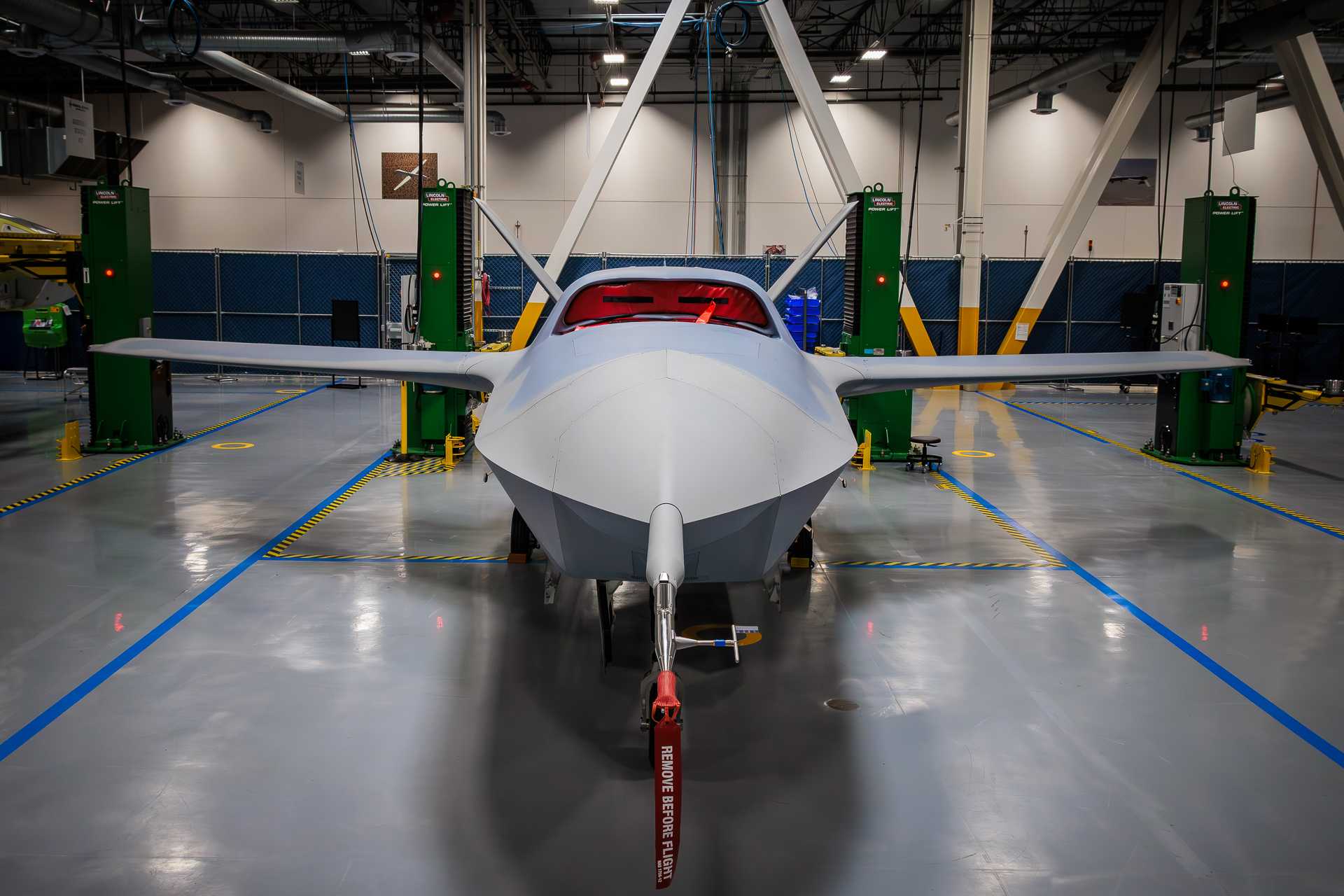
Developed by General Atomics Aeronautical Systems, the YFQ-42A Dark Merlin, the first official Increment 1 CCA contender, emphasizes modular payloads, autonomous teaming, and relatively low procurement cost for ISR, air-to-air support, strike, and electronic warfare missions. (Picture source: US DoD)
Increment 2 discussions increasingly reference deeper penetration operations, higher autonomy levels, and more advanced stealth characteristics. Northrop Grumman’s reported YFQ-48A effort appears aligned with this transition toward survivable semi-autonomous aircraft derived from experience with the X-47B and B-21. Operational experimentation is proceeding simultaneously with the CCA development through the Experimental Operations Unit (EOU) at Nellis AFB under Air Combat Command authority. Current experimentation includes distributed targeting, sensor fusion, command delegation, communications resilience, pilot workload management, and human-machine teaming procedures under degraded electronic warfare conditions.
The USAF is attempting to determine how many autonomous CCAs a single pilot can supervise during combat operations and what levels of autonomous authority remain acceptable during communications disruption. These command integration and autonomy control issues increasingly appear more difficult than the engineering challenges associated with building the aircraft themselves, making the EOU both a test organization and a doctrinal development structure for future U.S. autonomous tactical aviation.
More interestingly, the Netherlands formally joined Increment 1 experimentation in April 2026 by financing two prototypes assigned to the Nellis Experimental Operations Unit following a Letter of Intent signed on October 16, 2025, and a subsequent Letter of Acceptance process completed in 2026. Dutch personnel will now receive a direct access to operational testing, command-and-control experimentation, sensor fusion integration, and autonomy procedures, likely linked to future F-35A operations, while the aircraft remain U.S-operated assets.
The arrangement reflects wider NATO interest in autonomous force multiplication for smaller fighter fleets, as demonstrated by the Turkish Kizilelma and the Australian MQ-28A Ghost Bat. Simultaneously, US Air Force leadership increasingly identifies industrial scalability rather than technical feasibility as the program’s principal challenge, emphasizing affordability, modular systems, open architectures, supply chain resilience, and production capacity as essential requirements for fielding hundreds of survivable autonomous aircraft during sustained high-intensity warfare.
Written by Jérôme Brahy
Jérôme Brahy is a defense analyst and documentalist at Army Recognition. He specializes in naval modernization, aviation, drones, armored vehicles, and artillery, with a focus on strategic developments in the United States, China, Ukraine, Russia, Türkiye, and Belgium. His analyses go beyond the facts, providing context, identifying key actors, and explaining why defense news matters on a global scale.