US approves $1.96 Billion APKWS laser-guided rocket sale to Saudi Arabia for drone defense
{loadposition bannertop}
{loadposition sidebarpub}
The United States State Department has approved a potential $1.96 billion Foreign Military Sale to Saudi Arabia for up to 20,000 Advanced Precision Kill Weapon System II (APKWS-II) guidance sections. This major procurement, split equally between 10,000 air-to-air and 10,000 air-to-ground integration kits, is strategically designed to provide the Royal Saudi Armed Forces with a cost-effective, high-volume defense capability against recurring drone incursions and low-altitude cruise missiles. By utilizing these laser-guided 70 mm rockets, Saudi Arabia can intercept lower-tier aerial threats while preserving its inventory of expensive, high-altitude air defense missiles like the AIM-120 AMRAAM and Patriot interceptors.
The proposed defense package includes 20,000 APKWS-II guidance kits, LAU-131 rocket pods, Mk-66 motors, Mk-152 warheads, and proximity fuzes to be supplied by principal contractor BAE Systems. This transaction represents a tenfold volume increase over Saudi Arabia’s previous $100 million purchase of 2,000 rounds in early 2025, supported by an unusually substantial deployment of 30 U.S. government and contractor personnel to manage long-term integration and maintenance.
Related topic: US Air Force tests F-15E Strike Eagle fighter armed with APKWS II rockets to increase interception capacity by seven times
Saudi AH-64E Apache Guardians are the most credible air-to-ground users because the APKWS is already qualified on them and can be carried in seven-round or 19-round 70 mm pods, preserving Hellfire missiles for tanks, hardened positions, and high-value targets. (Picture source: BAE Systems)
On July 15, 2026, the U.S. Department of State approved a possible $1.96 billion Foreign Military Sale (FMS) to Saudi Arabia for up to 20,000 Advanced Precision Kill Weapon System II (APKWS-II) guidance sections, split between 10,000 air-to-air kits and 10,000 air-to-ground kits. The proposed package also includes LAU-131 A/A seven-tube rocket pods, Mk-66 solid-propellant motors, Mk-152 high-explosive warheads, proximity fuzes, WTU-1/B practice warheads, inert Mk-66 motors, test equipment, employment equipment, spare and repair parts, publications, training systems, transportation, maintenance support, and U.S. Government and contractor engineering and logistics services.
BAE Systems in Nashua, New Hampshire, is the principal contractor. Saudi Arabia is apparently seeking a precision-guided 70 mm rocket for two distinct missions, one focused on low-cost interception of drones and selected cruise missiles, and the other on strikes against vehicles, personnel, launch points, small boats, and lightly protected infrastructure. This places the APKWS II between unguided Hydra 70 rockets and weapons such as Hellfire, Maverick, AIM-9X, AIM-120, Paveway, and JDAM, creating a lower-cost tier for targets that do not require a large warhead, long standoff range, or an expensive seeker. The July 2026 request is ten times larger than the March 2025 approval for 2,000 APKWS II rounds and related support valued at $100 million.
The earlier case represented a ceiling of $50,000 per round when the full package value was divided by quantity, while the 2026 case produces a nominal value of $98,000 per guidance section if the entire $1.96 billion ceiling is divided by 20,000. However, neither figure represents the actual price of the guidance unit, because both include support, and the 2026 package adds substantial quantities of launchers, motors, warheads, fuzes, training equipment, transportation, spare parts, engineering services, and in-country assistance. The unit cost of the guidance kit itself has generally remained in the $15,000 to $22,000 range, with a complete combat round normally costing $20,000 to $40,000 depending on warhead, fuze, motor, production lot, and support allocation.
The implementation requirement is unusually substantial for a 70 mm rocket sale, with 15 U.S. government representatives and 15 contractor personnel expected to remain in Saudi Arabia for an extended period. Their tasks will include technical reviews, training, maintenance support, configuration control, supply chain management, test support, launcher integration, and the establishment of repair and storage procedures. The two Saudi procurements therefore appear sequential. The 2025 case provided an initial or replenishment quantity of 2,000 rounds, while the 2026 case is sized to support multiple operational units, training stocks, dispersed storage, attrition reserves, and sustained expenditure during a possible campaign involving repeated drone incursions.
The APKWS II’s guidance unit is inserted between the Mk-66 rocket motor and the selected warhead and fuze, adding about 47 cm to the original rocket and about 4.1 kg to its mass. (Picture source: BAE Systems)
The APKWS II is built around the WGU-59/B guidance section, which converts an existing 70 mm Hydra 70 rocket into a semi-active laser-guided munition. The guidance unit is inserted between the Mk-66 rocket motor and the selected warhead and fuze, adding about 47 cm to the original rocket and about 4.1 kg to its mass. A complete round is therefore roughly 1.87 m long, 70 mm in diameter, has a deployed span of about 24.3 cm, and weighs close to 15 kg, although the final weight changes with the warhead and fuze. The weapon uses Distributed Aperture Semi-Active Laser Seeker technology, or DASALS, with four seeker apertures placed in the leading edges of the control canards rather than in the nose. The canards deploy about half a second after launch, detect reflected laser energy, and steer the rocket toward the designated point.
This arrangement preserves the nose section for existing Hydra 70 warheads and allows the same guidance kit to be combined with Mk-152 high-explosive, fragmentation, flechette, armor-penetrating, illumination, smoke, white-phosphorus, or practice payloads. Circular error probable (CEP) is below 0.5 m under suitable designation conditions, with a standard effective range of 1.1 to 5 km from helicopters and 2 to 11 km from fixed-wing aircraft. The original limit is primarily the energy available from the Mk-66 motor rather than the seeker, whose acquisition capability extends beyond the normal rocket envelope. The modular arrangement also reduces logistics complexity because users can retain existing motors, launch pods, warheads, handling equipment, and ammunition procedures instead of introducing a separate missile with a dedicated launcher and storage chain.
The weapon entered development in 2002, but the first program, led by General Dynamics, was cancelled in April 2005 after poor test performance. The operational requirement remained because U.S. forces lacked a precision weapon between unguided 70 mm rockets and the larger AGM-114 Hellfire missile, which weighs about 45 to 49 kg and carries a substantially larger warhead. BAE Systems completed a successful APKWS II flight test in September 2005, the competition reopened in October 2005, and BAE was selected as prime contractor in April 2006. Funding was removed from the proposed Fiscal Year 2008 budget, but testing continued, including a successful production-ready flight in May 2007. Program responsibility transferred from the U.S. Army to the U.S. Navy in November 2008, and the APKWS II reached initial operational capability with the U.S. Marine Corps in March 2012 before deployment to Afghanistan.
Full-rate production began in July 2012, and the first full-rate deliveries followed in October. Production later increased to 5,000 guidance kits annually in 2016 and exceeded 100,000 delivered kits by March 2026. A 2021 software update also increased its range by up to 30 percent through an optimized trajectory, steeper terminal attack angle, and revised danger-zone logic. Counter-UAS development produced the AGR-20F Fixed Wing, Air-Launched, Counter-Unmanned Aircraft Systems Ordnance, known as FALCO, which adds a proximity fuze and software changes for aerial targets. In April 2025, BAE Systems revealed a dual-mode variant with a passive infrared seeker and a mid-body warhead, allowing initial laser cueing followed by autonomous infrared terminal homing. Development of that version is scheduled to conclude by the end of 2026.
A fighter carrying two LAU-131 pods can load 14 APKWS rounds; four pods can provide 28; and six pods can provide 42, although actual combat loadouts must account for drag, targeting pods, fuel, conventional missiles, and mission radius. (Picture source: BAE Systems)
To date, the APKWS II rocket has been integrated on more than a dozen aircraft types. Helicopters include the AH-1W, AH-1Z, UH-1Y, AH-64 Apache, MH-60S, MH-60R, Bell 407GT, Eurocopter Tiger, and MV-22, while the AH-6 has also been associated with integration work. During AH-64 trials in October 2013, eight rockets were fired while the helicopter flew at speeds reaching 280 km/h, at launch altitudes from 91 to 457 m, and at ranges reaching 5 km. In April 2013, a UH-1Y fired ten rockets against stationary and moving small boats at distances of 2 to 4 km and achieved hits against all targets. Fixed-wing integration includes the A-10, F-16, F-15E, AV-8B, F/A-18, A-29, OV-10, OA-1K, and Eurofighter Typhoon. The F-16 first used the weapon operationally in June 2016, and the F-15E later became a major counter-UAS carrier because it can combine multiple LAU-131 pods with AIM-9X, AIM-120, targeting pods, and external fuel.
The British Royal Air Force completed Typhoon trials against ground and aerial targets in April 2026 and introduced the APKWS with No. 9 Squadron in the Middle East in May 2026. In May 2026, an MQ-9A Reaper fired APKWS rockets during multiple test profiles at the Nevada Test and Training Range, including shots against aerial targets. Ground use has been demonstrated through the Fletcher launcher, the four-round VAMPIRE system, and the Electronic Advanced Ground Launcher System, which combines four rockets with an RPS-40 radar and electro-optical and infrared sensors. These integrations mean Saudi Arabia could pursue rotary-wing, fighter, remotely piloted, vehicle-mounted, and fixed-site applications without waiting. Combat use began in Afghanistan, where U.S. Marine Corps helicopters employed APKWS IIs against firing points, personnel, light vehicles, and other targets that did not justify a Hellfire.
By January 2013, the weapon had completed 100 combat launches in Afghanistan without an in-flight failure. In Iraq and Syria, U.S. forces used about 200 APKWS rounds against Islamic State targets between June 2016 and January 2017, including 60 during the Battle of Mosul. The weapon was suited to urban operations because its 70 mm warhead produced a smaller blast area than Hellfire or a guided bomb while retaining sub-meter accuracy. Counter-air testing accelerated in December 2019 when an F-16 used a Sniper targeting pod to guide an APKWS round against a drone simulating a low-flying cruise missile. In June 2021, a proximity-fuzed round destroyed a Class 2 UAS, demonstrating that the weapon did not need a direct impact to defeat an aerial target. U.S. fighters later used APKWS against Houthi drones threatening shipping in the Red Sea and against Iranian one-way attack drones across the Middle East.
Ukraine received 14 VAMPIRE systems mounted on M1152 vehicles, with the first four delivered by mid-2023 and the remaining ten by the end of that year. Ukrainian F-16s have also employed APKWS against Russian drones, and a boat-mounted VAMPIRE launcher was credited in January 2025 with shooting down a Kh-59 cruise missile over the Black Sea. The weapon has therefore moved from helicopter close-air support to fighter-based counter-UAS, ground-based air defense, maritime defense, surface-to-surface attack, and cruise missile interception. The economic logic is measurable. A complete APKWS round, costing $20,000 to $40,000, is 11 to 22 times cheaper than an AIM-9X valued close to $450,000 and 25 to 50 times cheaper than an AIM-120 AMRAAM costing more than $1 million. The difference becomes decisive during repeated drone attacks because a defender can face dozens of one-way attack drones in a single raid and several raids over consecutive days.
In Iraq and Syria, U.S. forces used about 200 APKWS rounds against Islamic State targets between June 2016 and January 2017, including 60 during the Battle of Mosul. (Picture source: BAE Systems)
A fighter carrying two LAU-131 pods can load 14 APKWS rounds, four pods can provide 28, and six pods can provide 42, although actual combat loadouts must account for drag, targeting pods, fuel, conventional missiles, and mission radius. By contrast, a fighter may carry four to eight conventional air-to-air missiles depending on aircraft type and configuration. The proximity fuze compensates for the small target size by detonating the warhead when the rocket passes close enough to damage the airframe, engine, control surfaces, or warhead section. The standard version still requires continuous laser designation until impact, which limits simultaneous engagements and places demands on the targeting pod and aircrew.
The AGR-20F software and fuze improve the counter-air geometry, while the dual-mode infrared version under development is intended to reduce the need for continuous designation and increase firing rate against multiple drones or cruise missiles. Fighters are therefore using APKWS against Shahed attack drones and similar threats not because the rocket equals AIM-120 performance, but because those targets often fly below 250 km/h, maneuver little, follow predictable routes, and do not justify a $450,000 to $1 million interceptor. Saudi Arabia has several aircraft fleets that could absorb the weapon, but the likely allocation differs by mission.
Royal Saudi Land Forces Aviation Command’s AH-64E Apache Guardians are the most credible air-to-ground users because the APKWS is already qualified on the Apache and can be carried in seven-round or 19-round 70 mm pods. It would allow an Apache to reserve AGM-114 Hellfires for tanks, hardened positions, and high-value targets while using guided rockets against pickup trucks, mortar crews, rocket teams, light armored vehicles, checkpoints, small boats, and exposed launchers. The Saudi Arabian National Guard’s AH-6SA fleet is another likely recipient because the light helicopter has limited payload compared with an Apache and benefits from a 15 kg guided rocket rather than a 45 kg Hellfire.
For the air-to-air kits, the Royal Saudi Air Force’s 84 new-build F-15SAs, upgraded F-15S jets, and 72 Eurofighter Typhoons are the most plausible carriers. Saudi fighters could use APKWS on patrols over Abqaiq, Khurais, Ras Tanura, Yanbu, Jeddah, Jubail, air bases, ports, desalination plants, and power facilities, where one-way attack drones present a recurring threat. A stock of 10,000 air-to-air guidance kits would support training, operational alert detachments, wartime reserve, and sustained expenditure while preserving AIM-9X, AIM-120, Patriot, and THAAD interceptors for faster, higher, or more maneuverable threats.
Written by Jérôme Brahy
Jérôme Brahy is a defense analyst and documentalist at Army Recognition. He specializes in naval modernization, aviation, drones, armored vehicles, and artillery, with a focus on strategic developments in the United States, China, Ukraine, Russia, Türkiye, and Belgium. His analyses go beyond the facts, providing context, identifying key actors, and explaining why defense news matters on a global scale.
Explore More Defense News
• Land Defense News• Naval Defense News• Defense Aerospace News
{loadposition bannertop}
{loadposition sidebarpub}
The United States State Department has approved a potential $1.96 billion Foreign Military Sale to Saudi Arabia for up to 20,000 Advanced Precision Kill Weapon System II (APKWS-II) guidance sections. This major procurement, split equally between 10,000 air-to-air and 10,000 air-to-ground integration kits, is strategically designed to provide the Royal Saudi Armed Forces with a cost-effective, high-volume defense capability against recurring drone incursions and low-altitude cruise missiles. By utilizing these laser-guided 70 mm rockets, Saudi Arabia can intercept lower-tier aerial threats while preserving its inventory of expensive, high-altitude air defense missiles like the AIM-120 AMRAAM and Patriot interceptors.
The proposed defense package includes 20,000 APKWS-II guidance kits, LAU-131 rocket pods, Mk-66 motors, Mk-152 warheads, and proximity fuzes to be supplied by principal contractor BAE Systems. This transaction represents a tenfold volume increase over Saudi Arabia’s previous $100 million purchase of 2,000 rounds in early 2025, supported by an unusually substantial deployment of 30 U.S. government and contractor personnel to manage long-term integration and maintenance.
Related topic: US Air Force tests F-15E Strike Eagle fighter armed with APKWS II rockets to increase interception capacity by seven times
Saudi AH-64E Apache Guardians are the most credible air-to-ground users because the APKWS is already qualified on them and can be carried in seven-round or 19-round 70 mm pods, preserving Hellfire missiles for tanks, hardened positions, and high-value targets. (Picture source: BAE Systems)
On July 15, 2026, the U.S. Department of State approved a possible $1.96 billion Foreign Military Sale (FMS) to Saudi Arabia for up to 20,000 Advanced Precision Kill Weapon System II (APKWS-II) guidance sections, split between 10,000 air-to-air kits and 10,000 air-to-ground kits. The proposed package also includes LAU-131 A/A seven-tube rocket pods, Mk-66 solid-propellant motors, Mk-152 high-explosive warheads, proximity fuzes, WTU-1/B practice warheads, inert Mk-66 motors, test equipment, employment equipment, spare and repair parts, publications, training systems, transportation, maintenance support, and U.S. Government and contractor engineering and logistics services.
BAE Systems in Nashua, New Hampshire, is the principal contractor. Saudi Arabia is apparently seeking a precision-guided 70 mm rocket for two distinct missions, one focused on low-cost interception of drones and selected cruise missiles, and the other on strikes against vehicles, personnel, launch points, small boats, and lightly protected infrastructure. This places the APKWS II between unguided Hydra 70 rockets and weapons such as Hellfire, Maverick, AIM-9X, AIM-120, Paveway, and JDAM, creating a lower-cost tier for targets that do not require a large warhead, long standoff range, or an expensive seeker. The July 2026 request is ten times larger than the March 2025 approval for 2,000 APKWS II rounds and related support valued at $100 million.
The earlier case represented a ceiling of $50,000 per round when the full package value was divided by quantity, while the 2026 case produces a nominal value of $98,000 per guidance section if the entire $1.96 billion ceiling is divided by 20,000. However, neither figure represents the actual price of the guidance unit, because both include support, and the 2026 package adds substantial quantities of launchers, motors, warheads, fuzes, training equipment, transportation, spare parts, engineering services, and in-country assistance. The unit cost of the guidance kit itself has generally remained in the $15,000 to $22,000 range, with a complete combat round normally costing $20,000 to $40,000 depending on warhead, fuze, motor, production lot, and support allocation.
The implementation requirement is unusually substantial for a 70 mm rocket sale, with 15 U.S. government representatives and 15 contractor personnel expected to remain in Saudi Arabia for an extended period. Their tasks will include technical reviews, training, maintenance support, configuration control, supply chain management, test support, launcher integration, and the establishment of repair and storage procedures. The two Saudi procurements therefore appear sequential. The 2025 case provided an initial or replenishment quantity of 2,000 rounds, while the 2026 case is sized to support multiple operational units, training stocks, dispersed storage, attrition reserves, and sustained expenditure during a possible campaign involving repeated drone incursions.
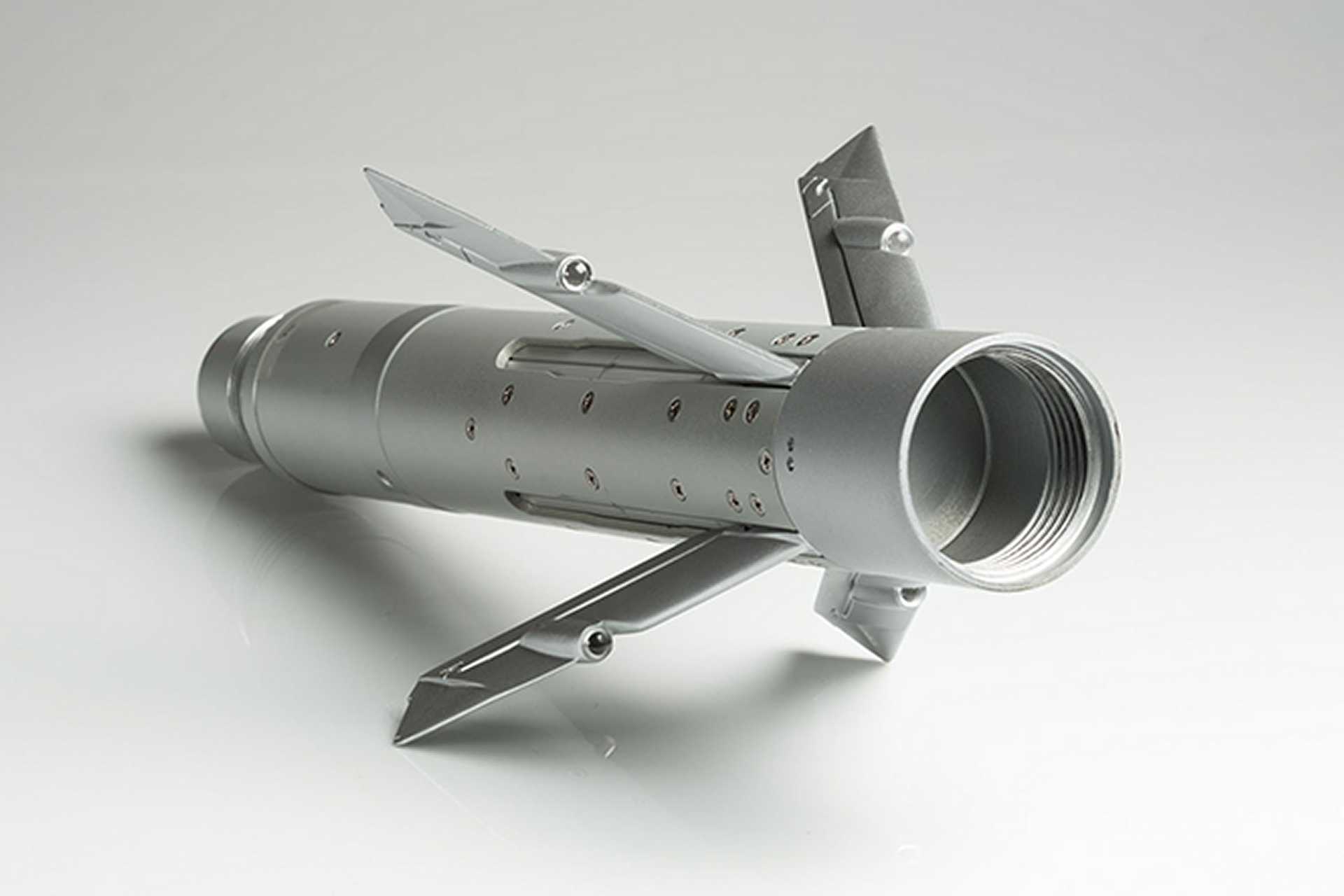
The APKWS II’s guidance unit is inserted between the Mk-66 rocket motor and the selected warhead and fuze, adding about 47 cm to the original rocket and about 4.1 kg to its mass. (Picture source: BAE Systems)
The APKWS II is built around the WGU-59/B guidance section, which converts an existing 70 mm Hydra 70 rocket into a semi-active laser-guided munition. The guidance unit is inserted between the Mk-66 rocket motor and the selected warhead and fuze, adding about 47 cm to the original rocket and about 4.1 kg to its mass. A complete round is therefore roughly 1.87 m long, 70 mm in diameter, has a deployed span of about 24.3 cm, and weighs close to 15 kg, although the final weight changes with the warhead and fuze. The weapon uses Distributed Aperture Semi-Active Laser Seeker technology, or DASALS, with four seeker apertures placed in the leading edges of the control canards rather than in the nose. The canards deploy about half a second after launch, detect reflected laser energy, and steer the rocket toward the designated point.
This arrangement preserves the nose section for existing Hydra 70 warheads and allows the same guidance kit to be combined with Mk-152 high-explosive, fragmentation, flechette, armor-penetrating, illumination, smoke, white-phosphorus, or practice payloads. Circular error probable (CEP) is below 0.5 m under suitable designation conditions, with a standard effective range of 1.1 to 5 km from helicopters and 2 to 11 km from fixed-wing aircraft. The original limit is primarily the energy available from the Mk-66 motor rather than the seeker, whose acquisition capability extends beyond the normal rocket envelope. The modular arrangement also reduces logistics complexity because users can retain existing motors, launch pods, warheads, handling equipment, and ammunition procedures instead of introducing a separate missile with a dedicated launcher and storage chain.
The weapon entered development in 2002, but the first program, led by General Dynamics, was cancelled in April 2005 after poor test performance. The operational requirement remained because U.S. forces lacked a precision weapon between unguided 70 mm rockets and the larger AGM-114 Hellfire missile, which weighs about 45 to 49 kg and carries a substantially larger warhead. BAE Systems completed a successful APKWS II flight test in September 2005, the competition reopened in October 2005, and BAE was selected as prime contractor in April 2006. Funding was removed from the proposed Fiscal Year 2008 budget, but testing continued, including a successful production-ready flight in May 2007. Program responsibility transferred from the U.S. Army to the U.S. Navy in November 2008, and the APKWS II reached initial operational capability with the U.S. Marine Corps in March 2012 before deployment to Afghanistan.
Full-rate production began in July 2012, and the first full-rate deliveries followed in October. Production later increased to 5,000 guidance kits annually in 2016 and exceeded 100,000 delivered kits by March 2026. A 2021 software update also increased its range by up to 30 percent through an optimized trajectory, steeper terminal attack angle, and revised danger-zone logic. Counter-UAS development produced the AGR-20F Fixed Wing, Air-Launched, Counter-Unmanned Aircraft Systems Ordnance, known as FALCO, which adds a proximity fuze and software changes for aerial targets. In April 2025, BAE Systems revealed a dual-mode variant with a passive infrared seeker and a mid-body warhead, allowing initial laser cueing followed by autonomous infrared terminal homing. Development of that version is scheduled to conclude by the end of 2026.
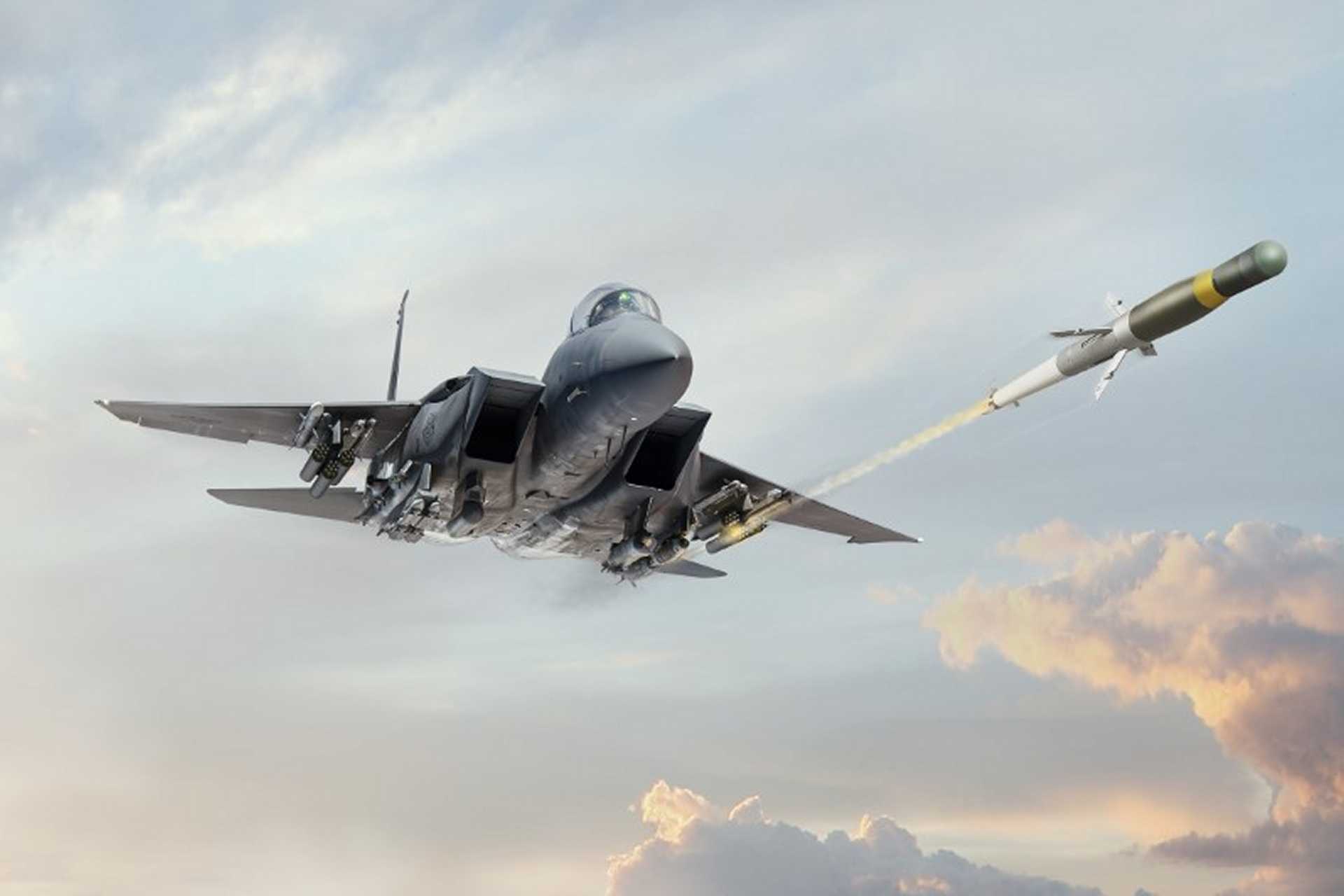
A fighter carrying two LAU-131 pods can load 14 APKWS rounds; four pods can provide 28; and six pods can provide 42, although actual combat loadouts must account for drag, targeting pods, fuel, conventional missiles, and mission radius. (Picture source: BAE Systems)
To date, the APKWS II rocket has been integrated on more than a dozen aircraft types. Helicopters include the AH-1W, AH-1Z, UH-1Y, AH-64 Apache, MH-60S, MH-60R, Bell 407GT, Eurocopter Tiger, and MV-22, while the AH-6 has also been associated with integration work. During AH-64 trials in October 2013, eight rockets were fired while the helicopter flew at speeds reaching 280 km/h, at launch altitudes from 91 to 457 m, and at ranges reaching 5 km. In April 2013, a UH-1Y fired ten rockets against stationary and moving small boats at distances of 2 to 4 km and achieved hits against all targets. Fixed-wing integration includes the A-10, F-16, F-15E, AV-8B, F/A-18, A-29, OV-10, OA-1K, and Eurofighter Typhoon. The F-16 first used the weapon operationally in June 2016, and the F-15E later became a major counter-UAS carrier because it can combine multiple LAU-131 pods with AIM-9X, AIM-120, targeting pods, and external fuel.
The British Royal Air Force completed Typhoon trials against ground and aerial targets in April 2026 and introduced the APKWS with No. 9 Squadron in the Middle East in May 2026. In May 2026, an MQ-9A Reaper fired APKWS rockets during multiple test profiles at the Nevada Test and Training Range, including shots against aerial targets. Ground use has been demonstrated through the Fletcher launcher, the four-round VAMPIRE system, and the Electronic Advanced Ground Launcher System, which combines four rockets with an RPS-40 radar and electro-optical and infrared sensors. These integrations mean Saudi Arabia could pursue rotary-wing, fighter, remotely piloted, vehicle-mounted, and fixed-site applications without waiting. Combat use began in Afghanistan, where U.S. Marine Corps helicopters employed APKWS IIs against firing points, personnel, light vehicles, and other targets that did not justify a Hellfire.
By January 2013, the weapon had completed 100 combat launches in Afghanistan without an in-flight failure. In Iraq and Syria, U.S. forces used about 200 APKWS rounds against Islamic State targets between June 2016 and January 2017, including 60 during the Battle of Mosul. The weapon was suited to urban operations because its 70 mm warhead produced a smaller blast area than Hellfire or a guided bomb while retaining sub-meter accuracy. Counter-air testing accelerated in December 2019 when an F-16 used a Sniper targeting pod to guide an APKWS round against a drone simulating a low-flying cruise missile. In June 2021, a proximity-fuzed round destroyed a Class 2 UAS, demonstrating that the weapon did not need a direct impact to defeat an aerial target. U.S. fighters later used APKWS against Houthi drones threatening shipping in the Red Sea and against Iranian one-way attack drones across the Middle East.
Ukraine received 14 VAMPIRE systems mounted on M1152 vehicles, with the first four delivered by mid-2023 and the remaining ten by the end of that year. Ukrainian F-16s have also employed APKWS against Russian drones, and a boat-mounted VAMPIRE launcher was credited in January 2025 with shooting down a Kh-59 cruise missile over the Black Sea. The weapon has therefore moved from helicopter close-air support to fighter-based counter-UAS, ground-based air defense, maritime defense, surface-to-surface attack, and cruise missile interception. The economic logic is measurable. A complete APKWS round, costing $20,000 to $40,000, is 11 to 22 times cheaper than an AIM-9X valued close to $450,000 and 25 to 50 times cheaper than an AIM-120 AMRAAM costing more than $1 million. The difference becomes decisive during repeated drone attacks because a defender can face dozens of one-way attack drones in a single raid and several raids over consecutive days.
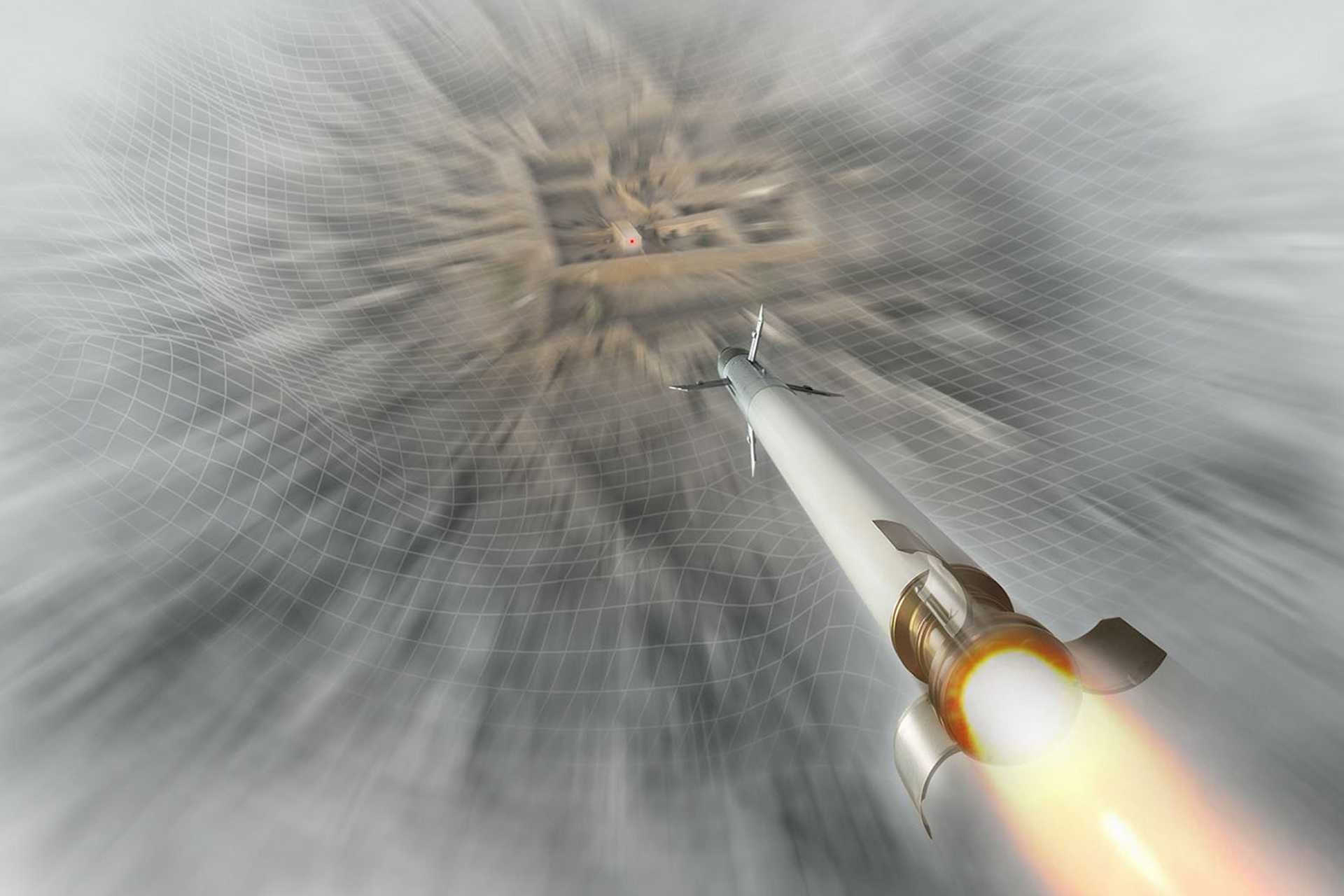
In Iraq and Syria, U.S. forces used about 200 APKWS rounds against Islamic State targets between June 2016 and January 2017, including 60 during the Battle of Mosul. (Picture source: BAE Systems)
A fighter carrying two LAU-131 pods can load 14 APKWS rounds, four pods can provide 28, and six pods can provide 42, although actual combat loadouts must account for drag, targeting pods, fuel, conventional missiles, and mission radius. By contrast, a fighter may carry four to eight conventional air-to-air missiles depending on aircraft type and configuration. The proximity fuze compensates for the small target size by detonating the warhead when the rocket passes close enough to damage the airframe, engine, control surfaces, or warhead section. The standard version still requires continuous laser designation until impact, which limits simultaneous engagements and places demands on the targeting pod and aircrew.
The AGR-20F software and fuze improve the counter-air geometry, while the dual-mode infrared version under development is intended to reduce the need for continuous designation and increase firing rate against multiple drones or cruise missiles. Fighters are therefore using APKWS against Shahed attack drones and similar threats not because the rocket equals AIM-120 performance, but because those targets often fly below 250 km/h, maneuver little, follow predictable routes, and do not justify a $450,000 to $1 million interceptor. Saudi Arabia has several aircraft fleets that could absorb the weapon, but the likely allocation differs by mission.
Royal Saudi Land Forces Aviation Command’s AH-64E Apache Guardians are the most credible air-to-ground users because the APKWS is already qualified on the Apache and can be carried in seven-round or 19-round 70 mm pods. It would allow an Apache to reserve AGM-114 Hellfires for tanks, hardened positions, and high-value targets while using guided rockets against pickup trucks, mortar crews, rocket teams, light armored vehicles, checkpoints, small boats, and exposed launchers. The Saudi Arabian National Guard’s AH-6SA fleet is another likely recipient because the light helicopter has limited payload compared with an Apache and benefits from a 15 kg guided rocket rather than a 45 kg Hellfire.
For the air-to-air kits, the Royal Saudi Air Force’s 84 new-build F-15SAs, upgraded F-15S jets, and 72 Eurofighter Typhoons are the most plausible carriers. Saudi fighters could use APKWS on patrols over Abqaiq, Khurais, Ras Tanura, Yanbu, Jeddah, Jubail, air bases, ports, desalination plants, and power facilities, where one-way attack drones present a recurring threat. A stock of 10,000 air-to-air guidance kits would support training, operational alert detachments, wartime reserve, and sustained expenditure while preserving AIM-9X, AIM-120, Patriot, and THAAD interceptors for faster, higher, or more maneuverable threats.
Written by Jérôme Brahy
Jérôme Brahy is a defense analyst and documentalist at Army Recognition. He specializes in naval modernization, aviation, drones, armored vehicles, and artillery, with a focus on strategic developments in the United States, China, Ukraine, Russia, Türkiye, and Belgium. His analyses go beyond the facts, providing context, identifying key actors, and explaining why defense news matters on a global scale.
Explore More Defense News
• Land Defense News
• Naval Defense News
• Defense Aerospace News