Türkiye Reveals Baykar K2 Loitering Munition for Long-Range Swarm Strike Missions
{loadposition bannertop}
{loadposition sidebarpub}
Türkiye’s defense manufacturer Baykar unveiled the K2 long-range kamikaze unmanned aerial vehicle on 14 March 2026, a runway-operated loitering munition designed for extended strike missions and coordinated swarm operations. The system signals Türkiye’s continued push to expand its unmanned strike portfolio while emphasizing longer reach and mass precision attack capabilities.
Turkish defense firm Baykar publicly revealed the K2 loitering munition on 14 March 2026, introducing a runway operated kamikaze unmanned aerial vehicle designed for long distance strike missions and coordinated swarm operations. Unlike many smaller loitering munitions launched from tubes or rails, the K2 is capable of taking off from short and unprepared runways while carrying a relatively large warhead, suggesting a concept focused on extended operational reach and higher impact payloads. The platform appears intended for mass deployment in networked operations where multiple drones can coordinate attacks against high-value targets or air defense systems. The unveiling expands Baykar’s rapidly growing unmanned strike ecosystem, which already includes systems such as the Bayraktar TB2 and Akinci UAV. Follow Army Recognition on Google News at this link
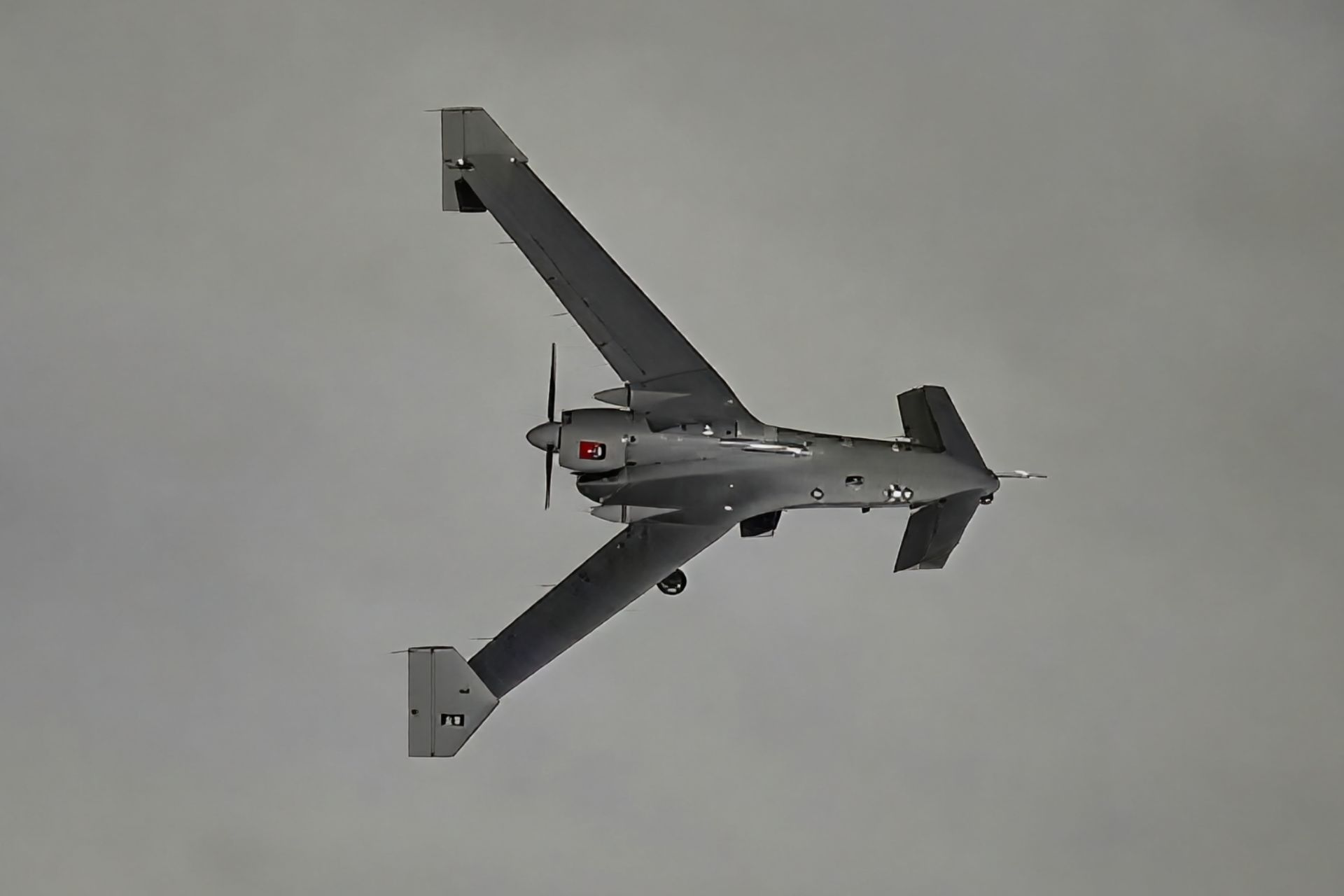
K2 long-range kamikaze UAV developed by Baykar during formation flight testing over the Saros Gulf in Türkiye, demonstrating autonomous swarm operation capability (Picture source: Baykar)
Flight tests of the platform were conducted from the Kesan Flight Training and Test Center in Edirne province, where several K2 aircraft performed formation flights over the Saros Gulf. During the demonstration, five UAVs executed coordinated maneuvers including right echelon, line, and V formations, maintaining precise positioning relative to each other through onboard sensors and autonomous flight software. The tests reportedly took place over several days and demonstrated the aircraft’s ability to operate collectively while maintaining stable formation without pilot intervention.
The K2 is described by Baykar as a long-range kamikaze UAV with a maximum takeoff weight of around 800 kilograms and a reported operational range exceeding 2,000 kilometers. Within that mass envelope, the system can carry a 200 kilogram warhead, a payload size that places it well above most conventional loitering munitions. Baykar also indicates that the platform can reach speeds exceeding 200 kilometers per hour and remain airborne for more than 13 hours, enabling deep strike missions against high-value targets such as logistics nodes, radar installations or naval vessels operating at extended distances.
Footage released during the unveiling also highlights the system’s ability to conduct autonomous swarm operations. In the demonstration sequence, five K2 air vehicles perform coordinated flight and land together on the same runway before moving into a parked formation. Baykar states that the onboard architecture integrates artificial intelligence-assisted functions for navigation, target identification, and engagement coordination between multiple aircraft. Such capabilities indicate that the system is intended to operate in cooperative groups rather than as isolated single-use platforms.
The overall configuration reveals a design that appears partially derived from the Bayraktar TB2 unmanned combat aerial vehicle. The Bayraktar TB2 medium altitude long endurance UAV, widely used by the Turkish Armed Forces and several export customers, normally carries electro-optical sensors and guided munitions such as the MAM L or MAM C precision strike weapons. In the case of the K2, the fuselage proportions and propulsion layout resemble those of the TB2, although the aerodynamic arrangement differs markedly.
Where the TB2 uses straight wings and an inverted V tail, the K2 adopts a tailless configuration with swept wings, wingtip control surfaces and forward lifting canards. These canards appear larger than typical control surfaces and incorporate flaps intended to reduce takeoff distance. This arrangement suggests that the aircraft was engineered to operate from short runways or expeditionary strips where traditional launch systems would be impractical. A stabilized electro optical gimbal mounted beneath the fuselage provides the primary sensor for target detection and terminal guidance, while an additional night capable camera supports operations in low visibility conditions.
The navigation architecture is also designed to function in environments where Global Navigation Satellite System signals are denied or heavily jammed. In such scenarios, the aircraft relies on its onboard optical sensors to visually scan terrain features and estimate its own position, allowing it to continue navigating toward its target even without satellite positioning signals. This approach enhances survivability in electronic warfare environments where GNSS jamming has become a standard defensive measure.
#K2 KAMİKAZE İHA ✈️🚀✅Yapay Zeka Otonom Sürü Uçuşu✅Yapay Zeka Görüntü Tabanlı:Seyrüsefer & Hedefleme & Angajman🔹2000+ km Menzil🔹200 kg Harp Başlığı🔹Kısa Hazırlıksız Pistlerden Kalkış🔹800 kg Kalkış Ağırlığı🔹Çok Defa Kullanabilme#MilliTeknolojiHamlesi 🌍🇹🇷#K2… pic.twitter.com/1JqPNZBXDB— BAYKAR (@BaykarTech) March 14, 2026
The propulsion architecture has not been formally confirmed, yet the platform’s apparent lineage implies the use of a gasoline engine in the 100-horsepower class similar to the engines powering Bayraktar TB2 systems. Baykar has also been developing its own indigenous TM100 engine, which falls within the same power category and is designed for tactical UAVs in the one-ton class. If integrated on the K2, such an engine would provide the endurance necessary to sustain missions extending well beyond the immediate battlefield.
Another detail observed in the demonstration footage concerns the presence of an external pod carried by one of the aircraft in the formation. The pod, mounted beneath the fuselage, is absent from the other vehicles in the swarm. This configuration may indicate a leader aircraft equipped with additional communications or mission management hardware responsible for coordinating the group. In a distributed attack concept, such a node could relay targeting information, allocate strike tasks and maintain datalink connectivity across the formation. The platform can operate through both line of sight and satellite communications links, allowing beyond line of sight control during long range missions.
The K2 fits into a growing category of large loitering strike UAVs capable of combining endurance with cooperative tactics. A swarm of such aircraft could saturate defensive systems by approaching from multiple axes while sharing targeting data between units. The 200-kilogram warhead also expands the range of potential targets. Hardened infrastructure, command posts, radar stations, and naval vessels operating near contested littorals fall within the type of targets that such a payload could threaten. In addition, the runway-based launch concept removes the need for specialized launch rails or catapults, allowing deployment from dispersed forward operating bases.
The demonstration environment offers another clue about the system’s intended role. Several scenes in the test video show the K2 aircraft positioned on the same mock runway used during ground tests of the Bayraktar TB3 unmanned combat aerial vehicle. The Bayraktar TB3 short takeoff and landing UCAV was designed specifically for operations from the Turkish Navy’s TCG Anadolu landing helicopter dock. The presence of the K2 in the same environment suggests that the platform could eventually operate from the Anadolu as a long range strike effector.
In such a configuration, TB3 aircraft equipped with advanced sensors could provide reconnaissance and targeting data, while groups of K2 UAVs conduct long distance strike missions. Operating from a large deck amphibious ship positioned outside hostile missile range, these systems would allow naval forces to conduct stand-off attacks against coastal targets or maritime threats without exposing manned aircraft to dense air defense networks. The emergence of the K2 also reflects a broader trend in Türkiye’s defense industrial strategy. Over the past decade, Ankara has invested heavily in autonomous systems, export- oriented UAV programs, and indigenous propulsion technologies. These efforts have already produced platforms such as the Bayraktar TB2 and Akinci high altitude long endurance UAV, both of which have been exported widely and used in multiple conflicts.
{loadposition bannertop}
{loadposition sidebarpub}
Türkiye’s defense manufacturer Baykar unveiled the K2 long-range kamikaze unmanned aerial vehicle on 14 March 2026, a runway-operated loitering munition designed for extended strike missions and coordinated swarm operations. The system signals Türkiye’s continued push to expand its unmanned strike portfolio while emphasizing longer reach and mass precision attack capabilities.
Turkish defense firm Baykar publicly revealed the K2 loitering munition on 14 March 2026, introducing a runway operated kamikaze unmanned aerial vehicle designed for long distance strike missions and coordinated swarm operations. Unlike many smaller loitering munitions launched from tubes or rails, the K2 is capable of taking off from short and unprepared runways while carrying a relatively large warhead, suggesting a concept focused on extended operational reach and higher impact payloads. The platform appears intended for mass deployment in networked operations where multiple drones can coordinate attacks against high-value targets or air defense systems. The unveiling expands Baykar’s rapidly growing unmanned strike ecosystem, which already includes systems such as the Bayraktar TB2 and Akinci UAV. Follow Army Recognition on Google News at this link
K2 long-range kamikaze UAV developed by Baykar during formation flight testing over the Saros Gulf in Türkiye, demonstrating autonomous swarm operation capability (Picture source: Baykar)
Flight tests of the platform were conducted from the Kesan Flight Training and Test Center in Edirne province, where several K2 aircraft performed formation flights over the Saros Gulf. During the demonstration, five UAVs executed coordinated maneuvers including right echelon, line, and V formations, maintaining precise positioning relative to each other through onboard sensors and autonomous flight software. The tests reportedly took place over several days and demonstrated the aircraft’s ability to operate collectively while maintaining stable formation without pilot intervention.
The K2 is described by Baykar as a long-range kamikaze UAV with a maximum takeoff weight of around 800 kilograms and a reported operational range exceeding 2,000 kilometers. Within that mass envelope, the system can carry a 200 kilogram warhead, a payload size that places it well above most conventional loitering munitions. Baykar also indicates that the platform can reach speeds exceeding 200 kilometers per hour and remain airborne for more than 13 hours, enabling deep strike missions against high-value targets such as logistics nodes, radar installations or naval vessels operating at extended distances.
Footage released during the unveiling also highlights the system’s ability to conduct autonomous swarm operations. In the demonstration sequence, five K2 air vehicles perform coordinated flight and land together on the same runway before moving into a parked formation. Baykar states that the onboard architecture integrates artificial intelligence-assisted functions for navigation, target identification, and engagement coordination between multiple aircraft. Such capabilities indicate that the system is intended to operate in cooperative groups rather than as isolated single-use platforms.
The overall configuration reveals a design that appears partially derived from the Bayraktar TB2 unmanned combat aerial vehicle. The Bayraktar TB2 medium altitude long endurance UAV, widely used by the Turkish Armed Forces and several export customers, normally carries electro-optical sensors and guided munitions such as the MAM L or MAM C precision strike weapons. In the case of the K2, the fuselage proportions and propulsion layout resemble those of the TB2, although the aerodynamic arrangement differs markedly.
Where the TB2 uses straight wings and an inverted V tail, the K2 adopts a tailless configuration with swept wings, wingtip control surfaces and forward lifting canards. These canards appear larger than typical control surfaces and incorporate flaps intended to reduce takeoff distance. This arrangement suggests that the aircraft was engineered to operate from short runways or expeditionary strips where traditional launch systems would be impractical. A stabilized electro optical gimbal mounted beneath the fuselage provides the primary sensor for target detection and terminal guidance, while an additional night capable camera supports operations in low visibility conditions.
The navigation architecture is also designed to function in environments where Global Navigation Satellite System signals are denied or heavily jammed. In such scenarios, the aircraft relies on its onboard optical sensors to visually scan terrain features and estimate its own position, allowing it to continue navigating toward its target even without satellite positioning signals. This approach enhances survivability in electronic warfare environments where GNSS jamming has become a standard defensive measure.
#K2 KAMİKAZE İHA ✈️🚀
✅Yapay Zeka Otonom Sürü Uçuşu
✅Yapay Zeka Görüntü Tabanlı:
Seyrüsefer & Hedefleme & Angajman🔹2000+ km Menzil
🔹200 kg Harp Başlığı
🔹Kısa Hazırlıksız Pistlerden Kalkış
🔹800 kg Kalkış Ağırlığı
🔹Çok Defa Kullanabilme#MilliTeknolojiHamlesi 🌍🇹🇷#K2… pic.twitter.com/1JqPNZBXDB— BAYKAR (@BaykarTech) March 14, 2026
The propulsion architecture has not been formally confirmed, yet the platform’s apparent lineage implies the use of a gasoline engine in the 100-horsepower class similar to the engines powering Bayraktar TB2 systems. Baykar has also been developing its own indigenous TM100 engine, which falls within the same power category and is designed for tactical UAVs in the one-ton class. If integrated on the K2, such an engine would provide the endurance necessary to sustain missions extending well beyond the immediate battlefield.
Another detail observed in the demonstration footage concerns the presence of an external pod carried by one of the aircraft in the formation. The pod, mounted beneath the fuselage, is absent from the other vehicles in the swarm. This configuration may indicate a leader aircraft equipped with additional communications or mission management hardware responsible for coordinating the group. In a distributed attack concept, such a node could relay targeting information, allocate strike tasks and maintain datalink connectivity across the formation. The platform can operate through both line of sight and satellite communications links, allowing beyond line of sight control during long range missions.
The K2 fits into a growing category of large loitering strike UAVs capable of combining endurance with cooperative tactics. A swarm of such aircraft could saturate defensive systems by approaching from multiple axes while sharing targeting data between units. The 200-kilogram warhead also expands the range of potential targets. Hardened infrastructure, command posts, radar stations, and naval vessels operating near contested littorals fall within the type of targets that such a payload could threaten. In addition, the runway-based launch concept removes the need for specialized launch rails or catapults, allowing deployment from dispersed forward operating bases.
The demonstration environment offers another clue about the system’s intended role. Several scenes in the test video show the K2 aircraft positioned on the same mock runway used during ground tests of the Bayraktar TB3 unmanned combat aerial vehicle. The Bayraktar TB3 short takeoff and landing UCAV was designed specifically for operations from the Turkish Navy’s TCG Anadolu landing helicopter dock. The presence of the K2 in the same environment suggests that the platform could eventually operate from the Anadolu as a long range strike effector.
In such a configuration, TB3 aircraft equipped with advanced sensors could provide reconnaissance and targeting data, while groups of K2 UAVs conduct long distance strike missions. Operating from a large deck amphibious ship positioned outside hostile missile range, these systems would allow naval forces to conduct stand-off attacks against coastal targets or maritime threats without exposing manned aircraft to dense air defense networks. The emergence of the K2 also reflects a broader trend in Türkiye’s defense industrial strategy. Over the past decade, Ankara has invested heavily in autonomous systems, export- oriented UAV programs, and indigenous propulsion technologies. These efforts have already produced platforms such as the Bayraktar TB2 and Akinci high altitude long endurance UAV, both of which have been exported widely and used in multiple conflicts.