Russian Su-30SM Armed with Kh-31 Strike Missiles Intercepted by French Rafale Fighters Near NATO Airspace
{loadposition bannertop}
{loadposition sidebarpub}
French forces have released footage showing a Rafale fighter tracking a Russian Su-30 armed with Kh-31-class missiles over the Baltic Sea, highlighting rising tensions in NATO airspace. The presence of strike-capable munitions on the Russian aircraft underscores the growing risk of escalation during routine patrols in contested regions.
The Kh-31 missile family provides the Su-30 with high-speed anti-ship and anti-radiation capabilities, allowing it to target both naval assets and air defense systems. Such armed configurations during patrols are widely seen as strategic signaling, reflecting a broader pattern of combat-ready deployments aimed at reinforcing deterrence and influencing military posture in Europe.
Related Topic: French Rafales Take Over Baltic Air Policing in Lithuania to Reshape NATO’s Eastern Air Defense Shield
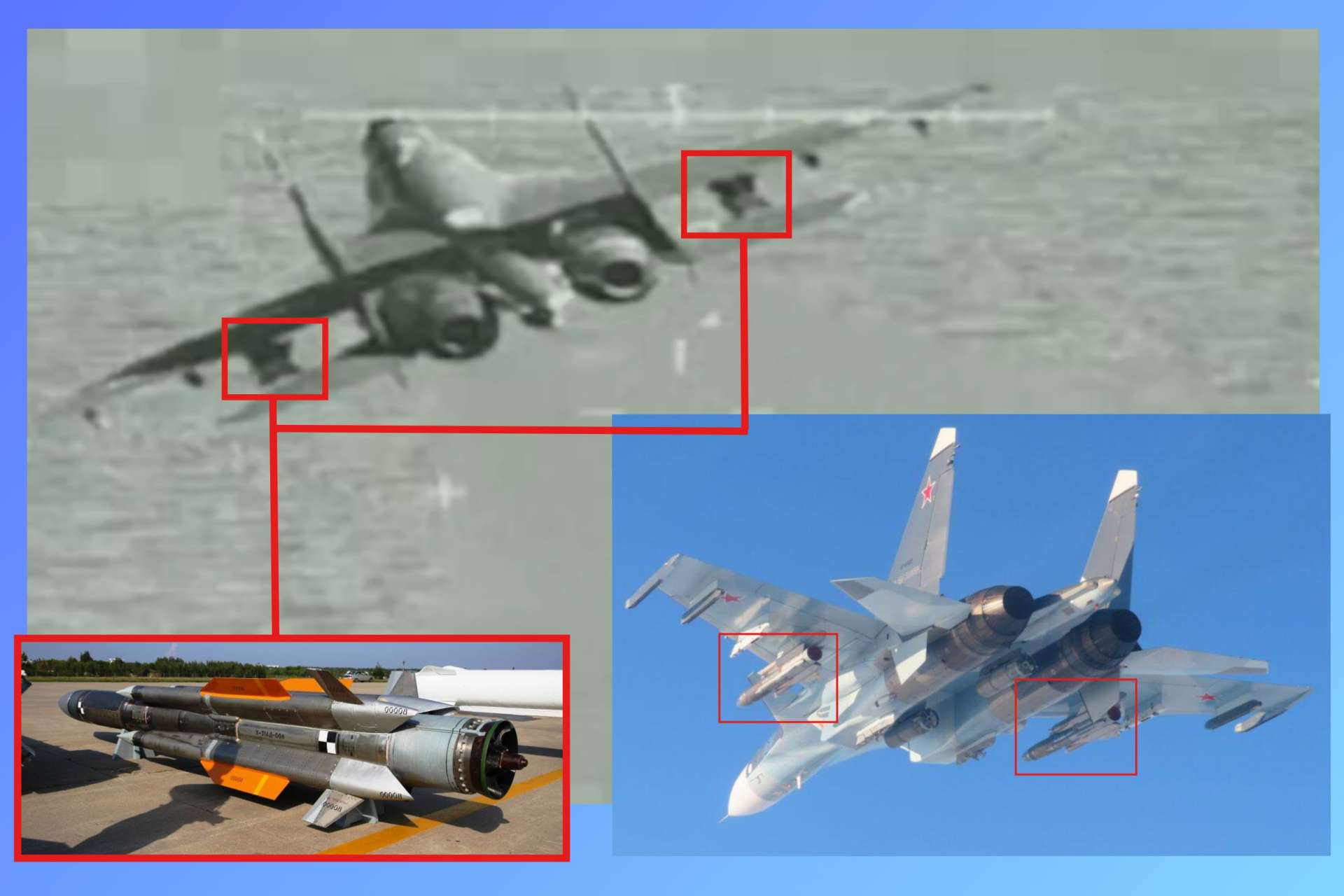
A Russian Su-30SM flying over the Baltic with two Kh-31-class missiles signaled a deliberate capability to threaten NATO radars or ships during a routine intercept (Picture Source: French Air Force / Russian Social Media)
The key issue is the meaning of the loadout. A Su-30SM or SM2 carrying two Kh-31-class missiles is not configured for a simple show-the-flag patrol. The Kh-31 family includes anti-radiation and anti-ship variants, both designed to threaten the systems that give an opponent its first layer of combat power: radars, air-defense networks, and warships. Rosoboronexport describes the Kh-31P as an anti-radiation missile for countering enemy air defenses, while other official Russian export reports also present the Kh-31A as a high-speed anti-ship missile intended for strikes against surface combatants. Even without a confirmed sub-variant from the available imagery, the operational message is already clear: the aircraft was carrying stores intended to prosecute emitting targets or naval platforms, not merely to provide self-protection in the air.
That aspect becomes even sharper in the Baltic, where geography amplifies every tactical signal. Distances are short, NATO air-policing aircraft launch from Lithuania and Estonia, allied naval units move through confined waters, and Russia’s Kaliningrad enclave sits at the center of a broader anti-access architecture. In such an environment, a Russian fighter visibly carrying Kh-31-type missiles suggests more than theoretical capability. It points to mission profiles linked to suppression of enemy air defenses, maritime strike, escort for intelligence aircraft, or pressure operations designed to complicate NATO’s recognized air picture and surface picture from the opening phase of any confrontation. France’s current Rafale deployment to Šiauliai is itself part of NATO’s standing effort to protect Baltic airspace, underlining how quickly such encounters are folded into allied deterrence and response mechanisms.
If the missiles were anti-radiation variants such as the Kh-31P or a related model, then the message was directed first at NATO’s sensor network. Anti-radiation weapons are built to home on radar emissions, which makes them relevant against ground-based air-defense systems, coastal surveillance nodes, and shipborne fire-control radars. In practical terms, that means the aircraft was visibly configured for the type of sortie that would support suppression of enemy air defenses. In the Baltic context, this would fit Russian efforts to remind NATO that any air operation near its northwestern approaches could begin with attempts to degrade detection, target tracking, and battlespace awareness rather than with traditional fighter-versus-fighter engagements alone. This is why the loadout carries operational weight far beyond the simple fact of an intercept.
If the missiles instead belonged to the anti-ship branch of the Kh-31 family, the implication remains serious, but shifts toward maritime denial. Official specifications describe the Kh-31A as a supersonic missile intended to strike ships up to destroyer size. In a Baltic scenario, that points toward a role in threatening frigates, corvettes, patrol vessels, or support ships operating close to NATO’s northeastern flank. That kind of visible carriage would send a message not only to air-policing detachments but also to allied maritime commanders: Russian tactical aviation remains capable of quickly pivoting from routine presence to sea-control or sea-denial tasking in one of Europe’s most strategically crowded maritime spaces.
The encounter becomes even more meaningful when read alongside the broader pattern of Russian activity reported around the same French deployment. The official French post referred to four Rafale interventions in one week and the identification of six aircraft, while reporting on the released footage also mentioned the presence of a Russian Il-20M electronic intelligence aircraft. That combination is analytically important. An intelligence platform gathering emissions data and mapping allied responses, paired with a fighter carrying missiles designed to exploit or attack those emissions in wartime, forms a coherent operational picture. Even in peacetime, that pairing acts as a rehearsal in signaling, surveillance, and reaction testing. It allows Russia to observe how NATO detects, classifies, shadows, and publicly communicates such sorties, all while demonstrating a strike package logic tailored to the Baltic theater.
What this sortie communicates is less about imminent attack than about controlled coercion. Russia did not need to violate NATO airspace or launch a weapon to make the point. By flying near the alliance’s monitored approaches with a combat-relevant loadout, it forced NATO to treat the aircraft as a platform potentially capable of suppressing radars or threatening ships at short notice. That raises the psychological and operational pressure on air-policing detachments and shows how routine encounters in the Baltic increasingly overlap with wartime mission profiles. The weapons under the wings are central because they turn an intercept from a policing event into a strategic message about escalation options, target priorities, and readiness to challenge NATO’s sensor architecture and maritime posture.
This episode should be read as a Russian demonstration of intent as much as capability. The Su-30’s visible loadout suggested a platform prepared not simply to fly near NATO, but to signal an ability to blind, disrupt, or threaten the systems on which NATO would rely first in a Baltic crisis. Whether the missiles were optimized primarily for anti-radiation or anti-ship use, the underlying message was the same: Russia wants allied planners to assume that even a routine encounter over the Baltic can conceal the logic of a first-wave strike against radars, ships, and the command-and-response time they protect.
Written by Teoman S. Nicanci – Defense Analyst, Army Recognition Group
Teoman S. Nicanci holds degrees in Political Science, Comparative and International Politics, and International Relations and Diplomacy from leading Belgian universities, with research focused on Russian strategic behavior, defense technology, and modern warfare. He is a defense analyst at Army Recognition, specializing in the global defense industry, military armament, and emerging defense technologies.
{loadposition bannertop}
{loadposition sidebarpub}
French forces have released footage showing a Rafale fighter tracking a Russian Su-30 armed with Kh-31-class missiles over the Baltic Sea, highlighting rising tensions in NATO airspace. The presence of strike-capable munitions on the Russian aircraft underscores the growing risk of escalation during routine patrols in contested regions.
The Kh-31 missile family provides the Su-30 with high-speed anti-ship and anti-radiation capabilities, allowing it to target both naval assets and air defense systems. Such armed configurations during patrols are widely seen as strategic signaling, reflecting a broader pattern of combat-ready deployments aimed at reinforcing deterrence and influencing military posture in Europe.
Related Topic: French Rafales Take Over Baltic Air Policing in Lithuania to Reshape NATO’s Eastern Air Defense Shield
A Russian Su-30SM flying over the Baltic with two Kh-31-class missiles signaled a deliberate capability to threaten NATO radars or ships during a routine intercept (Picture Source: French Air Force / Russian Social Media)
The key issue is the meaning of the loadout. A Su-30SM or SM2 carrying two Kh-31-class missiles is not configured for a simple show-the-flag patrol. The Kh-31 family includes anti-radiation and anti-ship variants, both designed to threaten the systems that give an opponent its first layer of combat power: radars, air-defense networks, and warships. Rosoboronexport describes the Kh-31P as an anti-radiation missile for countering enemy air defenses, while other official Russian export reports also present the Kh-31A as a high-speed anti-ship missile intended for strikes against surface combatants. Even without a confirmed sub-variant from the available imagery, the operational message is already clear: the aircraft was carrying stores intended to prosecute emitting targets or naval platforms, not merely to provide self-protection in the air.
That aspect becomes even sharper in the Baltic, where geography amplifies every tactical signal. Distances are short, NATO air-policing aircraft launch from Lithuania and Estonia, allied naval units move through confined waters, and Russia’s Kaliningrad enclave sits at the center of a broader anti-access architecture. In such an environment, a Russian fighter visibly carrying Kh-31-type missiles suggests more than theoretical capability. It points to mission profiles linked to suppression of enemy air defenses, maritime strike, escort for intelligence aircraft, or pressure operations designed to complicate NATO’s recognized air picture and surface picture from the opening phase of any confrontation. France’s current Rafale deployment to Šiauliai is itself part of NATO’s standing effort to protect Baltic airspace, underlining how quickly such encounters are folded into allied deterrence and response mechanisms.
If the missiles were anti-radiation variants such as the Kh-31P or a related model, then the message was directed first at NATO’s sensor network. Anti-radiation weapons are built to home on radar emissions, which makes them relevant against ground-based air-defense systems, coastal surveillance nodes, and shipborne fire-control radars. In practical terms, that means the aircraft was visibly configured for the type of sortie that would support suppression of enemy air defenses. In the Baltic context, this would fit Russian efforts to remind NATO that any air operation near its northwestern approaches could begin with attempts to degrade detection, target tracking, and battlespace awareness rather than with traditional fighter-versus-fighter engagements alone. This is why the loadout carries operational weight far beyond the simple fact of an intercept.
If the missiles instead belonged to the anti-ship branch of the Kh-31 family, the implication remains serious, but shifts toward maritime denial. Official specifications describe the Kh-31A as a supersonic missile intended to strike ships up to destroyer size. In a Baltic scenario, that points toward a role in threatening frigates, corvettes, patrol vessels, or support ships operating close to NATO’s northeastern flank. That kind of visible carriage would send a message not only to air-policing detachments but also to allied maritime commanders: Russian tactical aviation remains capable of quickly pivoting from routine presence to sea-control or sea-denial tasking in one of Europe’s most strategically crowded maritime spaces.
The encounter becomes even more meaningful when read alongside the broader pattern of Russian activity reported around the same French deployment. The official French post referred to four Rafale interventions in one week and the identification of six aircraft, while reporting on the released footage also mentioned the presence of a Russian Il-20M electronic intelligence aircraft. That combination is analytically important. An intelligence platform gathering emissions data and mapping allied responses, paired with a fighter carrying missiles designed to exploit or attack those emissions in wartime, forms a coherent operational picture. Even in peacetime, that pairing acts as a rehearsal in signaling, surveillance, and reaction testing. It allows Russia to observe how NATO detects, classifies, shadows, and publicly communicates such sorties, all while demonstrating a strike package logic tailored to the Baltic theater.
What this sortie communicates is less about imminent attack than about controlled coercion. Russia did not need to violate NATO airspace or launch a weapon to make the point. By flying near the alliance’s monitored approaches with a combat-relevant loadout, it forced NATO to treat the aircraft as a platform potentially capable of suppressing radars or threatening ships at short notice. That raises the psychological and operational pressure on air-policing detachments and shows how routine encounters in the Baltic increasingly overlap with wartime mission profiles. The weapons under the wings are central because they turn an intercept from a policing event into a strategic message about escalation options, target priorities, and readiness to challenge NATO’s sensor architecture and maritime posture.
This episode should be read as a Russian demonstration of intent as much as capability. The Su-30’s visible loadout suggested a platform prepared not simply to fly near NATO, but to signal an ability to blind, disrupt, or threaten the systems on which NATO would rely first in a Baltic crisis. Whether the missiles were optimized primarily for anti-radiation or anti-ship use, the underlying message was the same: Russia wants allied planners to assume that even a routine encounter over the Baltic can conceal the logic of a first-wave strike against radars, ships, and the command-and-response time they protect.
Written by Teoman S. Nicanci – Defense Analyst, Army Recognition Group
Teoman S. Nicanci holds degrees in Political Science, Comparative and International Politics, and International Relations and Diplomacy from leading Belgian universities, with research focused on Russian strategic behavior, defense technology, and modern warfare. He is a defense analyst at Army Recognition, specializing in the global defense industry, military armament, and emerging defense technologies.