U.S. Air Force Deploys YFQ-44A Fury Combat Drone with Experimental Unit
{loadposition bannertop}
{loadposition sidebarpub}
The U.S. Air Force is accelerating development of combat drones designed to fight alongside crewed aircraft, aiming to compress the path from concept to battlefield use. This effort is being driven through an experimental phase at Edwards Air Force Base, where operators are directly involved in how the systems are employed.
At the center is the YFQ-44A, a collaborative combat aircraft shaped by real-time pilot feedback during testing. This approach ties operational demands to design from the outset and supports a broader shift toward adaptive, networked airpower for contested environments.
Related topic: U.S. Launches YFQ-44A Fury Drone Production for U.S. Air Force Autonomous Combat Fleet
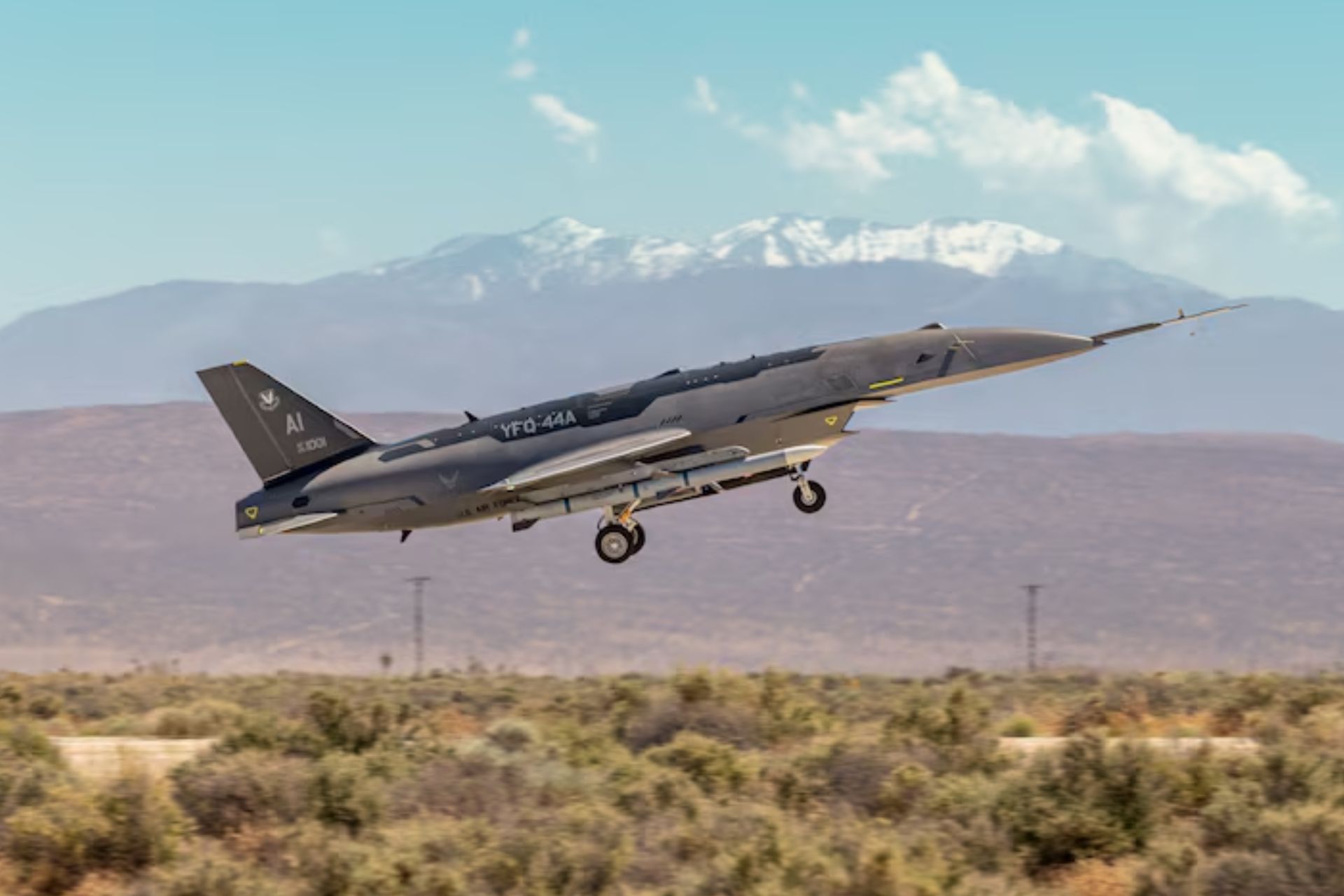
A YFQ-44A departs from Edwards Air Force Base during a Collaborative Combat Aircraft exercise. (Picture source: US DoD)
This exercise signals a change in methodology. Rather than relying on a traditional sequence in which technical validation precedes operational use, the U.S. Air Force now introduces operators at an earlier stage. Personnel from the Experimental Operations Unit manage the full mission cycle, from planning to execution and post-flight analysis. This involvement helps identify real-world constraints more rapidly, while accelerating the refinement of procedures and systems, drawing on lessons observed in recent conflicts in Ukraine and the Middle East, where resilience and dispersion have become central considerations.
According to information released on April 16, 2026, by the Secretary of the Air Force Public Affairs, the activity was conducted in coordination with the 412th Test Wing of Air Force Materiel Command. This collaboration establishes a continuous feedback loop between operators, engineers, and industry. Observations from flight operations are used immediately to adjust both technical parameters and operational concepts within the framework of the Warfighting Acquisition System, which emphasizes responsiveness and iterative capability development.
The YFQ-44A reflects this approach in its design. Developed for semi-autonomous operations, the aircraft incorporates automated functions from the outset, including taxi and takeoff phases. This reduces operator workload while enabling a higher operational tempo. Control is supported by Anduril’s Menace-T command, control, communications, and computing solution, which relies on a ruggedized laptop to manage mission planning, flight execution, and data processing. This replaces fixed infrastructure with a mobile setup suited to dispersed operations.
The YFQ-44, referred to as “Fury” by Anduril, originates from designs developed by Blue Force Technologies, acquired in 2023, and later adapted for the Collaborative Combat Aircraft program. It is one of two configurations selected by the U.S. Air Force under the program’s first increment, alongside the General Atomics YFQ-42, following a prototype contract awarded in 2023. At this stage, no large-scale production decision has been confirmed, although an industrial ramp-up is expected during 2026.
The aircraft adopts a configuration comparable to a light fighter, with dimensions roughly half those of an F-16 Fighting Falcon. It measures approximately 6.1 meters in length, with a wingspan of 5.2 meters, and a maximum takeoff weight of about 2,270 kilograms. Its airframe includes swept trapezoidal wings, a chin-mounted air intake, and a cruciform tail arrangement, supporting maneuverability while limiting structural complexity. Powered by a Williams FJ44-4M turbofan producing around 18 kN of thrust, it can reach speeds close to Mach 0.95 and operate at altitudes up to approximately 15,000 meters. Its ability to sustain up to 9 g allows it to operate within performance envelopes comparable to those of crewed combat aircraft.
The system also emphasizes modularity and open architecture. The aircraft features external hardpoints capable of carrying air-to-air missiles such as the AIM-120 AMRAAM, which offers beyond-visual-range engagement capability, typically exceeding 100 kilometers depending on the variant. It can also carry a range of payloads, including sensors, electronic warfare systems, or precision-guided munitions, depending on mission requirements. Its open software architecture enables rapid updates, supporting ongoing improvements in autonomy, sensor fusion, and mission systems.
A key feature lies in its autonomy framework. Through secure data links, the drone can execute pre-planned missions independently while remaining under human supervision. This allows operators to delegate tasks such as threat detection, target designation, or defensive counter-air missions. This human-machine teaming model, referred to as Manned-Unmanned Teaming, is intended to extend the reach and effectiveness of a single fighter aircraft by distributing tasks across multiple assets.
These characteristics align with the Agile Combat Employment concept. The ability to operate from dispersed and minimally equipped locations reduces vulnerability to precision strikes targeting main operating bases. During the Edwards exercise, operations were conducted from a simulated forward site with limited resources while maintaining a high sortie rate, demonstrating the feasibility of sustained air operations in degraded environments.
The YFQ-44A is designed to act as a force multiplier alongside crewed aircraft such as the F-35 and future Next Generation Air Dominance systems. By extending sensor coverage, increasing available missile capacity, or functioning as a decoy, it contributes to improving both survivability and overall effectiveness of formations. It can be deployed ahead of crewed aircraft to penetrate contested airspace, detect adversary defenses, or saturate sensor networks, while preserving human pilots from direct exposure.
The sustained flight tempo observed during the exercise indicates a focus on continuous operational use rather than limited demonstrations. Repeated sorties generate operational data, refine maintenance processes, and test command-and-control resilience. This iterative approach supports gradual confidence-building among operators, a necessary condition for long-term integration, as the program aims to deliver operational capability by the end of the decade.
The Collaborative Combat Aircraft program also reflects a broader evolution in air warfare. Current planning points to the deployment of several hundred to potentially more than a thousand such systems, organized in support of crewed aircraft within a distributed architecture. This approach seeks to generate affordable mass capable of absorbing operational risk, extending sensor coverage, and multiplying engagement options in contested environments.
The development of collaborative combat aircraft is gaining momentum, influenced by recent high-intensity conflicts. The integration of autonomous systems operating in networked configurations is reshaping airpower dynamics. It introduces a model in which air superiority depends less on the performance of individual aircraft and more on the ability to coordinate a distributed set of sensors and effectors, capable of saturating defenses, sustaining operational tempo, and preserving critical assets over time.
Written By Erwan Halna du Fretay – Defense Analyst, Army Recognition GroupErwan Halna du Fretay holds a Master’s degree in International Relations and has experience studying conflicts and global arms transfers. His research interests lie in security and strategic studies, particularly the dynamics of the defense industry, the evolution of military technologies, and the strategic transformation of armed forces.
{loadposition bannertop}
{loadposition sidebarpub}
The U.S. Air Force is accelerating development of combat drones designed to fight alongside crewed aircraft, aiming to compress the path from concept to battlefield use. This effort is being driven through an experimental phase at Edwards Air Force Base, where operators are directly involved in how the systems are employed.
At the center is the YFQ-44A, a collaborative combat aircraft shaped by real-time pilot feedback during testing. This approach ties operational demands to design from the outset and supports a broader shift toward adaptive, networked airpower for contested environments.
Related topic: U.S. Launches YFQ-44A Fury Drone Production for U.S. Air Force Autonomous Combat Fleet
A YFQ-44A departs from Edwards Air Force Base during a Collaborative Combat Aircraft exercise. (Picture source: US DoD)
This exercise signals a change in methodology. Rather than relying on a traditional sequence in which technical validation precedes operational use, the U.S. Air Force now introduces operators at an earlier stage. Personnel from the Experimental Operations Unit manage the full mission cycle, from planning to execution and post-flight analysis. This involvement helps identify real-world constraints more rapidly, while accelerating the refinement of procedures and systems, drawing on lessons observed in recent conflicts in Ukraine and the Middle East, where resilience and dispersion have become central considerations.
According to information released on April 16, 2026, by the Secretary of the Air Force Public Affairs, the activity was conducted in coordination with the 412th Test Wing of Air Force Materiel Command. This collaboration establishes a continuous feedback loop between operators, engineers, and industry. Observations from flight operations are used immediately to adjust both technical parameters and operational concepts within the framework of the Warfighting Acquisition System, which emphasizes responsiveness and iterative capability development.
The YFQ-44A reflects this approach in its design. Developed for semi-autonomous operations, the aircraft incorporates automated functions from the outset, including taxi and takeoff phases. This reduces operator workload while enabling a higher operational tempo. Control is supported by Anduril’s Menace-T command, control, communications, and computing solution, which relies on a ruggedized laptop to manage mission planning, flight execution, and data processing. This replaces fixed infrastructure with a mobile setup suited to dispersed operations.
The YFQ-44, referred to as “Fury” by Anduril, originates from designs developed by Blue Force Technologies, acquired in 2023, and later adapted for the Collaborative Combat Aircraft program. It is one of two configurations selected by the U.S. Air Force under the program’s first increment, alongside the General Atomics YFQ-42, following a prototype contract awarded in 2023. At this stage, no large-scale production decision has been confirmed, although an industrial ramp-up is expected during 2026.
The aircraft adopts a configuration comparable to a light fighter, with dimensions roughly half those of an F-16 Fighting Falcon. It measures approximately 6.1 meters in length, with a wingspan of 5.2 meters, and a maximum takeoff weight of about 2,270 kilograms. Its airframe includes swept trapezoidal wings, a chin-mounted air intake, and a cruciform tail arrangement, supporting maneuverability while limiting structural complexity. Powered by a Williams FJ44-4M turbofan producing around 18 kN of thrust, it can reach speeds close to Mach 0.95 and operate at altitudes up to approximately 15,000 meters. Its ability to sustain up to 9 g allows it to operate within performance envelopes comparable to those of crewed combat aircraft.
The system also emphasizes modularity and open architecture. The aircraft features external hardpoints capable of carrying air-to-air missiles such as the AIM-120 AMRAAM, which offers beyond-visual-range engagement capability, typically exceeding 100 kilometers depending on the variant. It can also carry a range of payloads, including sensors, electronic warfare systems, or precision-guided munitions, depending on mission requirements. Its open software architecture enables rapid updates, supporting ongoing improvements in autonomy, sensor fusion, and mission systems.
A key feature lies in its autonomy framework. Through secure data links, the drone can execute pre-planned missions independently while remaining under human supervision. This allows operators to delegate tasks such as threat detection, target designation, or defensive counter-air missions. This human-machine teaming model, referred to as Manned-Unmanned Teaming, is intended to extend the reach and effectiveness of a single fighter aircraft by distributing tasks across multiple assets.
These characteristics align with the Agile Combat Employment concept. The ability to operate from dispersed and minimally equipped locations reduces vulnerability to precision strikes targeting main operating bases. During the Edwards exercise, operations were conducted from a simulated forward site with limited resources while maintaining a high sortie rate, demonstrating the feasibility of sustained air operations in degraded environments.
The YFQ-44A is designed to act as a force multiplier alongside crewed aircraft such as the F-35 and future Next Generation Air Dominance systems. By extending sensor coverage, increasing available missile capacity, or functioning as a decoy, it contributes to improving both survivability and overall effectiveness of formations. It can be deployed ahead of crewed aircraft to penetrate contested airspace, detect adversary defenses, or saturate sensor networks, while preserving human pilots from direct exposure.
The sustained flight tempo observed during the exercise indicates a focus on continuous operational use rather than limited demonstrations. Repeated sorties generate operational data, refine maintenance processes, and test command-and-control resilience. This iterative approach supports gradual confidence-building among operators, a necessary condition for long-term integration, as the program aims to deliver operational capability by the end of the decade.
The Collaborative Combat Aircraft program also reflects a broader evolution in air warfare. Current planning points to the deployment of several hundred to potentially more than a thousand such systems, organized in support of crewed aircraft within a distributed architecture. This approach seeks to generate affordable mass capable of absorbing operational risk, extending sensor coverage, and multiplying engagement options in contested environments.
The development of collaborative combat aircraft is gaining momentum, influenced by recent high-intensity conflicts. The integration of autonomous systems operating in networked configurations is reshaping airpower dynamics. It introduces a model in which air superiority depends less on the performance of individual aircraft and more on the ability to coordinate a distributed set of sensors and effectors, capable of saturating defenses, sustaining operational tempo, and preserving critical assets over time.
Written By Erwan Halna du Fretay – Defense Analyst, Army Recognition Group
Erwan Halna du Fretay holds a Master’s degree in International Relations and has experience studying conflicts and global arms transfers. His research interests lie in security and strategic studies, particularly the dynamics of the defense industry, the evolution of military technologies, and the strategic transformation of armed forces.