U.S. Air Force Prepares A-10 Warthogs for Agile Combat Employment from Austere and Contested Airstrips
{loadposition bannertop}
{loadposition sidebarpub}
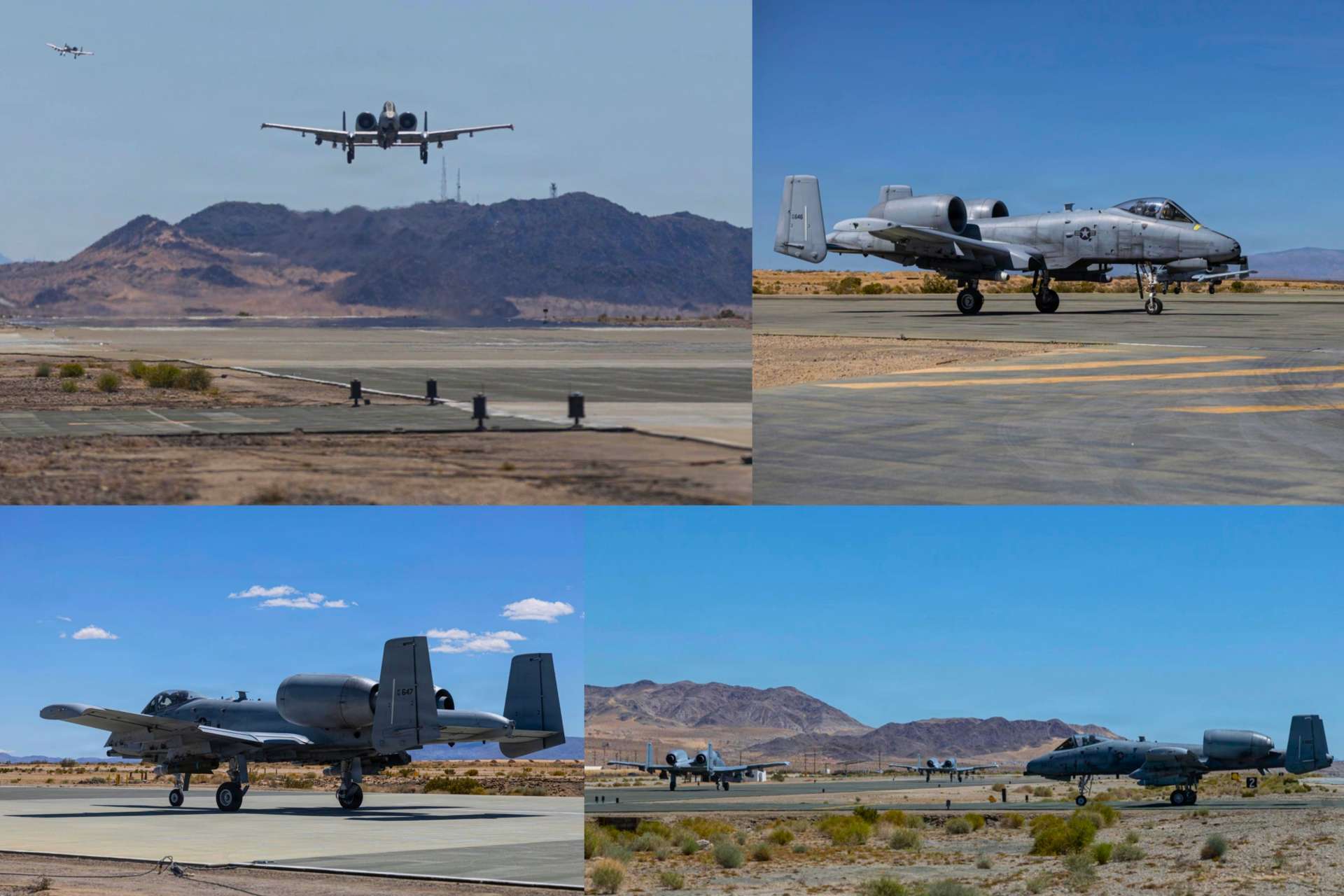
The U.S. Air Force is preparing the A-10 Thunderbolt II to operate from rough, damaged, and exposed airstrips, as demonstrated during expeditionary landing field training at Twentynine Palms, with imagery released by the U.S. Defense Visual Information Distribution Service. This strengthens its ability to keep flying in a war where major bases may be struck early, reinforcing dispersed operations as essential to sustaining combat airpower across contested theaters while the aircraft remains in service through 2030.
Training on unimproved surfaces shows the A-10 remains valuable not just for close air support, but for operating from austere locations where other aircraft may struggle. Its rugged design, short-field performance, survivability, and long loiter time make it a practical asset for Agile Combat Employment and for future campaigns in the Pacific or Europe, where mobility, resilience, and battlefield access will shape airpower effectiveness.
Related Topic: U.S. A-10 Warthogs Hunt Iranian Fast Attack Craft in Strait of Hormuz During Operation Epic Fury
The U.S. Air Force is training the A-10 Thunderbolt II to operate from rough, unimproved airstrips under its Agile Combat Employment concept, reinforcing the aircraft’s role in sustaining combat operations from dispersed and contested environments (Picture Source: U.S. Air Force)
What makes this training especially noteworthy is its direct connection to Agile Combat Employment, the Air Force’s concept for shifting combat power away from large, predictable bases toward smaller, dispersed operating locations. Official Air Force doctrine describes ACE as a way to move forces across predetermined dispersed sites in order to complicate an adversary’s targeting and preserve operational reach. In practical terms, the A-10 activity at Twentynine Palms shows the Air Force rehearsing exactly that kind of survival-focused maneuver: getting airborne, recovering, and sustaining combat operations from rough surfaces in a battlefield where fixed infrastructure may be damaged, denied, or under attack. Seen from a broader operational angle, this is the kind of preparation that says a great deal about how the U.S. military expects future air campaigns to unfold.
What gives this training extra depth is what “unimproved surfaces” really mean in operational practice. This is not just about landing on a rough strip for demonstration value. It points to an Air Force effort to keep aircraft usable when ideal infrastructure is unavailable, whether because a runway is unfinished, damaged by missile strikes, or simply too exposed to remain a safe operating location. In that sense, the A-10 is not only being trained to fly from austere sites, but to remain part of the fight when the normal architecture of airpower has already been disrupted. That detail gives the Twentynine Palms event a much more operational character than a routine training story might suggest.
This becomes even more important because future U.S. operations may depend less on sanctuary air bases and more on the ability to generate sorties from forward operating bases, damaged airfields, and contested environments. In the Indo-Pacific, the challenge is distance, dispersion, and island geography, which place a premium on flexible basing and the rapid movement of airpower across a wide theater. Recent Pacific Air Forces exercises have centered on ACE movements to simulated forward locations and on rapid airfield damage repair across dozens of sites, underscoring how seriously the service is preparing for a campaign in which runway access cannot be taken for granted. The A-10’s training on unimproved surfaces fits cleanly into that requirement. There is a very concrete logic here: an aircraft able to keep flying when infrastructure is limited gives the United States more options in exactly the regions where logistics may be the first target.
Viewed through a Pacific lens, the logic becomes even clearer. U.S. planners have spent years refining Agile Combat Employment around dispersed air operations, island chains, and the need to move combat power across a wide theater where fixed bases may be targeted early. Recent Indo-Pacific work on ACE and runway recovery shows that the challenge is not only striking power at range, but also the ability to keep aircraft moving, refueling, rearming, and flying after an initial attack. In that environment, an aircraft already associated with short takeoff and landing performance and rugged forward employment brings a very practical advantage. The Twentynine Palms training can thus be read as a rehearsal for a broader operational problem the United States expects to face in any major Pacific contingency.
The European dimension is just as important. The war in Ukraine and broader NATO planning have reinforced the danger of runway denial, missile attack, and the rapid targeting of concentrated aircraft on major air bases. U.S. and allied exercises in Europe have increasingly emphasized dispersed operations, rapid airfield repair, and the restoration of flight operations within hours rather than days. Senior U.S. Air Forces in Europe leaders have openly tied ACE to the need to disperse aircraft among multiple airfields and even highways as precision threats expand. Against that backdrop, the Twentynine Palms event can be read as more than local training: it is preparation for the kind of high-intensity fight in which survivability begins on the ground before the first weapon is released in the air. From a reporting standpoint, this is where the exercise becomes more than a visual training story and starts to reflect the deeper evolution of U.S. combat aviation posture.
The A-10 remains especially useful for this mission because it brings a combination of qualities few aircraft can match in the same package. Official Air Force reports continue to emphasize its excellent maneuverability at low speeds and altitude, long loiter time near battle areas, survivability, wide combat radius, and short takeoff and landing capability that permits operations in and out of locations near front lines. Those characteristics are highly valuable in an ACE framework. A platform that can absorb operational stress, remain close to friendly forces, and still generate combat power from austere conditions becomes more than a close air support aircraft; it becomes a practical tool for maintaining pressure when logistics are strained and base networks are under threat. That is also what gives the A-10 a very specific place in the current force mix: it offers persistence and ruggedness in a form that is directly tied to battlefield access.
That is why the recent decision to keep the A-10 through 2030 deserves to be read as a strategic readiness choice, not merely a force-structure adjustment. Reuters reported on April 20 that Air Force Secretary Troy Meink confirmed the A-10 would remain in service through 2030 in order to preserve combat power while replacement production ramps up, with the aircraft’s combat performance in the Iran fight helping drive the decision. Seen through the lens of the Twentynine Palms training, that extension looks increasingly coherent: the United States is not holding onto the A-10 out of sentiment, but because it still fills a mission set at the intersection of firepower, survivability, rough-field utility, and expeditionary responsiveness.
The message from Twentynine Palms is unmistakable. The United States is preparing the A-10 not for symbolic appearances, but for the hard conditions of modern war: broken runways, remote forward sites, joint operations, and contested theaters stretching from the Pacific islands to Europe’s exposed eastern flank. By training the aircraft to launch and recover from unimproved surfaces in a simulated deployed environment, the U.S. Air Force is demonstrating that combat credibility still depends on platforms able to fight from the edge, endure friction, and keep delivering support when the battlefield becomes most demanding.
Written by Teoman S. Nicanci – Defense Analyst, Army Recognition Group
Teoman S. Nicanci holds degrees in Political Science, Comparative and International Politics, and International Relations and Diplomacy from leading Belgian universities, with research focused on Russian strategic behavior, defense technology, and modern warfare. He is a defense analyst at Army Recognition, specializing in the global defense industry, military armament, and emerging defense technologies.
{loadposition bannertop}
{loadposition sidebarpub}
The U.S. Air Force is preparing the A-10 Thunderbolt II to operate from rough, damaged, and exposed airstrips, as demonstrated during expeditionary landing field training at Twentynine Palms, with imagery released by the U.S. Defense Visual Information Distribution Service. This strengthens its ability to keep flying in a war where major bases may be struck early, reinforcing dispersed operations as essential to sustaining combat airpower across contested theaters while the aircraft remains in service through 2030.
Training on unimproved surfaces shows the A-10 remains valuable not just for close air support, but for operating from austere locations where other aircraft may struggle. Its rugged design, short-field performance, survivability, and long loiter time make it a practical asset for Agile Combat Employment and for future campaigns in the Pacific or Europe, where mobility, resilience, and battlefield access will shape airpower effectiveness.
The U.S. Air Force is training the A-10 Thunderbolt II to operate from rough, unimproved airstrips under its Agile Combat Employment concept, reinforcing the aircraft’s role in sustaining combat operations from dispersed and contested environments (Picture Source: U.S. Air Force)
What makes this training especially noteworthy is its direct connection to Agile Combat Employment, the Air Force’s concept for shifting combat power away from large, predictable bases toward smaller, dispersed operating locations. Official Air Force doctrine describes ACE as a way to move forces across predetermined dispersed sites in order to complicate an adversary’s targeting and preserve operational reach. In practical terms, the A-10 activity at Twentynine Palms shows the Air Force rehearsing exactly that kind of survival-focused maneuver: getting airborne, recovering, and sustaining combat operations from rough surfaces in a battlefield where fixed infrastructure may be damaged, denied, or under attack. Seen from a broader operational angle, this is the kind of preparation that says a great deal about how the U.S. military expects future air campaigns to unfold.
What gives this training extra depth is what “unimproved surfaces” really mean in operational practice. This is not just about landing on a rough strip for demonstration value. It points to an Air Force effort to keep aircraft usable when ideal infrastructure is unavailable, whether because a runway is unfinished, damaged by missile strikes, or simply too exposed to remain a safe operating location. In that sense, the A-10 is not only being trained to fly from austere sites, but to remain part of the fight when the normal architecture of airpower has already been disrupted. That detail gives the Twentynine Palms event a much more operational character than a routine training story might suggest.
This becomes even more important because future U.S. operations may depend less on sanctuary air bases and more on the ability to generate sorties from forward operating bases, damaged airfields, and contested environments. In the Indo-Pacific, the challenge is distance, dispersion, and island geography, which place a premium on flexible basing and the rapid movement of airpower across a wide theater. Recent Pacific Air Forces exercises have centered on ACE movements to simulated forward locations and on rapid airfield damage repair across dozens of sites, underscoring how seriously the service is preparing for a campaign in which runway access cannot be taken for granted. The A-10’s training on unimproved surfaces fits cleanly into that requirement. There is a very concrete logic here: an aircraft able to keep flying when infrastructure is limited gives the United States more options in exactly the regions where logistics may be the first target.
Viewed through a Pacific lens, the logic becomes even clearer. U.S. planners have spent years refining Agile Combat Employment around dispersed air operations, island chains, and the need to move combat power across a wide theater where fixed bases may be targeted early. Recent Indo-Pacific work on ACE and runway recovery shows that the challenge is not only striking power at range, but also the ability to keep aircraft moving, refueling, rearming, and flying after an initial attack. In that environment, an aircraft already associated with short takeoff and landing performance and rugged forward employment brings a very practical advantage. The Twentynine Palms training can thus be read as a rehearsal for a broader operational problem the United States expects to face in any major Pacific contingency.
The European dimension is just as important. The war in Ukraine and broader NATO planning have reinforced the danger of runway denial, missile attack, and the rapid targeting of concentrated aircraft on major air bases. U.S. and allied exercises in Europe have increasingly emphasized dispersed operations, rapid airfield repair, and the restoration of flight operations within hours rather than days. Senior U.S. Air Forces in Europe leaders have openly tied ACE to the need to disperse aircraft among multiple airfields and even highways as precision threats expand. Against that backdrop, the Twentynine Palms event can be read as more than local training: it is preparation for the kind of high-intensity fight in which survivability begins on the ground before the first weapon is released in the air. From a reporting standpoint, this is where the exercise becomes more than a visual training story and starts to reflect the deeper evolution of U.S. combat aviation posture.
The A-10 remains especially useful for this mission because it brings a combination of qualities few aircraft can match in the same package. Official Air Force reports continue to emphasize its excellent maneuverability at low speeds and altitude, long loiter time near battle areas, survivability, wide combat radius, and short takeoff and landing capability that permits operations in and out of locations near front lines. Those characteristics are highly valuable in an ACE framework. A platform that can absorb operational stress, remain close to friendly forces, and still generate combat power from austere conditions becomes more than a close air support aircraft; it becomes a practical tool for maintaining pressure when logistics are strained and base networks are under threat. That is also what gives the A-10 a very specific place in the current force mix: it offers persistence and ruggedness in a form that is directly tied to battlefield access.
That is why the recent decision to keep the A-10 through 2030 deserves to be read as a strategic readiness choice, not merely a force-structure adjustment. Reuters reported on April 20 that Air Force Secretary Troy Meink confirmed the A-10 would remain in service through 2030 in order to preserve combat power while replacement production ramps up, with the aircraft’s combat performance in the Iran fight helping drive the decision. Seen through the lens of the Twentynine Palms training, that extension looks increasingly coherent: the United States is not holding onto the A-10 out of sentiment, but because it still fills a mission set at the intersection of firepower, survivability, rough-field utility, and expeditionary responsiveness.
The message from Twentynine Palms is unmistakable. The United States is preparing the A-10 not for symbolic appearances, but for the hard conditions of modern war: broken runways, remote forward sites, joint operations, and contested theaters stretching from the Pacific islands to Europe’s exposed eastern flank. By training the aircraft to launch and recover from unimproved surfaces in a simulated deployed environment, the U.S. Air Force is demonstrating that combat credibility still depends on platforms able to fight from the edge, endure friction, and keep delivering support when the battlefield becomes most demanding.
Written by Teoman S. Nicanci – Defense Analyst, Army Recognition Group
Teoman S. Nicanci holds degrees in Political Science, Comparative and International Politics, and International Relations and Diplomacy from leading Belgian universities, with research focused on Russian strategic behavior, defense technology, and modern warfare. He is a defense analyst at Army Recognition, specializing in the global defense industry, military armament, and emerging defense technologies.