Türkiye’s Titra Alpin Unmanned Helicopter Offers NATO Airborne Launch of Eight Merküt FPV Kamikaze Drones
{loadposition bannertop}
{loadposition sidebarpub}
Türkiye’s Titra has unveiled a new combat configuration of its Alpin unmanned helicopter capable of carrying and launching eight Merküt FPV kamikaze drones, a development presented during SAHA Expo 2026 in Istanbul. The system gives NATO-aligned forces a mobile airborne drone-launch platform that can extend the reach of FPV strikes, reduce exposure of ground operators, and improve tactical flexibility in contested environments shaped by electronic warfare and dense drone activity.
The Alpin-Merküt pairing combines the endurance and payload capacity of a rotary-wing unmanned aircraft with the precision attack role of lightweight FPV drones, creating a distributed warfare tool suited for reconnaissance, counter-drone missions, convoy protection, and rapid battlefield response. By launching FPV drones from the air instead of fixed ground positions, the system expands operational reach and reflects a broader shift toward layered autonomous warfare concepts now becoming central to NATO’s future force structure and high-intensity combat planning.
Related Topic: Türkiye’s ZD300 Drone Carrier Could Expand NATO FPV Strike Operations with Six Merkut Drones
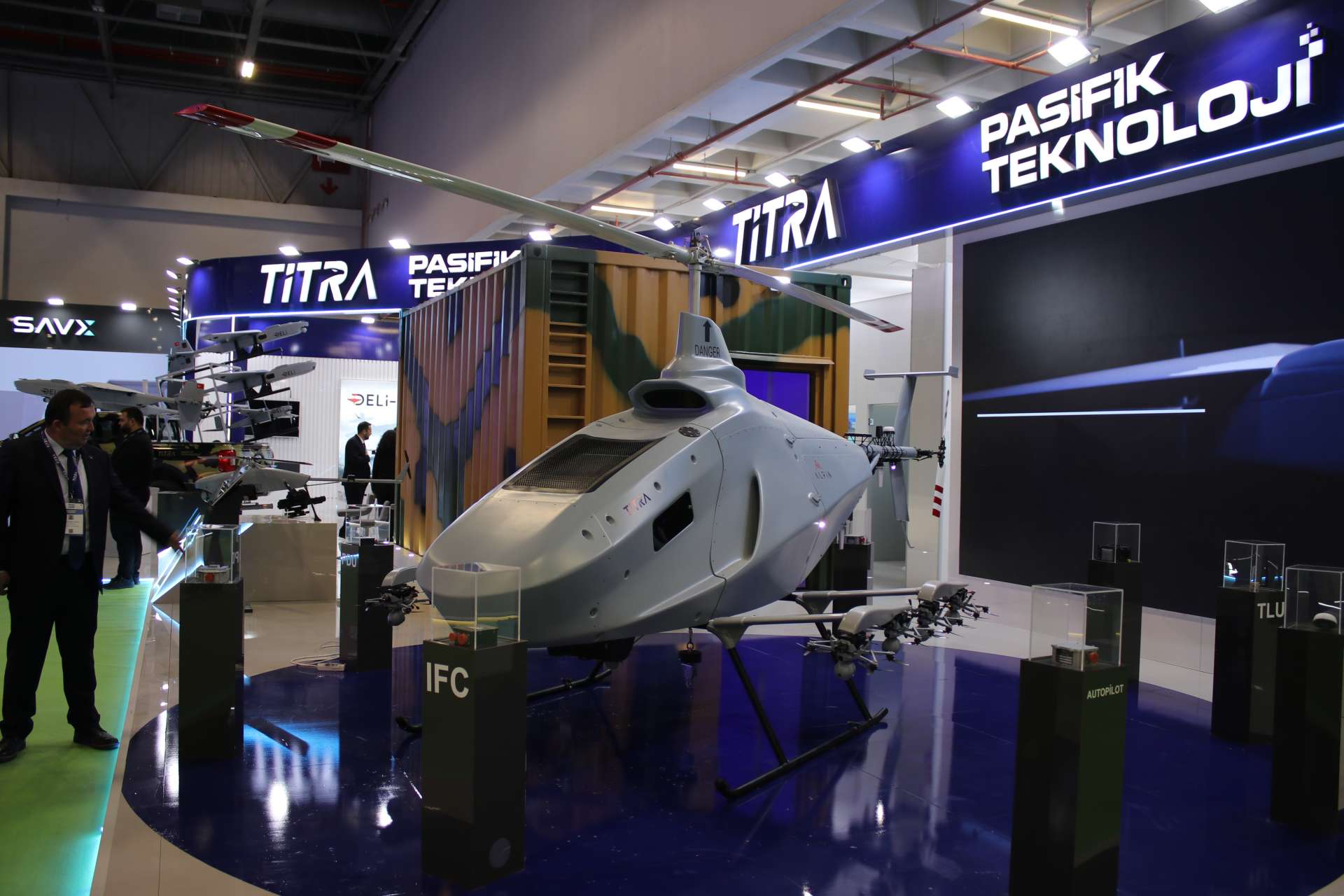
Turkish defense company Titra unveiled an Alpin unmanned helicopter carrying eight Merküt FPV kamikaze drones at SAHA Expo 2026, showcasing a new airborne launch concept designed for NATO-style contested drone warfare (Picture Source: Army Recognition Group)
During SAHA Expo 2026 in Istanbul, Türkiye, Turkish defense company Titra unveiled a new configuration of its Alpin unmanned helicopter carrying eight Merküt FPV drones, with four installed on the right side and four on the left side. The system reflects Türkiye’s growing ability to transform operational lessons, industrial capacity, and unmanned systems expertise into solutions that could directly support NATO’s future missions in drone-intensive warfare.
The system displayed by Titra introduces a combined unmanned architecture that brings together two distinct categories of aerial systems within a single operational framework. In this configuration, Alpin serves as the rotary-wing unmanned carrier, while Merküt, presented by the company among its multi-rotor vehicles, provides the tactical FPV drone component. This pairing gives the platform a role that goes beyond conventional unmanned helicopter missions, shifting Alpin from a single-purpose aerial vehicle into an airborne deployment node capable of carrying, positioning, and launching multiple small drones according to the tactical situation. Your original draft already established this Alpin-Merküt architecture, the eight-drone layout, and the NATO-oriented operational relevance as the core of the article.
Company reports indicate that Alpin-2 offers a payload capacity of 200 kg, a control radius of 200 km, more than nine hours of endurance, and a service ceiling of 21,000 ft. These characteristics allow the platform to operate beyond the immediate forward line, remain airborne for extended periods, and carry mission-specific payloads depending on operational requirements. In the configuration unveiled at SAHA Expo 2026, this capacity is used to mount eight Merküt drones externally, with four installed on each side of the helicopter. The result is a Turkish airborne mothership concept that can transport FPV drones toward the area of interest, reposition before launch, and release multiple effectors from a mobile aerial platform rather than from a fixed ground position.
The Merküt element gives this configuration its tactical effect. Company reports describe Merküt as a new-generation FPV drone developed for modern combat environments, particularly against asymmetric threats, and equipped with a high-precision, safe, and effective munition concept. Titra lists Merküt under its multi-rotor vehicle category, while Alpin is listed under rotary-wing systems, confirming the dual nature of the concept: a helicopter-type unmanned carrier combined with smaller FPV drones intended to deliver the final tactical action. In operational terms, this means Alpin provides endurance, altitude, standoff distance, and mobility, while Merküt provides close-range FPV engagement once released from the carrier platform.
This configuration introduces a significant operational difference compared with conventional FPV drone employment. Standard FPV drones are generally launched from the ground, which can restrict their effective use because of terrain, radio line-of-sight limitations, enemy electronic warfare, and the proximity required between operators and the target area. By placing eight Merküt drones on the Alpin helicopter, Titra offers a solution in which the launch point itself becomes mobile. The Alpin can move the drones closer to the area of interest, approach from unexpected directions, climb over terrain obstacles, reposition during the mission, and provide a broader deployment envelope before the FPV drones are released. This transforms Merküt from a short-range tactical asset into part of a wider aerial delivery architecture, where endurance, altitude, and standoff distance are provided by the unmanned helicopter.
Available information indicates that Merküt has been associated with a 10 km flight range, a 2.5 kg-class air vehicle, around 30 minutes of endurance, and a dedicated munition concept using approximately 600 grams of explosive with around 1,000 fragments. The system has also been presented with thermal camera-equipped and wired variants, a target-tracking function, and an air-to-air defense concept against hostile UAVs, including the possibility of kinetic impact or proximity-based fragmentation effects. Integrated with Alpin, these features create a layered unmanned system in which the helicopter does not merely carry drones but extends their practical employment envelope, allowing multiple Merküt drones to be launched from the air toward targets, hostile drones, or contested areas where ground-launched systems would face limitations.
For NATO, this type of system could offer a practical answer to the operational realities emerging from recent conflicts. Alliance forces are preparing for environments where electronic warfare, air defense networks, mobile enemy units, and low-cost drones can limit freedom of movement and challenge traditional force protection models. An unmanned helicopter carrying eight FPV drones could support reconnaissance-in-force, convoy protection, counter-sabotage missions, base defense, border security, maritime littoral surveillance, and rapid response operations. It could also be useful in mountainous regions, dense urban terrain, island defense scenarios, and forward operating environments where manned helicopters may face high risk and where ground units may lack the line of sight or range to launch FPV drones effectively.
The most important value of the Alpin-Merküt configuration lies in the kind of warfare it supports. It is designed for distributed drone warfare, high-intensity battlefield support, counter-drone warfare, hybrid warfare, and contested-area operations. In a high-intensity conflict, the system could be used to deliver multiple FPV drones against dispersed enemy positions, light vehicles, small tactical units, or hostile unmanned systems. In hybrid warfare, it could provide fast and flexible response against infiltration attempts, sabotage teams, or irregular threats operating across difficult terrain. In counter-drone warfare, Merküt’s FPV profile and reported air-to-air concept could allow the system to support the protection of bases, convoys, and forward units against hostile UAVs. In NATO operations, these roles are increasingly relevant because the Alliance must operate in environments where drones are no longer secondary assets but central tools for surveillance, attack, disruption, and psychological pressure.
Compared with larger fixed-wing unmanned combat aircraft, the Alpin-Merküt configuration offers a different operational value. It is not intended to replace long-endurance armed UAVs used for strategic surveillance or deep strike missions, but rather to fill the gap between heavy unmanned platforms and small tactical drones launched by ground troops. Its rotary-wing design allows vertical takeoff and landing, hover capability, and deployment from confined or improvised areas, while its endurance and control radius give it more reach than a small tactical quadcopter. Compared with ground-launched FPV drones or loitering munitions, the system can shift the point of attack away from the point of departure, complicating enemy detection and allowing Turkish or allied forces to project small unmanned effectors into areas that would otherwise be difficult to access.
The system also has implications for NATO’s evolving doctrine on distributed operations. The Alliance is increasingly focused on resilient networks, dispersed firepower, rapid targeting cycles, and lower-cost systems that can complement expensive aircraft, missiles, and sensors. A Turkish Alpin helicopter equipped with eight Merküt drones could act as an airborne node in this architecture, extending the reach of small FPV drones while reducing risk to personnel. In NATO missions, it could provide a deployable solution for high-risk reconnaissance, localized precision effects, counter-UAV response, and support to special operations or rapid reaction units. For allied forces operating far from large bases, such a system could offer an adaptable tool that combines mobility, persistence, and tactical mass.
For Türkiye, the unveiling of Alpin with eight Merküt drones at SAHA Expo 2026 reinforces the country’s position as one of NATO’s most active innovators in unmanned systems. Türkiye has already built a strong reputation in the UAV sector, and the Alpin-Merküt configuration shows a further step toward unmanned teaming, modular payloads, and combat systems designed around battlefield lessons. The concept also supports Ankara’s broader defense-industrial strategy, which aims to reduce foreign dependency, increase exportable national solutions, and strengthen Türkiye’s role as a supplier of mission-ready systems for allies and partner countries. Within NATO, this gives Türkiye an additional contribution to offer beyond traditional platforms: an operational concept built around drones, autonomy, tactical flexibility, and affordable precision.
The geopolitical significance is also clear. As the war in Ukraine, instability around the Black Sea, tensions in the Middle East, and maritime security challenges continue to shape NATO priorities, unmanned systems have become central to deterrence and operational planning. Türkiye’s geographic position, defense-industrial base, and combat-informed unmanned systems ecosystem make it a key actor in this transformation. By presenting an unmanned helicopter able to carry eight Merküt drones, Titra is not only showing a new product configuration, but also highlighting how Turkish industry can respond quickly to the changing character of warfare. The system could be relevant for NATO’s eastern flank, Mediterranean operations, Black Sea security, and expeditionary missions where speed, flexibility, and unmanned reach are increasingly decisive.
The unveiling of Titra’s Alpin helicopter carrying eight Merküt drones at SAHA Expo 2026 sends a strong message about Türkiye’s direction in unmanned warfare. By combining the endurance and payload capacity of a rotary-wing unmanned helicopter with the tactical effect of multiple FPV drones, Titra has presented a system that could serve both national defense requirements and NATO operational needs. For Türkiye, it demonstrates industrial confidence and technological maturity. For NATO, it offers a Turkish-built solution suited to a new era of dispersed, contested, drone-intensive, and hybrid warfare, where the ability to launch multiple small effectors from a mobile aerial platform could become a decisive operational advantage.
Written by Teoman S. Nicanci – Defense Analyst, Army Recognition Group
Teoman S. Nicanci holds degrees in Political Science, Comparative and International Politics, and International Relations and Diplomacy from leading Belgian universities, with research focused on Russian strategic behavior, defense technology, and modern warfare. He is a defense analyst at Army Recognition, specializing in the global defense industry, military armament, and emerging defense technologies.
{loadposition bannertop}
{loadposition sidebarpub}
Türkiye’s Titra has unveiled a new combat configuration of its Alpin unmanned helicopter capable of carrying and launching eight Merküt FPV kamikaze drones, a development presented during SAHA Expo 2026 in Istanbul. The system gives NATO-aligned forces a mobile airborne drone-launch platform that can extend the reach of FPV strikes, reduce exposure of ground operators, and improve tactical flexibility in contested environments shaped by electronic warfare and dense drone activity.
The Alpin-Merküt pairing combines the endurance and payload capacity of a rotary-wing unmanned aircraft with the precision attack role of lightweight FPV drones, creating a distributed warfare tool suited for reconnaissance, counter-drone missions, convoy protection, and rapid battlefield response. By launching FPV drones from the air instead of fixed ground positions, the system expands operational reach and reflects a broader shift toward layered autonomous warfare concepts now becoming central to NATO’s future force structure and high-intensity combat planning.
Related Topic: Türkiye’s ZD300 Drone Carrier Could Expand NATO FPV Strike Operations with Six Merkut Drones
Turkish defense company Titra unveiled an Alpin unmanned helicopter carrying eight Merküt FPV kamikaze drones at SAHA Expo 2026, showcasing a new airborne launch concept designed for NATO-style contested drone warfare (Picture Source: Army Recognition Group)
During SAHA Expo 2026 in Istanbul, Türkiye, Turkish defense company Titra unveiled a new configuration of its Alpin unmanned helicopter carrying eight Merküt FPV drones, with four installed on the right side and four on the left side. The system reflects Türkiye’s growing ability to transform operational lessons, industrial capacity, and unmanned systems expertise into solutions that could directly support NATO’s future missions in drone-intensive warfare.
The system displayed by Titra introduces a combined unmanned architecture that brings together two distinct categories of aerial systems within a single operational framework. In this configuration, Alpin serves as the rotary-wing unmanned carrier, while Merküt, presented by the company among its multi-rotor vehicles, provides the tactical FPV drone component. This pairing gives the platform a role that goes beyond conventional unmanned helicopter missions, shifting Alpin from a single-purpose aerial vehicle into an airborne deployment node capable of carrying, positioning, and launching multiple small drones according to the tactical situation. Your original draft already established this Alpin-Merküt architecture, the eight-drone layout, and the NATO-oriented operational relevance as the core of the article.
Company reports indicate that Alpin-2 offers a payload capacity of 200 kg, a control radius of 200 km, more than nine hours of endurance, and a service ceiling of 21,000 ft. These characteristics allow the platform to operate beyond the immediate forward line, remain airborne for extended periods, and carry mission-specific payloads depending on operational requirements. In the configuration unveiled at SAHA Expo 2026, this capacity is used to mount eight Merküt drones externally, with four installed on each side of the helicopter. The result is a Turkish airborne mothership concept that can transport FPV drones toward the area of interest, reposition before launch, and release multiple effectors from a mobile aerial platform rather than from a fixed ground position.
The Merküt element gives this configuration its tactical effect. Company reports describe Merküt as a new-generation FPV drone developed for modern combat environments, particularly against asymmetric threats, and equipped with a high-precision, safe, and effective munition concept. Titra lists Merküt under its multi-rotor vehicle category, while Alpin is listed under rotary-wing systems, confirming the dual nature of the concept: a helicopter-type unmanned carrier combined with smaller FPV drones intended to deliver the final tactical action. In operational terms, this means Alpin provides endurance, altitude, standoff distance, and mobility, while Merküt provides close-range FPV engagement once released from the carrier platform.
This configuration introduces a significant operational difference compared with conventional FPV drone employment. Standard FPV drones are generally launched from the ground, which can restrict their effective use because of terrain, radio line-of-sight limitations, enemy electronic warfare, and the proximity required between operators and the target area. By placing eight Merküt drones on the Alpin helicopter, Titra offers a solution in which the launch point itself becomes mobile. The Alpin can move the drones closer to the area of interest, approach from unexpected directions, climb over terrain obstacles, reposition during the mission, and provide a broader deployment envelope before the FPV drones are released. This transforms Merküt from a short-range tactical asset into part of a wider aerial delivery architecture, where endurance, altitude, and standoff distance are provided by the unmanned helicopter.
Available information indicates that Merküt has been associated with a 10 km flight range, a 2.5 kg-class air vehicle, around 30 minutes of endurance, and a dedicated munition concept using approximately 600 grams of explosive with around 1,000 fragments. The system has also been presented with thermal camera-equipped and wired variants, a target-tracking function, and an air-to-air defense concept against hostile UAVs, including the possibility of kinetic impact or proximity-based fragmentation effects. Integrated with Alpin, these features create a layered unmanned system in which the helicopter does not merely carry drones but extends their practical employment envelope, allowing multiple Merküt drones to be launched from the air toward targets, hostile drones, or contested areas where ground-launched systems would face limitations.
For NATO, this type of system could offer a practical answer to the operational realities emerging from recent conflicts. Alliance forces are preparing for environments where electronic warfare, air defense networks, mobile enemy units, and low-cost drones can limit freedom of movement and challenge traditional force protection models. An unmanned helicopter carrying eight FPV drones could support reconnaissance-in-force, convoy protection, counter-sabotage missions, base defense, border security, maritime littoral surveillance, and rapid response operations. It could also be useful in mountainous regions, dense urban terrain, island defense scenarios, and forward operating environments where manned helicopters may face high risk and where ground units may lack the line of sight or range to launch FPV drones effectively.
The most important value of the Alpin-Merküt configuration lies in the kind of warfare it supports. It is designed for distributed drone warfare, high-intensity battlefield support, counter-drone warfare, hybrid warfare, and contested-area operations. In a high-intensity conflict, the system could be used to deliver multiple FPV drones against dispersed enemy positions, light vehicles, small tactical units, or hostile unmanned systems. In hybrid warfare, it could provide fast and flexible response against infiltration attempts, sabotage teams, or irregular threats operating across difficult terrain. In counter-drone warfare, Merküt’s FPV profile and reported air-to-air concept could allow the system to support the protection of bases, convoys, and forward units against hostile UAVs. In NATO operations, these roles are increasingly relevant because the Alliance must operate in environments where drones are no longer secondary assets but central tools for surveillance, attack, disruption, and psychological pressure.
Compared with larger fixed-wing unmanned combat aircraft, the Alpin-Merküt configuration offers a different operational value. It is not intended to replace long-endurance armed UAVs used for strategic surveillance or deep strike missions, but rather to fill the gap between heavy unmanned platforms and small tactical drones launched by ground troops. Its rotary-wing design allows vertical takeoff and landing, hover capability, and deployment from confined or improvised areas, while its endurance and control radius give it more reach than a small tactical quadcopter. Compared with ground-launched FPV drones or loitering munitions, the system can shift the point of attack away from the point of departure, complicating enemy detection and allowing Turkish or allied forces to project small unmanned effectors into areas that would otherwise be difficult to access.
The system also has implications for NATO’s evolving doctrine on distributed operations. The Alliance is increasingly focused on resilient networks, dispersed firepower, rapid targeting cycles, and lower-cost systems that can complement expensive aircraft, missiles, and sensors. A Turkish Alpin helicopter equipped with eight Merküt drones could act as an airborne node in this architecture, extending the reach of small FPV drones while reducing risk to personnel. In NATO missions, it could provide a deployable solution for high-risk reconnaissance, localized precision effects, counter-UAV response, and support to special operations or rapid reaction units. For allied forces operating far from large bases, such a system could offer an adaptable tool that combines mobility, persistence, and tactical mass.
For Türkiye, the unveiling of Alpin with eight Merküt drones at SAHA Expo 2026 reinforces the country’s position as one of NATO’s most active innovators in unmanned systems. Türkiye has already built a strong reputation in the UAV sector, and the Alpin-Merküt configuration shows a further step toward unmanned teaming, modular payloads, and combat systems designed around battlefield lessons. The concept also supports Ankara’s broader defense-industrial strategy, which aims to reduce foreign dependency, increase exportable national solutions, and strengthen Türkiye’s role as a supplier of mission-ready systems for allies and partner countries. Within NATO, this gives Türkiye an additional contribution to offer beyond traditional platforms: an operational concept built around drones, autonomy, tactical flexibility, and affordable precision.
The geopolitical significance is also clear. As the war in Ukraine, instability around the Black Sea, tensions in the Middle East, and maritime security challenges continue to shape NATO priorities, unmanned systems have become central to deterrence and operational planning. Türkiye’s geographic position, defense-industrial base, and combat-informed unmanned systems ecosystem make it a key actor in this transformation. By presenting an unmanned helicopter able to carry eight Merküt drones, Titra is not only showing a new product configuration, but also highlighting how Turkish industry can respond quickly to the changing character of warfare. The system could be relevant for NATO’s eastern flank, Mediterranean operations, Black Sea security, and expeditionary missions where speed, flexibility, and unmanned reach are increasingly decisive.
The unveiling of Titra’s Alpin helicopter carrying eight Merküt drones at SAHA Expo 2026 sends a strong message about Türkiye’s direction in unmanned warfare. By combining the endurance and payload capacity of a rotary-wing unmanned helicopter with the tactical effect of multiple FPV drones, Titra has presented a system that could serve both national defense requirements and NATO operational needs. For Türkiye, it demonstrates industrial confidence and technological maturity. For NATO, it offers a Turkish-built solution suited to a new era of dispersed, contested, drone-intensive, and hybrid warfare, where the ability to launch multiple small effectors from a mobile aerial platform could become a decisive operational advantage.
Written by Teoman S. Nicanci – Defense Analyst, Army Recognition Group
Teoman S. Nicanci holds degrees in Political Science, Comparative and International Politics, and International Relations and Diplomacy from leading Belgian universities, with research focused on Russian strategic behavior, defense technology, and modern warfare. He is a defense analyst at Army Recognition, specializing in the global defense industry, military armament, and emerging defense technologies.