U.S. Navy F/A-18F Super Hornet Spotted Carrying AIM-260A Missile to Redefine Beyond-Visual-Range Air Warfare
{loadposition bannertop}
{loadposition sidebarpub}
The U.S. Navy has been spotted flying an F/A-18F Super Hornet with what appears to be the AIM-260A Joint Advanced Tactical Missile, marking the first publicly documented sighting of the long-secret AMRAAM successor on a frontline combat aircraft. Photos taken at Eglin Air Force Base on May 13, 2026, and published by Jonathan Tweedy indicate the missile has entered a visible integration-testing phase that could significantly extend the reach and survivability of U.S. carrier aviation in future beyond-visual-range air combat.
Designed to outrange the AIM-120 AMRAAM while fitting existing fighter stations and stealth weapon bays, the AIM-260A is intended to restore the U.S. advantage against advanced Chinese and Russian long-range air-to-air missiles. Its integration with platforms such as the Super Hornet, F-22, F-35, and future autonomous Collaborative Combat Aircraft points toward a more networked air warfare model where distributed sensors, stealth aircraft, unmanned shooters, and long-range missiles operate together to strike first and control larger engagement zones across contested theaters like the Indo-Pacific.
Related Topic: U.S. Navy Completes First Fully In-House F/A-18 Block III Upgrade to Extend Carrier Strike Reach and Readiness
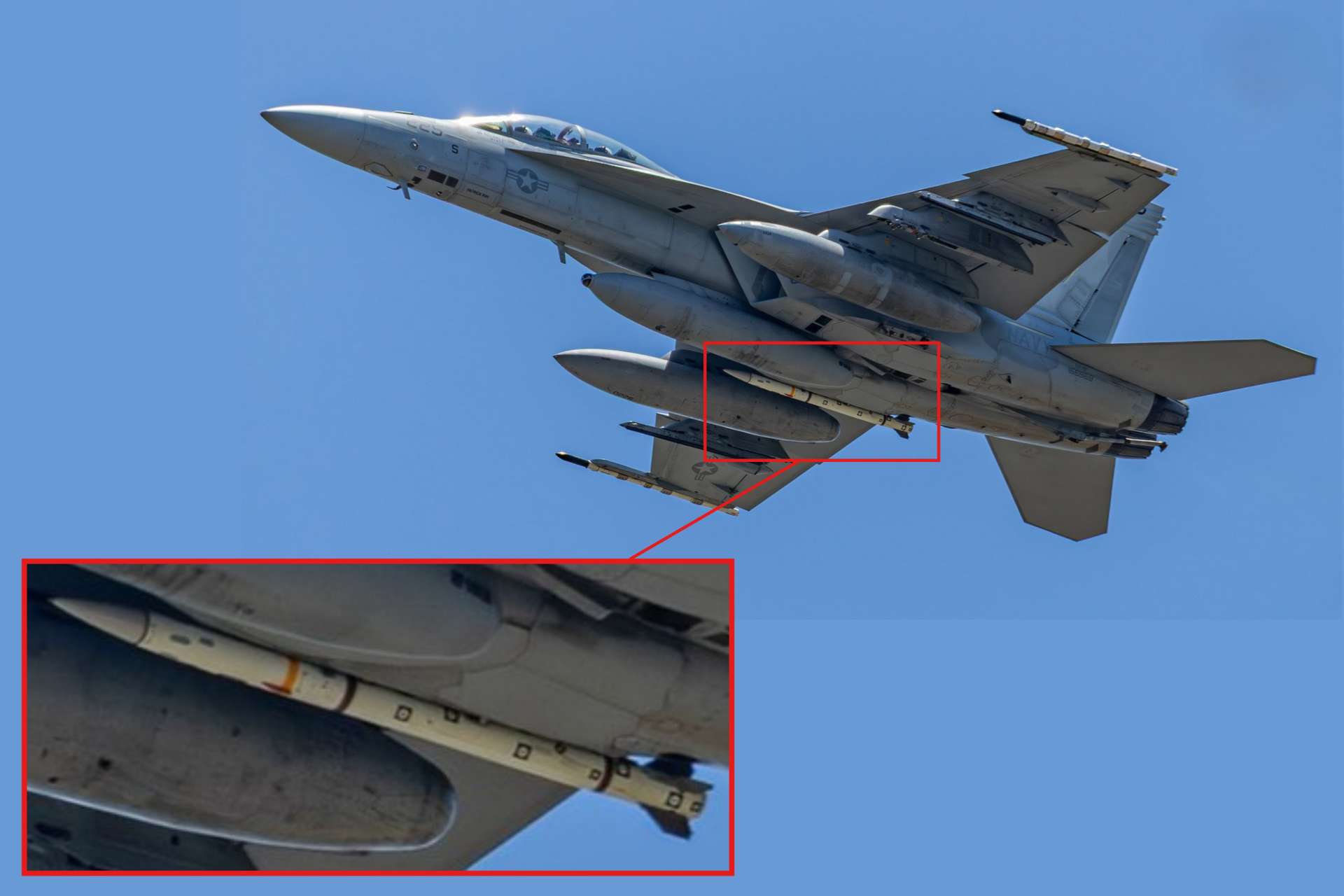
A newly photographed Boeing F/A-18F Super Hornet carrying the AIM-260A Joint Advanced Tactical Missile suggests the United States is moving closer to fielding a next-generation beyond-visual-range weapon designed to restore long-range air combat advantage against peer adversaries (Picture Source: Jonathan Tweedy)
Photos taken by Jonathan Tweedy at Eglin Air Force Base on May 13, 2026, showed a U.S. Navy F/A-18F Super Hornet carrying what appears to be the AIM-260A Joint Advanced Tactical Missile, providing the first openly documented view of the AMRAAM successor on a frontline tactical aircraft. The sighting suggests that the previously concealed JATM program has entered a visible stage of platform-integration testing, with direct implications for U.S. Navy carrier aviation and future joint air combat. Designed to exceed the reach of the AIM-120 AMRAAM while remaining compatible with its dimensional constraints, the AIM-260A could reshape beyond-visual-range engagements against peer adversaries equipped with long-range air-to-air missiles.
The sighting does not confirm operational deployment, but it strongly suggests that the AIM-260A has reached a more mature phase of captive-carry, separation, telemetry, or flight-test work. Eglin Air Force Base is closely associated with U.S. aerial weapons testing, and the appearance of the missile on a Navy F/A-18F points to an integration effort directly connected to frontline carrier aviation rather than a purely laboratory-stage program. Since the AIM-260A has remained largely hidden from public view despite years of development, this external look gives analysts an important opportunity to assess its configuration, carriage logic, and intended role within the future U.S. air combat architecture.
The AIM-260A Joint Advanced Tactical Missile, also known as JATM, was publicly acknowledged in 2019 as a new long-range air-to-air missile developed to succeed the AIM-120 Advanced Medium-Range Air-to-Air Missile. At the time, U.S. Air Force officials described the weapon as offering greater range than AMRAAM and as a response to China’s PL-15, a missile whose reach has shaped American concerns about losing firing advantage in beyond-visual-range combat. Initial integration was planned for the F-22 weapons bay and the Navy’s F/A-18, with the F-35 to follow, a sequence that explains why this documented carriage on a Super Hornet is important for both naval aviation and joint air operations.
The comparison with the AIM-120 is central to understanding the program. AMRAAM remains a highly capable active-radar-guided air-to-air missile, with the AIM-120D variant adding improved range, GPS-assisted guidance, updated datalinks, greater lethality, and stronger resistance to jamming. Public U.S. Air Force reference data lists the AIM-120 with a length of about 12 feet, a 7-inch diameter, a 1.7-foot span, a high-explosive blast-fragmentation warhead, and a boost-sustain solid-propellant rocket motor. The latest AIM-120D3 configuration has received Form, Fit, and Function Refresh improvements and new software upgrades, allowing AMRAAM to remain a key “capacity” weapon alongside the future AIM-260A.
The AIM-260A appears to follow a different design philosophy from a simple AMRAAM upgrade. Its expected value lies not only in longer range, but also in a wider no-escape zone, better endgame energy, improved networked guidance, stronger resistance to electronic attack, and the ability to engage aircraft protected by advanced sensors, jamming, and low-observable design. Its AMRAAM-compatible dimensions are especially important because they allow the missile to fit existing aircraft stations and, more critically, the internal weapons bays of stealth aircraft. A larger missile could offer more reach, but it would impose penalties on stealth, drag, aircraft handling, and fleet integration. The AIM-260A seems designed to solve that trade-off by combining longer reach with a form factor suitable for fifth-generation fighters and carrier-based aircraft.
For the U.S. Navy, the F/A-18F sighting carries a specific operational message. The Super Hornet remains a core element of the carrier air wing, with NAVAIR describing the F/A-18E/F as a twin-engine, multi-mission tactical aircraft used for air superiority, fighter escort, reconnaissance, aerial refueling, close air support, suppression of air defenses, and precision strike. The Block III standard adds longer service life, reduced radar signature, advanced networking infrastructure, improved computing, and a cockpit built around a broader tactical picture. Integrating AIM-260A on this aircraft could give carrier strike groups a longer-range counter-air weapon while the future F/A-XX remains under development.
This missile also changes the role of stealth aircraft in the air battle. For the F-22, internal carriage of AIM-260A would preserve low observability while extending the aircraft’s ability to engage enemy fighters, bombers, or support aircraft before entering a hostile missile envelope. For the F-35, later integration would pair the missile with one of the most capable sensor-fusion platforms in service, allowing targets to be detected, classified, and passed through datalinks without forcing every shooter to activate its own radar. In practical terms, AIM-260A is not only a missile replacement; it is a weapon designed for a battlespace in which stealth aircraft, electronic warfare, airborne early warning, passive sensors, and distributed targeting all interact.
The future role of AIM-260A on Collaborative Combat Aircraft could be even more disruptive. U.S. Air Force leaders have stated that JATM is expected to equip these unmanned autonomous aircraft when they enter service, adding a new dimension to air combat planning. A CCA armed with AIM-260A could act as a forward missile carrier, sensor relay, decoy, or distributed shooter controlled by a crewed fighter operating farther from enemy defenses. This would increase the number of available weapons in the battlespace and force adversaries to track more launch platforms, not only manned fighters. In an Indo-Pacific scenario, where distance, basing limits, tanker vulnerability, and Chinese anti-access systems shape every engagement, this distributed model could extend U.S. airpower without exposing pilots to the highest-risk launch zones.
The strategic consequences go beyond the technical comparison between two missiles. The AIM-120 helped define Western beyond-visual-range air combat for more than three decades, but the growth of Chinese and Russian long-range air-to-air weapons has challenged the assumption that U.S. fighters can always fire first from a safer distance. The AIM-260A is intended to shift that equation back toward U.S. and allied forces by extending the engagement envelope, protecting high-value aircraft such as tankers and airborne command-and-control platforms, and supporting carrier air defense over wider maritime areas. In the Pacific, this could push the air engagement zone farther away from U.S. carriers and support aircraft, a key factor in any crisis around Taiwan, the South China Sea, or the first island chain.
The documented appearance of the AIM-260A under a Super Hornet signals that the next stage of American air combat is transitioning from a largely hidden program into a phase where platform integration can now be observed externally. If the missile reaches large-scale service, it could reshape how U.S. fighters, carrier air wings, stealth aircraft, and unmanned combat platforms conduct long-range engagements. Its emergence points to a future in which air superiority will depend less on a single aircraft type and more on the ability to connect sensors, shooters, autonomous platforms, and long-range weapons into one combat network capable of detecting first, targeting faster, and firing from beyond the enemy’s preferred engagement range.
Written by Teoman S. Nicanci – Defense Analyst, Army Recognition Group
Teoman S. Nicanci holds degrees in Political Science, Comparative and International Politics, and International Relations and Diplomacy from leading Belgian universities, with research focused on Russian strategic behavior, defense technology, and modern warfare. He is a defense analyst at Army Recognition, specializing in the global defense industry, military armament, and emerging defense technologies.
{loadposition bannertop}
{loadposition sidebarpub}
The U.S. Navy has been spotted flying an F/A-18F Super Hornet with what appears to be the AIM-260A Joint Advanced Tactical Missile, marking the first publicly documented sighting of the long-secret AMRAAM successor on a frontline combat aircraft. Photos taken at Eglin Air Force Base on May 13, 2026, and published by Jonathan Tweedy indicate the missile has entered a visible integration-testing phase that could significantly extend the reach and survivability of U.S. carrier aviation in future beyond-visual-range air combat.
Designed to outrange the AIM-120 AMRAAM while fitting existing fighter stations and stealth weapon bays, the AIM-260A is intended to restore the U.S. advantage against advanced Chinese and Russian long-range air-to-air missiles. Its integration with platforms such as the Super Hornet, F-22, F-35, and future autonomous Collaborative Combat Aircraft points toward a more networked air warfare model where distributed sensors, stealth aircraft, unmanned shooters, and long-range missiles operate together to strike first and control larger engagement zones across contested theaters like the Indo-Pacific.
Related Topic: U.S. Navy Completes First Fully In-House F/A-18 Block III Upgrade to Extend Carrier Strike Reach and Readiness
A newly photographed Boeing F/A-18F Super Hornet carrying the AIM-260A Joint Advanced Tactical Missile suggests the United States is moving closer to fielding a next-generation beyond-visual-range weapon designed to restore long-range air combat advantage against peer adversaries (Picture Source: Jonathan Tweedy)
Photos taken by Jonathan Tweedy at Eglin Air Force Base on May 13, 2026, showed a U.S. Navy F/A-18F Super Hornet carrying what appears to be the AIM-260A Joint Advanced Tactical Missile, providing the first openly documented view of the AMRAAM successor on a frontline tactical aircraft. The sighting suggests that the previously concealed JATM program has entered a visible stage of platform-integration testing, with direct implications for U.S. Navy carrier aviation and future joint air combat. Designed to exceed the reach of the AIM-120 AMRAAM while remaining compatible with its dimensional constraints, the AIM-260A could reshape beyond-visual-range engagements against peer adversaries equipped with long-range air-to-air missiles.
The sighting does not confirm operational deployment, but it strongly suggests that the AIM-260A has reached a more mature phase of captive-carry, separation, telemetry, or flight-test work. Eglin Air Force Base is closely associated with U.S. aerial weapons testing, and the appearance of the missile on a Navy F/A-18F points to an integration effort directly connected to frontline carrier aviation rather than a purely laboratory-stage program. Since the AIM-260A has remained largely hidden from public view despite years of development, this external look gives analysts an important opportunity to assess its configuration, carriage logic, and intended role within the future U.S. air combat architecture.
The AIM-260A Joint Advanced Tactical Missile, also known as JATM, was publicly acknowledged in 2019 as a new long-range air-to-air missile developed to succeed the AIM-120 Advanced Medium-Range Air-to-Air Missile. At the time, U.S. Air Force officials described the weapon as offering greater range than AMRAAM and as a response to China’s PL-15, a missile whose reach has shaped American concerns about losing firing advantage in beyond-visual-range combat. Initial integration was planned for the F-22 weapons bay and the Navy’s F/A-18, with the F-35 to follow, a sequence that explains why this documented carriage on a Super Hornet is important for both naval aviation and joint air operations.
The comparison with the AIM-120 is central to understanding the program. AMRAAM remains a highly capable active-radar-guided air-to-air missile, with the AIM-120D variant adding improved range, GPS-assisted guidance, updated datalinks, greater lethality, and stronger resistance to jamming. Public U.S. Air Force reference data lists the AIM-120 with a length of about 12 feet, a 7-inch diameter, a 1.7-foot span, a high-explosive blast-fragmentation warhead, and a boost-sustain solid-propellant rocket motor. The latest AIM-120D3 configuration has received Form, Fit, and Function Refresh improvements and new software upgrades, allowing AMRAAM to remain a key “capacity” weapon alongside the future AIM-260A.
The AIM-260A appears to follow a different design philosophy from a simple AMRAAM upgrade. Its expected value lies not only in longer range, but also in a wider no-escape zone, better endgame energy, improved networked guidance, stronger resistance to electronic attack, and the ability to engage aircraft protected by advanced sensors, jamming, and low-observable design. Its AMRAAM-compatible dimensions are especially important because they allow the missile to fit existing aircraft stations and, more critically, the internal weapons bays of stealth aircraft. A larger missile could offer more reach, but it would impose penalties on stealth, drag, aircraft handling, and fleet integration. The AIM-260A seems designed to solve that trade-off by combining longer reach with a form factor suitable for fifth-generation fighters and carrier-based aircraft.
For the U.S. Navy, the F/A-18F sighting carries a specific operational message. The Super Hornet remains a core element of the carrier air wing, with NAVAIR describing the F/A-18E/F as a twin-engine, multi-mission tactical aircraft used for air superiority, fighter escort, reconnaissance, aerial refueling, close air support, suppression of air defenses, and precision strike. The Block III standard adds longer service life, reduced radar signature, advanced networking infrastructure, improved computing, and a cockpit built around a broader tactical picture. Integrating AIM-260A on this aircraft could give carrier strike groups a longer-range counter-air weapon while the future F/A-XX remains under development.
This missile also changes the role of stealth aircraft in the air battle. For the F-22, internal carriage of AIM-260A would preserve low observability while extending the aircraft’s ability to engage enemy fighters, bombers, or support aircraft before entering a hostile missile envelope. For the F-35, later integration would pair the missile with one of the most capable sensor-fusion platforms in service, allowing targets to be detected, classified, and passed through datalinks without forcing every shooter to activate its own radar. In practical terms, AIM-260A is not only a missile replacement; it is a weapon designed for a battlespace in which stealth aircraft, electronic warfare, airborne early warning, passive sensors, and distributed targeting all interact.
The future role of AIM-260A on Collaborative Combat Aircraft could be even more disruptive. U.S. Air Force leaders have stated that JATM is expected to equip these unmanned autonomous aircraft when they enter service, adding a new dimension to air combat planning. A CCA armed with AIM-260A could act as a forward missile carrier, sensor relay, decoy, or distributed shooter controlled by a crewed fighter operating farther from enemy defenses. This would increase the number of available weapons in the battlespace and force adversaries to track more launch platforms, not only manned fighters. In an Indo-Pacific scenario, where distance, basing limits, tanker vulnerability, and Chinese anti-access systems shape every engagement, this distributed model could extend U.S. airpower without exposing pilots to the highest-risk launch zones.
The strategic consequences go beyond the technical comparison between two missiles. The AIM-120 helped define Western beyond-visual-range air combat for more than three decades, but the growth of Chinese and Russian long-range air-to-air weapons has challenged the assumption that U.S. fighters can always fire first from a safer distance. The AIM-260A is intended to shift that equation back toward U.S. and allied forces by extending the engagement envelope, protecting high-value aircraft such as tankers and airborne command-and-control platforms, and supporting carrier air defense over wider maritime areas. In the Pacific, this could push the air engagement zone farther away from U.S. carriers and support aircraft, a key factor in any crisis around Taiwan, the South China Sea, or the first island chain.
The documented appearance of the AIM-260A under a Super Hornet signals that the next stage of American air combat is transitioning from a largely hidden program into a phase where platform integration can now be observed externally. If the missile reaches large-scale service, it could reshape how U.S. fighters, carrier air wings, stealth aircraft, and unmanned combat platforms conduct long-range engagements. Its emergence points to a future in which air superiority will depend less on a single aircraft type and more on the ability to connect sensors, shooters, autonomous platforms, and long-range weapons into one combat network capable of detecting first, targeting faster, and firing from beyond the enemy’s preferred engagement range.
Written by Teoman S. Nicanci – Defense Analyst, Army Recognition Group
Teoman S. Nicanci holds degrees in Political Science, Comparative and International Politics, and International Relations and Diplomacy from leading Belgian universities, with research focused on Russian strategic behavior, defense technology, and modern warfare. He is a defense analyst at Army Recognition, specializing in the global defense industry, military armament, and emerging defense technologies.