British Army AH-64E Apache Attack Helicopters Set to Gain Autonomous Wingman Drones Developed by Anduril UK
{loadposition bannertop}
{loadposition sidebarpub}
Anduril UK has been down-selected by the UK Ministry of Defence for the next phase of Project NYX, a British Army programme to develop autonomous “wingman” drones for the AH-64E Apache, the company announced on May 15, 2026. The effort matters because it reflects a major shift in attack aviation doctrine, with the British Army seeking to extend Apache reach, survivability, and combat mass in contested environments increasingly shaped by layered air defences, electronic warfare, and autonomous systems.
Project NYX is designed to give Apache crews autonomous platforms able to conduct reconnaissance, target acquisition, electronic warfare, and potentially strike missions while operating ahead of crewed helicopters. Anduril’s concept focuses on collaborative mission autonomy, modular payload integration, and long-range hybrid-electric VTOL capability, reinforcing a broader NATO trend toward distributed combat networks where crewed aircraft act as command nodes for autonomous systems across the battlespace.
Related Topic: U.S. Army Apache Evolves from Cold War Tank Killer to Networked Combat Node Enabled by Anduril Altius-700
Britain selected Anduril UK to develop autonomous wingman drones for the British Army’s AH-64E Apache fleet under Project NYX (Picture Source: Anduril)
Anduril announced on May 15, 2026, that Anduril UK had been down-selected by the UK Ministry of Defence for the next phase of the British Army’s Project NYX, a programme aimed at developing autonomous collaborative platforms for AH-64E Apache attack helicopters. The decision places Anduril UK at the centre of a British effort to reshape attack aviation around uncrewed systems, artificial intelligence, and distributed combat mass. The move is relevant because it addresses a growing battlefield reality: crewed helicopters need greater reach, survivability, and sensor coverage to operate in increasingly contested environments.
Project NYX is designed to provide the British Army with uncrewed air systems capable of operating as loyal wingmen for Apache crews across reconnaissance, precision strike, target acquisition, and electronic warfare missions. According to the UK Ministry of Defence, the programme has now reached a new milestone with a £10 million investment and four selected industry partners: Anduril Industries UK, BAE Systems Operations, Tekever, and Thales UK. The MoD plans to assess the designs over the coming months before selecting up to two contenders in autumn 2026 for prototype work, with the aim of fielding an operational variant by 2030 if the prototypes prove successful.
For Anduril UK, the programme responds to a specific operational gap. The British Army’s AH-64E Apache remains one of the most capable attack helicopters in NATO service, but the spread of layered air defence systems, electronic warfare, battlefield surveillance, and low-cost drones has changed the risk calculus for rotary-wing forces. Instead of forcing Apache crews to move deeper into threat envelopes to detect, classify, and engage targets, Project NYX seeks to add autonomous airborne platforms able to extend the helicopter’s reach while keeping crews farther from first contact. The concept is based on “command rather than control,” meaning the uncrewed aircraft would operate within mission parameters without requiring pilots to directly fly them, while lethal decisions would remain under human authority.
Anduril’s proposed approach is built around collaborative mission autonomy rather than a conventional remotely piloted drone model. The company says its platform is being designed from the ground up to team with crewed aircraft, manage launched effects, and provide additional combat mass across wider areas of operation. This would allow Apache formations to distribute sensing, targeting, electronic effects, and potentially strike functions across a networked system instead of concentrating risk and decision-making inside a single crewed aircraft. For the British Army, that could create a more survivable aviation force able to penetrate or operate around defended areas while multiplying the number of sensors and effectors available to commanders.
The technical elements disclosed by Anduril suggest that its Project NYX solution will combine autonomy software with design features drawn from the hybrid-electric VTOL sector. The company refers to a platform capable of self-deploying over long distances, rapidly entering contested environments, and carrying payloads above the programme’s stated requirements. Anduril also stresses that the aircraft is intended to be open, modular, and interoperable, allowing future integration of UK sovereign sensors, effectors, and third-party payloads as mission needs evolve. This point is central to the programme’s long-term value: the aircraft must not only meet today’s Apache wingman requirement, but also remain adaptable as counter-drone systems, air defences, communications threats, and battlefield autonomy develop over the next decade.
Anduril UK is also presenting Project NYX as an industrial and sovereign capability effort. Since its launch in 2019, the company says it has grown to more than 100 engineers, designers, and specialists in the UK, while its test facility in north Wales is being used to push autonomous systems through regular trials. The company states that it has already invested tens of millions of pounds of its own funding into the capability it intends to deliver for NYX and has completed test flights of a full-scale surrogate vehicle while expanding its flight envelope. Its British industrial team includes GKN Aerospace, Isembard, Atom Performance Technologies, Flarebright, ISS Aerospace, and Rowden Technologies, while Archer Aviation is contributing VTOL design expertise and hybrid powertrain technology from its new UK engineering hub in Bristol.
The British programme also reflects a broader allied trend already visible in recent U.S. Army Apache testing. At Yuma Proving Ground, an AH-64 Apache launched an Altius 700 launched effect during the Cross Domain Fires Concept Focused Warfighting Experiment 26, demonstrating how attack helicopters can extend sensing and targeting beyond their own onboard systems. Army Recognition reported that the test included launches from both hover and movement, a significant step because it brings the concept closer to operational manoeuvre conditions. The same reporting noted that the Apache is evolving from a Cold War-era tank killer into a networked combat node able to project sensing, deception, and effects forward through autonomous systems.
Project NYX marks more than another drone procurement effort for the British Army. It indicates a shift in how attack aviation may be structured, with crewed helicopters acting less as isolated strike platforms and more as command nodes for autonomous systems able to scout, relay, disrupt, and engage across contested battlespace. Anduril UK’s down-selection gives the company an opportunity to turn its autonomy, hybrid-electric propulsion, and open-architecture claims into a deployable British capability. If the programme reaches operational service by 2030, the Apache force could gain a new layer of survivability and combat mass at a time when NATO armies are seeking faster, more distributed, and more resilient ways to fight against peer adversaries.
Written by Teoman S. Nicanci – Defense Analyst, Army Recognition Group
Teoman S. Nicanci holds degrees in Political Science, Comparative and International Politics, and International Relations and Diplomacy from leading Belgian universities, with research focused on Russian strategic behavior, defense technology, and modern warfare. He is a defense analyst at Army Recognition, specializing in the global defense industry, military armament, and emerging defense technologies.
{loadposition bannertop}
{loadposition sidebarpub}
Anduril UK has been down-selected by the UK Ministry of Defence for the next phase of Project NYX, a British Army programme to develop autonomous “wingman” drones for the AH-64E Apache, the company announced on May 15, 2026. The effort matters because it reflects a major shift in attack aviation doctrine, with the British Army seeking to extend Apache reach, survivability, and combat mass in contested environments increasingly shaped by layered air defences, electronic warfare, and autonomous systems.
Project NYX is designed to give Apache crews autonomous platforms able to conduct reconnaissance, target acquisition, electronic warfare, and potentially strike missions while operating ahead of crewed helicopters. Anduril’s concept focuses on collaborative mission autonomy, modular payload integration, and long-range hybrid-electric VTOL capability, reinforcing a broader NATO trend toward distributed combat networks where crewed aircraft act as command nodes for autonomous systems across the battlespace.
Related Topic: U.S. Army Apache Evolves from Cold War Tank Killer to Networked Combat Node Enabled by Anduril Altius-700
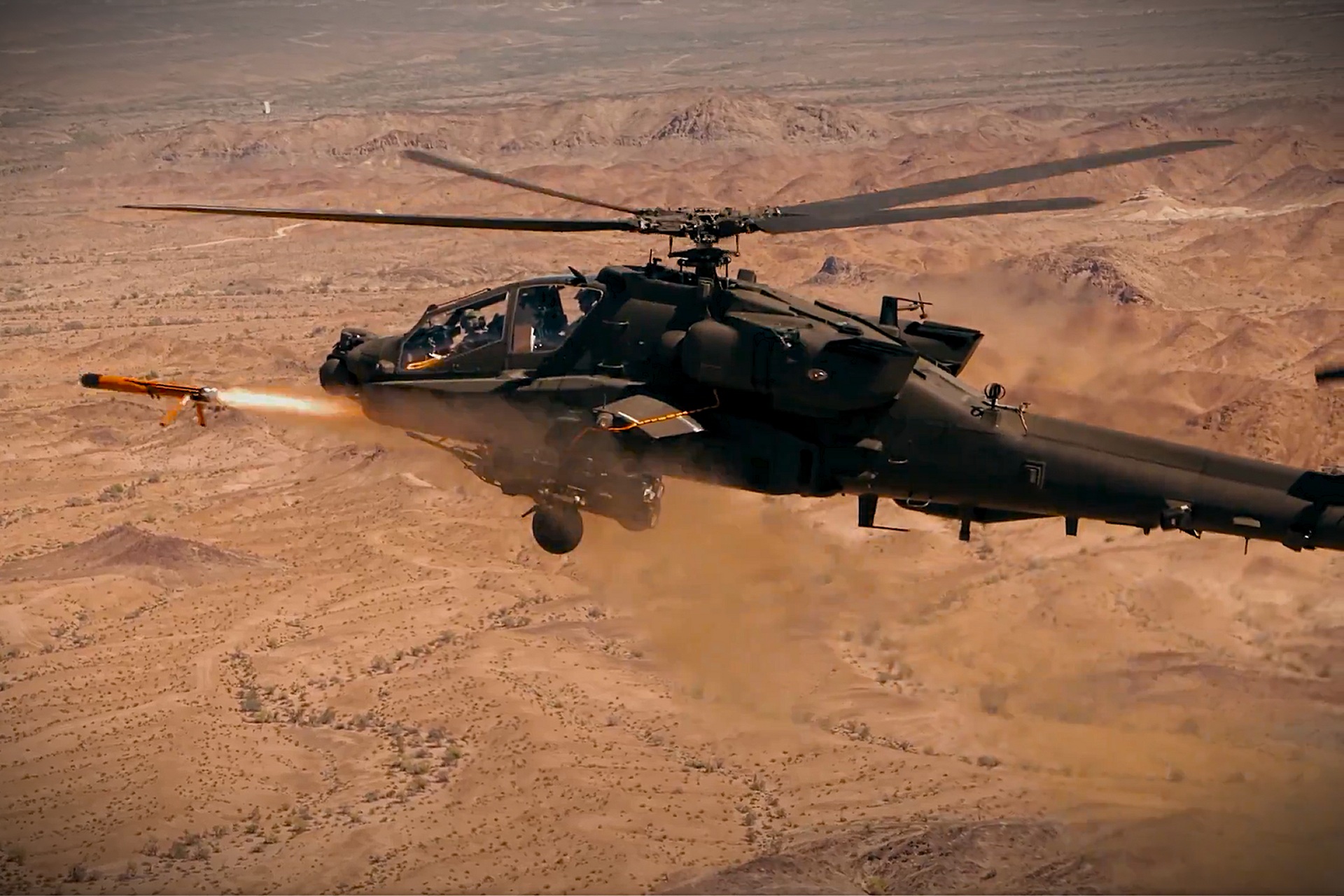
Britain selected Anduril UK to develop autonomous wingman drones for the British Army’s AH-64E Apache fleet under Project NYX (Picture Source: Anduril)
Anduril announced on May 15, 2026, that Anduril UK had been down-selected by the UK Ministry of Defence for the next phase of the British Army’s Project NYX, a programme aimed at developing autonomous collaborative platforms for AH-64E Apache attack helicopters. The decision places Anduril UK at the centre of a British effort to reshape attack aviation around uncrewed systems, artificial intelligence, and distributed combat mass. The move is relevant because it addresses a growing battlefield reality: crewed helicopters need greater reach, survivability, and sensor coverage to operate in increasingly contested environments.
Project NYX is designed to provide the British Army with uncrewed air systems capable of operating as loyal wingmen for Apache crews across reconnaissance, precision strike, target acquisition, and electronic warfare missions. According to the UK Ministry of Defence, the programme has now reached a new milestone with a £10 million investment and four selected industry partners: Anduril Industries UK, BAE Systems Operations, Tekever, and Thales UK. The MoD plans to assess the designs over the coming months before selecting up to two contenders in autumn 2026 for prototype work, with the aim of fielding an operational variant by 2030 if the prototypes prove successful.
For Anduril UK, the programme responds to a specific operational gap. The British Army’s AH-64E Apache remains one of the most capable attack helicopters in NATO service, but the spread of layered air defence systems, electronic warfare, battlefield surveillance, and low-cost drones has changed the risk calculus for rotary-wing forces. Instead of forcing Apache crews to move deeper into threat envelopes to detect, classify, and engage targets, Project NYX seeks to add autonomous airborne platforms able to extend the helicopter’s reach while keeping crews farther from first contact. The concept is based on “command rather than control,” meaning the uncrewed aircraft would operate within mission parameters without requiring pilots to directly fly them, while lethal decisions would remain under human authority.
Anduril’s proposed approach is built around collaborative mission autonomy rather than a conventional remotely piloted drone model. The company says its platform is being designed from the ground up to team with crewed aircraft, manage launched effects, and provide additional combat mass across wider areas of operation. This would allow Apache formations to distribute sensing, targeting, electronic effects, and potentially strike functions across a networked system instead of concentrating risk and decision-making inside a single crewed aircraft. For the British Army, that could create a more survivable aviation force able to penetrate or operate around defended areas while multiplying the number of sensors and effectors available to commanders.
The technical elements disclosed by Anduril suggest that its Project NYX solution will combine autonomy software with design features drawn from the hybrid-electric VTOL sector. The company refers to a platform capable of self-deploying over long distances, rapidly entering contested environments, and carrying payloads above the programme’s stated requirements. Anduril also stresses that the aircraft is intended to be open, modular, and interoperable, allowing future integration of UK sovereign sensors, effectors, and third-party payloads as mission needs evolve. This point is central to the programme’s long-term value: the aircraft must not only meet today’s Apache wingman requirement, but also remain adaptable as counter-drone systems, air defences, communications threats, and battlefield autonomy develop over the next decade.
Anduril UK is also presenting Project NYX as an industrial and sovereign capability effort. Since its launch in 2019, the company says it has grown to more than 100 engineers, designers, and specialists in the UK, while its test facility in north Wales is being used to push autonomous systems through regular trials. The company states that it has already invested tens of millions of pounds of its own funding into the capability it intends to deliver for NYX and has completed test flights of a full-scale surrogate vehicle while expanding its flight envelope. Its British industrial team includes GKN Aerospace, Isembard, Atom Performance Technologies, Flarebright, ISS Aerospace, and Rowden Technologies, while Archer Aviation is contributing VTOL design expertise and hybrid powertrain technology from its new UK engineering hub in Bristol.
The British programme also reflects a broader allied trend already visible in recent U.S. Army Apache testing. At Yuma Proving Ground, an AH-64 Apache launched an Altius 700 launched effect during the Cross Domain Fires Concept Focused Warfighting Experiment 26, demonstrating how attack helicopters can extend sensing and targeting beyond their own onboard systems. Army Recognition reported that the test included launches from both hover and movement, a significant step because it brings the concept closer to operational manoeuvre conditions. The same reporting noted that the Apache is evolving from a Cold War-era tank killer into a networked combat node able to project sensing, deception, and effects forward through autonomous systems.
Project NYX marks more than another drone procurement effort for the British Army. It indicates a shift in how attack aviation may be structured, with crewed helicopters acting less as isolated strike platforms and more as command nodes for autonomous systems able to scout, relay, disrupt, and engage across contested battlespace. Anduril UK’s down-selection gives the company an opportunity to turn its autonomy, hybrid-electric propulsion, and open-architecture claims into a deployable British capability. If the programme reaches operational service by 2030, the Apache force could gain a new layer of survivability and combat mass at a time when NATO armies are seeking faster, more distributed, and more resilient ways to fight against peer adversaries.
Written by Teoman S. Nicanci – Defense Analyst, Army Recognition Group
Teoman S. Nicanci holds degrees in Political Science, Comparative and International Politics, and International Relations and Diplomacy from leading Belgian universities, with research focused on Russian strategic behavior, defense technology, and modern warfare. He is a defense analyst at Army Recognition, specializing in the global defense industry, military armament, and emerging defense technologies.