US approves $3 billion deal to triple South Korea’s MH-60R Seahawk naval helicopter fleet
{loadposition bannertop}
{loadposition sidebarpub}
The United States has approved a possible $3 billion sale of 24 additional MH-60R Seahawk naval helicopters to South Korea, a move announced on May 18, 2026, that would triple the Republic of Korea Navy’s planned fleet from 12 to 36 aircraft and sharply expand its anti-submarine warfare capacity against growing North Korean underwater threats. The approval comes less than two months after the ROKN activated its first operational MH-60Rs at Jinhae Naval Base, signaling that Seoul is moving from a limited fleet replacement effort toward a broader restructuring of its maritime warfare posture focused on persistent submarine detection and fleet protection.
The expanded package equips the MH-60R with integrated dipping sonar, maritime surveillance radar, electronic warfare systems, and networked targeting capabilities that allow the helicopter to independently detect and engage submarine threats in the crowded littoral waters surrounding the Korean Peninsula. With enough aircraft to support continuous deployments across destroyers and frigates, the acquisition strengthens allied interoperability with the U.S. Navy while reinforcing South Korea’s shift toward networked, multi-domain combat operations designed to counter submarine-launched missile threats and maintain maritime control across the Indo-Pacific.
Related topic: Belgium considers U.S. MH-60R Seahawk helicopter for maritime search and rescue operations
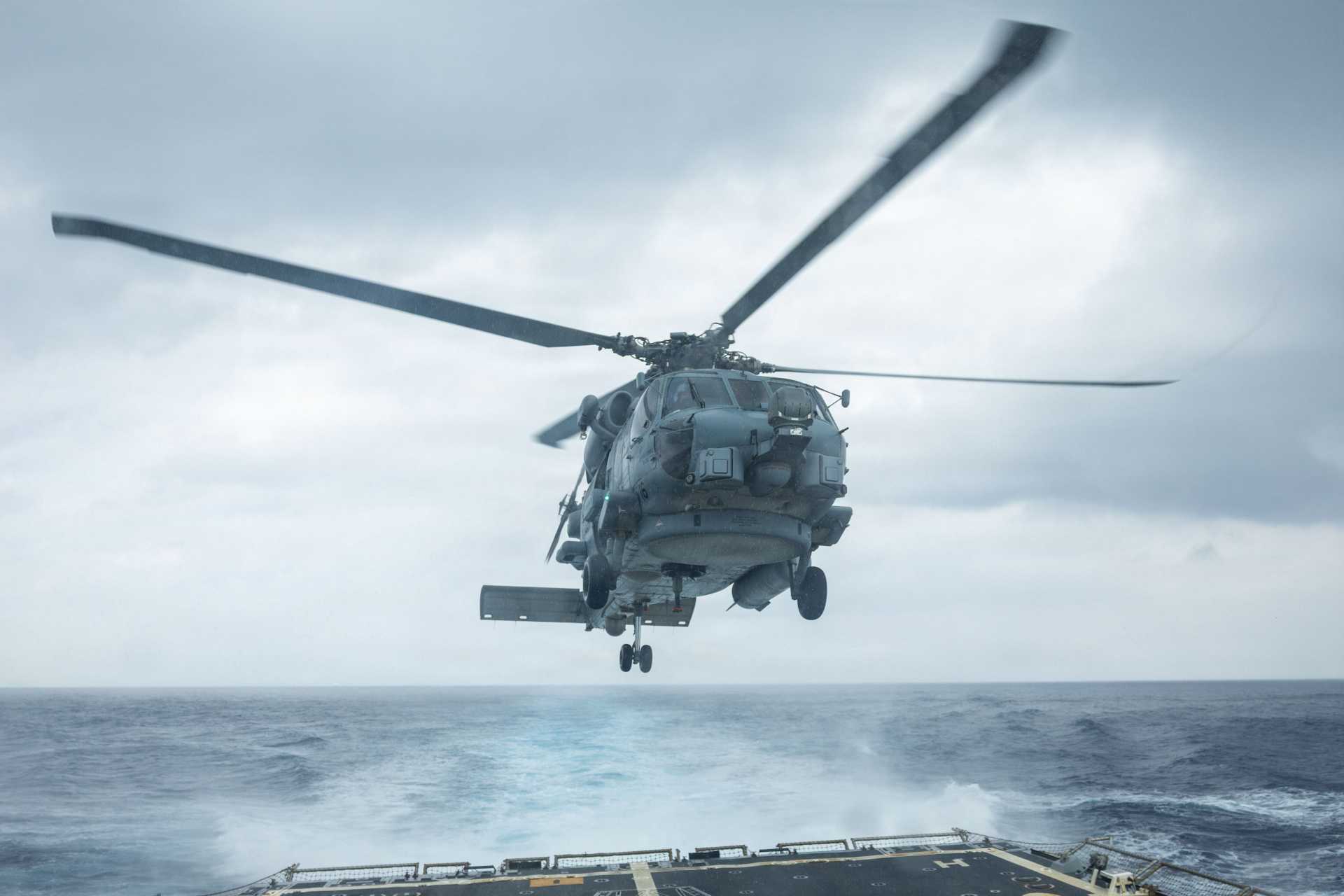
Issued alongside a $1.2 billion Apache helicopter modernization program, this potential $3 billion FMS would triple South Korea’s planned fleet of MH-60R Seahawk anti-submarine warfare helicopters from 12 to 36 units. (Picture source: US Navy)
On May 18, 2026, the U.S. State Department approved a possible $3 billion Foreign Military Sale (FMS) to South Korea for 24 additional MH-60R Seahawk multi-mission naval helicopters together with anti-submarine warfare (ASW) sensors, electronic warfare suites, training systems, sustainment equipment, and logistics support, less than seven weeks after the South Korean Navy (ROKN) activated its first two operational MH-60Rs on April 1, 2026, at Jinhae Naval Base with the 62nd Maritime Helicopter Squadron.
If implemented in full, the approval would triple South Korea’s planned MH-60R fleet from 12 to 36 helicopters, transforming the purchase from a limited replacement effort into a fleet-wide anti-submarine warfare restructuring. This FMS was issued simultaneously with a separate $1.2 billion AH-64E Apache modernization package for the South Korean Army, bringing the combined value of both approvals to $4.2 billion. At the same time, South Korean concerns regarding North Korea are growing, particularly about the Sinpo-class ballistic missile submarine program and the possible expansion of the country’s underwater launch capabilities.
The MH-60R package includes 24 helicopters, 52 Embedded GPS/Inertial Navigation Systems with Selective Availability Anti-Spoofing Modules including four spare units, 24 Airborne Low Frequency Sonars, APS-153(V) maritime surveillance radars, AN/ALQ-210 electronic support measures systems, AN/AAS-44C(V) EO/IR targeting systems, AN/AAR-47 missile warning systems, and AN/ALE-47 countermeasure dispensers.
South Korea also requested Joint Mission Planning Systems, Tactical Operational Flight Trainers, avionics training systems, weapons-loading trainers, communications equipment, software support, engineering services, spare engine containers, and sustainment infrastructure intended to support long-term operational readiness. Additional equipment includes eight M240D 7.62mm machine guns, T700-GE-401D engines, repair parts inventories, publications, and contractor logistics support. The structure of the package indicates that Seoul is preparing for continuous deployment operations involving multiple shipborne detachments rather than a small training-oriented fleet.
The approval substantially expands South Korea’s original Maritime Helicopter-II acquisition program signed in December 2020, under which Seoul acquired 12 MH-60Rs through a Foreign Military Sales agreement valued at roughly $878 million. The first helicopter arrived in South Korea in early 2025, and the first two MH-60Rs formally entered operational service on April 1, 2026. The initial acquisition program focused primarily on replacing aging anti-submarine helicopters and improving interoperability with U.S. Navy forces operating around the Korean Peninsula, but the new 24-unit package triples planned inventory levels and creates enough units for simultaneous deployments across multiple naval formations.
South Korea’s Defense Acquisition Program Administration (DAPA) is also conducting another naval helicopter competition valued at roughly $2.23 billion for the 2025-2032 period, with the MH-60R competing against the NHIndustries NH90, indicating that Seoul assesses its current anti-submarine helicopter fleet as insufficient for its projected operational requirements. The Republic of Korea Navy (ROKN) currently operates 24 Super Lynx Mk.99 and Mk.99A helicopters acquired during the 1990s, eight Leonardo AW159 Wildcats, and the first MH-60Rs now entering service.
The Super Lynx fleet increasingly faces sustainment and modernization limitations due to age, spare parts availability, and sensor obsolescence, while the AW159 fleet remains too small to sustain broad anti-submarine coverage across multiple naval task groups simultaneously. By contrast, the MH-60R combines dipping sonar capability, sonobuoy processing, maritime surveillance radar, electronic support measures, infrared targeting systems, and networked datalink architecture within a single helicopter capable of simultaneous anti-submarine and anti-surface warfare operations.
Expanding the inventory to 36 helicopters would provide enough MH-60Rs to sustain rotational deployments aboard KDX destroyers, Incheon-class frigates, and future surface combatants while reducing fragmentation between training, maintenance, and logistics pipelines. The MH-60R’s operational relevance for South Korea is tied primarily to its integrated sensor architecture and its ability to independently detect, classify, track, and engage submarine contacts in the congested littoral environments surrounding the Korean Peninsula.
Its primary acoustic sensor is the AN/AQS-22 Airborne Low Frequency Sonar (ALFS), a dipping sonar system in which the helicopter lowers the sonar into the water to conduct active and passive acoustic searches in real time. This low-frequency sonar was selected because it improves detection performance against quieter diesel-electric submarines operating at extended ranges. The Seahawk also carries the APS-153(V) maritime surveillance radar equipped with an Automatic Radar Periscope Detection and Discrimination (ARPDD) capability optimized for detecting periscopes, snorkels, semi-submerged contacts, and small surface objects within cluttered maritime environments.
Conditions around the Korean Peninsula involve dense commercial shipping traffic, fishing activity, shallow littoral waters, and extensive coastal interference, all of which complicate submarine detection operations and increase false contact rates, but the APS-153 processing architecture was specifically designed to manage such conditions. The MH-60R Seahawk emerged from the U.S. Navy’s effort to merge the operational roles of the SH-60B and SH-60F Seahawk variants into a single helicopter capable of simultaneous anti-submarine and anti-surface warfare operations.
The SH-60B specialized in LAMPS III (Light Airborne Multi-Purpose System) operations, maritime surveillance, and sonobuoy deployment, while the SH-60F focused on carrier-based dipping sonar anti-submarine operations. The resulting MH-60R entered U.S. Navy service in 2006 and achieved full operational capability in 2010 with an integrated mission architecture centered on the AN/AQS-22 ALFS sonar, APS-153 radar, AN/ALQ-210 electronic support measures suite, Link-16 tactical datalink, AN/AAR-47 missile warning system, AN/ALE-47 countermeasure dispensers, and AN/AAS-44C(V) electro-optical turret.
Acoustic, radar, infrared, and electronic sensor inputs are fused onboard into a unified tactical picture, reducing operator workload and allowing the helicopter to independently classify submarine contacts before transmitting targeting data directly to surface combatants, maritime patrol aircraft, and allied naval forces, particularly relevant for combined naval operations in the East China Sea and Sea of Japan. Structurally, the MH-60R remains derived from the UH-60 Black Hawk but incorporates naval modifications, including folding rotor blades, a hinged tail section, reinforced landing gear for deck recovery operations, and corrosion-resistant structural treatment for long-term saltwater exposure.
The helicopter measures 64 ft 10 in in length, stands roughly 17 ft high, and has a maximum gross weight of 23,500 lb while being powered by two GE T700-GE-401C or -401D engines optimized for maritime reliability and one-engine emergency recovery margins. Unlike earlier anti-submarine warfare concepts in which helicopters primarily localized contacts for ships to attack, the MH-60R can independently prosecute submarine targets using Mk 54 lightweight torpedoes, while also carrying AGM-114 Hellfire missiles, APKWS-guided rockets, and machine guns for anti-surface warfare missions.
The helicopter also introduced a fully digital cockpit replacing earlier analog Seahawk layouts, while integrated datalink connectivity enables cooperative submarine tracking, shared targeting information, and real-time integration with fleet combat management systems. Lockheed Martin reports fleet availability rates between 95% and 98%, operating costs below $6,500 per flight hour, and more than 350 MH-60Rs delivered globally, creating mature spare parts and sustainment economies among operators, including Australia, India, Denmark, Greece, Saudi Arabia, and South Korea.
The acquisition also reinforces long-term collaboration between U.S. and South Korean naval forces while directly addressing the underwater threat environment surrounding the Korean Peninsula. North Korea continues prioritizing submarine-launched ballistic missile development focused on survivable second-strike capability and covert maritime launch options to complicate allied surveillance and missile defense architectures. South Korea’s anti-submarine modernization, therefore, targets several operational requirements simultaneously, including detection of diesel-electric submarines in shallow littoral waters, tracking submerged missile-launch platforms, protection of naval task groups, and defense of maritime lines of communication.
Expansion of the Republic of Korea Navy’s MH-60R inventory also improves interoperability with U.S. Navy Helicopter Maritime Strike squadrons operating across the Indo-Pacific, with aircraft commonality simplifying maintenance procedures, logistics support, tactical coordination, joint exercises, and sensor data sharing. The simultaneous approval of the AH-64E Apache modernization package, including AN/APG-78 Longbow radars, Link-16 tactical terminals, and Manned-Unmanned Teaming X systems, demonstrates that Seoul’s current procurement cycle is focused on expanding networked combat capability across maritime and land domains rather than conducting isolated replacement acquisitions.
Written by Jérôme Brahy
Jérôme Brahy is a defense analyst and documentalist at Army Recognition. He specializes in naval modernization, aviation, drones, armored vehicles, and artillery, with a focus on strategic developments in the United States, China, Ukraine, Russia, Türkiye, and Belgium. His analyses go beyond the facts, providing context, identifying key actors, and explaining why defense news matters on a global scale.
{loadposition bannertop}
{loadposition sidebarpub}
The United States has approved a possible $3 billion sale of 24 additional MH-60R Seahawk naval helicopters to South Korea, a move announced on May 18, 2026, that would triple the Republic of Korea Navy’s planned fleet from 12 to 36 aircraft and sharply expand its anti-submarine warfare capacity against growing North Korean underwater threats. The approval comes less than two months after the ROKN activated its first operational MH-60Rs at Jinhae Naval Base, signaling that Seoul is moving from a limited fleet replacement effort toward a broader restructuring of its maritime warfare posture focused on persistent submarine detection and fleet protection.
The expanded package equips the MH-60R with integrated dipping sonar, maritime surveillance radar, electronic warfare systems, and networked targeting capabilities that allow the helicopter to independently detect and engage submarine threats in the crowded littoral waters surrounding the Korean Peninsula. With enough aircraft to support continuous deployments across destroyers and frigates, the acquisition strengthens allied interoperability with the U.S. Navy while reinforcing South Korea’s shift toward networked, multi-domain combat operations designed to counter submarine-launched missile threats and maintain maritime control across the Indo-Pacific.
Related topic: Belgium considers U.S. MH-60R Seahawk helicopter for maritime search and rescue operations
Issued alongside a $1.2 billion Apache helicopter modernization program, this potential $3 billion FMS would triple South Korea’s planned fleet of MH-60R Seahawk anti-submarine warfare helicopters from 12 to 36 units. (Picture source: US Navy)
On May 18, 2026, the U.S. State Department approved a possible $3 billion Foreign Military Sale (FMS) to South Korea for 24 additional MH-60R Seahawk multi-mission naval helicopters together with anti-submarine warfare (ASW) sensors, electronic warfare suites, training systems, sustainment equipment, and logistics support, less than seven weeks after the South Korean Navy (ROKN) activated its first two operational MH-60Rs on April 1, 2026, at Jinhae Naval Base with the 62nd Maritime Helicopter Squadron.
If implemented in full, the approval would triple South Korea’s planned MH-60R fleet from 12 to 36 helicopters, transforming the purchase from a limited replacement effort into a fleet-wide anti-submarine warfare restructuring. This FMS was issued simultaneously with a separate $1.2 billion AH-64E Apache modernization package for the South Korean Army, bringing the combined value of both approvals to $4.2 billion. At the same time, South Korean concerns regarding North Korea are growing, particularly about the Sinpo-class ballistic missile submarine program and the possible expansion of the country’s underwater launch capabilities.
The MH-60R package includes 24 helicopters, 52 Embedded GPS/Inertial Navigation Systems with Selective Availability Anti-Spoofing Modules including four spare units, 24 Airborne Low Frequency Sonars, APS-153(V) maritime surveillance radars, AN/ALQ-210 electronic support measures systems, AN/AAS-44C(V) EO/IR targeting systems, AN/AAR-47 missile warning systems, and AN/ALE-47 countermeasure dispensers.
South Korea also requested Joint Mission Planning Systems, Tactical Operational Flight Trainers, avionics training systems, weapons-loading trainers, communications equipment, software support, engineering services, spare engine containers, and sustainment infrastructure intended to support long-term operational readiness. Additional equipment includes eight M240D 7.62mm machine guns, T700-GE-401D engines, repair parts inventories, publications, and contractor logistics support. The structure of the package indicates that Seoul is preparing for continuous deployment operations involving multiple shipborne detachments rather than a small training-oriented fleet.
The approval substantially expands South Korea’s original Maritime Helicopter-II acquisition program signed in December 2020, under which Seoul acquired 12 MH-60Rs through a Foreign Military Sales agreement valued at roughly $878 million. The first helicopter arrived in South Korea in early 2025, and the first two MH-60Rs formally entered operational service on April 1, 2026. The initial acquisition program focused primarily on replacing aging anti-submarine helicopters and improving interoperability with U.S. Navy forces operating around the Korean Peninsula, but the new 24-unit package triples planned inventory levels and creates enough units for simultaneous deployments across multiple naval formations.
South Korea’s Defense Acquisition Program Administration (DAPA) is also conducting another naval helicopter competition valued at roughly $2.23 billion for the 2025-2032 period, with the MH-60R competing against the NHIndustries NH90, indicating that Seoul assesses its current anti-submarine helicopter fleet as insufficient for its projected operational requirements. The Republic of Korea Navy (ROKN) currently operates 24 Super Lynx Mk.99 and Mk.99A helicopters acquired during the 1990s, eight Leonardo AW159 Wildcats, and the first MH-60Rs now entering service.
The Super Lynx fleet increasingly faces sustainment and modernization limitations due to age, spare parts availability, and sensor obsolescence, while the AW159 fleet remains too small to sustain broad anti-submarine coverage across multiple naval task groups simultaneously. By contrast, the MH-60R combines dipping sonar capability, sonobuoy processing, maritime surveillance radar, electronic support measures, infrared targeting systems, and networked datalink architecture within a single helicopter capable of simultaneous anti-submarine and anti-surface warfare operations.
Expanding the inventory to 36 helicopters would provide enough MH-60Rs to sustain rotational deployments aboard KDX destroyers, Incheon-class frigates, and future surface combatants while reducing fragmentation between training, maintenance, and logistics pipelines. The MH-60R’s operational relevance for South Korea is tied primarily to its integrated sensor architecture and its ability to independently detect, classify, track, and engage submarine contacts in the congested littoral environments surrounding the Korean Peninsula.
Its primary acoustic sensor is the AN/AQS-22 Airborne Low Frequency Sonar (ALFS), a dipping sonar system in which the helicopter lowers the sonar into the water to conduct active and passive acoustic searches in real time. This low-frequency sonar was selected because it improves detection performance against quieter diesel-electric submarines operating at extended ranges. The Seahawk also carries the APS-153(V) maritime surveillance radar equipped with an Automatic Radar Periscope Detection and Discrimination (ARPDD) capability optimized for detecting periscopes, snorkels, semi-submerged contacts, and small surface objects within cluttered maritime environments.
Conditions around the Korean Peninsula involve dense commercial shipping traffic, fishing activity, shallow littoral waters, and extensive coastal interference, all of which complicate submarine detection operations and increase false contact rates, but the APS-153 processing architecture was specifically designed to manage such conditions. The MH-60R Seahawk emerged from the U.S. Navy’s effort to merge the operational roles of the SH-60B and SH-60F Seahawk variants into a single helicopter capable of simultaneous anti-submarine and anti-surface warfare operations.
The SH-60B specialized in LAMPS III (Light Airborne Multi-Purpose System) operations, maritime surveillance, and sonobuoy deployment, while the SH-60F focused on carrier-based dipping sonar anti-submarine operations. The resulting MH-60R entered U.S. Navy service in 2006 and achieved full operational capability in 2010 with an integrated mission architecture centered on the AN/AQS-22 ALFS sonar, APS-153 radar, AN/ALQ-210 electronic support measures suite, Link-16 tactical datalink, AN/AAR-47 missile warning system, AN/ALE-47 countermeasure dispensers, and AN/AAS-44C(V) electro-optical turret.
Acoustic, radar, infrared, and electronic sensor inputs are fused onboard into a unified tactical picture, reducing operator workload and allowing the helicopter to independently classify submarine contacts before transmitting targeting data directly to surface combatants, maritime patrol aircraft, and allied naval forces, particularly relevant for combined naval operations in the East China Sea and Sea of Japan. Structurally, the MH-60R remains derived from the UH-60 Black Hawk but incorporates naval modifications, including folding rotor blades, a hinged tail section, reinforced landing gear for deck recovery operations, and corrosion-resistant structural treatment for long-term saltwater exposure.
The helicopter measures 64 ft 10 in in length, stands roughly 17 ft high, and has a maximum gross weight of 23,500 lb while being powered by two GE T700-GE-401C or -401D engines optimized for maritime reliability and one-engine emergency recovery margins. Unlike earlier anti-submarine warfare concepts in which helicopters primarily localized contacts for ships to attack, the MH-60R can independently prosecute submarine targets using Mk 54 lightweight torpedoes, while also carrying AGM-114 Hellfire missiles, APKWS-guided rockets, and machine guns for anti-surface warfare missions.
The helicopter also introduced a fully digital cockpit replacing earlier analog Seahawk layouts, while integrated datalink connectivity enables cooperative submarine tracking, shared targeting information, and real-time integration with fleet combat management systems. Lockheed Martin reports fleet availability rates between 95% and 98%, operating costs below $6,500 per flight hour, and more than 350 MH-60Rs delivered globally, creating mature spare parts and sustainment economies among operators, including Australia, India, Denmark, Greece, Saudi Arabia, and South Korea.
The acquisition also reinforces long-term collaboration between U.S. and South Korean naval forces while directly addressing the underwater threat environment surrounding the Korean Peninsula. North Korea continues prioritizing submarine-launched ballistic missile development focused on survivable second-strike capability and covert maritime launch options to complicate allied surveillance and missile defense architectures. South Korea’s anti-submarine modernization, therefore, targets several operational requirements simultaneously, including detection of diesel-electric submarines in shallow littoral waters, tracking submerged missile-launch platforms, protection of naval task groups, and defense of maritime lines of communication.
Expansion of the Republic of Korea Navy’s MH-60R inventory also improves interoperability with U.S. Navy Helicopter Maritime Strike squadrons operating across the Indo-Pacific, with aircraft commonality simplifying maintenance procedures, logistics support, tactical coordination, joint exercises, and sensor data sharing. The simultaneous approval of the AH-64E Apache modernization package, including AN/APG-78 Longbow radars, Link-16 tactical terminals, and Manned-Unmanned Teaming X systems, demonstrates that Seoul’s current procurement cycle is focused on expanding networked combat capability across maritime and land domains rather than conducting isolated replacement acquisitions.
Written by Jérôme Brahy
Jérôme Brahy is a defense analyst and documentalist at Army Recognition. He specializes in naval modernization, aviation, drones, armored vehicles, and artillery, with a focus on strategic developments in the United States, China, Ukraine, Russia, Türkiye, and Belgium. His analyses go beyond the facts, providing context, identifying key actors, and explaining why defense news matters on a global scale.