U.S. Air Force A-10C Thunderbolt II Trains to Evade Modern Air Defenses While Delivering Precision Strikes
{loadposition bannertop}
{loadposition sidebarpub}
U.S. Air Force A-10C Thunderbolt II attack aircraft are training to deliver close air support in contested airspace, with imagery released on June 8, 2026, by the U.S. Defense Visual Information Distribution Service showing a 66th Weapons Squadron aircraft deploying defensive flares over the Nevada Test and Training Range. The mission illustrates how the Air Force is refining Warthog tactics for environments where infrared-guided missiles, drones, electronic warfare, and mobile air-defense systems can threaten aircraft operating near ground forces.
The training reinforces the A-10C’s continued relevance as a heavily armed attack aircraft able to loiter, visually confirm targets, and provide sustained fire support under pressure. Its effectiveness in future missions will depend not only on its weapons load, but on survivability drills, joint-force integration, resilient communications, threat awareness, and precise timing in high-risk battlespaces.
Related Topic: U.S. Central Command Reveals Armed A-10 Warthog Attack Aircraft Supporting Operation Epic Fury Against Iran
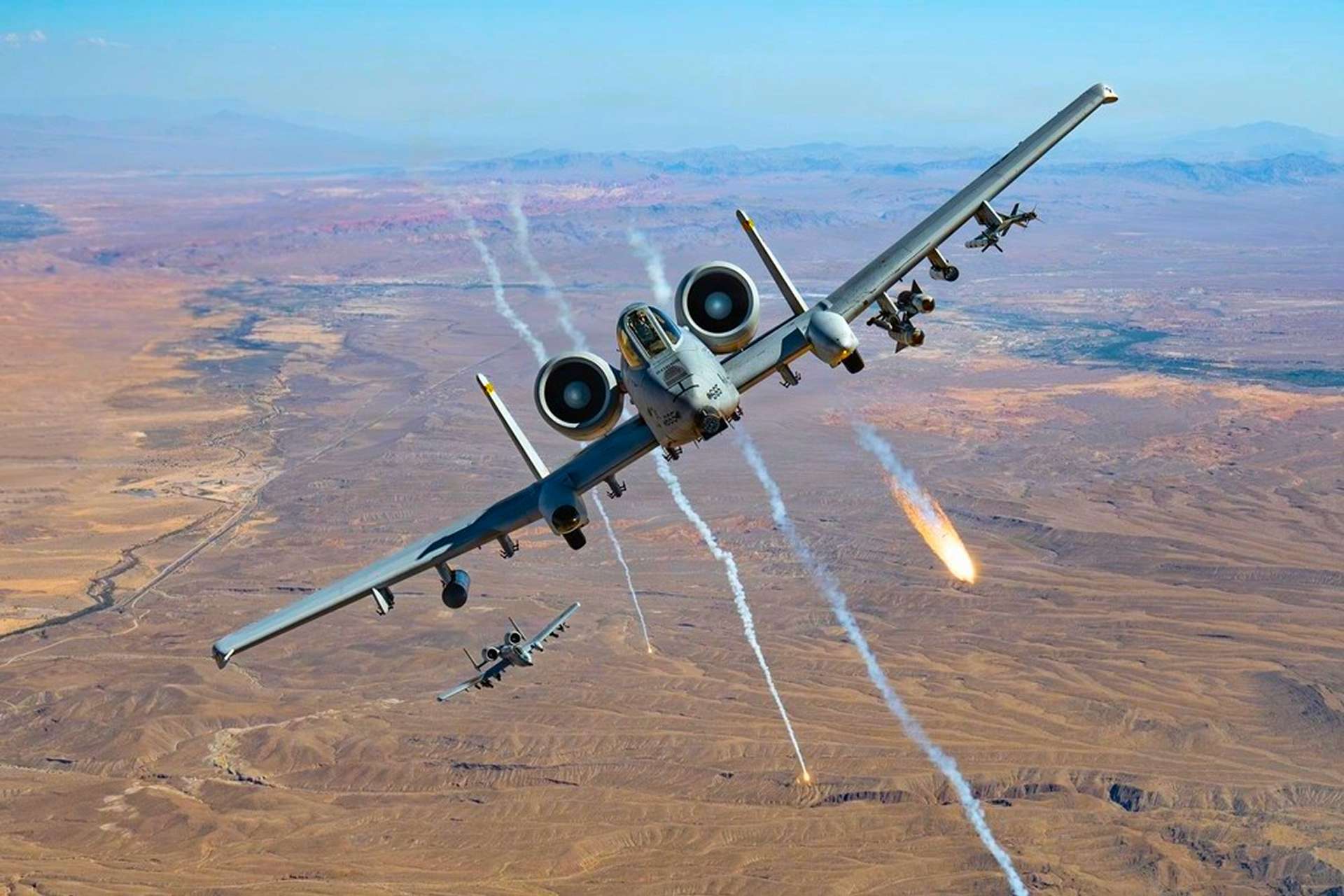
The U.S. Air Force is training A-10 Warthog crews to survive and deliver close air support in contested combat environments, using advanced Weapons School exercises that emphasize missile-threat evasion, joint-force integration, and battlefield survivability (Picture Source: U.S. Air Force)
On June 8, 2026, the U.S. Defense Visual Information Distribution Service released new imagery showing U.S. Air Force A-10 Thunderbolt II attack aircraft from the 66th Weapons Squadron conducting a Weapons School Integration mission over the Nevada Test and Training Range. Captured on May 28, the sequence shows an A-10 deploying defensive flares during an evasive maneuver, offering a rare visual insight into how the U.S. Air Force is preparing its close-air-support force to survive and operate in increasingly contested battlespaces. More than a routine training release, the imagery highlights the continued tactical relevance of the A-10 as the service refines its ability to integrate attack aviation with multiple mission partners, following the aircraft’s recent operational employment during Operation Epic Fury as a persistent close-air-support, armed-overwatch, and strike platform.
The mission was conducted by A-10 Thunderbolt II aircraft assigned to the 66th Weapons Squadron, part of the U.S. Air Force Weapons School. This unit is responsible for developing advanced tactical expertise and instructor-level proficiency for the A-10 community, ensuring that operational squadrons benefit from lessons learned in high-end training environments. A Weapons School Integration mission, commonly referred to as WSINT, is not a routine flight event. It is a demanding capstone scenario designed to challenge students to build tactically relevant plans, employ weapons effectively, and integrate multiple mission partners across combat, mobility, intelligence, command-and-control, and support functions.
The most visible and operationally relevant element of the release is the A-10 deploying defensive flares while performing an evasive maneuver. In military aviation, flares are infrared countermeasures designed to decoy infrared-guided missiles away from the aircraft. Their use during WSINT reflects the type of threat environment the U.S. Air Force is preparing for: a battlefield where close-air-support aircraft may face man-portable air-defense systems, mobile short-range air-defense systems, infrared-guided missiles, armed drones, electronic warfare, and dispersed enemy formations. For the A-10, which was designed to operate near friendly forces and close to hostile positions, survivability is directly linked to mission success.
The A-10C Thunderbolt II remains one of the most specialized combat aircraft in the U.S. Air Force inventory. Designed primarily for close air support, it is built around the 30mm GAU-8/A Avenger seven-barrel Gatling gun and can carry a flexible weapons load that may include AGM-65 Maverick air-to-surface missiles, laser-guided bombs, GPS-guided bombs, rockets, AIM-9 Sidewinder air-to-air missiles, electronic countermeasure equipment, chaff, and infrared countermeasure flares. Its operational value lies in its ability to operate at low altitude and low airspeed, remain near the battlefield, visually acquire and confirm targets, provide accurate fire support, and deliver sustained armed presence in direct support of forces on the ground.
That operational relevance was recently illustrated during Operation Epic Fury. According to Army Recognition, imagery released by U.S. Central Command showed armed A-10 Warthog attack aircraft supporting the operation, highlighting the platform’s endurance, in-flight refueling compatibility, and ability to carry a mixed combat load adapted to dynamic missions. In that context, the A-10 was not merely presented as a traditional close-air-support aircraft, but as a persistent armed presence able to support strike operations, armed overwatch, route security, maritime-adjacent surveillance, and rapid response against emerging tactical threats in a complex regional theater. Its combination of the 30mm GAU-8/A Avenger cannon, guided air-to-surface weapons, rockets, defensive systems, and extended loiter time gives commanders an aircraft capable of maintaining pressure on hostile forces while remaining available for time-sensitive engagements.
The WSINT mission over Nevada therefore appears closely aligned with the operational demands now shaping U.S. airpower employment. The U.S. Air Force is preparing A-10 crews for scenarios in which close air support will no longer unfold in permissive skies or against lightly defended ground targets, but in environments where aircrews must coordinate with multiple layers of the joint force before, during, and after weapons release. Future A-10 missions may require direct integration with fifth-generation fighters, intelligence-surveillance-reconnaissance aircraft, unmanned systems, electronic-warfare platforms, aerial refueling tankers, special operations teams, joint terminal attack controllers, and distributed command-and-control nodes. Under such conditions, the aircraft’s effectiveness will depend not only on its weapons load, but on the pilot’s ability to interpret a fragmented battlespace, manage threat exposure, exploit brief windows of tactical advantage, and deliver effects that support the commander’s wider operational plan.
This training also reveals what the U.S. Air Force is preparing for at the operational level: conflicts in which air superiority may be contested, temporary, or limited to specific areas rather than assumed across the entire theater. Potential adversaries can combine surface-to-air missile systems, passive detection networks, electronic attack, cyber disruption, one-way attack drones, loitering munitions, mobile launchers, and dispersed ground formations to complicate U.S. air operations. For an aircraft such as the A-10, this demands disciplined mission planning, carefully coordinated ingress and egress routes, integration with suppression or degradation of enemy air defenses, resilient communications, real-time threat updates, and rehearsed defensive reactions against missile engagements. The flare deployment seen over the Nevada Test and Training Range is therefore not only a dramatic image, but a visible indicator of training for dense, mobile, and fast-evolving threat environments where survivability and tactical integration may decide whether close air support can be delivered at the decisive moment.
The continued presence of the A-10 in advanced Weapons School training also reflects a broader reality for the U.S. Air Force. Despite repeated debates over the aircraft’s future, the Warthog remains operationally relevant because it offers a combination of endurance, weapons flexibility, battlefield presence, and close coordination with ground forces that is difficult to replace immediately in certain mission sets. Operation Epic Fury showed that the aircraft can still be employed in a modern campaign, while WSINT demonstrates that its tactics are being refined for more demanding conditions. The A-10 may not represent the long-term future of U.S. tactical aviation, but it remains a combat asset that the Air Force is training to use with precision, caution, and integration.
The Nevada mission sends a clear strategic message: the A-10 is not being prepared for yesterday’s battlefield, but for the contested combat environment already redefining modern air warfare. From its recent operational employment during Operation Epic Fury to its participation in the Weapons School Integration mission over the Nevada Test and Training Range, the Warthog’s continued value now rests on far more than the firepower of its 30mm cannon or its legacy reputation. Its relevance depends on survivability, joint-force integration, disciplined mission planning, resilient communications, and the ability to deliver close air support when access to the battlespace is no longer guaranteed. The flare trail behind the A-10 captures this evolution in a single image: a battle-proven attack aircraft adapting to a future in which coordination, threat awareness, and tactical timing may determine whether decisive air support can reach forces on the ground at the critical moment.
Explore More Defense News
• Land Defense News• Naval Defense News• Defense Aerospace News
Written by Teoman S. Nicanci – Defense Analyst, Army Recognition Group
Teoman S. Nicanci holds degrees in Political Science, Comparative and International Politics, and International Relations and Diplomacy from leading Belgian universities, with research focused on Russian strategic behavior, defense technology, and modern warfare. He is a defense analyst at Army Recognition, specializing in the global defense industry, military armament, and emerging defense technologies.
{loadposition bannertop}
{loadposition sidebarpub}
U.S. Air Force A-10C Thunderbolt II attack aircraft are training to deliver close air support in contested airspace, with imagery released on June 8, 2026, by the U.S. Defense Visual Information Distribution Service showing a 66th Weapons Squadron aircraft deploying defensive flares over the Nevada Test and Training Range. The mission illustrates how the Air Force is refining Warthog tactics for environments where infrared-guided missiles, drones, electronic warfare, and mobile air-defense systems can threaten aircraft operating near ground forces.
The training reinforces the A-10C’s continued relevance as a heavily armed attack aircraft able to loiter, visually confirm targets, and provide sustained fire support under pressure. Its effectiveness in future missions will depend not only on its weapons load, but on survivability drills, joint-force integration, resilient communications, threat awareness, and precise timing in high-risk battlespaces.
Related Topic: U.S. Central Command Reveals Armed A-10 Warthog Attack Aircraft Supporting Operation Epic Fury Against Iran
The U.S. Air Force is training A-10 Warthog crews to survive and deliver close air support in contested combat environments, using advanced Weapons School exercises that emphasize missile-threat evasion, joint-force integration, and battlefield survivability (Picture Source: U.S. Air Force)
On June 8, 2026, the U.S. Defense Visual Information Distribution Service released new imagery showing U.S. Air Force A-10 Thunderbolt II attack aircraft from the 66th Weapons Squadron conducting a Weapons School Integration mission over the Nevada Test and Training Range. Captured on May 28, the sequence shows an A-10 deploying defensive flares during an evasive maneuver, offering a rare visual insight into how the U.S. Air Force is preparing its close-air-support force to survive and operate in increasingly contested battlespaces. More than a routine training release, the imagery highlights the continued tactical relevance of the A-10 as the service refines its ability to integrate attack aviation with multiple mission partners, following the aircraft’s recent operational employment during Operation Epic Fury as a persistent close-air-support, armed-overwatch, and strike platform.
The mission was conducted by A-10 Thunderbolt II aircraft assigned to the 66th Weapons Squadron, part of the U.S. Air Force Weapons School. This unit is responsible for developing advanced tactical expertise and instructor-level proficiency for the A-10 community, ensuring that operational squadrons benefit from lessons learned in high-end training environments. A Weapons School Integration mission, commonly referred to as WSINT, is not a routine flight event. It is a demanding capstone scenario designed to challenge students to build tactically relevant plans, employ weapons effectively, and integrate multiple mission partners across combat, mobility, intelligence, command-and-control, and support functions.
The most visible and operationally relevant element of the release is the A-10 deploying defensive flares while performing an evasive maneuver. In military aviation, flares are infrared countermeasures designed to decoy infrared-guided missiles away from the aircraft. Their use during WSINT reflects the type of threat environment the U.S. Air Force is preparing for: a battlefield where close-air-support aircraft may face man-portable air-defense systems, mobile short-range air-defense systems, infrared-guided missiles, armed drones, electronic warfare, and dispersed enemy formations. For the A-10, which was designed to operate near friendly forces and close to hostile positions, survivability is directly linked to mission success.
The A-10C Thunderbolt II remains one of the most specialized combat aircraft in the U.S. Air Force inventory. Designed primarily for close air support, it is built around the 30mm GAU-8/A Avenger seven-barrel Gatling gun and can carry a flexible weapons load that may include AGM-65 Maverick air-to-surface missiles, laser-guided bombs, GPS-guided bombs, rockets, AIM-9 Sidewinder air-to-air missiles, electronic countermeasure equipment, chaff, and infrared countermeasure flares. Its operational value lies in its ability to operate at low altitude and low airspeed, remain near the battlefield, visually acquire and confirm targets, provide accurate fire support, and deliver sustained armed presence in direct support of forces on the ground.
That operational relevance was recently illustrated during Operation Epic Fury. According to Army Recognition, imagery released by U.S. Central Command showed armed A-10 Warthog attack aircraft supporting the operation, highlighting the platform’s endurance, in-flight refueling compatibility, and ability to carry a mixed combat load adapted to dynamic missions. In that context, the A-10 was not merely presented as a traditional close-air-support aircraft, but as a persistent armed presence able to support strike operations, armed overwatch, route security, maritime-adjacent surveillance, and rapid response against emerging tactical threats in a complex regional theater. Its combination of the 30mm GAU-8/A Avenger cannon, guided air-to-surface weapons, rockets, defensive systems, and extended loiter time gives commanders an aircraft capable of maintaining pressure on hostile forces while remaining available for time-sensitive engagements.
The WSINT mission over Nevada therefore appears closely aligned with the operational demands now shaping U.S. airpower employment. The U.S. Air Force is preparing A-10 crews for scenarios in which close air support will no longer unfold in permissive skies or against lightly defended ground targets, but in environments where aircrews must coordinate with multiple layers of the joint force before, during, and after weapons release. Future A-10 missions may require direct integration with fifth-generation fighters, intelligence-surveillance-reconnaissance aircraft, unmanned systems, electronic-warfare platforms, aerial refueling tankers, special operations teams, joint terminal attack controllers, and distributed command-and-control nodes. Under such conditions, the aircraft’s effectiveness will depend not only on its weapons load, but on the pilot’s ability to interpret a fragmented battlespace, manage threat exposure, exploit brief windows of tactical advantage, and deliver effects that support the commander’s wider operational plan.
This training also reveals what the U.S. Air Force is preparing for at the operational level: conflicts in which air superiority may be contested, temporary, or limited to specific areas rather than assumed across the entire theater. Potential adversaries can combine surface-to-air missile systems, passive detection networks, electronic attack, cyber disruption, one-way attack drones, loitering munitions, mobile launchers, and dispersed ground formations to complicate U.S. air operations. For an aircraft such as the A-10, this demands disciplined mission planning, carefully coordinated ingress and egress routes, integration with suppression or degradation of enemy air defenses, resilient communications, real-time threat updates, and rehearsed defensive reactions against missile engagements. The flare deployment seen over the Nevada Test and Training Range is therefore not only a dramatic image, but a visible indicator of training for dense, mobile, and fast-evolving threat environments where survivability and tactical integration may decide whether close air support can be delivered at the decisive moment.
The continued presence of the A-10 in advanced Weapons School training also reflects a broader reality for the U.S. Air Force. Despite repeated debates over the aircraft’s future, the Warthog remains operationally relevant because it offers a combination of endurance, weapons flexibility, battlefield presence, and close coordination with ground forces that is difficult to replace immediately in certain mission sets. Operation Epic Fury showed that the aircraft can still be employed in a modern campaign, while WSINT demonstrates that its tactics are being refined for more demanding conditions. The A-10 may not represent the long-term future of U.S. tactical aviation, but it remains a combat asset that the Air Force is training to use with precision, caution, and integration.
The Nevada mission sends a clear strategic message: the A-10 is not being prepared for yesterday’s battlefield, but for the contested combat environment already redefining modern air warfare. From its recent operational employment during Operation Epic Fury to its participation in the Weapons School Integration mission over the Nevada Test and Training Range, the Warthog’s continued value now rests on far more than the firepower of its 30mm cannon or its legacy reputation. Its relevance depends on survivability, joint-force integration, disciplined mission planning, resilient communications, and the ability to deliver close air support when access to the battlespace is no longer guaranteed. The flare trail behind the A-10 captures this evolution in a single image: a battle-proven attack aircraft adapting to a future in which coordination, threat awareness, and tactical timing may determine whether decisive air support can reach forces on the ground at the critical moment.
Explore More Defense News
• Land Defense News
• Naval Defense News
• Defense Aerospace News
Written by Teoman S. Nicanci – Defense Analyst, Army Recognition Group
Teoman S. Nicanci holds degrees in Political Science, Comparative and International Politics, and International Relations and Diplomacy from leading Belgian universities, with research focused on Russian strategic behavior, defense technology, and modern warfare. He is a defense analyst at Army Recognition, specializing in the global defense industry, military armament, and emerging defense technologies.