X-BAT Clears Its Most Critical Propulsion Test on the Path to Vertical Flight
{loadposition bannertop}
{loadposition sidebarpub}
Shield AI has moved X-BAT significantly closer to vertical flight after successfully completing integration, actuation and engine light-off testing of its AVEN thrust-vectoring nozzle with the F110-GE-129E engine, the company announced with GE Aerospace on July 20, 2026. The milestone is critical because X-BAT’s ability to operate without runways, survive in contested environments and generate combat power from dispersed locations depends entirely on this propulsion system performing as designed.
The successful test confirmed that the engine and AVEN nozzle function together as an integrated propulsion system, paving the way for the aircraft’s first vertical-flight demonstrations. If validated in flight, this capability could enable autonomous combat aircraft to launch from ships, remote islands and austere forward sites, supporting distributed operations and reducing dependence on vulnerable airbases in future high-intensity conflicts, particularly across the Indo-Pacific.
Related Topic: Shield AI Tests Key X-BAT Technologies Ahead of Autonomous VTOL Fighter’s First Flight
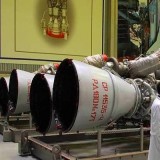
Shield AI and GE Aerospace successfully tested the X-BAT’s integrated AVEN thrust-vectoring nozzle and F110 engine, clearing a critical propulsion milestone toward runway-independent vertical flight (Picture Source: Shield AI)
On July 20, 2026, Shield AI and GE Aerospace announced the successful integration, actuation and engine light-off testing of the advanced Axisymmetric Vectoring Exhaust Nozzle, or AVEN, for the X-BAT aircraft. Conducted at GE Aerospace’s test operations site in Peebles, Ohio, the campaign marks the most decisive milestone yet in transforming X-BAT from an ambitious autonomous fighter concept into a runway-independent combat aircraft. The achievement is particularly significant because X-BAT’s entire operational promise depends on its ability to take off and land vertically. According to Shield AI, the test has now cleared a critical path toward the aircraft’s first vertical-flight demonstrations.
The Technology That Will Determine X-BAT’s Future
Engineers from Shield AI and GE Aerospace modified and integrated the AVEN nozzle into the F110-GE-129E engine before completing functional checkouts, coordinated nozzle movements and engine light-off testing. For the first time since the 1990s, AVEN’s hardware, control systems and engine architecture were brought together in a fully integrated campaign of this kind. The test demonstrated that the engine and thrust-vectoring nozzle could respond to defined control sequences as a unified propulsion system, moving X-BAT beyond isolated component trials and into a more advanced stage of aircraft development.
This milestone is the most important achievement in the X-BAT program so far because vertical flight cannot be delivered through aerodynamic design alone. During takeoff, hovering and landing, the aircraft must use precisely directed engine thrust to maintain balance, control its attitude and prevent instability. “X-BAT is designed to take off and land vertically from anywhere, no airbase, no runway, and that capability lives or dies with propulsion,” said Armor Harris, senior vice president of aircraft engineering at Shield AI. AVEN is therefore not an additional performance feature; it is the technology on which the aircraft’s entire operational concept depends.
AVEN was originally developed for a multi-axis thrust-vectoring program flown aboard an F-16 in the 1990s, accumulating 73 hours of ground testing and 135 flight hours across 95 flights. Shield AI and GE Aerospace have now refurbished and adapted that proven hardware for a significantly different mission requiring faster nozzle gimbaling and more demanding attitude control during vertical operations. Its integration with the F110-GE-129E combines established thrust-vectoring technology with an engine family that has accumulated more than 11 million flight hours, allowing the program to advance without starting from an unproven propulsion architecture.
Rewriting the Indo-Pacific Basing Equation
The strategic importance of vertical flight extends far beyond the aircraft’s technical performance. X-BAT is being developed to confront some of the most serious vulnerabilities facing modern air forces: concentrated bases, exposed runways and the growing ability of adversaries to strike fixed infrastructure with precision weapons. These risks are especially acute in the Indo-Pacific, where operations are spread across enormous distances and conventional combat aircraft depend on a limited network of airfields located on islands and coastal territories. Runways can be monitored, targeted, cratered or temporarily closed, potentially grounding aircraft at the moment they are most urgently needed.
A long-range and survivable aircraft capable of operating without a runway could fundamentally change military planning across the region. X-BAT could potentially disperse aboard ships, isolated islands, remote forward positions and temporary operating sites, creating a distributed network of launch and recovery points that would be far more difficult for an adversary to identify and neutralize. Instead of concentrating combat power at a small number of predictable airbases, commanders could reposition autonomous aircraft across multiple locations, preserve operational momentum after attacks and force an opponent to devote more surveillance assets and weapons to a much larger target set.
Powered by Shield AI’s Hivemind autonomy software, X-BAT is designed to operate independently or alongside crewed aircraft as part of a wider force package. The aircraft is expected to carry weapons in the 2,000-pound class internally, deliver a combat radius of approximately 1,000 nautical miles and generate 80 kilowatts of electrical power for electronic warfare, intelligence, surveillance, reconnaissance and radar systems. The successful engine light-off does not yet constitute vertical flight, and the program must still demonstrate controlled lift, stable hovering, transition to forward flight, thermal management and repeatable recovery. However, the Peebles campaign confirms that the aircraft’s most critical propulsion components can function together, clearing the technical gateway through which the entire X-BAT concept must pass.
The AVEN integration and F110 engine light-off represent more than a successful propulsion test; they mark a potential turning point in the future of American combat aviation. If Shield AI converts this achievement into reliable vertical-flight performance, X-BAT could give U.S. forces the ability to generate autonomous airpower from locations where conventional fighters cannot operate. Across the Indo-Pacific, ships, isolated islands and austere forward positions could become unpredictable combat nodes, strengthening U.S. future air supremacy through mobility, autonomy and freedom from vulnerable runway infrastructure.
Written by Teoman S. Nicanci – Defense Analyst, Army Recognition Group
Teoman S. Nicanci holds degrees in Political Science, Comparative and International Politics, and International Relations and Diplomacy from leading Belgian universities, with research focused on Russian strategic behavior, defense technology, and modern warfare. He is a defense analyst at Army Recognition, specializing in the global defense industry, military armament, and emerging defense technologies.
Explore More Defense News
• Land Defense News• Naval Defense News• Defense Aerospace News
{loadposition bannertop}
{loadposition sidebarpub}
Shield AI has moved X-BAT significantly closer to vertical flight after successfully completing integration, actuation and engine light-off testing of its AVEN thrust-vectoring nozzle with the F110-GE-129E engine, the company announced with GE Aerospace on July 20, 2026. The milestone is critical because X-BAT’s ability to operate without runways, survive in contested environments and generate combat power from dispersed locations depends entirely on this propulsion system performing as designed.
The successful test confirmed that the engine and AVEN nozzle function together as an integrated propulsion system, paving the way for the aircraft’s first vertical-flight demonstrations. If validated in flight, this capability could enable autonomous combat aircraft to launch from ships, remote islands and austere forward sites, supporting distributed operations and reducing dependence on vulnerable airbases in future high-intensity conflicts, particularly across the Indo-Pacific.
Related Topic: Shield AI Tests Key X-BAT Technologies Ahead of Autonomous VTOL Fighter’s First Flight
Shield AI and GE Aerospace successfully tested the X-BAT’s integrated AVEN thrust-vectoring nozzle and F110 engine, clearing a critical propulsion milestone toward runway-independent vertical flight (Picture Source: Shield AI)
On July 20, 2026, Shield AI and GE Aerospace announced the successful integration, actuation and engine light-off testing of the advanced Axisymmetric Vectoring Exhaust Nozzle, or AVEN, for the X-BAT aircraft. Conducted at GE Aerospace’s test operations site in Peebles, Ohio, the campaign marks the most decisive milestone yet in transforming X-BAT from an ambitious autonomous fighter concept into a runway-independent combat aircraft. The achievement is particularly significant because X-BAT’s entire operational promise depends on its ability to take off and land vertically. According to Shield AI, the test has now cleared a critical path toward the aircraft’s first vertical-flight demonstrations.
The Technology That Will Determine X-BAT’s Future
Engineers from Shield AI and GE Aerospace modified and integrated the AVEN nozzle into the F110-GE-129E engine before completing functional checkouts, coordinated nozzle movements and engine light-off testing. For the first time since the 1990s, AVEN’s hardware, control systems and engine architecture were brought together in a fully integrated campaign of this kind. The test demonstrated that the engine and thrust-vectoring nozzle could respond to defined control sequences as a unified propulsion system, moving X-BAT beyond isolated component trials and into a more advanced stage of aircraft development.
This milestone is the most important achievement in the X-BAT program so far because vertical flight cannot be delivered through aerodynamic design alone. During takeoff, hovering and landing, the aircraft must use precisely directed engine thrust to maintain balance, control its attitude and prevent instability. “X-BAT is designed to take off and land vertically from anywhere, no airbase, no runway, and that capability lives or dies with propulsion,” said Armor Harris, senior vice president of aircraft engineering at Shield AI. AVEN is therefore not an additional performance feature; it is the technology on which the aircraft’s entire operational concept depends.
AVEN was originally developed for a multi-axis thrust-vectoring program flown aboard an F-16 in the 1990s, accumulating 73 hours of ground testing and 135 flight hours across 95 flights. Shield AI and GE Aerospace have now refurbished and adapted that proven hardware for a significantly different mission requiring faster nozzle gimbaling and more demanding attitude control during vertical operations. Its integration with the F110-GE-129E combines established thrust-vectoring technology with an engine family that has accumulated more than 11 million flight hours, allowing the program to advance without starting from an unproven propulsion architecture.
Rewriting the Indo-Pacific Basing Equation
The strategic importance of vertical flight extends far beyond the aircraft’s technical performance. X-BAT is being developed to confront some of the most serious vulnerabilities facing modern air forces: concentrated bases, exposed runways and the growing ability of adversaries to strike fixed infrastructure with precision weapons. These risks are especially acute in the Indo-Pacific, where operations are spread across enormous distances and conventional combat aircraft depend on a limited network of airfields located on islands and coastal territories. Runways can be monitored, targeted, cratered or temporarily closed, potentially grounding aircraft at the moment they are most urgently needed.
A long-range and survivable aircraft capable of operating without a runway could fundamentally change military planning across the region. X-BAT could potentially disperse aboard ships, isolated islands, remote forward positions and temporary operating sites, creating a distributed network of launch and recovery points that would be far more difficult for an adversary to identify and neutralize. Instead of concentrating combat power at a small number of predictable airbases, commanders could reposition autonomous aircraft across multiple locations, preserve operational momentum after attacks and force an opponent to devote more surveillance assets and weapons to a much larger target set.
Powered by Shield AI’s Hivemind autonomy software, X-BAT is designed to operate independently or alongside crewed aircraft as part of a wider force package. The aircraft is expected to carry weapons in the 2,000-pound class internally, deliver a combat radius of approximately 1,000 nautical miles and generate 80 kilowatts of electrical power for electronic warfare, intelligence, surveillance, reconnaissance and radar systems. The successful engine light-off does not yet constitute vertical flight, and the program must still demonstrate controlled lift, stable hovering, transition to forward flight, thermal management and repeatable recovery. However, the Peebles campaign confirms that the aircraft’s most critical propulsion components can function together, clearing the technical gateway through which the entire X-BAT concept must pass.
The AVEN integration and F110 engine light-off represent more than a successful propulsion test; they mark a potential turning point in the future of American combat aviation. If Shield AI converts this achievement into reliable vertical-flight performance, X-BAT could give U.S. forces the ability to generate autonomous airpower from locations where conventional fighters cannot operate. Across the Indo-Pacific, ships, isolated islands and austere forward positions could become unpredictable combat nodes, strengthening U.S. future air supremacy through mobility, autonomy and freedom from vulnerable runway infrastructure.
Written by Teoman S. Nicanci – Defense Analyst, Army Recognition Group
Teoman S. Nicanci holds degrees in Political Science, Comparative and International Politics, and International Relations and Diplomacy from leading Belgian universities, with research focused on Russian strategic behavior, defense technology, and modern warfare. He is a defense analyst at Army Recognition, specializing in the global defense industry, military armament, and emerging defense technologies.
Explore More Defense News
• Land Defense News
• Naval Defense News
• Defense Aerospace News