Belgium secures U.S. approval for $3.69 Billion AMRAAM missile deal to rebuild its air defense
{loadposition bannertop}
{loadposition sidebarpub}
Belgium has secured U.S. approval for a potential $3.69 billion AIM-120 AMRAAM missile package covering both its F-35A fighters and future NASAMS air defense batteries, according to reporting published on May 9, 2026, by L’Écho, De Tijd, and Belga. The deal would give Belgium a unified missile architecture for air combat and ground-based interception, sharply strengthening NATO interoperability while rebuilding a medium-range air defense capability that Belgium has lacked since the post-Cold War drawdowns.
The scale of the package suggests Belgium is preparing for sustained high-intensity operations rather than limited peacetime inventories, with enough missiles to support its expanding F-35 fleet and ten planned NASAMS batteries. By pairing AMRAAM-equipped F-35As with NASAMS protection for strategic hubs such as Antwerp and Zeebrugge, Belgium is moving toward a layered defense model designed to counter aircraft, cruise missiles, and mass drone attacks while also positioning its industry for a future role in NATO missile production and sustainment.
Related topic: Belgium emerges as top candidate for US AIM-120 AMRAAM missile co-production in Europe
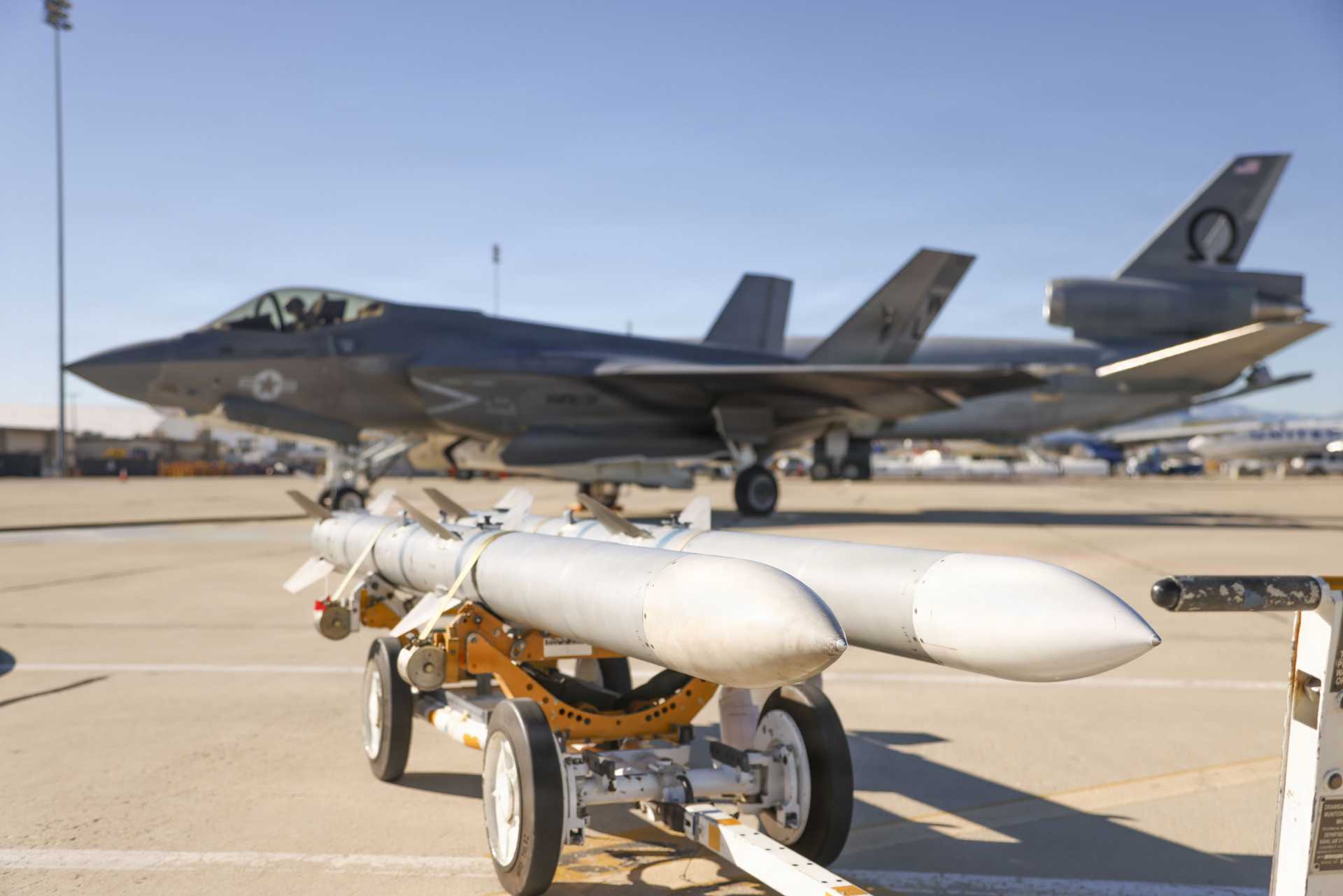
Belgium secured a $3.69 billion approval to buy large numbers of U.S. AIM-120 AMRAAM missiles for its future F-35 fighter jets and NASAMS air defense systems, while also seeking to establish partial missile production in Europe through FN Herstal. (Picture source: US DoD)
On May 9, 2026, L’Écho, De Tijd, and Belga revealed that Belgium received approval from the U.S. Defense Security Cooperation Agency (DSCA) for a Foreign Military Sales package valued at up to $3.69 billion (€3.13 billion) covering AIM-120 AMRAAM missiles for its F-35A fleet and its NASAMS air defense systems. The procurement links Belgium’s fighter modernization and reconstruction of a national medium-range ground-based air defense capability into a single missile architecture based on the AIM-120 family, standardizing inventories, logistics, maintenance, and training across air-to-air and surface-to-air missions.
The acquisition is also tied directly to Belgium’s €36 billion Defense Planning 2030 framework and NATO capability targets after the Ukraine war exposed the inadequacy of Western missile stockpiles and production rates during sustained high-intensity operations. Belgium currently lacks a modern layered medium-range air defense network, leaving infrastructure such as Antwerp and Zeebrugge dependent largely on allied coverage and short-range systems. Brussels is simultaneously attempting to secure a partial AMRAAM production activity through FN Herstal in facilities near Zutendaal to integrate Belgium into the U.S. missile supply chain.
The closest benchmark is probably Japan’s January 2025 DSCA approval for up to 1,200 AIM-120D-3/C-8 AMRAAM air-to-air missiles at $3.64 billion, and Saudi Arabia’s 2025 approval for 1,000 AIM-120C-8 missiles in a package worth $3.5 billion. So, using recent DSCA precedents, a $3.69 billion ceiling strongly suggests Belgium’s package could involve around 1,000 to 1,200 AMRAAM missiles, depending on the exact missile mix, support equipment, spares, training rounds, guidance sections, integration work, and sustainment included. The scale of the package reflects the combined requirements for Belgium’s expanding F-35 fleet and the incoming ten NASAMS batteries.
Belgium initially ordered 34 F-35As to replace the F-16AM/BM fleet introduced in 1979, but this number was later increased to 45 units, more aligned with NATO requirements. The NASAMS acquisition alone is estimated at roughly €2.5 billion excluding missiles, while each launcher generally carries six interceptors, immediately creating demand for several hundred AIM-120 missiles once operational reserves, training stocks, and reload inventories are included. Belgium likely selected the AIM-120 because the missile already forms the standard medium-range weapon across a large portion of NATO air forces and NASAMS operators.
The AMRAAM entered U.S. service in September 1991 as the replacement for the AIM-7 Sparrow and has now evolved into an active radar-guided beyond-visual-range missile capable of independent terminal guidance after launch. Export discussions for European operators focus on the AIM-120C-8, while the U.S. military is transitioning toward AIM-120D-3 and eventually the AIM-260 Joint Advanced Tactical Missile (JTAM). The AIM-120C-8 incorporates upgrades derived from AIM-120D, including improved datalink functionality, revised guidance algorithms, and enhanced resistance to electronic countermeasures.
Late AMRAAM variants exceed 160 km engagement range under favorable launch conditions and combine inertial navigation, active radar homing, and mid-course updates transmitted from launch aircraft or networked sensors against maneuvering targets. The missile acquisition can be directly linked to Belgium’s transition toward the F-35A and the operational requirements of NATO air operations. Belgium’s first F-35As arrived at Florennes Air Base on October 13, 2025, after pilot and maintainer training at Luke Air Force Base in Arizona and other U.S. facilities. Belgian fighters are delivered in the TR-3 configuration, expanding computing power, onboard memory, and future Block 4 integration capacity.
Existing Belgian integration plans for the F-35 already include AIM-9X Sidewinder missiles, GBU-39 Small Diameter Bombs, and Joint Strike Missiles, while the AMRAAM acquisition fills the medium-range beyond-visual-range segment required for NATO air policing, nuclear-sharing missions, and coalition deployments. Belgian F-35 squadrons are expected to operate alongside Dutch, Norwegian, Danish, Finnish, and Italian F-35 units within NATO’s integrated air operations framework. The NASAMS acquisition, for its part, constitutes Belgium’s first major investment in medium-range ground-based air defense since the post-Cold War dismantling of earlier capabilities.
Belgium entered the 2020s without a modern layered medium-range interception network capable of defending infrastructure against aircraft, cruise missiles, or large drone formations. The NASAMS was selected because it already operates within NATO and uses the AIM-120 as a surface-launched interceptor, allowing commonality between air and ground missile inventories. The procurement prioritizes protection of Antwerp and Zeebrugge, both central NATO logistics and reinforcement hubs linking Western Europe with alliance mobility corridors toward Central and Eastern Europe.
Ukraine demonstrated that medium-range air defense systems consume missiles at rates significantly higher than anticipated in most pre-2022 NATO planning models, especially during sustained mixed drone and cruise missile attacks. Belgium, therefore, prioritized rapid fielding and alliance interoperability over sovereign development. The industrial dimension of the AMRAAM in Belgium may center in the future on FN Herstal and its facilities near Zutendaal, as Belgium is seen as the lead candidate to secure partial component production and potentially final assembly work for European AMRAAM deliveries.
The initiative is tied to U.S. efforts to increase annual AMRAAM output from roughly 1,200 missiles toward nearly 1,900 missiles annually in response to combined demand generated by F-35 expansion, NASAMS procurement, and wider NATO rearmament. RTX and Raytheon reportedly already engaged at least 30 Belgian firms to establish a distributed supply chain covering structural sections, precision machining, integration activity, and mechanical assemblies. Belgium’s position is reinforced by participation in the U.S. F-35 global supply chain through Sonaca, SABCA, Asco Industries, and Be-Lightning, alongside earlier cooperation on F-16 sustainment.
Critical technologies, including seekers, propulsion systems, software architecture, and guidance electronics, are expected to remain under U.S. control even if final assembly migrates partially to Europe. The strategic rationale behind possible Belgian AMRAAM production is also tied to NATO’s effort to expand missile throughput capacity without disrupting the U.S. transition toward newer missile variants. Relocating portions of AIM-120C-8 production to Europe would allow U.S. facilities to prioritize AIM-120D-3 and future AIM-260 manufacturing while maintaining supply continuity for allied operators dependent on export-compliant C-series variants.
Belgium offers logistical advantages through proximity to Germany, France, the Netherlands, and the United Kingdom, combined with access to Antwerp port infrastructure and dense rail-road freight connectivity. Brussels also accepts foreign-controlled production structures without demanding sovereign design authority or broad technology-transfer arrangements, reducing negotiation complexity compared with some competing European industrial proposals. The likely outcome remains a Tier 2 industrial role focused on integration, sustainment, airframes, and mechanical assemblies rather than propulsion technologies or seeker development.
Written by Jérôme Brahy
Jérôme Brahy is a defense analyst and documentalist at Army Recognition. He specializes in naval modernization, aviation, drones, armored vehicles, and artillery, with a focus on strategic developments in the United States, China, Ukraine, Russia, Türkiye, and Belgium. His analyses go beyond the facts, providing context, identifying key actors, and explaining why defense news matters on a global scale.
{loadposition bannertop}
{loadposition sidebarpub}
Belgium has secured U.S. approval for a potential $3.69 billion AIM-120 AMRAAM missile package covering both its F-35A fighters and future NASAMS air defense batteries, according to reporting published on May 9, 2026, by L’Écho, De Tijd, and Belga. The deal would give Belgium a unified missile architecture for air combat and ground-based interception, sharply strengthening NATO interoperability while rebuilding a medium-range air defense capability that Belgium has lacked since the post-Cold War drawdowns.
The scale of the package suggests Belgium is preparing for sustained high-intensity operations rather than limited peacetime inventories, with enough missiles to support its expanding F-35 fleet and ten planned NASAMS batteries. By pairing AMRAAM-equipped F-35As with NASAMS protection for strategic hubs such as Antwerp and Zeebrugge, Belgium is moving toward a layered defense model designed to counter aircraft, cruise missiles, and mass drone attacks while also positioning its industry for a future role in NATO missile production and sustainment.
Related topic: Belgium emerges as top candidate for US AIM-120 AMRAAM missile co-production in Europe
Belgium secured a $3.69 billion approval to buy large numbers of U.S. AIM-120 AMRAAM missiles for its future F-35 fighter jets and NASAMS air defense systems, while also seeking to establish partial missile production in Europe through FN Herstal. (Picture source: US DoD)
On May 9, 2026, L’Écho, De Tijd, and Belga revealed that Belgium received approval from the U.S. Defense Security Cooperation Agency (DSCA) for a Foreign Military Sales package valued at up to $3.69 billion (€3.13 billion) covering AIM-120 AMRAAM missiles for its F-35A fleet and its NASAMS air defense systems. The procurement links Belgium’s fighter modernization and reconstruction of a national medium-range ground-based air defense capability into a single missile architecture based on the AIM-120 family, standardizing inventories, logistics, maintenance, and training across air-to-air and surface-to-air missions.
The acquisition is also tied directly to Belgium’s €36 billion Defense Planning 2030 framework and NATO capability targets after the Ukraine war exposed the inadequacy of Western missile stockpiles and production rates during sustained high-intensity operations. Belgium currently lacks a modern layered medium-range air defense network, leaving infrastructure such as Antwerp and Zeebrugge dependent largely on allied coverage and short-range systems. Brussels is simultaneously attempting to secure a partial AMRAAM production activity through FN Herstal in facilities near Zutendaal to integrate Belgium into the U.S. missile supply chain.
The closest benchmark is probably Japan’s January 2025 DSCA approval for up to 1,200 AIM-120D-3/C-8 AMRAAM air-to-air missiles at $3.64 billion, and Saudi Arabia‘s 2025 approval for 1,000 AIM-120C-8 missiles in a package worth $3.5 billion. So, using recent DSCA precedents, a $3.69 billion ceiling strongly suggests Belgium’s package could involve around 1,000 to 1,200 AMRAAM missiles, depending on the exact missile mix, support equipment, spares, training rounds, guidance sections, integration work, and sustainment included. The scale of the package reflects the combined requirements for Belgium’s expanding F-35 fleet and the incoming ten NASAMS batteries.
Belgium initially ordered 34 F-35As to replace the F-16AM/BM fleet introduced in 1979, but this number was later increased to 45 units, more aligned with NATO requirements. The NASAMS acquisition alone is estimated at roughly €2.5 billion excluding missiles, while each launcher generally carries six interceptors, immediately creating demand for several hundred AIM-120 missiles once operational reserves, training stocks, and reload inventories are included. Belgium likely selected the AIM-120 because the missile already forms the standard medium-range weapon across a large portion of NATO air forces and NASAMS operators.
The AMRAAM entered U.S. service in September 1991 as the replacement for the AIM-7 Sparrow and has now evolved into an active radar-guided beyond-visual-range missile capable of independent terminal guidance after launch. Export discussions for European operators focus on the AIM-120C-8, while the U.S. military is transitioning toward AIM-120D-3 and eventually the AIM-260 Joint Advanced Tactical Missile (JTAM). The AIM-120C-8 incorporates upgrades derived from AIM-120D, including improved datalink functionality, revised guidance algorithms, and enhanced resistance to electronic countermeasures.
Late AMRAAM variants exceed 160 km engagement range under favorable launch conditions and combine inertial navigation, active radar homing, and mid-course updates transmitted from launch aircraft or networked sensors against maneuvering targets. The missile acquisition can be directly linked to Belgium’s transition toward the F-35A and the operational requirements of NATO air operations. Belgium’s first F-35As arrived at Florennes Air Base on October 13, 2025, after pilot and maintainer training at Luke Air Force Base in Arizona and other U.S. facilities. Belgian fighters are delivered in the TR-3 configuration, expanding computing power, onboard memory, and future Block 4 integration capacity.
Existing Belgian integration plans for the F-35 already include AIM-9X Sidewinder missiles, GBU-39 Small Diameter Bombs, and Joint Strike Missiles, while the AMRAAM acquisition fills the medium-range beyond-visual-range segment required for NATO air policing, nuclear-sharing missions, and coalition deployments. Belgian F-35 squadrons are expected to operate alongside Dutch, Norwegian, Danish, Finnish, and Italian F-35 units within NATO’s integrated air operations framework. The NASAMS acquisition, for its part, constitutes Belgium’s first major investment in medium-range ground-based air defense since the post-Cold War dismantling of earlier capabilities.
Belgium entered the 2020s without a modern layered medium-range interception network capable of defending infrastructure against aircraft, cruise missiles, or large drone formations. The NASAMS was selected because it already operates within NATO and uses the AIM-120 as a surface-launched interceptor, allowing commonality between air and ground missile inventories. The procurement prioritizes protection of Antwerp and Zeebrugge, both central NATO logistics and reinforcement hubs linking Western Europe with alliance mobility corridors toward Central and Eastern Europe.
Ukraine demonstrated that medium-range air defense systems consume missiles at rates significantly higher than anticipated in most pre-2022 NATO planning models, especially during sustained mixed drone and cruise missile attacks. Belgium, therefore, prioritized rapid fielding and alliance interoperability over sovereign development. The industrial dimension of the AMRAAM in Belgium may center in the future on FN Herstal and its facilities near Zutendaal, as Belgium is seen as the lead candidate to secure partial component production and potentially final assembly work for European AMRAAM deliveries.
The initiative is tied to U.S. efforts to increase annual AMRAAM output from roughly 1,200 missiles toward nearly 1,900 missiles annually in response to combined demand generated by F-35 expansion, NASAMS procurement, and wider NATO rearmament. RTX and Raytheon reportedly already engaged at least 30 Belgian firms to establish a distributed supply chain covering structural sections, precision machining, integration activity, and mechanical assemblies. Belgium’s position is reinforced by participation in the U.S. F-35 global supply chain through Sonaca, SABCA, Asco Industries, and Be-Lightning, alongside earlier cooperation on F-16 sustainment.
Critical technologies, including seekers, propulsion systems, software architecture, and guidance electronics, are expected to remain under U.S. control even if final assembly migrates partially to Europe. The strategic rationale behind possible Belgian AMRAAM production is also tied to NATO’s effort to expand missile throughput capacity without disrupting the U.S. transition toward newer missile variants. Relocating portions of AIM-120C-8 production to Europe would allow U.S. facilities to prioritize AIM-120D-3 and future AIM-260 manufacturing while maintaining supply continuity for allied operators dependent on export-compliant C-series variants.
Belgium offers logistical advantages through proximity to Germany, France, the Netherlands, and the United Kingdom, combined with access to Antwerp port infrastructure and dense rail-road freight connectivity. Brussels also accepts foreign-controlled production structures without demanding sovereign design authority or broad technology-transfer arrangements, reducing negotiation complexity compared with some competing European industrial proposals. The likely outcome remains a Tier 2 industrial role focused on integration, sustainment, airframes, and mechanical assemblies rather than propulsion technologies or seeker development.
Written by Jérôme Brahy
Jérôme Brahy is a defense analyst and documentalist at Army Recognition. He specializes in naval modernization, aviation, drones, armored vehicles, and artillery, with a focus on strategic developments in the United States, China, Ukraine, Russia, Türkiye, and Belgium. His analyses go beyond the facts, providing context, identifying key actors, and explaining why defense news matters on a global scale.