Emirates vs Qatar Airways: the Champions League final no one talks about
When Paris Saint-Germain and Arsenal walk out in Budapest’s Puskás Aréna on Saturday for the Champions League final, two airlines will be watching with more than passing interest. Qatar Airways’ logo will be across PSG’s chest, Emirates’ on Arsenal’s. The two Gulf carriers, bitter commercial rivals for decades, will contest football’s biggest prize by proxy — a fitting climax to a season in which the aviation industry has, quietly and expensively, taken over European football.
This year’s Champions League semi-finals featured four clubs. Three of them carried an airline on their shirts. Emirates sponsored Arsenal, Qatar Airways backed PSG. Riyadh Air, the Saudi carrier that only launched commercially in 2024, had its name on Atlético Madrid’s front. Bayern Munich, the fourth semi-finalist, wore Deutsche Telekom on their jersey, but counts Emirates among its most prominent commercial partners in its capacity as a platinum sponsor — a seven-year deal signed last year, as AeroTime reported. In effect, the aviation industry filled every seat at European football’s top table.
This did not happen by accident.
The numbers behind the names
Airline sponsorship of elite football clubs has become one of the most expensive and strategically deliberate forms of brand building in global sport. As AeroTime has previously examined in depth, the relationship between Gulf carriers and European football clubs is built on recognition of the fact that no other medium offers comparable, sustained visibility to a global audience of the right demographic profile. The sums involved make that case plain.
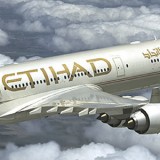
kovop / Shutterstock.comManchester City’s shirt deal with Etihad Airways, which runs through the 2028-29 season, is valued at roughly £65m (~$87m) per year, making it one of the largest in the Premier League. Real Madrid’s arrangement with Emirates is reported to be around €70m (~$81m) annually, a figure that reflects the club’s unmatched global reach. PSG’s deal with Qatar Airways — a partnership that carries the additional weight of shared Qatari state interest — is estimated at between €70m and €80m (~$81m–$93m) per year, the richest shirt deal currently active in European club football.
AeroTimeArsenal’s arrangement with Emirates, extended through the 2027-28 season, is worth approximately £50m to £60m (~$67m–$81m) annually. That figure includes both shirt and training kit rights bundled into a single contract — a deliberate strategy, analysts have noted, to maximize the combined value of multiple assets rather than selling them separately.
Bayern Munich’s relationship with Emirates sits at a different level of the market. The German club already carries Deutsche Telekom on its shirt front, so Emirates occupies what both parties call a platinum partner position — prominent stadium and broadcast branding, deep commercial integration, but not the shirt front itself. The arrangement, signed in 2025 and running through the 2031-32 season, is reported at around €5m (~$6m) per year. In the context of shirt deals, that’s a modest sum. But it buys Emirates consistent visibility at a club that has now reached consecutive Champions League semi-finals — and that visibility, on Saturday night, will reach 150 million screens.
A pattern five years in the making
This season’s airline-dominated semi-final is not an outlier. It is the continuation of a trend that has become one of the defining commercial stories of European football.
In 2020-21, Emirates and Etihad both had clubs in the final four — Real Madrid and Manchester City respectively. The following season, the same pairing appeared again, with the same airlines on the same shirts. In 2022-23, Emirates found itself backing two semi-finalists simultaneously: Real Madrid and AC Milan. Manchester City, with Etihad on their chests, went on to win the trophy that year.
AeroTimeThe 2023-24 season brought Emirates and Qatar Airways into the semi-finals together for the first time, with Real Madrid and PSG. Real Madrid won the final — meaning Emirates has seen a club that it’s sponsoring lift the trophy for two of the past four seasons. Qatar Airways claimed its first winners’ medal in 2024-25, when PSG defeated Inter in the final, with the Qatar Airways logo prominent on their shirts as the players celebrated in Munich.
Of the past six Champions League winners, five bore an airline on their shirts when they lifted the trophy. The sole exception was Chelsea in 2020-21, a season when the club carried no airline partner. Every other winner since then has been an airline’s club.
The audience airlines are buying
The commercial logic is visible in the viewership figures. The Champions League final draws an average global live audience of between 145 million and 166 million, according to UEFA’s own estimates across the past three seasons. UEFA has also noted that up to 450 million people watch at least some part of a single final’s broadcast across all platforms combined.
For an airline, that is not a football audience: it is a travel audience. The demographics of Champions League viewership — concentrated in Europe, the Middle East, Asia and an increasingly engaged North American market — map closely onto the long-haul routes that Emirates, Qatar Airways and Etihad are most aggressively competing to fill. A Champions League final watched by 150 million people across those markets is, in effect, a global advertising campaign that no conventional media buy could replicate at equivalent cost per impression.
SPORT PRESS MEDIA / Shutterstock.comThe strategy, as AeroTime’s Ian Molyneaux has detailed, is not simply about shirt logos. It encompasses stadium naming, lounge access, cargo partnerships, loyalty program tie-ups and hospitality packages that turn a club’s travelling support into a pipeline of premium passengers. Emirates’ portfolio now spans Arsenal, Real Madrid, AC Milan, Olympique Lyonnais and Benfica, across five leagues. Qatar Airways backs PSG and holds significant UEFA-level sponsorship assets directly. Etihad underwrites Manchester City and Girona, two clubs connected by the same Abu Dhabi ownership group.
The shirt is merely the visible part. The commercial architecture behind it runs considerably deeper.
The Riyadh Air bet that paid off
Perhaps the most striking story of this season belongs to Riyadh Air. The Saudi carrier, which received its air operator’s certificate in 2024 and is still constructing its route network, took what many regarded as a calculated risk when it signed Atlético Madrid as a front-of-shirt partner. Atlético are perennial Champions League contenders but rarely favorites. Paying for shirt space on a club that might exit in the group stage would be an expensive way to introduce a new airline brand to the European market — and with the deal value undisclosed, the exposure risk was entirely Riyadh Air’s to absorb.
Final call for our Copa. Aúpa @Atleti pic.twitter.com/vjksmoSOWP— Riyadh Air | طيران الرياض (@RiyadhAir) April 17, 2026 Instead, Atlético reached the semi-finals, eliminating Inter Milan and Borussia Dortmund along the way. Riyadh Air’s name was on front pages and broadcast graphics across the continent for the best part of two months. For a carrier still establishing itself in a market dominated by Emirates and Qatar Airways, the exposure has been exceptional value — the kind of brand introduction that a conventional advertising campaign across the same markets would cost many times more to achieve.
The choice of partner matters as much as the decision to enter football at all. Riyadh Air, on its first attempt, chose very well.
What the final means commercially
Saturday’s match in Budapest is, among other things, a direct commercial confrontation between two of the world’s largest airlines. Emirates and Qatar Airways compete on dozens of long-haul routes, taking in London, Paris, Frankfurt, Singapore, Sydney and New York. They fight for the same premium passengers, the same cargo contracts, the same corporate travel accounts. On 30 May, they will also compete for the most-watched club football trophy on Earth, with an audience of roughly 150 million watching live.
AeroTimeFor Emirates, an Arsenal victory would extend a record that already includes Real Madrid’s triumphs in 2022 and 2024 — three Champions League wins in four years for clubs bearing its logo. For Qatar Airways, a PSG victory would deliver back-to-back European titles, cementing the airline’s association with the dominant club in this era of the competition.
Neither airline will admit publicly that Saturday’s result matters to them commercially. Nevertheless, both will be watching it very carefully indeed.
Airlines as the new power behind football
The broader picture, stepping back from Saturday’s final, is of an aviation industry that has embedded itself at the apex of the world’s most-watched sport with remarkable thoroughness and strategic precision. The investment is not philanthropic, nor is it vanity spending by state-backed carriers with unlimited budgets. These are deals made by airlines that have modelled audience scale, brand geography and long-term return on visibility with considerable rigor.
Keith Heaton / Shutterstock.comThe Champions League, with its guaranteed semi-final audience of tens of millions and its final watched by 150 million people or more across 200 territories, is the most efficient vehicle for the visibility that global sport currently provides. Emirates understood that first. Qatar Airways followed. Etihad built a club. And now Riyadh Air, on its debut season, has demonstrated that the playbook still works.
This season, the airlines did not just sponsor the Champions League. In three of the four semi-final berths, they were right there on the shirts.
The Champions League final between Paris Saint-Germain and Arsenal takes place on Saturday 30 May in Budapest. Qatar Airways will be on one shirt, Emirates on the other. One of them will win, but both already have.The post Emirates vs Qatar Airways: the Champions League final no one talks about appeared first on AeroTime.
When Paris Saint-Germain and Arsenal walk out in Budapest’s Puskás Aréna on Saturday for the Champions League final,…
The post Emirates vs Qatar Airways: the Champions League final no one talks about appeared first on AeroTime.