First U.S. F-35A Fighter Jets for Polish Air Force Arrive in Poland to Strengthen NATO Eastern Flank
{loadposition bannertop}
{loadposition sidebarpub}
The first three U.S. Lockheed Martin F-35A Lightning II fighter jets ordered by Poland arrive at the 32nd Tactical Air Base in Łask on May 22, 2026, marking a major leap in the country’s combat airpower and strengthening NATO’s deterrence posture along its eastern flank. Their arrival introduces fifth-generation stealth strike and advanced sensor-fusion capabilities into Polish service, significantly improving Warsaw’s ability to conduct air-superiority, precision-attack, and intelligence-gathering missions in contested battle spaces.
The F-35A gives Poland the ability to detect, track, and engage threats at longer ranges while operating with reduced radar visibility against advanced air defense systems. The deployment reflects a broader NATO push to integrate stealth aircraft and networked warfare capabilities to counter increasingly sophisticated Russian military activity in Eastern Europe.Related Topic: U.S. sends 18 more F-35A fighter jets from UK to Middle East as Iran nuclear talks begin
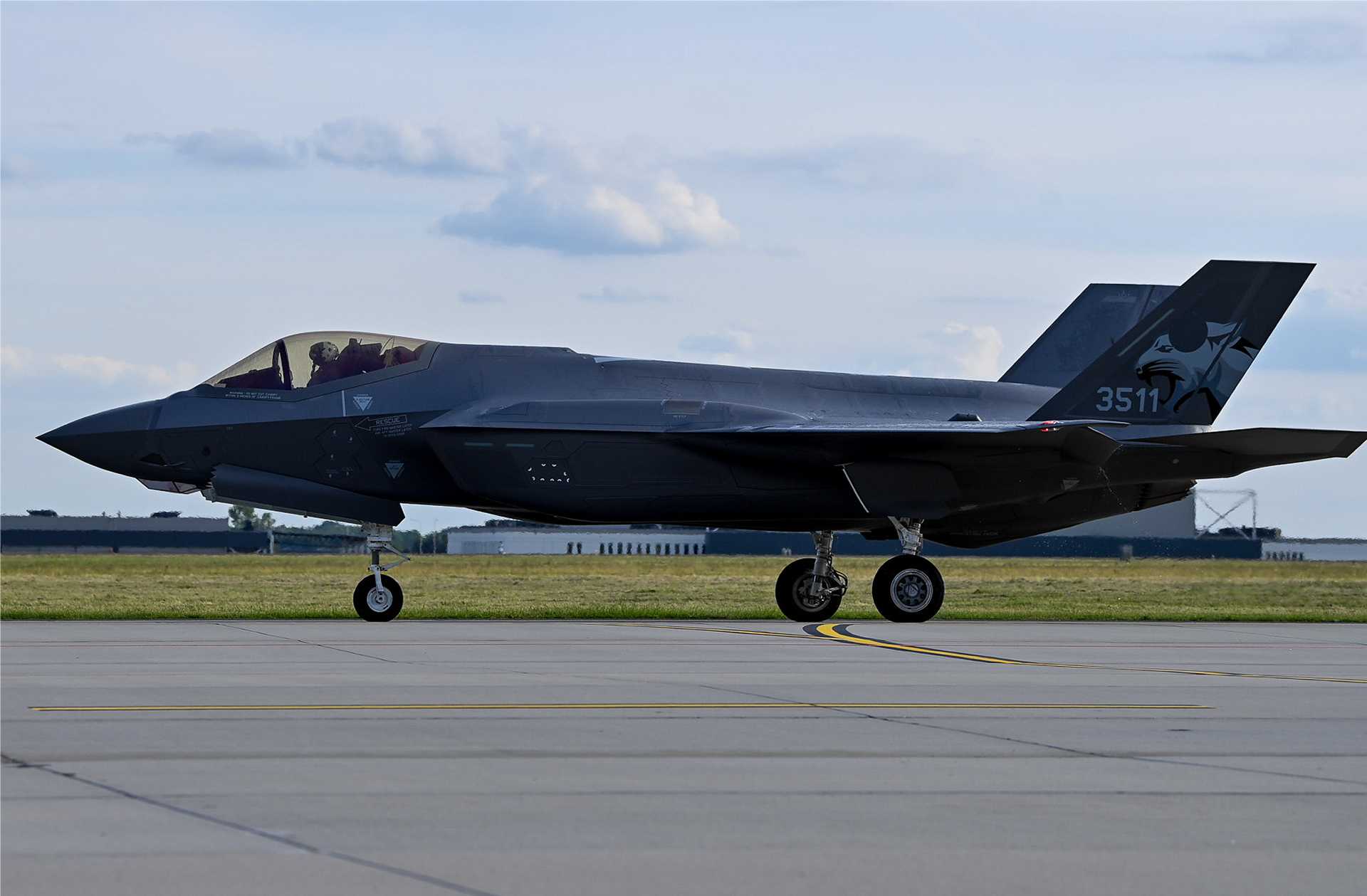
The first three American-made F-35A Lightning II combat aircraft purchased by Poland arrive at Łask Air Base on May 22, 2026, marking the beginning of fifth-generation air combat capability for the Polish Air Force. (Picture source: Polish MoD)
The official arrival ceremony brought together senior Polish political and military leadership, including the Secretary of State and Chief of Staff of the President of the Republic of Poland, Paweł Szefernaker; Deputy Defense Ministers Paweł Bejda and Cezary Tomczyk; representatives of the National Security Bureau; and senior commanders of the Polish Armed Forces. The delivery follows Poland’s acquisition contract for 32 F-35A aircraft signed with the United States and confirms Warsaw’s accelerated transition toward a fully interoperable NATO fifth-generation combat aviation force.
The F-35A acquisition represents one of the most important combat aviation modernization efforts undertaken by Poland since joining NATO. Designed as a fifth-generation multirole combat aircraft, the F-35A combines low-observable stealth characteristics with advanced avionics, distributed sensor fusion, electronic warfare systems, and network-centric battlefield connectivity. For the Polish Air Force, this transforms not only tactical aviation capabilities but also operational doctrine, enabling real-time battlespace awareness and deep-strike missions against heavily defended targets.
On May 22, 2026, at the 32nd Tactical Air Base in Łask, Polish Deputy Prime Minister and Minister of National Defense Władysław Kosiniak-Kamysz, accompanied by Deputy Defense Ministers Paweł Bejda and Cezary Tomczyk, senior commanders of the Polish Armed Forces, and government officials, attended the official welcome ceremony for the first three F-35A Lightning II combat aircraft delivered to the Polish Air Force.
Unlike legacy fourth-generation fighter aircraft, the F-35A integrates multiple sensors into a single operational picture for pilots, reducing decision-making time and increasing survivability in high-threat environments. The aircraft’s AN/APG-81 AESA radar, Electro-Optical Targeting System, Distributed Aperture System, and advanced electronic support measures enable detection, tracking, and engagement of enemy aircraft and ground threats at extended ranges while remaining difficult to detect. This capability is particularly relevant for operations along NATO’s eastern border, where Russia’s anti-access and area-denial systems continue to shape regional defense planning.
Poland’s contract covers 32 F-35A aircraft, along with a comprehensive logistics and training package designed to sustain operational readiness through 2030. The logistics package includes spare and consumable parts inventories, ground support equipment, and an advanced IT-based operational management infrastructure that will support fleet maintenance, mission planning, and lifecycle management. This long-term sustainment architecture is essential for maintaining high sortie generation rates and ensuring availability during crisis or wartime operations.
The training package constitutes a critical element of the program and reflects Poland’s intention to rapidly build a fully autonomous fifth-generation fighter force. It includes extensive training for pilot and maintenance personnel, an Integrated Training Center, and eight full-mission flight simulators. These simulators will allow Polish crews to rehearse advanced combat scenarios, electronic warfare operations, and multinational NATO missions without the operational cost of live-flight training. The approach mirrors U.S. Air Force and allied F-35 operational training concepts focused on distributed readiness and rapid mission integration.
Łask Air Base itself is expected to become one of the most strategically important combat aviation hubs in Central Europe. Already used extensively for NATO exercises and allied deployments, the base now gains a permanent fifth-generation combat aviation capability that can support both national defense missions and alliance-wide operations. The stationing of F-35A aircraft at Łask strengthens NATO’s integrated air defense posture and increases the alliance’s capacity for rapid response in Eastern Europe.
The arrival of the F-35A also marks the next phase in the modernization of the Polish Air Force, which has already undergone a major transformation through the acquisition and operational integration of F-16C/D Block 52+ multirole combat aircraft. Poland currently operates one of the largest and most modern F-16 fleets in Europe, providing advanced precision strike, suppression of enemy air defenses, and NATO interoperability capabilities. With the introduction of the fifth-generation F-35A aircraft, the Polish Air Force is rapidly evolving into one of the strongest and most technologically advanced air forces in Europe.
The combination of fourth-generation F-16 fighters and fifth-generation F-35A aircraft creates a highly effective layered combat aviation structure. While the F-35A can penetrate contested airspace and conduct stealth reconnaissance or precision strikes, the F-16 fleet can deliver large-scale conventional firepower and support sustained air operations. This mixed-force structure significantly improves Poland’s ability to conduct multi-domain combat operations while integrating with NATO airborne early warning, missile defense, and long-range strike assets.
Poland’s broader military modernization strategy also includes the acquisition of M1A2 Abrams and K2 Black Panther main battle tanks, HIMARS multiple launch rocket systems, Patriot air defense systems, and AH-64E Apache attack helicopters. Together, these acquisitions aim to establish one of Europe’s most capable conventional deterrence forces. The F-35A provides a critical airborne component to this strategy by linking ground, air, and missile defense assets into a highly connected combat network.
From an industrial and strategic perspective, Poland’s integration into the global F-35 program deepens defense cooperation with the United States and strengthens Warsaw’s role within NATO’s high-end combat aviation structure. As more European nations adopt the F-35, including Finland, Germany, Belgium, the Netherlands, Norway, Denmark, and Italy, interoperability between allied air forces continues to expand. Shared logistics, training, mission data management, and operational procedures create a more unified allied airpower framework capable of coordinated multinational operations.
Operationally, the arrival of the first aircraft sends a strong signal of deterrence across the region. Fifth-generation combat aircraft provide advantages not only through stealth but through their ability to collect, process, and distribute battlefield intelligence across joint forces in real time. In a potential high-intensity conflict scenario, Polish F-35As could support suppression of enemy air defenses, target acquisition for long-range fires, and precision strikes against command infrastructure while coordinating with allied forces operating across multiple domains.
The delivery also demonstrates the speed at which Poland has transformed its defense posture following Russia’s invasion of Ukraine. Warsaw has become one of NATO’s leading defense spenders relative to GDP and has accelerated procurement timelines across nearly every branch of its armed forces. The operational introduction of the F-35A now places Poland among a select group of European nations capable of deploying fifth-generation stealth combat aircraft at scale.
As additional aircraft are delivered over the coming years, the Polish Air Force is expected to progressively expand operational certification, pilot conversion programs, and integration with NATO command structures. The program will eventually replace aging Soviet-era combat aircraft still operating in Poland and establish the F-35A as the backbone of the country’s future tactical aviation capability.Written by Alain Servaes – Chief Editor, Army Recognition GroupAlain Servaes is a former infantry non-commissioned officer and the founder of Army Recognition. With over 20 years in defense journalism, he provides expert analysis on military equipment, NATO operations, and the global defense industry.
{loadposition bannertop}
{loadposition sidebarpub}
The first three U.S. Lockheed Martin F-35A Lightning II fighter jets ordered by Poland arrive at the 32nd Tactical Air Base in Łask on May 22, 2026, marking a major leap in the country’s combat airpower and strengthening NATO’s deterrence posture along its eastern flank. Their arrival introduces fifth-generation stealth strike and advanced sensor-fusion capabilities into Polish service, significantly improving Warsaw’s ability to conduct air-superiority, precision-attack, and intelligence-gathering missions in contested battle spaces.
The F-35A gives Poland the ability to detect, track, and engage threats at longer ranges while operating with reduced radar visibility against advanced air defense systems. The deployment reflects a broader NATO push to integrate stealth aircraft and networked warfare capabilities to counter increasingly sophisticated Russian military activity in Eastern Europe.
Related Topic: U.S. sends 18 more F-35A fighter jets from UK to Middle East as Iran nuclear talks begin
The first three American-made F-35A Lightning II combat aircraft purchased by Poland arrive at Łask Air Base on May 22, 2026, marking the beginning of fifth-generation air combat capability for the Polish Air Force. (Picture source: Polish MoD)
The official arrival ceremony brought together senior Polish political and military leadership, including the Secretary of State and Chief of Staff of the President of the Republic of Poland, Paweł Szefernaker; Deputy Defense Ministers Paweł Bejda and Cezary Tomczyk; representatives of the National Security Bureau; and senior commanders of the Polish Armed Forces. The delivery follows Poland’s acquisition contract for 32 F-35A aircraft signed with the United States and confirms Warsaw’s accelerated transition toward a fully interoperable NATO fifth-generation combat aviation force.
The F-35A acquisition represents one of the most important combat aviation modernization efforts undertaken by Poland since joining NATO. Designed as a fifth-generation multirole combat aircraft, the F-35A combines low-observable stealth characteristics with advanced avionics, distributed sensor fusion, electronic warfare systems, and network-centric battlefield connectivity. For the Polish Air Force, this transforms not only tactical aviation capabilities but also operational doctrine, enabling real-time battlespace awareness and deep-strike missions against heavily defended targets.
On May 22, 2026, at the 32nd Tactical Air Base in Łask, Polish Deputy Prime Minister and Minister of National Defense Władysław Kosiniak-Kamysz, accompanied by Deputy Defense Ministers Paweł Bejda and Cezary Tomczyk, senior commanders of the Polish Armed Forces, and government officials, attended the official welcome ceremony for the first three F-35A Lightning II combat aircraft delivered to the Polish Air Force.
Unlike legacy fourth-generation fighter aircraft, the F-35A integrates multiple sensors into a single operational picture for pilots, reducing decision-making time and increasing survivability in high-threat environments. The aircraft’s AN/APG-81 AESA radar, Electro-Optical Targeting System, Distributed Aperture System, and advanced electronic support measures enable detection, tracking, and engagement of enemy aircraft and ground threats at extended ranges while remaining difficult to detect. This capability is particularly relevant for operations along NATO’s eastern border, where Russia’s anti-access and area-denial systems continue to shape regional defense planning.
Poland’s contract covers 32 F-35A aircraft, along with a comprehensive logistics and training package designed to sustain operational readiness through 2030. The logistics package includes spare and consumable parts inventories, ground support equipment, and an advanced IT-based operational management infrastructure that will support fleet maintenance, mission planning, and lifecycle management. This long-term sustainment architecture is essential for maintaining high sortie generation rates and ensuring availability during crisis or wartime operations.
The training package constitutes a critical element of the program and reflects Poland’s intention to rapidly build a fully autonomous fifth-generation fighter force. It includes extensive training for pilot and maintenance personnel, an Integrated Training Center, and eight full-mission flight simulators. These simulators will allow Polish crews to rehearse advanced combat scenarios, electronic warfare operations, and multinational NATO missions without the operational cost of live-flight training. The approach mirrors U.S. Air Force and allied F-35 operational training concepts focused on distributed readiness and rapid mission integration.
Łask Air Base itself is expected to become one of the most strategically important combat aviation hubs in Central Europe. Already used extensively for NATO exercises and allied deployments, the base now gains a permanent fifth-generation combat aviation capability that can support both national defense missions and alliance-wide operations. The stationing of F-35A aircraft at Łask strengthens NATO’s integrated air defense posture and increases the alliance’s capacity for rapid response in Eastern Europe.
The arrival of the F-35A also marks the next phase in the modernization of the Polish Air Force, which has already undergone a major transformation through the acquisition and operational integration of F-16C/D Block 52+ multirole combat aircraft. Poland currently operates one of the largest and most modern F-16 fleets in Europe, providing advanced precision strike, suppression of enemy air defenses, and NATO interoperability capabilities. With the introduction of the fifth-generation F-35A aircraft, the Polish Air Force is rapidly evolving into one of the strongest and most technologically advanced air forces in Europe.
The combination of fourth-generation F-16 fighters and fifth-generation F-35A aircraft creates a highly effective layered combat aviation structure. While the F-35A can penetrate contested airspace and conduct stealth reconnaissance or precision strikes, the F-16 fleet can deliver large-scale conventional firepower and support sustained air operations. This mixed-force structure significantly improves Poland’s ability to conduct multi-domain combat operations while integrating with NATO airborne early warning, missile defense, and long-range strike assets.
Poland’s broader military modernization strategy also includes the acquisition of M1A2 Abrams and K2 Black Panther main battle tanks, HIMARS multiple launch rocket systems, Patriot air defense systems, and AH-64E Apache attack helicopters. Together, these acquisitions aim to establish one of Europe’s most capable conventional deterrence forces. The F-35A provides a critical airborne component to this strategy by linking ground, air, and missile defense assets into a highly connected combat network.
From an industrial and strategic perspective, Poland’s integration into the global F-35 program deepens defense cooperation with the United States and strengthens Warsaw’s role within NATO’s high-end combat aviation structure. As more European nations adopt the F-35, including Finland, Germany, Belgium, the Netherlands, Norway, Denmark, and Italy, interoperability between allied air forces continues to expand. Shared logistics, training, mission data management, and operational procedures create a more unified allied airpower framework capable of coordinated multinational operations.
Operationally, the arrival of the first aircraft sends a strong signal of deterrence across the region. Fifth-generation combat aircraft provide advantages not only through stealth but through their ability to collect, process, and distribute battlefield intelligence across joint forces in real time. In a potential high-intensity conflict scenario, Polish F-35As could support suppression of enemy air defenses, target acquisition for long-range fires, and precision strikes against command infrastructure while coordinating with allied forces operating across multiple domains.
The delivery also demonstrates the speed at which Poland has transformed its defense posture following Russia’s invasion of Ukraine. Warsaw has become one of NATO’s leading defense spenders relative to GDP and has accelerated procurement timelines across nearly every branch of its armed forces. The operational introduction of the F-35A now places Poland among a select group of European nations capable of deploying fifth-generation stealth combat aircraft at scale.
As additional aircraft are delivered over the coming years, the Polish Air Force is expected to progressively expand operational certification, pilot conversion programs, and integration with NATO command structures. The program will eventually replace aging Soviet-era combat aircraft still operating in Poland and establish the F-35A as the backbone of the country’s future tactical aviation capability.
Written by Alain Servaes – Chief Editor, Army Recognition Group
Alain Servaes is a former infantry non-commissioned officer and the founder of Army Recognition. With over 20 years in defense journalism, he provides expert analysis on military equipment, NATO operations, and the global defense industry.