Lockheed Martin wins $35 billion award to quadruple THAAD production
On June 24, 2026, the US government awarded Lockheed Martin a seven-year contract worth up to $35 billion to quadruple production of Terminal High Altitude Area Defense (THAAD) interceptors, putting into effect a framework agreement signed on January 29, 2026.
The award was issued as an undefinitized contract action, a mechanism that allows work to begin before final terms and pricing are agreed. The $35 billion figure is therefore a ceiling rather than a settled value, and Lockheed Martin’s own disclosures note the arrangement could still be modified, reduced, or not fully funded depending on congressional appropriations.
Demand is rising. We’re accelerating. We have been awarded a multiyear undefinitized contract by the @DeptofWar for up to $35B to increase THAAD production, supported by $9B+ in investments through 2030 and 20 U.S. expanding facilities. We are delivering the Arsenal of… pic.twitter.com/k13FlNzsey— Lockheed Martin (@LockheedMartin) June 24, 2026
One of the first awards under the new acquisition model
Lockheed Martin described the contract as one of the first full-scale transitions from framework agreement to execution under the Department of War’s Acquisition Transformation Strategy, an approach intended to give manufacturers and their suppliers longer-term demand signals so they can invest in capacity ahead of firm orders. Tim Cahill, president of Lockheed Martin Missiles and Fire Control, said the award marked a “transformational shift to multiyear procurement.”
The company was the first contractor to announce a framework agreement under the initiative. Since January 2026, the Department of War has reached comparable arrangements covering the PAC-3 MSE interceptor and the Precision Strike Missile. In April 2026, the US Army awarded Lockheed Martin a separate $4.76 billion contract for accelerated PAC-3 MSE production, most of it funded through foreign military sales accounts.
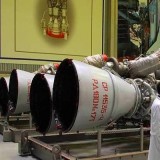
THAAD interceptor assembly line (Credit: Lockheed Martin)
The THAAD award builds on more than $9 billion in company investment planned through 2030, which Lockheed Martin says has already delivered over 20 new or modernized facilities. The company recently broke ground on a Munitions Production Center in Troy, Alabama, opened a Next Generation Interceptor facility in Courtland, Alabama, and established a Munitions Acceleration Center in Camden, Arkansas.
Demand shaped by Operation Epic Fury
THAAD is the only US system capable of engaging targets both inside and outside the atmosphere. Lockheed Martin said its interceptors have been used during Operation Epic Fury, the US-Israeli air campaign against Iran that began on February 28, 2026, a conflict that has placed sustained pressure on US interceptor inventories.
That demand has stretched THAAD units already in the field. All six launchers from the US battery in Seongju, South Korea, have returned to base after being relocated to Osan Air Base in March 2026, the South Korean news agency Yonhap reported on June 21, 2026. The move had fueled speculation that the US military planned to send THAAD interceptors to the Middle East, though US Forces Korea said the system remained in South Korea, a position its commander, General Xavier Brunson, repeated at a Senate hearing in April 2026.
The strain extends to Patriot stocks. The US and Gulf states are estimated by the Royal United Services Institute to have fired more than 1,800 Patriot rounds in the operation’s first 16 days, and the resulting pressure has already prompted warnings to Baltic and Scandinavian buyers, Lithuania among them, of possible delays to contracted weapons deliveries.The post Lockheed Martin wins $35 billion award to quadruple THAAD production appeared first on AeroTime.
On June 24, 2026, the US government awarded Lockheed Martin a seven-year contract worth up to $35 billion…
The post Lockheed Martin wins $35 billion award to quadruple THAAD production appeared first on AeroTime.