Russia flies new Su-57D twin-seat stealth fighter to command future Okhotnik combat drones
{loadposition bannertop}
{loadposition sidebarpub}
Russia has flown the new Su-57D twin-seat stealth fighter for the first time, with United Aircraft Corporation confirming on May 19, 2026, that the aircraft is being developed not just as a fighter, but as an airborne command platform designed to control future S-70 Okhotnik combat drones and coordinate complex strike operations. The program signals Russia’s push toward manned-unmanned teaming and distributed air warfare, where stealth aircraft increasingly function as battlefield network managers rather than only missile shooters.
The Su-57D adds a second crew member dedicated to drone control, electronic warfare management, and sensor coordination, allowing the pilot to focus on tactical flying during high-intensity combat operations. By adapting the existing Su-57 airframe instead of funding a clean-sheet sixth-generation fighter, Moscow is pursuing a lower-cost path toward future air combat concepts centered on loyal wingman drones, precision strike coordination, and electronic attack integration despite ongoing industrial and sanctions-related constraints.
Related topic: China’s new dual-seat J-20S stealth fighter pioneers advanced drone control capability
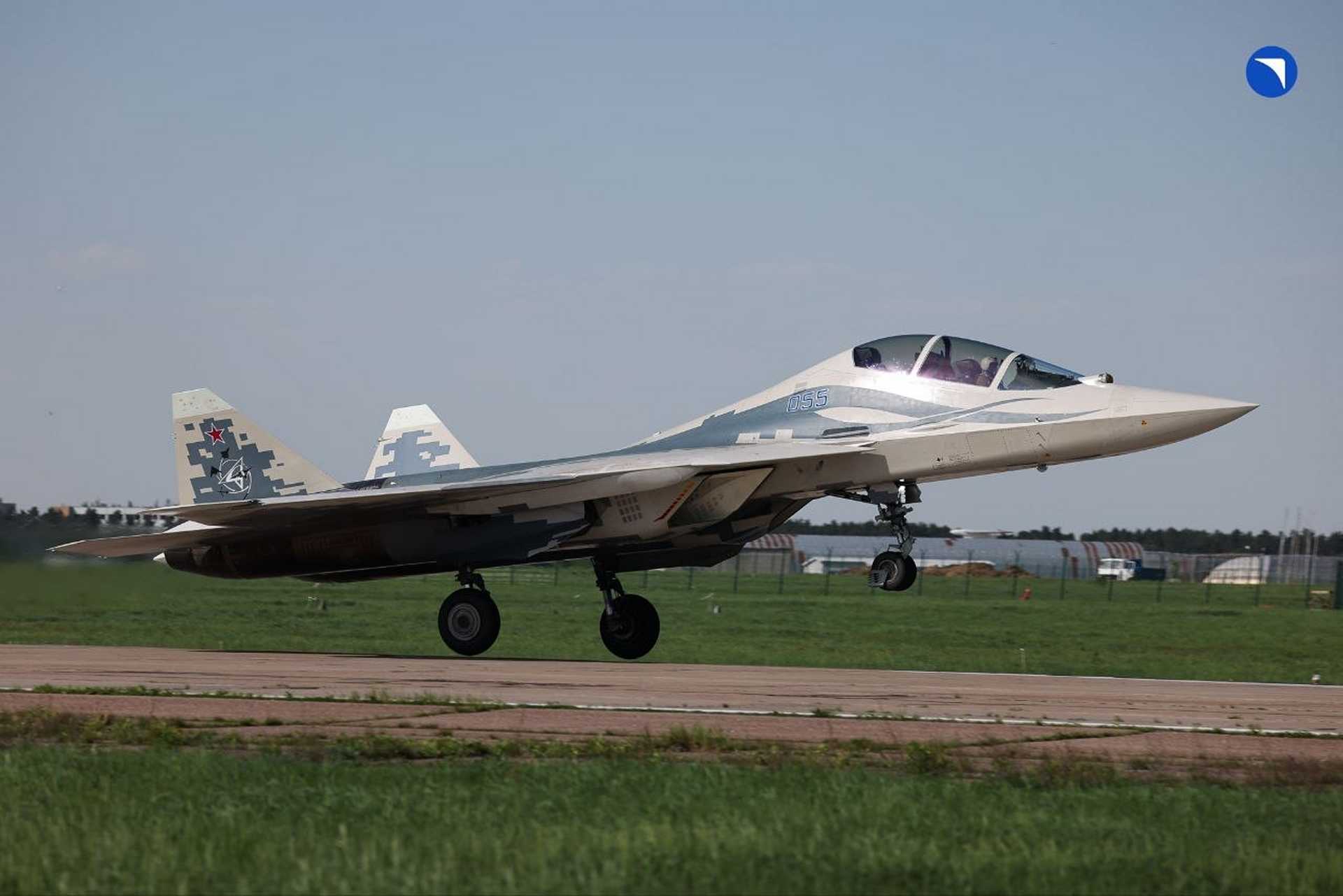
Russia’s First Deputy Prime Minister Denis Manturov identified three primary missions for the Su-57D: combat training, airborne strike coordination, and command-and-control of unmanned combat aircraft. (Picture source: UAC)
On May 19, 2026, United Aircraft Corporation (UAC) confirmed that Russia conducted the maiden flight of the Su-57D twin-seat stealth fighter at the Komsomolsk-on-Amur Aircraft Plant, formally introducing a two-seat derivative of the Su-57 developed under the PAK FA program. Sukhoi chief test pilot Sergei Bogdan flew the aircraft after taxi trials conducted on May 16, while First Deputy Prime Minister Denis Manturov identified three primary missions for the Su-57D: combat training, airborne strike coordination, and command-and-control of unmanned combat aircraft.
The Su-57D emerged less than three years after UAC registered a November 2023 patent covering a twin-seat Su-57 optimized for UAV coordination and airborne command functions. The timing also coincides with Russia’s ongoing integration work involving the S-70 Okhotnik-B UCAV, which began joint experimental flights with Su-57 prototypes in 2019. Unlike earlier two-seat Su-27 Flanker derivatives focused on pilot conversion or strike navigation, the Su-57D appears intended to function as a network-management aircraft coordinating drones, electronic warfare systems, and precision strike assets.
The development timeline suggests the Su-57D was initiated internally by Sukhoi and UAC rather than through an original Ministry of Defence requirement. Rostec and Russian state media first acknowledged work on a twin-seat Su-57 in July 2021, while the November 2023 patent already outlined a modified cockpit arrangement and drone-control mission profile. The interval between patent registration and flight testing was less than 30 months, unusually short for a major fighter jet structural modification, indicating heavy reliance on existing developmental infrastructure.
Russian aviation circles repeatedly associated the Su-57D with the “055 Blue” T-50 prototype damaged during an engine incident in 2014. Reusing an earlier developmental airframe would logically reduce manufacturing requirements, preserve KnAAPO serial production capacity, and accelerate systems integration. The project, therefore, appears less focused on creating a new fighter variant than on rapidly adapting the Su-57 airframe for crewed-uncrewed teaming operations. The Su-57D replaces the standard single-seat cockpit with a tandem dual-seat arrangement beneath an elongated canopy extending farther aft along the dorsal spine.
The rear cockpit is elevated relative to the pilot’s position, following the configuration used on fighters such as the Su-30SM and Su-27UB to improve visibility and mission management efficiency for the second operator. Integration of the additional crew station likely required relocation of avionics bays, environmental control systems, mission computers, cooling architecture, and portions of the Su-57’s forward fuel volume. Available imagery nevertheless indicates that the Su-57D retains the wing geometry, engine spacing, side weapons bays, tandem internal weapons bays, and engine nacelles used by the Su-57.
However, the redesign imposes aerodynamic and low-observable penalties because the enlarged canopy and modified upper fuselage profile increase frontal radar reflections relative to the original fighter, whose frontal radar cross-section was estimated in Russian patent material between 0.1 and 1 square meters. Additional weight associated with the second cockpit and mission-management equipment also likely reduces fuel fraction, endurance, and maneuverability compared to the single-seat variant. The Su-57D’s operational rationale is said to center on reducing pilot workload during high-density electronic warfare and network-centric combat operations.
Existing Su-57 prototypes already participated in integration flights with the S-70 Okhotnik-B drone beginning in September 2019, establishing the basis for future manned-unmanned teaming operations involving reconnaissance, strike coordination, and electronic attack support. The second crew member aboard the Su-57D appears intended to supervise drone coordination, datalink management, sensor fusion, target allocation, and electronic warfare sequencing while the pilot concentrates on tactical flight operations. The November 2023 UAC patent specifically identified the twin-seat Su-57 as an airborne command center capable of directing unmanned combat aircraft carrying guided munitions.
Such a configuration addresses a practical limitation affecting modern single-seat stealth fighters operating in saturated electromagnetic environments where pilots must simultaneously manage radar tracking, electronic countermeasures, missile employment, navigation, and communication traffic. The Su-57D therefore functions less as a conventional fighter and more as a forward airborne battle management node integrated into a distributed strike network involving drones, electronic warfare assets, and precision-guided weapons. Russia’s decision to field a dedicated twin-seat fifth-generation jet differs from the trajectory followed by the American F-22 and F-35, where automation and simulator training eliminated the requirement for onboard weapons systems officers.
Russian operational planning instead appears to assess that future combat environments involving simultaneous drone control, electronic attack coordination, and long-range strike management may exceed the workload capacity of a single pilot. Russian sources specifically linked the Su-57D to missions currently performed by twin-seat Su-30SM and Su-34 aircraft, including strike coordination and management of complex multi-axis operations. The second crew member, therefore, likely functions similarly to a traditional Soviet and Russian Weapons Systems Officer (WSO) responsible for target prioritization, electronic warfare supervision, and mission sequencing.
The Su-57D might also reflect a broader doctrinal transition inside Russian tactical aviation, away from treating stealth fighters solely as penetration aircraft and toward using them as airborne coordination systems synchronizing sensors, drones, strike aircraft, and electronic warfare assets across a distributed battlespace. Interestingly, the Su-57D places Russia into a direct conceptual competition with China’s Chengdu J-20S, currently the only other publicly known twin-seat fifth-generation fighter in flight testing. In both cases, the fighters are optimized primarily for command-and-control and loyal wingman coordination missions rather than just pilot conversion training.
Western sixth-generation programs such as NGAD and GCAP similarly prioritize collaborative combat aircraft and manned-unmanned teaming, although the Russian approach differs because it adapts an existing fifth-generation airframe instead of funding a clean-sheet sixth-generation aircraft. Moscow appears to be pursuing a lower-cost transition toward selected sixth-generation operational concepts by modifying available infrastructure and developmental airframes rather than initiating a completely new fighter program. This can be explained by broader constraints affecting the Russian aerospace sector, including sanctions-related restrictions on microelectronics, avionics, and advanced manufacturing equipment.
The Su-57D, therefore, functions simultaneously as an operational capability, a doctrinal testbed, and a technology bridge linking the existing Su-57 fleet to future Russian manned-unmanned combat architectures. The aircraft also entered testing while the broader Su-57 procurement program remained substantially smaller than originally envisioned during the early PAK FA phase. Russia ordered 76 serial-production Su-57 fighters in 2019, but estimated fleet totals remain close to 42 aircraft, including prototypes as of 2026, forcing Russian Aerospace Forces to continue relying heavily on upgraded Su-35S, Su-30SM, and Su-34 jets for frontline tactical aviation missions.
Production scalability remains constrained by sanctions affecting semiconductors, avionics components, and aerospace manufacturing supply chains. Within this industrial environment, the Su-57D’s reliance on existing fuselage geometry and probable reuse of developmental airframes significantly reduces cost and manufacturing pressure compared to initiating a fully independent aircraft program. For Russia, even a limited operational deployment could provide disproportionate doctrinal value because the aircraft’s primary importance lies in mission coordination capability rather than mass fighter production.
Export considerations remain closely tied to the Su-57D’s strategic role, particularly regarding India and the cancelled FGFA partnership. During earlier Indo-Russian negotiations, New Delhi repeatedly requested a twin-seat derivative of the Su-57 capable of supporting long-range strike coordination and enhanced mission-management flexibility, while disagreements over stealth performance, technology transfer, cost-sharing, and workshare distribution collapsed the program in 2018.
The Su-57D now aligns more closely with those earlier Indian operational preferences because it combines a dual-seat layout with compatibility for Russian-made weapons systems and logistical infrastructure associated with India’s Su-30MKI fleet. Russian media continue referencing possible Indian interest involving acquisition figures exceeding 100 aircraft, although no confirmed negotiations have been announced publicly. More broadly, the Su-57D represents a potential doctrinal shift inside Russian tactical aviation toward future combat concepts centered on drone coordination, sensor integration, electronic warfare management, and distributed strike operations rather than purely traditional fighter-performance metrics.
Written by Jérôme Brahy
Jérôme Brahy is a defense analyst and documentalist at Army Recognition. He specializes in naval modernization, aviation, drones, armored vehicles, and artillery, with a focus on strategic developments in the United States, China, Ukraine, Russia, Türkiye, and Belgium. His analyses go beyond the facts, providing context, identifying key actors, and explaining why defense news matters on a global scale.
{loadposition bannertop}
{loadposition sidebarpub}
Russia has flown the new Su-57D twin-seat stealth fighter for the first time, with United Aircraft Corporation confirming on May 19, 2026, that the aircraft is being developed not just as a fighter, but as an airborne command platform designed to control future S-70 Okhotnik combat drones and coordinate complex strike operations. The program signals Russia’s push toward manned-unmanned teaming and distributed air warfare, where stealth aircraft increasingly function as battlefield network managers rather than only missile shooters.
The Su-57D adds a second crew member dedicated to drone control, electronic warfare management, and sensor coordination, allowing the pilot to focus on tactical flying during high-intensity combat operations. By adapting the existing Su-57 airframe instead of funding a clean-sheet sixth-generation fighter, Moscow is pursuing a lower-cost path toward future air combat concepts centered on loyal wingman drones, precision strike coordination, and electronic attack integration despite ongoing industrial and sanctions-related constraints.
Related topic: China’s new dual-seat J-20S stealth fighter pioneers advanced drone control capability
Russia’s First Deputy Prime Minister Denis Manturov identified three primary missions for the Su-57D: combat training, airborne strike coordination, and command-and-control of unmanned combat aircraft. (Picture source: UAC)
On May 19, 2026, United Aircraft Corporation (UAC) confirmed that Russia conducted the maiden flight of the Su-57D twin-seat stealth fighter at the Komsomolsk-on-Amur Aircraft Plant, formally introducing a two-seat derivative of the Su-57 developed under the PAK FA program. Sukhoi chief test pilot Sergei Bogdan flew the aircraft after taxi trials conducted on May 16, while First Deputy Prime Minister Denis Manturov identified three primary missions for the Su-57D: combat training, airborne strike coordination, and command-and-control of unmanned combat aircraft.
The Su-57D emerged less than three years after UAC registered a November 2023 patent covering a twin-seat Su-57 optimized for UAV coordination and airborne command functions. The timing also coincides with Russia’s ongoing integration work involving the S-70 Okhotnik-B UCAV, which began joint experimental flights with Su-57 prototypes in 2019. Unlike earlier two-seat Su-27 Flanker derivatives focused on pilot conversion or strike navigation, the Su-57D appears intended to function as a network-management aircraft coordinating drones, electronic warfare systems, and precision strike assets.
The development timeline suggests the Su-57D was initiated internally by Sukhoi and UAC rather than through an original Ministry of Defence requirement. Rostec and Russian state media first acknowledged work on a twin-seat Su-57 in July 2021, while the November 2023 patent already outlined a modified cockpit arrangement and drone-control mission profile. The interval between patent registration and flight testing was less than 30 months, unusually short for a major fighter jet structural modification, indicating heavy reliance on existing developmental infrastructure.
Russian aviation circles repeatedly associated the Su-57D with the “055 Blue” T-50 prototype damaged during an engine incident in 2014. Reusing an earlier developmental airframe would logically reduce manufacturing requirements, preserve KnAAPO serial production capacity, and accelerate systems integration. The project, therefore, appears less focused on creating a new fighter variant than on rapidly adapting the Su-57 airframe for crewed-uncrewed teaming operations. The Su-57D replaces the standard single-seat cockpit with a tandem dual-seat arrangement beneath an elongated canopy extending farther aft along the dorsal spine.
The rear cockpit is elevated relative to the pilot’s position, following the configuration used on fighters such as the Su-30SM and Su-27UB to improve visibility and mission management efficiency for the second operator. Integration of the additional crew station likely required relocation of avionics bays, environmental control systems, mission computers, cooling architecture, and portions of the Su-57’s forward fuel volume. Available imagery nevertheless indicates that the Su-57D retains the wing geometry, engine spacing, side weapons bays, tandem internal weapons bays, and engine nacelles used by the Su-57.
However, the redesign imposes aerodynamic and low-observable penalties because the enlarged canopy and modified upper fuselage profile increase frontal radar reflections relative to the original fighter, whose frontal radar cross-section was estimated in Russian patent material between 0.1 and 1 square meters. Additional weight associated with the second cockpit and mission-management equipment also likely reduces fuel fraction, endurance, and maneuverability compared to the single-seat variant. The Su-57D’s operational rationale is said to center on reducing pilot workload during high-density electronic warfare and network-centric combat operations.
Existing Su-57 prototypes already participated in integration flights with the S-70 Okhotnik-B drone beginning in September 2019, establishing the basis for future manned-unmanned teaming operations involving reconnaissance, strike coordination, and electronic attack support. The second crew member aboard the Su-57D appears intended to supervise drone coordination, datalink management, sensor fusion, target allocation, and electronic warfare sequencing while the pilot concentrates on tactical flight operations. The November 2023 UAC patent specifically identified the twin-seat Su-57 as an airborne command center capable of directing unmanned combat aircraft carrying guided munitions.
Such a configuration addresses a practical limitation affecting modern single-seat stealth fighters operating in saturated electromagnetic environments where pilots must simultaneously manage radar tracking, electronic countermeasures, missile employment, navigation, and communication traffic. The Su-57D therefore functions less as a conventional fighter and more as a forward airborne battle management node integrated into a distributed strike network involving drones, electronic warfare assets, and precision-guided weapons. Russia’s decision to field a dedicated twin-seat fifth-generation jet differs from the trajectory followed by the American F-22 and F-35, where automation and simulator training eliminated the requirement for onboard weapons systems officers.
Russian operational planning instead appears to assess that future combat environments involving simultaneous drone control, electronic attack coordination, and long-range strike management may exceed the workload capacity of a single pilot. Russian sources specifically linked the Su-57D to missions currently performed by twin-seat Su-30SM and Su-34 aircraft, including strike coordination and management of complex multi-axis operations. The second crew member, therefore, likely functions similarly to a traditional Soviet and Russian Weapons Systems Officer (WSO) responsible for target prioritization, electronic warfare supervision, and mission sequencing.
The Su-57D might also reflect a broader doctrinal transition inside Russian tactical aviation, away from treating stealth fighters solely as penetration aircraft and toward using them as airborne coordination systems synchronizing sensors, drones, strike aircraft, and electronic warfare assets across a distributed battlespace. Interestingly, the Su-57D places Russia into a direct conceptual competition with China’s Chengdu J-20S, currently the only other publicly known twin-seat fifth-generation fighter in flight testing. In both cases, the fighters are optimized primarily for command-and-control and loyal wingman coordination missions rather than just pilot conversion training.
Western sixth-generation programs such as NGAD and GCAP similarly prioritize collaborative combat aircraft and manned-unmanned teaming, although the Russian approach differs because it adapts an existing fifth-generation airframe instead of funding a clean-sheet sixth-generation aircraft. Moscow appears to be pursuing a lower-cost transition toward selected sixth-generation operational concepts by modifying available infrastructure and developmental airframes rather than initiating a completely new fighter program. This can be explained by broader constraints affecting the Russian aerospace sector, including sanctions-related restrictions on microelectronics, avionics, and advanced manufacturing equipment.
The Su-57D, therefore, functions simultaneously as an operational capability, a doctrinal testbed, and a technology bridge linking the existing Su-57 fleet to future Russian manned-unmanned combat architectures. The aircraft also entered testing while the broader Su-57 procurement program remained substantially smaller than originally envisioned during the early PAK FA phase. Russia ordered 76 serial-production Su-57 fighters in 2019, but estimated fleet totals remain close to 42 aircraft, including prototypes as of 2026, forcing Russian Aerospace Forces to continue relying heavily on upgraded Su-35S, Su-30SM, and Su-34 jets for frontline tactical aviation missions.
Production scalability remains constrained by sanctions affecting semiconductors, avionics components, and aerospace manufacturing supply chains. Within this industrial environment, the Su-57D’s reliance on existing fuselage geometry and probable reuse of developmental airframes significantly reduces cost and manufacturing pressure compared to initiating a fully independent aircraft program. For Russia, even a limited operational deployment could provide disproportionate doctrinal value because the aircraft’s primary importance lies in mission coordination capability rather than mass fighter production.
Export considerations remain closely tied to the Su-57D’s strategic role, particularly regarding India and the cancelled FGFA partnership. During earlier Indo-Russian negotiations, New Delhi repeatedly requested a twin-seat derivative of the Su-57 capable of supporting long-range strike coordination and enhanced mission-management flexibility, while disagreements over stealth performance, technology transfer, cost-sharing, and workshare distribution collapsed the program in 2018.
The Su-57D now aligns more closely with those earlier Indian operational preferences because it combines a dual-seat layout with compatibility for Russian-made weapons systems and logistical infrastructure associated with India’s Su-30MKI fleet. Russian media continue referencing possible Indian interest involving acquisition figures exceeding 100 aircraft, although no confirmed negotiations have been announced publicly. More broadly, the Su-57D represents a potential doctrinal shift inside Russian tactical aviation toward future combat concepts centered on drone coordination, sensor integration, electronic warfare management, and distributed strike operations rather than purely traditional fighter-performance metrics.
Written by Jérôme Brahy
Jérôme Brahy is a defense analyst and documentalist at Army Recognition. He specializes in naval modernization, aviation, drones, armored vehicles, and artillery, with a focus on strategic developments in the United States, China, Ukraine, Russia, Türkiye, and Belgium. His analyses go beyond the facts, providing context, identifying key actors, and explaining why defense news matters on a global scale.