Sweden deploys Gripen fighter jets to track Russian submarine during Baltic Sea transit
{loadposition bannertop}
{loadposition sidebarpub}
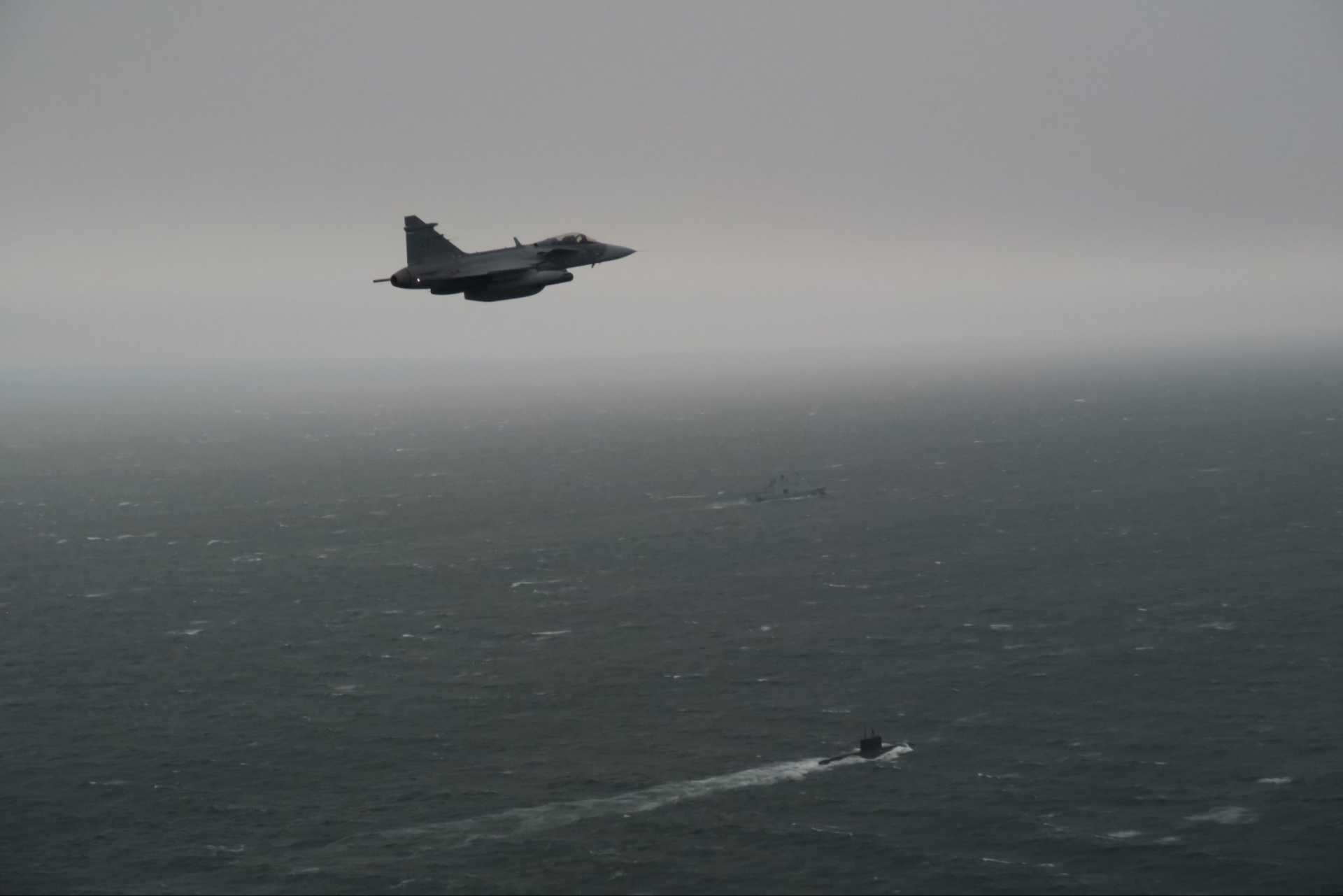
The JAS 39 Gripen of the Swedish Air Force tracked a Kilo-class submarine during its transit through the Kattegat on April 10, 2026, maintaining continuous contact as it moved toward the Baltic Sea.
The rapid deployment enabled Sweden to exploit the submarine’s surface or snorkeling exposure, demonstrating effective airborne maritime surveillance and real-time target tracking in a constrained operational corridor. The mission involved integrated ISR inputs from coastal radar, naval units, and allied sensors, forming a continuous tracking chain over a key maritime chokepoint. This operation underscores Sweden’s ability to detect and monitor Russian naval movements with high responsiveness, reinforcing regional situational awareness, deterrence posture, and NATO-aligned interoperability in the Baltic Sea theater.
Related topic: Russia deploys two-thirds of its nuclear submarine force in Arctic forcing US to rethink deterrence
Upon arrival, the Swedish Gripen observed the Russian submarine either fully surfaced or at snorkeling depth, where the mast or sail was visible above the waterline. (Picture source: Swedish MoD)
On April 10, 2026, the Swedish Air Force detected and tracked a Russian Kilo-class submarine transiting north-east through the Kattegat toward the Baltic Sea, deploying two JAS 39 Gripen fighters to establish and maintain contact while the submarine operated on the surface or at snorkeling depth. The mission was integrated into a broader surveillance framework combining Swedish coastal radar coverage, naval units, and allied ISR inputs, forming a continuous tracking chain. Swedish authorities assessed the movement as part of routine Russian submarine redeployment into the Baltic Fleet’s operating area, confirming the mission was limited to identification, monitoring, and reporting.
The Kattegat was selected as the observation point due to its role as a mandatory transit corridor between the North Sea and the Baltic Sea, with limited navigable routes. The submarine’s exposure on or near the surface created conditions where the Gripen fighter jet could rapidly exploit its detection capabilities. The initial detection phase occurred within a 30,000 km² sea area where Swedish coastal radar systems and naval sensors maintain a continuous monitoring of maritime traffic. The Kattegat spans approximately 60 to 120 km in width, with depth constraints in several sectors limiting submerged maneuverability for large diesel-electric submarines.
Once the contact was detected, the Gripen fighters were scrambled and vectored directly to the submarine’s position using pre-existing tracking data, eliminating the need for a search pattern. Upon arrival, the Gripen observed the Russian submarine either fully surfaced or at snorkeling depth, where the mast or sail was visible above the waterline. Visual confirmation was achieved, supported by imagery showing the characteristic sail structure and hull proportions of a Kilo-class submarine. The Swedish fighter maintained a continuous track as the submarine proceeded along a predictable route toward the Baltic Sea, likely via the Great Belt or Øresund straits. Tracking responsibility was shared with surface units and allied sensors, ensuring uninterrupted monitoring. The Kilo-class submarine operates on a diesel-electric propulsion system, which imposes periodic exposure requirements due to battery limitations.
Submerged endurance at low speed typically ranges from two to five days, after which the submarine must snorkel or surface to recharge batteries using diesel engines. This recharge cycle lasts between three and eight hours, during which the submarine’s detectability increases significantly. At snorkeling depth, approximately 10 to 15 meters, the mast is exposed above the surface, while full surfacing reveals the hull and sail, increasing radar cross-section and visual signature. The submarine’s length of about 70 meters and surfaced displacement between 3,000 and 4,000 tons produce a radar return comparable to a small surface vessel, while its diesel engine generates exhaust plumes and thermal output, contributing to infrared detectability.
In the constrained waters of the Kattegat, maneuvering options are limited, forcing the submarine to follow established transit corridors. These constraints create predictable exposure intervals that can be exploited by NATO airborne and surface surveillance systems. The Gripen C/D’s PS-05/A pulse-Doppler radar has an air target detection range of approximately 120 km and can detect surface contacts at distances between 50 and 100 km, depending on size and sea state. Against a surfaced submarine with a large radar cross-section, initial detection is feasible at ranges between 80 and 150 km under favorable conditions.
Doppler processing allows the radar to distinguish the submarine’s movement from sea clutter, enabling stable track maintenance. Electro-optical systems extend identification capability to 40 to 80 km, allowing classification based on sail geometry, hull profile, and wake characteristics. Infrared detection systems, such as those on the Gripen E/F, can detect diesel exhaust plumes and thermal contrasts at distances between 20 and 50 km, depending on atmospheric conditions. These sensor layers operate in parallel, providing redundancy and reducing the probability of losing contact. Once detected, the submarine can be continuously tracked using a combination of active and passive sensing.
Geographic constraints in the Kattegat significantly reduce the stealth effectiveness of Russian submarines during transit. The shallow depth, often ranging between 20 and 50 meters in key areas, reduces the ability to exploit deep-water concealment, while the narrow width of the corridor, ranging between 60 and 120 km, forces vessels into predictable routes, increasing the probability of detection once a contact is identified. Airborne platforms operating at altitude benefit from a radar horizon exceeding 200 km, allowing a single Gripen to monitor large sections of the transit corridor. Wake signatures generated by the submarine can persist for several minutes, providing a secondary detection cue even after submergence.
These conditions allow the Swedish fighter jet to maintain persistent coverage of a submarine with limited numbers of sorties. In short, the Kattegat effectively functions as a controlled monitoring zone for submarine movements entering the Baltic Sea. Inputs from coastal radar stations, Swedish Navy surface combatants, and allied ISR assets were combined through real-time datalink systems to create a shared operational picture. The Gripen’s role focused on rapid localization, visual confirmation, and continuous tracking of the submarine while it remained detectable.
Data collected by the jet was transmitted to other units, enabling coordinated tracking and handover as the Russian submarine moved through the corridor. This distributed approach reduces the risk of losing contact if one sensor or asset becomes unavailable. The use of both active radar and passive infrared detection also provides complementary coverage, increasing tracking reliability. Surface units can assume tracking responsibility if the submarine submerges, using last known position data and constrained geography to predict movement and maintain constant presence. Airborne assets were effective in this case because the submarine’s operational state removed its primary advantage, which is acoustic stealth when submerged.
Detection ranges for a surfaced submarine are significantly higher than for a submerged target, with radar detection between 80 and 150 km, infrared detection between 20 and 50 km, and visual identification up to 80 km under favorable conditions. The submarine’s exposure during battery recharge cycles, lasting three to eight hours, provides a time window that exceeds the response time of fighter jets traveling at supersonic speeds. Therefore, the Gripen reached the target area quickly, established contact, and maintained tracking through orbiting patterns or sortie rotation. Even if the submarine submerges, the last known position, combined with constrained movement options, allows for rapid reacquisition. The Gripen’s data sharing with allied forces ensured that tracking information is continuously updated and distributed across the network, which reduces the probability of undetected transit.
Written by Jérôme Brahy
Jérôme Brahy is a defense analyst and documentalist at Army Recognition. He specializes in naval modernization, aviation, drones, armored vehicles, and artillery, with a focus on strategic developments in the United States, China, Ukraine, Russia, Türkiye, and Belgium. His analyses go beyond the facts, providing context, identifying key actors, and explaining why defense news matters on a global scale.
{loadposition bannertop}
{loadposition sidebarpub}
The JAS 39 Gripen of the Swedish Air Force tracked a Kilo-class submarine during its transit through the Kattegat on April 10, 2026, maintaining continuous contact as it moved toward the Baltic Sea.
The rapid deployment enabled Sweden to exploit the submarine’s surface or snorkeling exposure, demonstrating effective airborne maritime surveillance and real-time target tracking in a constrained operational corridor. The mission involved integrated ISR inputs from coastal radar, naval units, and allied sensors, forming a continuous tracking chain over a key maritime chokepoint. This operation underscores Sweden’s ability to detect and monitor Russian naval movements with high responsiveness, reinforcing regional situational awareness, deterrence posture, and NATO-aligned interoperability in the Baltic Sea theater.
Related topic: Russia deploys two-thirds of its nuclear submarine force in Arctic forcing US to rethink deterrence
Upon arrival, the Swedish Gripen observed the Russian submarine either fully surfaced or at snorkeling depth, where the mast or sail was visible above the waterline. (Picture source: Swedish MoD)
On April 10, 2026, the Swedish Air Force detected and tracked a Russian Kilo-class submarine transiting north-east through the Kattegat toward the Baltic Sea, deploying two JAS 39 Gripen fighters to establish and maintain contact while the submarine operated on the surface or at snorkeling depth. The mission was integrated into a broader surveillance framework combining Swedish coastal radar coverage, naval units, and allied ISR inputs, forming a continuous tracking chain. Swedish authorities assessed the movement as part of routine Russian submarine redeployment into the Baltic Fleet’s operating area, confirming the mission was limited to identification, monitoring, and reporting.
The Kattegat was selected as the observation point due to its role as a mandatory transit corridor between the North Sea and the Baltic Sea, with limited navigable routes. The submarine’s exposure on or near the surface created conditions where the Gripen fighter jet could rapidly exploit its detection capabilities. The initial detection phase occurred within a 30,000 km² sea area where Swedish coastal radar systems and naval sensors maintain a continuous monitoring of maritime traffic. The Kattegat spans approximately 60 to 120 km in width, with depth constraints in several sectors limiting submerged maneuverability for large diesel-electric submarines.
Once the contact was detected, the Gripen fighters were scrambled and vectored directly to the submarine’s position using pre-existing tracking data, eliminating the need for a search pattern. Upon arrival, the Gripen observed the Russian submarine either fully surfaced or at snorkeling depth, where the mast or sail was visible above the waterline. Visual confirmation was achieved, supported by imagery showing the characteristic sail structure and hull proportions of a Kilo-class submarine. The Swedish fighter maintained a continuous track as the submarine proceeded along a predictable route toward the Baltic Sea, likely via the Great Belt or Øresund straits. Tracking responsibility was shared with surface units and allied sensors, ensuring uninterrupted monitoring. The Kilo-class submarine operates on a diesel-electric propulsion system, which imposes periodic exposure requirements due to battery limitations.
Submerged endurance at low speed typically ranges from two to five days, after which the submarine must snorkel or surface to recharge batteries using diesel engines. This recharge cycle lasts between three and eight hours, during which the submarine’s detectability increases significantly. At snorkeling depth, approximately 10 to 15 meters, the mast is exposed above the surface, while full surfacing reveals the hull and sail, increasing radar cross-section and visual signature. The submarine’s length of about 70 meters and surfaced displacement between 3,000 and 4,000 tons produce a radar return comparable to a small surface vessel, while its diesel engine generates exhaust plumes and thermal output, contributing to infrared detectability.
In the constrained waters of the Kattegat, maneuvering options are limited, forcing the submarine to follow established transit corridors. These constraints create predictable exposure intervals that can be exploited by NATO airborne and surface surveillance systems. The Gripen C/D’s PS-05/A pulse-Doppler radar has an air target detection range of approximately 120 km and can detect surface contacts at distances between 50 and 100 km, depending on size and sea state. Against a surfaced submarine with a large radar cross-section, initial detection is feasible at ranges between 80 and 150 km under favorable conditions.
Doppler processing allows the radar to distinguish the submarine’s movement from sea clutter, enabling stable track maintenance. Electro-optical systems extend identification capability to 40 to 80 km, allowing classification based on sail geometry, hull profile, and wake characteristics. Infrared detection systems, such as those on the Gripen E/F, can detect diesel exhaust plumes and thermal contrasts at distances between 20 and 50 km, depending on atmospheric conditions. These sensor layers operate in parallel, providing redundancy and reducing the probability of losing contact. Once detected, the submarine can be continuously tracked using a combination of active and passive sensing.
Geographic constraints in the Kattegat significantly reduce the stealth effectiveness of Russian submarines during transit. The shallow depth, often ranging between 20 and 50 meters in key areas, reduces the ability to exploit deep-water concealment, while the narrow width of the corridor, ranging between 60 and 120 km, forces vessels into predictable routes, increasing the probability of detection once a contact is identified. Airborne platforms operating at altitude benefit from a radar horizon exceeding 200 km, allowing a single Gripen to monitor large sections of the transit corridor. Wake signatures generated by the submarine can persist for several minutes, providing a secondary detection cue even after submergence.
These conditions allow the Swedish fighter jet to maintain persistent coverage of a submarine with limited numbers of sorties. In short, the Kattegat effectively functions as a controlled monitoring zone for submarine movements entering the Baltic Sea. Inputs from coastal radar stations, Swedish Navy surface combatants, and allied ISR assets were combined through real-time datalink systems to create a shared operational picture. The Gripen’s role focused on rapid localization, visual confirmation, and continuous tracking of the submarine while it remained detectable.
Data collected by the jet was transmitted to other units, enabling coordinated tracking and handover as the Russian submarine moved through the corridor. This distributed approach reduces the risk of losing contact if one sensor or asset becomes unavailable. The use of both active radar and passive infrared detection also provides complementary coverage, increasing tracking reliability. Surface units can assume tracking responsibility if the submarine submerges, using last known position data and constrained geography to predict movement and maintain constant presence. Airborne assets were effective in this case because the submarine’s operational state removed its primary advantage, which is acoustic stealth when submerged.
Detection ranges for a surfaced submarine are significantly higher than for a submerged target, with radar detection between 80 and 150 km, infrared detection between 20 and 50 km, and visual identification up to 80 km under favorable conditions. The submarine’s exposure during battery recharge cycles, lasting three to eight hours, provides a time window that exceeds the response time of fighter jets traveling at supersonic speeds. Therefore, the Gripen reached the target area quickly, established contact, and maintained tracking through orbiting patterns or sortie rotation. Even if the submarine submerges, the last known position, combined with constrained movement options, allows for rapid reacquisition. The Gripen‘s data sharing with allied forces ensured that tracking information is continuously updated and distributed across the network, which reduces the probability of undetected transit.
Written by Jérôme Brahy
Jérôme Brahy is a defense analyst and documentalist at Army Recognition. He specializes in naval modernization, aviation, drones, armored vehicles, and artillery, with a focus on strategic developments in the United States, China, Ukraine, Russia, Türkiye, and Belgium. His analyses go beyond the facts, providing context, identifying key actors, and explaining why defense news matters on a global scale.