Türkiye Opens New Era in NATO Airpower with İHA-230 Supersonic Ballistic Missile Armed Combat Drones

{loadposition bannertop}
{loadposition sidebarpub}
Türkiye has moved beyond using drones primarily as carriers for guided bombs by bringing the Roketsan İHA-230 supersonic ballistic missile into service, giving its unmanned fleet the ability to launch stand-off precision strikes from beyond 150 km. Announced during the Turkish Ministry of National Defence’s weekly briefing on 4 June 2026, the development strengthens both Türkiye’s deep-strike capability and NATO’s southeastern flank by enabling high-speed attacks against critical targets without exposing pilots to contested airspace.
Designed for integration with platforms such as the Bayraktar Akıncı, AKSUNGUR, and potentially the KIZILELMA, the İHA-230 combines supersonic speed, precision guidance, and multiple warhead options to engage air defenses, command nodes, infrastructure, and maritime targets. The missile’s introduction signals a broader shift toward distributed unmanned strike warfare, where combat drones can deliver battlefield effects once reserved for fighter aircraft and ground-based missile forces.
Related Topic: Turkish AKINCI Drone Achieves First Air-to-Air Kill Using EREN Loitering Munition Against Shahed-Type UAV
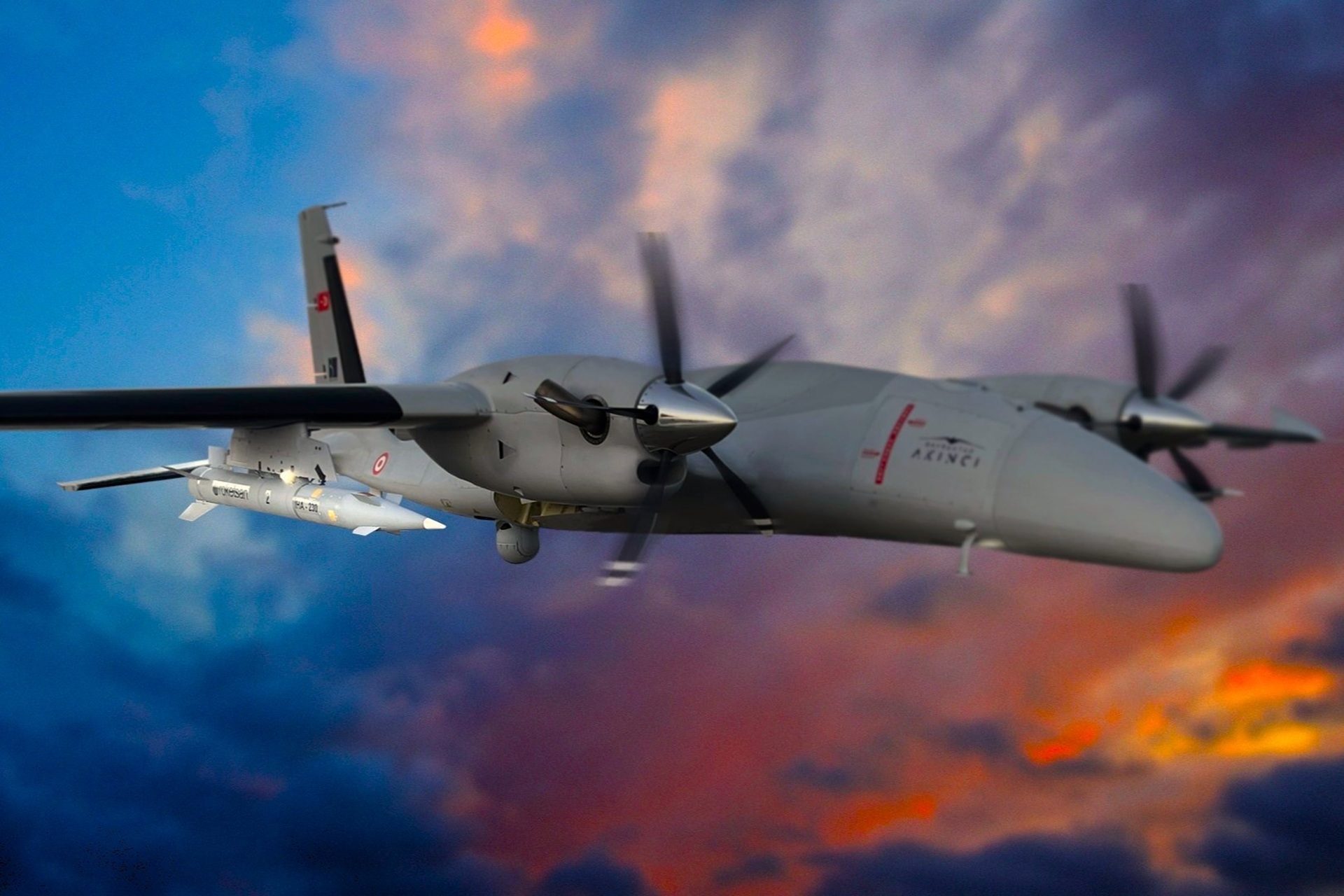
Türkiye has entered a new phase of unmanned warfare by fielding the İHA-230 supersonic ballistic missile on combat drones, giving its armed forces a long-range stand-off precision strike capability previously associated with manned aircraft and ground-based missile systems (Picture Source: Roketsan)
The weekly briefing published by the Turkish Ministry of National Defence on 4 June 2026, marked a new milestone in Türkiye’s evolution toward unmanned ballistic strike warfare, with Ministry spokesman Rear Admiral Zeki Aktürk confirming that inspection and acceptance procedures had been completed for the Roketsan İHA-230 air-to-surface ballistic supersonic missile, allowing the weapon to enter the inventory of the Turkish Land Forces Command, known in Turkish as Kara Kuvvetleri Komutanlığı. Although the briefing did not identify the launch platform assigned to the missile, the İHA-230 has so far been publicly associated with the Bayraktar Akıncı unmanned combat aerial vehicle developed by Baykar, while Roketsan also lists AKINCI, AKSUNGUR-class UCAVs and KIZILELMA among the airborne platforms that can be integrated with the system. This marks a major threshold for Türkiye and for NATO’s southern flank: a Turkish unmanned aircraft is no longer only a carrier for guided bombs or light missiles, but a potential launch platform for a ballistic supersonic weapon able to conduct stand-off precision strikes at ranges beyond 150 km.
The İHA-230, also designated UAV-230 by Roketsan, is an air-launched evolution of the 230 mm TRG-230 guided missile family, redesigned for release from offensive unmanned aircraft. Unlike the light precision munitions commonly associated with armed drones, such as small glide bombs or laser-guided micro missiles, the İHA-230 belongs to a different category of weapon: a ballistic supersonic air-to-surface missile intended to give combat drones higher speed, deeper reach and a more destructive strike effect. With a range exceeding 150 km depending on release altitude and aircraft speed, a length of 3.4 m, a diameter of 230 mm and a launch weight of roughly 225 to 230 kg, the missile gives Turkish unmanned aviation a stand-off attack capability that was previously associated mainly with manned combat aircraft or ground-based rocket artillery. Its guidance architecture combines autonomous navigation with resistance to jamming and terminal laser designation, enabling precision engagement with a stated accuracy of 10 m CEP or less. The missile can be fitted with warheads suited to different target sets, including pre-shaped fragmentation effects for personnel and exposed systems, as well as armour-piercing and thermobaric options for harder or more concentrated targets.
The missile’s launch sequence explains why its integration on UAVs is operationally significant. Before release, the İHA-230 completes firing preparation on the carrier aircraft. After separation, it free-falls for a short phase before autonomously igniting its solid-fuel rocket motor and following a ballistic high-speed trajectory toward the target. This allows the carrier drone to exploit altitude, speed and stand-off geometry, increasing range while avoiding deep penetration into contested airspace. For the Turkish Armed Forces, this creates a bridge between traditional UAV-launched smart munitions and larger stand-off weapons normally associated with fighter aircraft or ground-based rocket artillery. It gives an unmanned platform the ability to attack fixed land and maritime targets, air defence radars, communication systems, command centres, light armoured vehicles, critical infrastructure, collective personnel targets and targets of opportunity from outside many short- and medium-range air defence engagement envelopes.
The integration question is central to the operational impact because it defines how far Türkiye can push the İHA-230 from a new missile into a new operational concept. Baykar lists the Bayraktar Akıncı with a 1,500 kg payload capacity, a 30,000 ft operational altitude, a 40,000 ft service ceiling, line-of-sight and beyond-line-of-sight communications, and simultaneous ISR payload options including EO/IR and laser designation, multi-mode AESA radar and SIGINT. On mass alone, Akıncı could theoretically carry up to six İHA-230 missiles, since six missiles at around 225 to 230 kg would remain below the aircraft’s maximum payload capacity. This figure, however, should be understood as a theoretical calculation rather than a confirmed combat loadout. The real operational configuration will depend on pylon certification, launcher adapters, aerodynamic drag, fuel load, centre-of-gravity margins, safe separation trials, flight envelope restrictions and whether the aircraft must also carry mission sensors or laser-designation equipment. In practice, a more realistic configuration may involve one or two missiles for long-endurance ISR-strike missions, allowing Akıncı to combine target detection, stand-off ballistic attack and post-strike assessment in the same sortie, while heavier missile loads would require formal certification and would likely be reserved for dedicated strike missions.
Roketsan’s statement that the İHA-230 can be integrated on AKINCI, AKSUNGUR-class UCAVs and KIZILELMA broadens the analysis beyond a single drone and points to a wider Turkish concept for distributed unmanned deep strike. AKSUNGUR, developed by Turkish Aerospace, is known for long endurance and a payload capacity above 750 kg, which means it could theoretically carry multiple İHA-230 missiles by weight, although hardpoint capacity, weapon separation tests and mission configuration would determine which stations can safely carry a 225–230 kg missile. KIZILELMA introduces a different operational concept. Baykar lists the unmanned fighter aircraft with a 1.5-ton payload capacity, 0.9 Mach maximum speed, 25,000 ft operational altitude, low radar cross-section, AESA radar and air-to-air as well as strike payload options. If İHA-230 integration matures on KIZILELMA, Türkiye would be able to combine higher launch speed, reduced radar visibility and unmanned ballistic strike in an aircraft closer to a jet-powered combat asset than a traditional MALE UAV. This would move the Turkish drone ecosystem into a more demanding operational category, where unmanned aircraft could support deep strike, air defence suppression, time-sensitive targeting and stand-off attack missions that were once reserved for manned fighters or ground-based missile units.
The most important consequence is not only that Türkiye has armed a UAV with a larger missile, but that it has created an unmanned aerial launch architecture for ballistic supersonic fires. In practical terms, the Turkish Land Forces can now link persistent ISR, stand-off precision attack and rapid time-sensitive targeting without exposing a pilot or requiring a fighter aircraft to enter the most dangerous part of contested airspace. This is particularly relevant for suppression and destruction of enemy air defences, known as SEAD and DEAD missions. An Akıncı carrying İHA-230 could detect, classify or receive coordinates for a radar emitter, command vehicle, communications node or air defence battery, launch from stand-off range and remain available for battle damage assessment or follow-on target designation. This shortens the sensor-to-shooter cycle and gives land commanders an organic deep-strike tool that can complement artillery rockets, tactical missiles and manned airpower.
For drone warfare, İHA-230 signals a shift from the armed UAV as a persistent hunter-killer platform toward the UCAV as a mobile aerial launch rail for high-speed ballistic effects. Earlier generations of armed drones relied mainly on endurance, surveillance and relatively small precision munitions. The İHA-230 adds speed, stand-off distance and a ballistic flight profile, reducing defender reaction time compared with slower glide weapons or propeller-driven loitering munitions. Its trajectory is not identical to a manoeuvring cruise missile and still requires accurate targeting, mission planning, resilient communications and survivable launch platforms, but the combination of unmanned persistence and supersonic missile performance complicates enemy air defence planning. Radar coverage, command-post protection, SAM displacement and logistics dispersal all become more difficult when a UAV can launch a ballistic missile from flexible axes outside the immediate defended zone.
The geostrategic implications are equally important. Türkiye has already established itself as one of the world’s most influential UAV powers, and the entry into service of İHA-230 strengthens this position by adding a high-speed, long-range strike layer to its unmanned ecosystem. In the Black Sea, the Eastern Mediterranean, the Caucasus and the Middle East, this gives Ankara a flexible deterrent that can be dispersed, networked and adapted to different theatres. For NATO, the capability strengthens the Alliance’s southeastern flank by adding an indigenous Turkish unmanned precision-strike option aligned with distributed fires, multi-domain operations, resilient C4ISR and stand-off engagement. In a high-intensity scenario, Turkish UCAVs armed with ballistic supersonic missiles could contribute to early neutralization of hostile air defence nodes, maritime denial networks, command infrastructure and logistics centres, while reducing operational pressure on crewed fighter fleets.
The development also reflects a broader industrial and doctrinal achievement. İHA-230 combines a domestic missile manufacturer, a mature Turkish UCAV sector, national sensors, precision guidance, satellite communications, anti-jamming features and operational experience in network-enabled fires. This is not simply the addition of one missile to one drone; it is the emergence of a layered Turkish unmanned strike doctrine in which Akıncı, AKSUNGUR and eventually KIZILELMA can occupy different parts of the airpower spectrum. Akıncı offers payload, endurance and sensor fusion. AKSUNGUR adds long-endurance mission persistence. KIZILELMA introduces higher speed, reduced radar signature and fighter-like mission profiles. Together, these platforms could allow Türkiye to distribute ballistic strike capacity across turboprop UCAVs and jet-powered unmanned combat aircraft, creating multiple launch vectors and increasing the complexity faced by any adversary air defence network.
The entry into service of Roketsan’s İHA-230 with the Turkish Land Forces marks more than the delivery of a new missile. It confirms Türkiye’s movement into a new age of unmanned airpower, where drones can carry ballistic supersonic weapons, strike from stand-off range and support land operations with high-speed precision effects. For Ankara, it reinforces national defence autonomy, increases deterrence and strengthens the Turkish defence industry’s position in a fast-changing global market. For NATO, it adds an Allied capability that fits the future of distributed, unmanned and networked strike warfare. With İHA-230, Türkiye is moving beyond the era of armed drones carrying light precision munitions and entering a phase in which unmanned aircraft can serve as launch platforms for ballistic supersonic weapons, a development that could influence the next generation of air-land operations.
Written by Teoman S. Nicanci – Defense Analyst, Army Recognition Group
Teoman S. Nicanci holds degrees in Political Science, Comparative and International Politics, and International Relations and Diplomacy from leading Belgian universities, with research focused on Russian strategic behavior, defense technology, and modern warfare. He is a defense analyst at Army Recognition, specializing in the global defense industry, military armament, and emerging defense technologies.
{loadposition bannertop}
{loadposition sidebarpub}
Türkiye has moved beyond using drones primarily as carriers for guided bombs by bringing the Roketsan İHA-230 supersonic ballistic missile into service, giving its unmanned fleet the ability to launch stand-off precision strikes from beyond 150 km. Announced during the Turkish Ministry of National Defence’s weekly briefing on 4 June 2026, the development strengthens both Türkiye’s deep-strike capability and NATO’s southeastern flank by enabling high-speed attacks against critical targets without exposing pilots to contested airspace.
Designed for integration with platforms such as the Bayraktar Akıncı, AKSUNGUR, and potentially the KIZILELMA, the İHA-230 combines supersonic speed, precision guidance, and multiple warhead options to engage air defenses, command nodes, infrastructure, and maritime targets. The missile’s introduction signals a broader shift toward distributed unmanned strike warfare, where combat drones can deliver battlefield effects once reserved for fighter aircraft and ground-based missile forces.
Related Topic: Turkish AKINCI Drone Achieves First Air-to-Air Kill Using EREN Loitering Munition Against Shahed-Type UAV
Türkiye has entered a new phase of unmanned warfare by fielding the İHA-230 supersonic ballistic missile on combat drones, giving its armed forces a long-range stand-off precision strike capability previously associated with manned aircraft and ground-based missile systems (Picture Source: Roketsan)
The weekly briefing published by the Turkish Ministry of National Defence on 4 June 2026, marked a new milestone in Türkiye’s evolution toward unmanned ballistic strike warfare, with Ministry spokesman Rear Admiral Zeki Aktürk confirming that inspection and acceptance procedures had been completed for the Roketsan İHA-230 air-to-surface ballistic supersonic missile, allowing the weapon to enter the inventory of the Turkish Land Forces Command, known in Turkish as Kara Kuvvetleri Komutanlığı. Although the briefing did not identify the launch platform assigned to the missile, the İHA-230 has so far been publicly associated with the Bayraktar Akıncı unmanned combat aerial vehicle developed by Baykar, while Roketsan also lists AKINCI, AKSUNGUR-class UCAVs and KIZILELMA among the airborne platforms that can be integrated with the system. This marks a major threshold for Türkiye and for NATO’s southern flank: a Turkish unmanned aircraft is no longer only a carrier for guided bombs or light missiles, but a potential launch platform for a ballistic supersonic weapon able to conduct stand-off precision strikes at ranges beyond 150 km.
The İHA-230, also designated UAV-230 by Roketsan, is an air-launched evolution of the 230 mm TRG-230 guided missile family, redesigned for release from offensive unmanned aircraft. Unlike the light precision munitions commonly associated with armed drones, such as small glide bombs or laser-guided micro missiles, the İHA-230 belongs to a different category of weapon: a ballistic supersonic air-to-surface missile intended to give combat drones higher speed, deeper reach and a more destructive strike effect. With a range exceeding 150 km depending on release altitude and aircraft speed, a length of 3.4 m, a diameter of 230 mm and a launch weight of roughly 225 to 230 kg, the missile gives Turkish unmanned aviation a stand-off attack capability that was previously associated mainly with manned combat aircraft or ground-based rocket artillery. Its guidance architecture combines autonomous navigation with resistance to jamming and terminal laser designation, enabling precision engagement with a stated accuracy of 10 m CEP or less. The missile can be fitted with warheads suited to different target sets, including pre-shaped fragmentation effects for personnel and exposed systems, as well as armour-piercing and thermobaric options for harder or more concentrated targets.
The missile’s launch sequence explains why its integration on UAVs is operationally significant. Before release, the İHA-230 completes firing preparation on the carrier aircraft. After separation, it free-falls for a short phase before autonomously igniting its solid-fuel rocket motor and following a ballistic high-speed trajectory toward the target. This allows the carrier drone to exploit altitude, speed and stand-off geometry, increasing range while avoiding deep penetration into contested airspace. For the Turkish Armed Forces, this creates a bridge between traditional UAV-launched smart munitions and larger stand-off weapons normally associated with fighter aircraft or ground-based rocket artillery. It gives an unmanned platform the ability to attack fixed land and maritime targets, air defence radars, communication systems, command centres, light armoured vehicles, critical infrastructure, collective personnel targets and targets of opportunity from outside many short- and medium-range air defence engagement envelopes.
The integration question is central to the operational impact because it defines how far Türkiye can push the İHA-230 from a new missile into a new operational concept. Baykar lists the Bayraktar Akıncı with a 1,500 kg payload capacity, a 30,000 ft operational altitude, a 40,000 ft service ceiling, line-of-sight and beyond-line-of-sight communications, and simultaneous ISR payload options including EO/IR and laser designation, multi-mode AESA radar and SIGINT. On mass alone, Akıncı could theoretically carry up to six İHA-230 missiles, since six missiles at around 225 to 230 kg would remain below the aircraft’s maximum payload capacity. This figure, however, should be understood as a theoretical calculation rather than a confirmed combat loadout. The real operational configuration will depend on pylon certification, launcher adapters, aerodynamic drag, fuel load, centre-of-gravity margins, safe separation trials, flight envelope restrictions and whether the aircraft must also carry mission sensors or laser-designation equipment. In practice, a more realistic configuration may involve one or two missiles for long-endurance ISR-strike missions, allowing Akıncı to combine target detection, stand-off ballistic attack and post-strike assessment in the same sortie, while heavier missile loads would require formal certification and would likely be reserved for dedicated strike missions.
Roketsan’s statement that the İHA-230 can be integrated on AKINCI, AKSUNGUR-class UCAVs and KIZILELMA broadens the analysis beyond a single drone and points to a wider Turkish concept for distributed unmanned deep strike. AKSUNGUR, developed by Turkish Aerospace, is known for long endurance and a payload capacity above 750 kg, which means it could theoretically carry multiple İHA-230 missiles by weight, although hardpoint capacity, weapon separation tests and mission configuration would determine which stations can safely carry a 225–230 kg missile. KIZILELMA introduces a different operational concept. Baykar lists the unmanned fighter aircraft with a 1.5-ton payload capacity, 0.9 Mach maximum speed, 25,000 ft operational altitude, low radar cross-section, AESA radar and air-to-air as well as strike payload options. If İHA-230 integration matures on KIZILELMA, Türkiye would be able to combine higher launch speed, reduced radar visibility and unmanned ballistic strike in an aircraft closer to a jet-powered combat asset than a traditional MALE UAV. This would move the Turkish drone ecosystem into a more demanding operational category, where unmanned aircraft could support deep strike, air defence suppression, time-sensitive targeting and stand-off attack missions that were once reserved for manned fighters or ground-based missile units.
The most important consequence is not only that Türkiye has armed a UAV with a larger missile, but that it has created an unmanned aerial launch architecture for ballistic supersonic fires. In practical terms, the Turkish Land Forces can now link persistent ISR, stand-off precision attack and rapid time-sensitive targeting without exposing a pilot or requiring a fighter aircraft to enter the most dangerous part of contested airspace. This is particularly relevant for suppression and destruction of enemy air defences, known as SEAD and DEAD missions. An Akıncı carrying İHA-230 could detect, classify or receive coordinates for a radar emitter, command vehicle, communications node or air defence battery, launch from stand-off range and remain available for battle damage assessment or follow-on target designation. This shortens the sensor-to-shooter cycle and gives land commanders an organic deep-strike tool that can complement artillery rockets, tactical missiles and manned airpower.
For drone warfare, İHA-230 signals a shift from the armed UAV as a persistent hunter-killer platform toward the UCAV as a mobile aerial launch rail for high-speed ballistic effects. Earlier generations of armed drones relied mainly on endurance, surveillance and relatively small precision munitions. The İHA-230 adds speed, stand-off distance and a ballistic flight profile, reducing defender reaction time compared with slower glide weapons or propeller-driven loitering munitions. Its trajectory is not identical to a manoeuvring cruise missile and still requires accurate targeting, mission planning, resilient communications and survivable launch platforms, but the combination of unmanned persistence and supersonic missile performance complicates enemy air defence planning. Radar coverage, command-post protection, SAM displacement and logistics dispersal all become more difficult when a UAV can launch a ballistic missile from flexible axes outside the immediate defended zone.
The geostrategic implications are equally important. Türkiye has already established itself as one of the world’s most influential UAV powers, and the entry into service of İHA-230 strengthens this position by adding a high-speed, long-range strike layer to its unmanned ecosystem. In the Black Sea, the Eastern Mediterranean, the Caucasus and the Middle East, this gives Ankara a flexible deterrent that can be dispersed, networked and adapted to different theatres. For NATO, the capability strengthens the Alliance’s southeastern flank by adding an indigenous Turkish unmanned precision-strike option aligned with distributed fires, multi-domain operations, resilient C4ISR and stand-off engagement. In a high-intensity scenario, Turkish UCAVs armed with ballistic supersonic missiles could contribute to early neutralization of hostile air defence nodes, maritime denial networks, command infrastructure and logistics centres, while reducing operational pressure on crewed fighter fleets.
The development also reflects a broader industrial and doctrinal achievement. İHA-230 combines a domestic missile manufacturer, a mature Turkish UCAV sector, national sensors, precision guidance, satellite communications, anti-jamming features and operational experience in network-enabled fires. This is not simply the addition of one missile to one drone; it is the emergence of a layered Turkish unmanned strike doctrine in which Akıncı, AKSUNGUR and eventually KIZILELMA can occupy different parts of the airpower spectrum. Akıncı offers payload, endurance and sensor fusion. AKSUNGUR adds long-endurance mission persistence. KIZILELMA introduces higher speed, reduced radar signature and fighter-like mission profiles. Together, these platforms could allow Türkiye to distribute ballistic strike capacity across turboprop UCAVs and jet-powered unmanned combat aircraft, creating multiple launch vectors and increasing the complexity faced by any adversary air defence network.
The entry into service of Roketsan’s İHA-230 with the Turkish Land Forces marks more than the delivery of a new missile. It confirms Türkiye’s movement into a new age of unmanned airpower, where drones can carry ballistic supersonic weapons, strike from stand-off range and support land operations with high-speed precision effects. For Ankara, it reinforces national defence autonomy, increases deterrence and strengthens the Turkish defence industry’s position in a fast-changing global market. For NATO, it adds an Allied capability that fits the future of distributed, unmanned and networked strike warfare. With İHA-230, Türkiye is moving beyond the era of armed drones carrying light precision munitions and entering a phase in which unmanned aircraft can serve as launch platforms for ballistic supersonic weapons, a development that could influence the next generation of air-land operations.
Written by Teoman S. Nicanci – Defense Analyst, Army Recognition Group
Teoman S. Nicanci holds degrees in Political Science, Comparative and International Politics, and International Relations and Diplomacy from leading Belgian universities, with research focused on Russian strategic behavior, defense technology, and modern warfare. He is a defense analyst at Army Recognition, specializing in the global defense industry, military armament, and emerging defense technologies.